God Finds Us

Feast of St. Bartholomew
August 24, 2026

Today, we celebrate the feast of the Apostle, Bartholomew. Many believe that Bartholomew is the same person as Nathaniel – in fact, Nathaniel bar Talmai, (Talmai meaning “farmer” or “son of the furrows”).

Praying with today’s Gospel, I picture Nathaniel leaning back into his ancient fig tree, his fingers burrowing into the fertile earth around him. What might have been his ponderings as he dissolved into the fig tree’s generous shade?
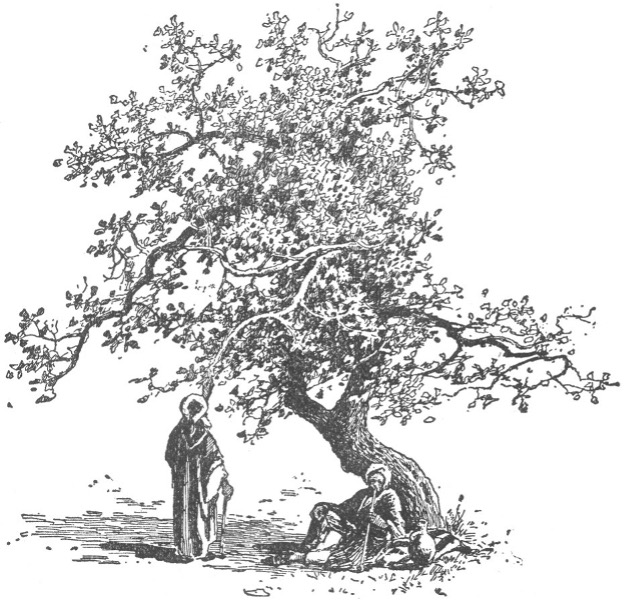
Nathaniel Under the Fig Tree
James Tissot

Knowing Psalm 145 by heart (today’s Responsorial), perhaps Nathaniel prayed it in his own very personal words:

Make me your loyal friend, O Lord.
I see your glory in all Creation.
Let me help others see that glory,
see themselves as a precious part of You.


Maybe Nathaniel had retreated to that tree because the noise around him didn’t hold an answer to his longing. He needed silence to remember that God will always find a way to bring our holy desires to fruition – just like the nearly sweet, unripe figs dancing just over Nathaniel’s ruminating head:

The LORD is just in all his ways
and holy in all his works.
The LORD is near to all who call upon him,
to all who call upon him in truth.

Psalm 145:17


Nathaniel found his truth, his answer that day. It walked right up to him in the form of his buddy Philip:

Philip found Nathanael and told him,
“We have found the one about whom Moses wrote in the law,
and also the prophets, Jesus son of Joseph, from Nazareth.”

John 1:45


Nathaniel, his head and belly still full of figs, takes a little while to get the full picture. But when he does, he gets it completely, unreservedly, and forever:

Rabbi, you are the Son of God;
you are the King of Israel….

John 1:49


The beautiful thing for Nathaniel is that Jesus was waiting for him too.

Before Philip called you, I saw you under the fig tree.

John 1:48

Oh, what secrets does that revelation hold!


We’re all under some kind of shadow at times, longing to hear God’s invitation. Nathaniel’s story assures us that the call will come through our hopeful prayer and deep desire for God’s glory — and perhaps a good friend who knows where we’re hiding and calls us to the light.


Poetry:  Joy and Peace in Believing by William Cowper, an English poet and hymnodist. One of the most popular poets of his time, Cowper changed the direction of 18th-century nature poetry by writing of everyday life and scenes of the English countryside.

Sometimes a light surprises
The Christian while he sings;
It is the Lord who rises
With healing on His wings;
When comforts are declining,
He grants the soul again
A season of clear shining,
To cheer it after rain.

In holy contemplation
We sweetly then pursue
The theme of God’s salvation,
And find it ever new;
Set free from present sorrow,
We cheerfully can say,
E’en let the unknown to-morrow
Bring with it what it may!

It can bring with it nothing,
But He will bear us through;
Who gives the lilies clothing,
Will clothe His people too;
Beneath the spreading heavens
No creature but is fed;
And He who feeds the ravens
Will give His children bread.
Though vine nor fig tree neither
Their wonted fruit shall bear,

Though all the field should wither,
Nor flocks nor herds be there:
Yet God the same abiding,
His praise shall tune my voice;
For, while in Him confiding,
I cannot but rejoice.


Music: Yet Will I Praise Thee – Kent Henry
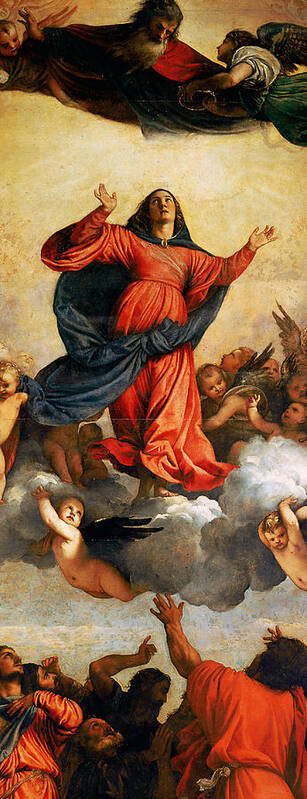
Lifted By Grace

Feast of the Assumption
August 15, 2026

Does Mary’s Assumption into Heaven matter to you?

Each year, when the liturgical cycle revolves to this Feast, I find myself confronted with a challenge. Do I dive into this doctrine and the mystery it carries, or do I stay with a thin interpretation that satisfies devotional expectations?

We all love Mary. We all hope she had an easy transit into heaven and a deserved welcome. But there’s no biblical or historical documentation to confirm that. And what does it matter anyway? Since we all trust that Mary is in heaven, does it matter how she got there?

Well, the Church says “Yes”, it does matter. And it matters so much that volumes have been written with theological explanations, beginning with Munificentissimus Deus. This document is the official Apostolic Constitution of Pope Pius XII defining the Dogma of the Assumption. (November 1950)

Picture the times. It had been five years since the end of WWII, and the slow healing from its devastation fostered a reconsideration of how humankind understood itself in the dynamic of good against evil. How could human hearts survive a war-ravaged world that had spewed a Holocaust! It was a ponderous repentance whose weight the Pope expressed so clearly in the document’s opening paragraphs:

Now, just like the present age, our pontificate is weighed down by ever so many cares, anxieties, and troubles, by reason of very severe calamities that have taken place and by reason of the fact that many have strayed away from truth and virtue. Nevertheless, we are greatly consoled to see that, while the Catholic faith is being professed publicly and vigorously, piety toward the Virgin Mother of God is flourishing and daily growing more fervent, and that almost everywhere on earth it is showing indications of a better and holier life. Thus, while the Blessed Virgin is fulfilling in the most affectionate manner her maternal duties on behalf of those redeemed by the blood of Christ, the minds and the hearts of her children are being vigorously aroused to a more assiduous consideration of her prerogatives. (MUNIFICENTISSIMUS DEUS – 2)


Inside the Pope’s formal language is a simple but powerful message. When the people of faith were faced with the indescribable horrors of war, they turned to Mary for consolation and hope. Their deep faith moved the Pope, after his prayerful and intense consideration, to confirm their devotion by proclaiming the Dogma of the Assumption and encouraging all people to benefit from its power.

For me, the message is this. Mary was a human being just like us. She opened her heart entirely to God’s grace whose power supported her in all the joys and sorrows of her life. As it did in Mary’s life, cooperation with grace allows us not only to withstand evil and death but to transcend them. By drawing inspiration from Mary, we too can respond to God’s invitation to full eternal life.


The post-war world of 1950 desperately needed the spiritual encouragement offered by the Pope’s declaration. Our continually bellicose and genocidal 21st-century world needs it even more. 

It is to be hoped that all the faithful will be stirred up to a stronger piety toward their heavenly Mother, and that the souls of all those who glory in the Christian name may be moved by the desire of sharing in the unity of Jesus Christ’s Mystical Body and of increasing their love for her who shows her motherly heart to all the members of this august body. And so we may hope that those who meditate upon the glorious example Mary offers us may be more and more convinced of the value of a human life entirely devoted to carrying out the heavenly Father’s will and to bringing good to others. Thus, while the illusory teachings of materialism and the corruption of morals that follows from these teachings threaten to extinguish the light of virtue and to ruin the lives of men by exciting discord among them, in this magnificent way all may see clearly to what a lofty goal our bodies and souls are destined. Finally, it is our hope that belief in Mary’s bodily Assumption into heaven will make our belief in our own resurrection stronger and render it more effective. (MUNIFICENTISSIMUS DEUS – 42)

If you would like to delve into some of the extensive theology around this dogma, a great place to start is Elizabeth Johnson’s masterpiece, Truly Our Sister.
I also found this essay by Matthew Levering to be verbose but enlightening:

https://churchlifejournal.nd.edu/articles/must-catholics-insist-upon-marys-assumption


Music: Vespro Della Beata Vergine – Claudio Monteverdi

Claudio Monteverdi’s Vespro della Beata Vergine (Vespers for the Blessed Virgin), published in 1610, is a monumental masterpiece of early sacred music. Bridging the Renaissance and Baroque eras, the work is celebrated for its dazzling combination of intimate solo singing, complex choral polyphony, and theatrical instrumental writing. (Wikipedia)

Suggested Scripture: Luke 1:39-56

For Your Reflection:

  • What feelings or reactions do I have after reading this reflection?
  • Do my feelings or reactions remind me of any passage or event in scripture, especially in the life of Christ? 
  • What actions might I take today because of my response to these readings?

Listen

Feast of the Transfiguration
August 6, 2026

Do you have a few favorite scripture stories?

I love passages like the Widow of Nain, Zacchaeus in the tree, Mary Magdalen and her “Rabboni.” These favorites, and many others, reveal Jesus’ deep compassion in the face of the human condition. They allow me to feel close to him and to trust his mercy even for my own life.

But some other passages are not on my favorites list. They don’t move me in the same way. The story of the Transfiguration — though it may transcend many others in significance — has never been one of my top ten. And perhaps that’s because I struggle to engage its otherworldly transcendence.

Over many years of praying with this Gospel, I have entered it through Peter’s eyes. At other times, I have wondered what Jesus was thinking. Sometimes I have asked Moses or Elijah for an insight. But somehow, I never quite reached the heart of this astonishing revelation of Who Jesus truly is.

My favorite Gospel stories invite me to imitate Jesus within the familiar contours of human life: to comfort the grieving as he did, to seek Jesus with reckless longing as Zacchaeus did, to cherish the way God speaks my name as Mary Magdalen did.

So what have I been missing in the Transfiguration?

Maybe this.

Have you ever had an unexpected grace that lifted you, just for a moment, out of your circumstances? The grace silenced you, whispered that the moment was more than it appeared, and that within it, God was calling you to a deeper intimacy. More than a wake-up moment, such an experience changes us in deeply spiritual and inexplicable ways.

These spiritual encounters can come in the simplest of forms. On a warm October afternoon many years ago, I stretched out on a park bench, exhausted from co-hosting a teenage retreat. Before closing my eyes for a little nap, I glanced up toward the sky into the glory of a golden sugar maple. The tree was so vibrant that it exuded a life beyond itself, offering that vibrancy to me. In the numinous silence, I experienced an intimate sign of God’s Presence and Love – at one with me, and with Creation. That single, beautiful tree has stayed with me for over fifty years.


I think that is the kind of moment we encounter in the Transfiguration.

Peter, James, and John — and perhaps even Jesus in his humanity — are lifted beyond ordinary time into the otherwise hidden radiance of God. For one breathtaking instant, the practical and apparent world gives way to an infinitely enduring reality.

The Divine Voice affirms that our lives are curtained by time, and that we truly exist in a dimension beyond our ordinary comprehension – Eternal Life. Jesus’ mission is to reveal that Truth to us and give us the courage to pursue it in imitation of him – even unto death. As the Voice commands, we must listen to him!

The gift of Transfiguration is a Divine Promise branded on our hearts, grounding us against any cross to come by convincing us of Resurrection.

Today, praying with this powerful scripture passage, I ask God for the courage to listen!


Music: Transfiguration – Carey Landry

Suggested Scripture: 2 Peter 1:16-19

For Your Reflection:

  • What feelings or reactions do I have after reading this reflection?
  • Do my feelings or reactions remind me of any passage or event in scripture, especially in the life of Christ? 
  • What actions might I take today because of my response to these readings?