When beechen buds begin to swell, And woods the blue-bird’s warble know, The yellow violet’s modest bell Peeps from the last year’s leaves below.
Ere russet fields their green resume, Sweet flower, I love, in forest bare, To meet thee, when thy faint perfume Alone is in the virgin air.
Of all her train, the hands of Spring First plant thee in the watery mould, And I have seen thee blossoming Beside the snow-bank’s edges cold.
Thy parent sun, who bade thee view Pale skies, and chilling moisture sip, Has bathed thee in his own bright hue, And streaked with jet thy glowing lip.
Yet slight thy form, and low thy seat, And earthward bent thy gentle eye, Unapt the passing view to meet When loftier flowers are flaunting nigh.
Oft, in the sunless April day, Thy early smile has stayed my walk; But midst the gorgeous blooms of May, I passed thee on thy humble stalk.
So they, who climb to wealth, forget The friends in darker fortunes tried. I copied them—but I regret That I should ape the ways of pride.
And when again the genial hour Awakes the painted tribes of light, I’ll not o’erlook the modest flower That made the woods of April bright.
Ah, Equinox! Today our Earth will put away her winter jewels – her cold snow pearls and glistening ice diamonds stored until distant December. With them, she lays aside her cool reserve, the stark elegance of silhouetted trees against a white landscape. She says, “I have finished my silent retreat”.
Instead, Lady Earth unveils her costume jewelry – that improbable mix of pinks, purples, greens and yellows. Even though this morning in Philadelphia, she wraps them in a shimmering chill, we know it hides a riotous, tumbling April.
Every year we wonder if those bare trees and barren hillsides will ever green again. But they do! Spring is the act of “Great Forgiveness”. It is the time when Nature mirrors the Infinite Mercy of her Creator and says, “Fear not, Sweet Earth. I am deeper than your cold. My resilience has redeemed us both for another chance at life”.
We human beings, too, are capable of such resilience. I remember my mother’s infinite patience with an annoying neighbor whose seemingly innocent conversation harbored veiled references to her economic superiority. Little wintry comments like, “It’s a shame you didn’t choose a Hoover. It would make your life so much easier!” Even as a child, I was nettled almost beyond tolerance by her chilly comparisons.
But my mother, who was no push-over and who did not suffer fools gladly, was patient and faithful. She would tell me that Mary never had the love of family and friends that we enjoyed. She helped me understand that sometimes people can’t help showing the December within their hearts if they have never been kindled by another’s kindness. My mother wanted me to live from the “Great Forgiveness” that can warm any cold, indifference, or careless judgment.
At one point when I was still very young, my mother became quite ill and after a long hospitalization, returned home for an extended recuperation. During that time, Mary came every day to cook for our large, working family. Weekly, she cleaned our house with the same decrepit vacuum she had earlier criticized. Without a word, Mary challenged me to learn another lesson about the nature of fidelity and true friendship and the opportunity to give it voice without words.
Years later, I read a quote that captured these lessons: “Always be kind. We never know the battles someone else may be fighting.” These are lessons I remember with gratitude today in this equinox of another “Great Forgiveness”. It is a largesse we can imitate if we simply remember the mercies we have received from the hand of our forgiving God.
Today, in God’s Lavish Mercy, we celebrate the feast of St. Athanasius, and since our readings repeat themes we have prayed with for a few days, I thought we might focus our prayer today on Athanasius.
During his lifetime, the Church struggled with the heresy of Arianism which questioned whether Jesus was really God. Athanasius was named a Doctor of the Church for his steadfast defense of the doctrine of the divinity of Christ. Some of Athanasius’s writings are suggestive of the theology of our great modern theologians, and so necessary for our spirituality today.
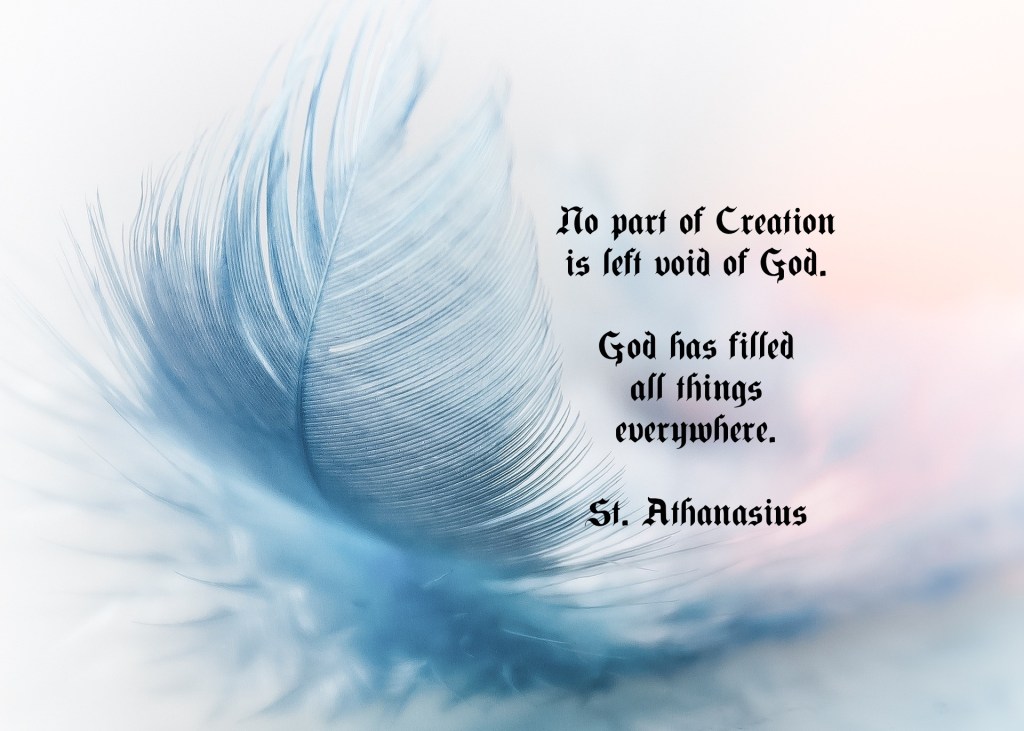
The Self-revealing of the Word is in every dimension – above, in creation; below, in the Incarnation; in the depth, in Hades; in the breadth, throughout the world. All things have been filled with the knowledge of God.
St. Athanasius
Pierre Teilhard de Chardin, the revered Jesuit theologian of the early 20th century, writes in a tone suggestive of Athanasius:
If we live at a distance from God, the universe remains neutral or hostile to us. But if believe in God, immediately all around us the elements, even the irksome, organize themselves into a friendly whole, ordered to the ultimate success of life.
Pierre de Chardin, SJ in Christianity and Evolution
More recently, beloved Pope Francis teaches with the same sacred appreciation of the “mystical” depths of Creation:
The universe unfolds in God, who fills it completely. Hence, there is a mystical meaning to be found in a leaf, in a mountain trail, in a dewdrop, in a poor person’s face. The ideal is not only to pass from the exterior to the interior to discover the action of God in the soul, but also to discover God in all things.
Pope Francis in Laudato Sí, 84)
As we pray in these early days of May, still drenched in the glory of Easter, may we hear God speaking to us in the infinitely new and ever-evolving power and beauty of all Creation.
The occurrence of chance in the world in its own finite way reflects the infinite creativity of the living God, endless source of fresh possibilities. The indwelling Creator Spirit grounds not only life’s regularities but also the novel occurrences that open up the status quo, igniting what is unexpected, interruptive, genuinely uncontrolled, and unimaginably possible. As boundless love at work in the universe, the Spirit embraces the chanciness of random mutations, being the source not only of order but also of the unexpected breaks in order that ensure freshness. Divine creativity is much more closely allied to the outbreak of novelty than our older order-oriented theology ever imagined
Elizabeth Johnson, CSJ – Distinguished Professor of Theology at Fordham University in her book, Ask the Beasts: Darwin and the God of Love
Poetry: Spring – Mary Oliver
Somewhere
a black bear
has just risen from sleep
and is staring
down the mountain.
All night
in the brisk and shallow restlessness
of early spring
I think of her,
her four black fists
flicking the gravel,
her tongue
like a red fire
touching the grass,
the cold water.
There is only one question:
how to love this world.
I think of her
rising
like a black and leafy ledge
to sharpen her claws against
the silence
of the trees.
Whatever else
my life is
with its poems
and its music
and its glass cities,
it is also this dazzling darkness
coming
down the mountain,
breathing and tasting;
all day I think of her -—
her white teeth,
her wordlessness,
her perfect love.
Music: Spring from The Four Seasons – Antonio Vivaldi


 Lavish Mercy