
Labor Day
September 7, 2026

Free for use under Pixabay Content License
Labor Day was first celebrated on September 5, 1882, in New York City with a parade organized by the Central Labor Union. It became an official federal holiday on June 28, 1894, when President Grover Cleveland signed legislation establishing the first Monday in September as a national holiday. (Wiki)
The day may invite us to reflect on many things:
- the final celebrations of summer
- the beginning of a new school year and all its possibilities
- the responsibilities that accompany a changing season
- the meaning of labor and work in our lives and in our society
It is that final point that deserves our attention today.
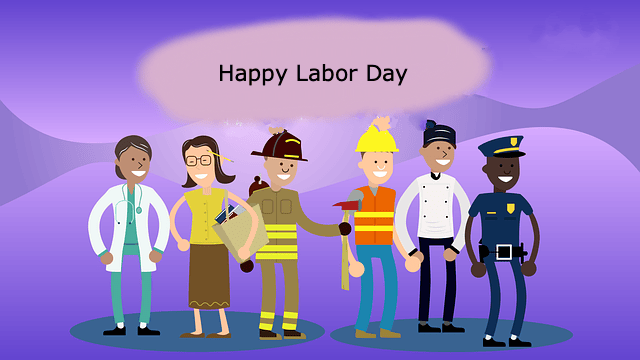
Free for use under Pixabay Content License
When we picture the American worker, we often imagine members of the labor force represented by unions: teachers, nurses, sanitation workers, police officers, and countless others whose efforts sustain our communities.
For me, Labor Day brings to mind my father, a safety-awarded truck driver for Cooper-Jarrett. With a Teamsters pin on his cap, he often left for work before dawn. I remember him returning home exhausted at times, yet deeply satisfied by the work he had accomplished. He valued his union membership, and when he was seriously injured in a workplace accident, the protections it provided became an economic lifeline for our family.

Free for use under Pixabay Content License
I also think of relatives whose livelihoods were not protected by union membership:
- my mother who, before I was born, spent years as a Bell Telephone operator;
- my grandfather and uncles who worked on the production lines of the Budd Company
- my great-grandmother who, like many Irish immigrants, labored in a nineteenth-century textile mill.
Their stories instilled in me a deep respect for honest work and a pride in belonging to a working family. Like many young people of my generation, I eagerly obtained my working papers as soon as I turned fourteen. I went on to earn a whopping $1.10 an hour for the next four years! I suspect many readers can tell similar stories.
Yet the world I have just described is a world of the past. It belongs to the age of the Industrial Revolution and its aftermath. Today, the realities of labor and work are being reshaped by extraordinary advances in science and technology. Amid such rapid change, the human person needs an anchor.
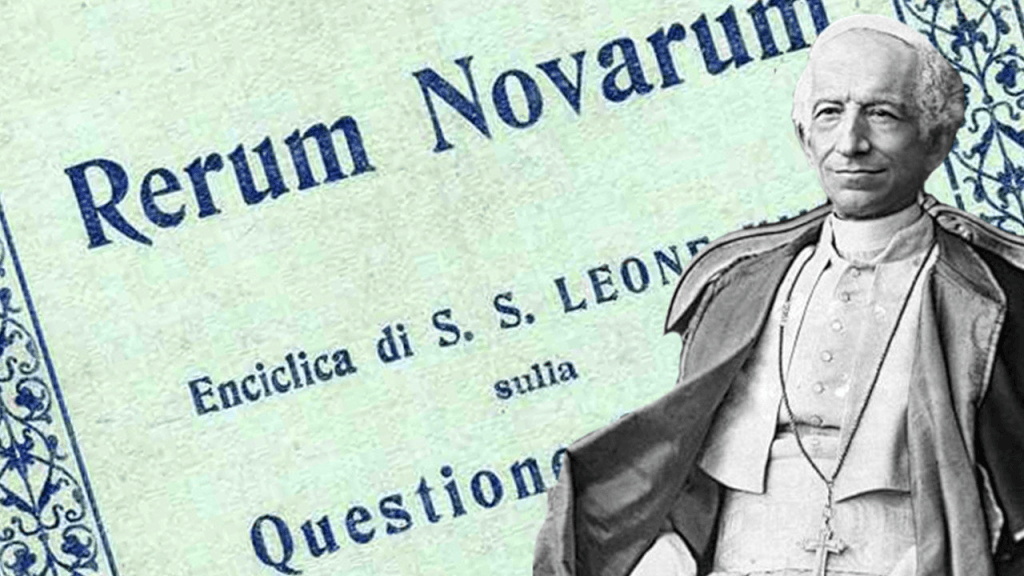
During the immense upheaval of the Industrial Revolution, Pope Leo XIII provided such an anchor through his landmark 1891 encyclical Rerum Novarum. Addressing the conditions faced by workers, while articulating enduring principles of Catholic social teaching, the document emphasized the dignity of the human person, the rights of laborers, and the demands of justice. More than a century later, its wisdom continues to shape moral and social discourse throughout the world.
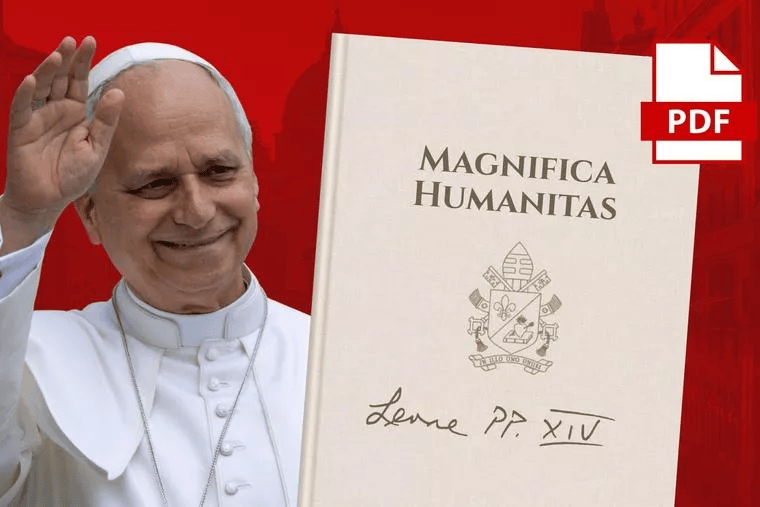
As we observe Labor Day 2026, we should turn our attention to Pope Leo XIV’s recent encyclical, Magnifica Humanitas, published this past spring. Just as Leo XIII addressed the challenges of industrialization, Leo XIV applies the enduring insights of Catholic social teaching to a world increasingly shaped by artificial intelligence and emerging technologies.
Many of you have had a chance over the summer to give the encyclical the careful and prayerful reflection it deserves. For me, three passages, in particular, speak powerfully to the meaning of work and human dignity in our own time. It might be best not to read them all at once, but to take one to ponder each day this week.
Leo XIII’s Encyclical Rerum Novarum constitutes a milestone in the development of the Church’s social teaching. The document places the dignity of work and of workers at the forefront of its reflection; affirms the right to a fair wage for oneself and one’s family; recognizes that persons have a fundamental value that takes precedence over capital and profit; defends private property along with its indispensable societal role; esteems workers’ associations; and proposes forms of cooperation between the different components of society as an alternative to the mentality of class struggle. It is not surprising, then, that Pius XI defined it as the “ Magna Carta” [25] of Christian social action. In Rerum Novarum, the Church’s ancient wisdom regarding the human person and life in society took on a new form capable of responding to the industrial age and offering the first major systematic framework for the Social Doctrine that would be further developed in the following decades. While many of the historical conditions described by Leo XIII have changed, at least two insights remain highly relevant today: the primacy of human labor over any mindset focused solely on finance or productivity — with the consequent attention to the people and families most susceptible to exploitation — and the inseparable link between proclaiming the Gospel and pursuing a more just social order. Rerum Novarum thereby continues to remind us that there is no authentic evangelization that does not also affect the structures of human society. (Magnifica Humanitas, 30)
Having recalled the principles that shine a light on Social Doctrine, I would now like to focus on certain challenges that profoundly shape our way of living today. The biblical image accompanying these reflections is that of a building project. On the one hand, there is the Tower of Babel, where collective effort follows a plan that dominates and ultimately dehumanizes (cf. Gen 11:1-9). On the other hand, there are the ruins of Jerusalem, which under Nehemiah’s direction are rebuilt piece by piece as a project of shared responsibility (cf. Neh 2–6). We are called to reflect on the great “construction sites” of our era and ask: What are we building? As technological development rapidly transforms languages, relationships, institutions and forms of power, we believers must and can choose which projects to work on and in what manner, so as to safeguard and value the grandeur of humanity that has been given to us as a gift. This is a choice not only for our future but also for our present, since artificial intelligence and other emerging technologies are already part of our daily lives. (Magnifica Humanitas, 90)
I am convinced that the concrete way of living out social relationships in the light of the Gospel is not established once and for all, but remains a task entrusted, from generation to generation, to the Christian community. Under the guidance of the Holy Spirit, the Church allows herself to be enlightened by God’s word, reads the signs of the times and creatively seeks new ways for relationships between peoples and nations to become ever more conformed to the demands of the Kingdom of God. [118] For this reason, I encourage all members of the Church not to be afraid of the present challenges, but to listen to one another and firmly embrace their responsibilities in building a more humane and fraternal society.(Magnifica Humanitas, 91)
These passages remind us that the Church’s concern for workers has never been limited to wages, working conditions, or economic systems. At its heart, Catholic social teaching frames these concerns: What does it mean to be human, to be a creature of God, to live in the community of Creation?
These questions become increasingly urgent as artificial intelligence transforms communication, employment, education, healthcare, commerce, and even our understanding of human relationships. The challenge facing the human community is critical – that of ensuring that technological progress remains at the service of the human person and the Creation we share.
In the encyclical, the image of two construction projects—the Tower of Babel and the rebuilding of Jerusalem—is especially compelling. Every generation is called to participate in the unfolding of Creation. Will the contribution of this generation diminish human dignity or strengthen it; will it isolate people or unite them; will it serve only power and wealth, or will it promote the universal common good?
Labor Day offers an ideal moment to reflect on those questions. It reminds us that work is never merely about productivity. Work is about people, families, communities, and human flourishing. It is about participating in God’s ongoing work of creation.
While researching this article, I came across the U.S. Department of Labor’s Hall of Honor, which recognizes notable figures associated with the American labor movement. One individual who particularly caught my attention was Frances Perkins, whose remarkable life I recently encountered in Stephanie Dray’s excellent novel, Becoming Madame Secretary. Perkins’s story has inspired me to learn more about other leaders who helped shape the rights and protections many workers enjoy today.
Perhaps some readers may wish to undertake that exploration as well.
To learn more about notable figures in the American labor movement, visit the U.S. Department of Labor Hall of Honor.
https://www.dol.gov/general/aboutdol/hallofhonor/inductees
To read the full text of Magnifica Humanitas, visit the Vatican website.
https://www.vatican.va/content/leo-xiv/en/encyclicals/documents/20260515-magnifica-humanitas.html
And for those who really want to steep themselves in this consequential history, read Rerum Novarum here:
Happy and blessed Labor Day to all of you, and let us pray for these blessings for all, no matter their citizenship, who work hard every day to support their families and communities.
 Lavish Mercy
Labor memories. My first job paid .35 cents an hour and I thought I was rich. Years later when I was a member of the Teamsters I knew I was rich. Thanks for sharing and Happy Labor Day!
LikeLiked by 1 person