Walk the Bridge

Sunday, February 3, 2019

Click here for readings

Today, in Mercy,  we begin our readings with God’s stern but magnificent commission to the prophet Jeremiah: 

… stand up and tell them
all that I command you.

What Jeremiah had to tell the Israelites was not good news. He prophesied that if they didn’t repent from their idolatry, Jerusalem would fall into the hands of foreign oppressors. Nobody wanted to hear it. They led Jeremiah a life, to the point that he is often referred to as “The Weeping Prophet”. Over the course of forty years and reign of five Judean kings, Jeremiah’s message continues until, in the end, it comes to fulfillment in the Babylonian Captivity.

How did Jeremiah sustain such confrontational preaching in the face of intractable resistance?

love is the bridgeJPG

Perhaps the answer lies in our second reading. He did it out of love.

Arthur Cundall, a British scripture scholar writes:

“God wanted a person
with a very gentle and tender heart
for this unrewarding ministry of condemnation.
Jeremiah’s subsequent career shows that
he had this quality in full measure.”

Jeremiah is a living example of the loving, humble, truth-seeking, hope-impelled soul described in 1 Corinthians, our second reading.

In Luke’s Gospel today, we see Jesus rejected in the same manner as Jeremiah. Jesus’s message asks his listeners for deep conversion of heart in order to be redeemed. Like the ancient Israelites, they don’t want to hear it. They cannot break through their comfortable existence to acknowledge its emptiness.

The message for us today? Is there an emptiness somewhere in our hearts that we have not yet given over to God? Are we filling it with “false gods”, rather than the loving virtues described in Corinthians?

We know where our “dead spaces” are, and we deeply intend them to come alive again. Today, let’s begin to walk the bridge from intention to practice.

Music:  Can’t help it. I love it.
Find Yourself in This Feast

Saturday, February 2, 2019

Click here for readings

Today, in Mercy, we celebrate the feast of the Presentation of Jesus in the Temple.

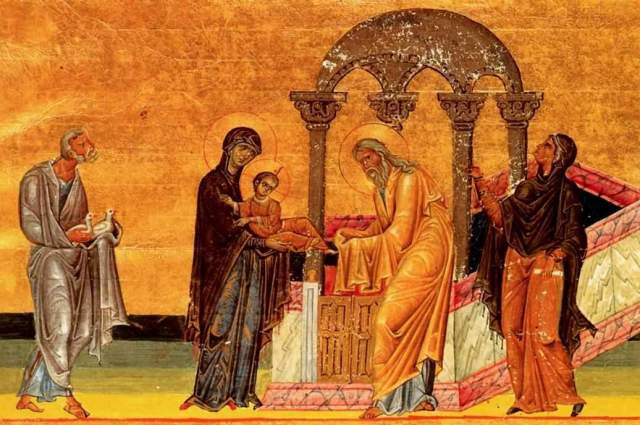
Presentation
Icon from The Menologion of Basil II, an illuminated manuscript designed as a church calendar or Eastern Orthodox Church service book (menologion) that was compiled c. 1000 AD, for the Byzantine Emperor Basil II

This event is layered with human and Divine dimensions. It is filled with memorable characters and key moments in their lives. One or more of their stories may touch your own experience as you pray today.

The infant Jesus, just forty days old, is presented and dedicated in the Temple, setting in motion his whole life as the fulfillment of Jewish expectation. We may reflect on the power of our own Baptisms. If we were infants when baptized, we may recall who carried us to the font and who stood for our dedication to Christ.

Mary and Joseph came to the Temple that day for the ritual of Purification. They place their young marriage, and their beginning parenthood, into the circle of their Jewish faith. We may reflect on those points of religious dedication in our own lives – marriage, religious profession, ordination, Confirmation, and just how much the sacred nature of these events impacts our daily living.

Anna and Simeon, long-faithful servants of God, rejoice in the fulfillment of their hopes for the Messiah. Those of us richer in years might gratefully reflect on God’s fidelity to us over the course of our lifetime, and what sacred hopes we still might long to have fulfilled.

Simeon, so completed by seeing his Savior, intones the moving prayer Nunc Dimittis – “Now You may dismiss your servant in peace.” We might pray for those who are nearing their life’s close that they may be blessed with peace. We might also pray for ourselves that we will experience peace and joy at the end of our lives.

And finally venerable Anna who, woman to woman, stood beside young Mary as Mary faced Simeon’s painful words:

Behold, this child is destined
for the fall and rise of many in Israel,
and to be a sign that will be contradicted
and you yourself a sword will pierce
so that the thoughts of many hearts may be revealed.

For a beautiful meditation on Anna, click here.

Music: Bach – Cantate BWV 125 – Mit Fried und Freud ich fahr dahin
Johann Sebastian Bach composed the cantata Mit Fried und Freud ich fahr dahin With peace and joy I depart), BWV 125, for use in a Lutheran service. He composed this in 1725 for the feast for the Purification of Mary which is celebrated on 2 February and is also known as Candlemas. The cantata is based on Martin Luther’s 1524 Hymn.

https://www.youtube.com/watch?v=q1f6P_INhWw&app=desktop

Mit Fried und Freud ich fahr dahin
In Gottes Willen,
Getrost ist mir mein Herz und Sinn,
Sanft und stille.
Wie Gott mir verheißen hat:
Der Tod ist mein Schlaf worden.

With peace and joy I go on my way
in God’s will.
My heart and mind are comforted,
peaceful and calm.
As God promised me
death has become my sleep.