
Tuesday of the First Week of Advent
December 5, 2023

Today’s Readings:
https://bible.usccb.org/bible/readings/120523.cfm
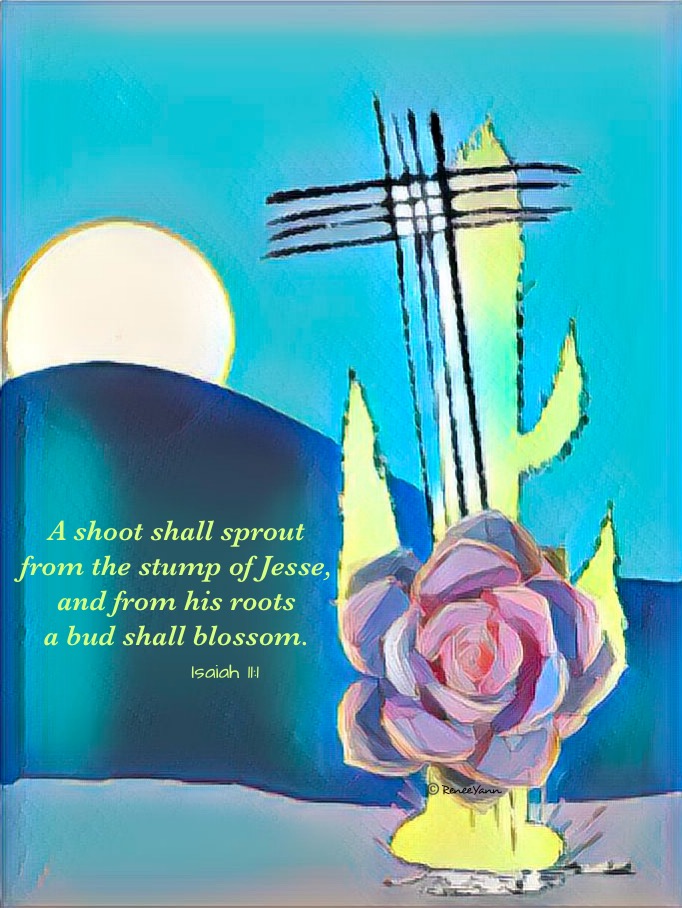
Today, in God’s Lavish Mercy, Isaiah challenges us with his outrageously hopeful poetry.
After describing, in lyrical magnificence, the Messianic Ruler, Isaiah tells us this:
Then the wolf shall be a guest of the lamb,
Isaiah 11:6-10
and the leopard shall lie down with the kid;
The calf and the young lion shall browse together,
with a little child to guide them.
The cow and the bear shall be neighbors,
together their young shall rest;
the lion shall eat hay like the ox.
The baby shall play by the cobra’s den,
and the child lay his hand on the adder’s lair.
There shall be no harm or ruin on all my holy mountain;
for the earth shall be filled with knowledge of the LORD,
as water covers the sea.
We love this lilting Advent balladry, don’t we? Its movement is laced with hidden bells and waft of pine. It makes us remember Handel’s Messiah and resolve to find and play the CD we put away last January.
But as much as we might love the passage, do we believe it? Is the era of messianic peace possible, and will it be realized through the mystery of Divine Love incarnate in Jesus Christ?
Well, here are the facts:
Isaiah lived and prophesied a redeemed kingdom about 700 years before Christ. When Christ was born, the world was in pretty much the same sad shape as it was when Isaiah wrote.
Jesus lived 2000 years ago, speaking and modeling specific instructions for the world’s transformation. But the world is in pretty much the same sad shape today as it was when Jesus lived.
So where is all this “peaceable kingdom” stuff happening? Is it non-existent or just invisible? Is it just the rather lunatic imagining of ancient prophets?
Today’s Gospel offers us an understanding of God’s Reign too deep for the world’s logic. By the gift of faith and the grace of Baptism, we have been given a new set of eyes, charged with the same outrageous yet real hope evident in Isaiah and enfleshed in Christ.
I give you praise, Father, Lord of heaven and earth,
Luke 10:21-24
for although you have hidden these things
from the wise and the learned
you have revealed them to the childlike…
… Turning to the disciples in private he said,
“Blessed are the eyes that see what you see.
For I say to you,
many prophets and kings desired to see what you see,
but did not see it,
and to hear what you hear, but did not hear it.
If we can give ourselves to the vulnerable simplicity Jesus describes, faith can transform us. The “Kingdom” can live in us and because of us!
We too will see the bud beyond the stump. New life will arise from what appears lifeless. The worldly fears and inhospitalities that prey on us will be tamed by a holy confidence. In life’s sinuous circumstances, we will see the Holy Mystery unfolding.
The Kingdom, so indiscernible in our fractious world, will “advent” in us. This is what we long for in our Advent prayer.
Poetry: Advent Credo – Allan Boesak, a South African pastor in the Dutch Reformed Church, politician, anti-apartheid activist, and author of fifteen books. This poem is taken from his book Walking on Thorns (Eerdmans, 1984), and is often but wrongly attributed to Daniel Berrigan.
It is not true that creation and the human family are doomed to destruction and loss—
This is true: For God so loved the world that He gave his only begotten Son, that whoever believes in Him shall not perish but have everlasting life;
It is not true that we must accept inhumanity and discrimination, hunger and poverty, death and destruction—
This is true: I have come that they may have life, and that abundantly.
It is not true that violence and hatred should have the last word, and that war and destruction rule forever—
This is true: Unto us a child is born, unto us a Son is given, and the government shall be upon his shoulder, his name shall be called wonderful councilor, mighty God, the Everlasting, the Prince of peace.
It is not true that we are simply victims of the powers of evil who seek to rule the world—
This is true: To me is given authority in heaven and on earth, and lo I am with you, even until the end of the world.
It is not true that we have to wait for those who are specially gifted, who are the prophets of the Church before we can be peacemakers—
This is true: I will pour out my spirit on all flesh and your sons and daughters shall prophesy, your young men shall see visions and your old men shall have dreams.

It is not true that our hopes for liberation of humankind, of justice, of human dignity of peace are not meant for this earth and for this history—
This is true: The hour comes, and it is now, that the true worshipers shall worship God in spirit and in truth.

So let us enter Advent in hope, even hope against hope. Let us see visions of love and peace and justice. Let us affirm with humility, with joy, with faith, with courage: Jesus Christ—the life of the world.
Music: Lo, How a Rose E’er Blooming – pre-17th century anonymous hymn
From Wikipedia: The hymn was originally written with two verses that describe the fulfillment of the prophecy of Isaiah foretelling the birth of Jesus. It emphasizes the royal genealogy of Jesus and Christian messianic prophecies. The hymn describes a rose sprouting from the stem of the Tree of Jesse, a symbolic device that depicts the descent of Jesus from Jesse of Bethlehem, the father of King David. The image was especially popular in medieval times, and it features in many works of religious art from the period. It has its origin in the Book of Isaiah:
And there shall come forth a rod out of the stem of Jesse, and a Branch shall grow out of his roots.— Isaiah 11:1
 Lavish Mercy