
Thursday of the First Week of Advent
Memorial of Saint Ambrose, Bishop and Doctor of the Church
December 7, 2023
Today’s Readings:
https://bible.usccb.org/bible/readings/120723.cfm
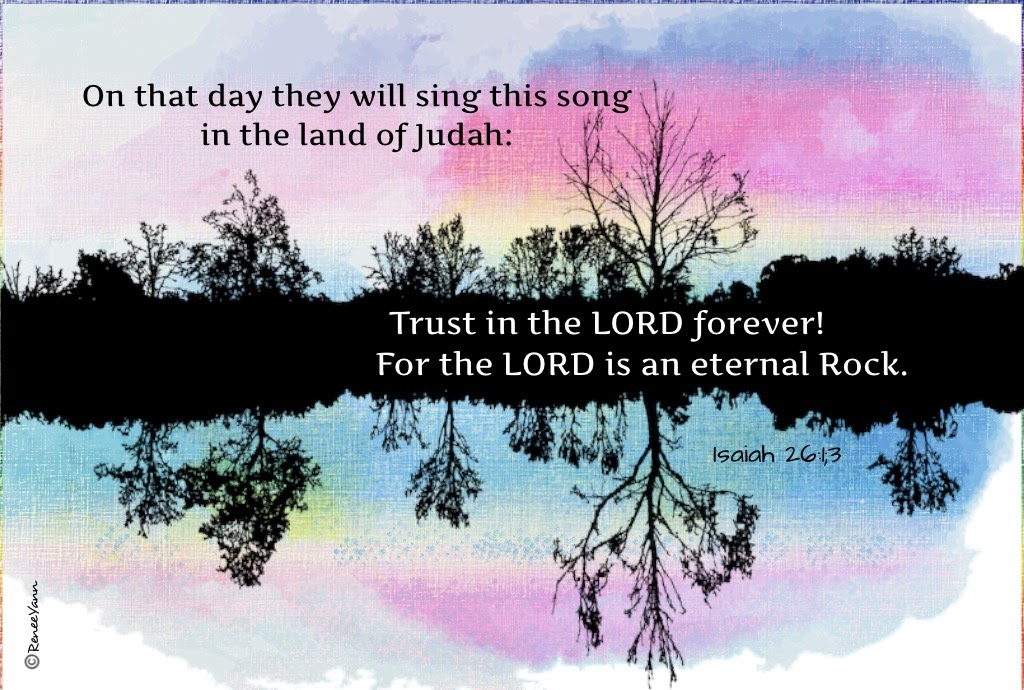
Today, in God’s Lavish Mercy, Isaiah describes the upside-down nature of God’s Reign:
Trust in the LORD forever!
Isaiah 26:4-6
For the LORD is an eternal Rock,
who humbles those in high places,
and the lofty city he brings down;
He tumbles it to the ground,
levels it with the dust.
It is trampled underfoot by the needy,
by the footsteps of the poor.

God humbles the haughty, dwindles the lofty, tramples the elite with the “footsteps of the poor”. Wow! God turns our messy world on its head to right it!
This eloquent prophecy was intended to bolster the hopes of Isaiah’s careworn exiled community. It imagines the embodiment of the hope for which they have no evidence. Isaiah tells a geographically imprisoned people that they will be the ultimate conquerors. He assures a shackled community that their trust will earn them jubilant liberation. He enjoins them to believe!
It is really hard to have that kind of faith and trust when we have no evidence of delivery from whatever imprisons or assails us. Sometimes we wait a lifetime for a prayer to be answered but it seems that it never is. Are we fools to keep believing under such circumstances? Or are we wise enough to trust that the answers have come in ways we could not yet discern?
Our Gospel summons us to the same type of wildly hopeful trust. Jesus says that we cannot foresee nor control what kind of weather will assail us in life. Therefore, we must have a firm and sure foundation in faith so that we may survive any storm.

Jesus tells us to hear the sacred word with integrity and to measure ourselves according to it, because simply murmuring “Lord, Lord” doesn’t merit a pass to eternal life.
Everyone who listens to these words of mine and acts on them
Matthew 7:24-27
will be like a wise one who built the house on rock.
The rain fell, the floods came,
and the winds blew and buffeted the house.
But it did not collapse; it had been set solidly on rock.
And everyone who listens to these words of mine
but does not act on them
will be like a fool who built the house on sand.
The rain fell, the floods came,
and the winds blew and buffeted the house.
And it collapsed and was completely ruined.
In this Advent time, let’s pray for a simple, wise and strong faith for ourselves and for those we love.
Prose: from On Obstinacy in Belief by C.S. Lewis
… a little bit long from Lewis but so worth it! If you like the excerpt, here’s a link to the entire essay:
https://thesewaneereview.com/articles/on-obstinacy-and-belief
Christians seem to praise an adherence to the original belief which holds out against any evidence whatever. I must now try to show why such praise is in fact a logical conclusion from the original belief itself.

This can be done best by thinking for a moment of situations in which the thing is reversed. In Christianity such faith is demanded of us; but there are situations in which we demand it of others. There are times when we can do all that a fellow creature needs if only he will trust us.

In getting a dog out of a trap, in extracting a thorn from a child’s finger, in teaching a boy to swim or rescuing one who can’t, in getting a frightened beginner over a nasty place on a mountain, the one fatal obstacle may be their distrust.

We are asking them to trust us in the teeth of their senses, their imagination, and their intelligence. We ask them to believe that what is painful will relieve their pain and that what looks dangerous is their only safety. We ask them to accept apparent impossibilities: that moving the paw further back into the trap is the way to get it out; that hurting the finger very much more will stop the finger hurting; that water which is obviously permeable will resist and support the body; that holding onto the only support within reach is not the way to avoid sinking; that to go higher and onto a more exposed ledge is the way not to fall.

To support all these incredibilia we can rely only on the other party’s confidence in us—a confidence certainly not based on demonstration, admittedly shot through with emotion, and perhaps, if we are strangers, resting on nothing but such assurance as the look of our face and the tone of our voice can supply, or even, for the dog, on our smell. Sometimes, because of their unbelief, we can do no mighty works.

But if we succeed, we do so because they have maintained their faith in us against apparently contrary evidence. No one blames us for demanding such faith. No one blames them for giving it. No one says afterward what an unintelligent dog or child or boy that must have been to trust us. If the young mountaineer were a scientist it would not be held against him, when he came up for a fellowship, that he had once departed from Clifford’s rule of evidence by entertaining a belief with strength greater than the evidence logically obliged him to.

Now to accept the Christian propositions is ipso facto to believe that we are to God, always, as that dog or child or bather or mountain climber was to us, only very much more so.
Music: Sheep May Safely Graze – J. S. Bach from from Cantata No. 208, “Was mir behagt” (Hunt Cantata), BWV 208, arr. by Egon Petri, (Oliver Schnyder – Piano)
 Lavish Mercy
Could you send me the poem: Christmas is for the old folks
Vspiegel@osfphila.org
LikeLike