
Friday of the Third Week of Advent
December 22, 2023
Today’s Readings:
https://bible.usccb.org/bible/readings/122223.cfm

Today, in God’s Lavish Mercy, we pray a heartfelt antiphon beseeching God to transform our world.
Our readings strengthen our prayer because they vibrate with luminous faith deepened by a palpable humanness like our own. We pray with these spiritually powerful women:
Mary and Hannah
courageous mothers
shining believers
agents of worship
prophets in common disguise.
Our first reading once again foreshadows Christ’s life. Hannah, a mother like Mary, gives her only son fully to God’s work. Notice that Hannah, not her husband, brings Samuel to the Temple and initiates the ritual of his dedication. It is Hannah who, claiming her womanhood, utters the simple canon that dedicates Samuel’s life.
Hannah brought Samuel with her,
1 Samuel 1:24-28
along with a three-year-old bull,
an ephah of flour, and a skin of wine,
and presented him at the temple of the LORD in Shiloh……
I am the woman who stood near you here, praying to the LORD.
I prayed for this child, and the LORD granted my request.
Now I, in turn, give him to the LORD;
as long as he lives, he shall be dedicated to the LORD.”
She left Samuel there.
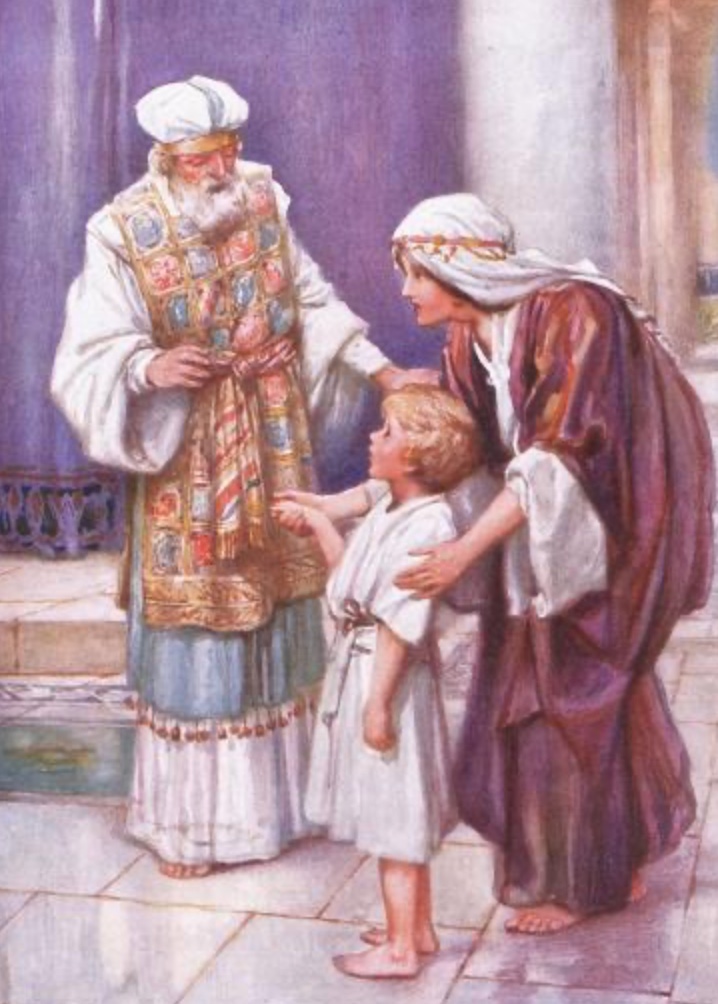
Hannah Leaves Samson at the Temple
But how poignantly the reading ends! Do not miss the human emptiness that filled her heart as she returned to her childless home.
She left Samuel there.
1 Samuel 1:28
In our Gospel, Mary offers us her Liturgy of the Word as she proclaims the liberated dimensions of a redeemed world.
My soul proclaims your greatness, O God!
My heart rejoices in you, my Savior,
because you have showered your servant with blessing!
From now to the end of time,
all generations will know the great things you have done for me.
Mighty One! Your name is holy!
In every age, your compassion flows to those who reverence you!
But all who seek to exalt themselves in arrogance
will be leveled by your power.
You have deposed the mighty from their seats of power,
and have raised the lowly to high places.
Those who suffer hunger, you have filled with good things.
Those who are privileged, you have turned away empty-handed.
You have come to the aid of your people,
in fulfillment of the promise you made to our ancestors
when you spoke blessing to Sarah and Hagar
and all their descendants, to the utmost generation!
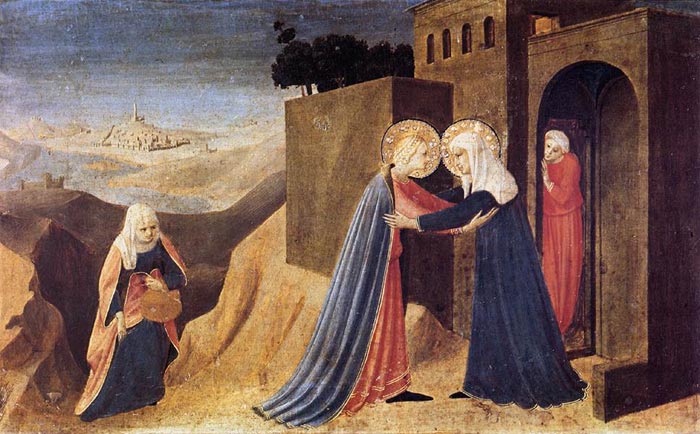
from the Cortona Altarpiece by Fra Angelico
After her courageous declaration, Mary spends three months with Elizabeth in a mutually-directed matriarchal retreat. She then goes back, alone but not alone, to the life she has yet to shape for the coming God. Once again, the striking solitude of this young mother as she travels home:
Mary remained with Elizabeth about three months
and then returned to her home.
Luke 1:56
What can we learn from these women today as we make a place for God in our hearts and in our world? Like Hannah, to what liturgies of giving am I called? Like Mary, does my life proclaim my faith in God’s transformative intention for Creation?
Poetry: The Eternal Feminine by Pierre de Chardin
When the world was born, I came into being.
Before the centuries were made, I issued from the hand of God. . .
God instilled me into the initial multiple
as a force of condensation and concentration.
In me is seen that side of beings by which they are joined as one,
in me the fragrance that makes them hasten together and leads them,
freely and passionately, along their road to unity.

Through me, all things have their movement and are made to work as one.
I am the beauty running through the world,
to make it associate in ordered groups;
the ideal held up before the world to make it ascend.
I am the Eternal Feminine.
I was the bond that held together the foundations of the universe. . .
I extend my being into the soul of the world. . .
I am the magnetic force of the universal presence
and the ceaseless ripple of its smile.
I open the door to the whole heart of creation:
I, the Gateway of the Earth, the Initiation. . .

In me, the soul is at work to sublimate the body —
Grace to divinize the soul.
Those who wish to continue to possess me
must change as I change. . .
It is God who awaits you in me!. . .
If, God, then, was able to emerge from himself,
he had first to lay a pathway of desire before his feet,
he had to spread before him a sweet savor of beauty.
It was then that he caused me to rise up,
a luminous mist hanging over the abyss—
between the earth and himself—
that, in me, he might dwell among you. . .

Lying between God and the earth,
as a zone of mutual attraction,
I draw them both together in a passionate union.
. . . I am the Eternal Feminine.
Music – Magnificat – Carl Philipp Emmanuel Bach
Carl Philipp Emanuel Bach (8 March 1714 – 14 December 1788), commonly abbreviated C. P. E. Bach, was a German Classical period composer and musician, the fifth child and second surviving son of Johann Sebastian Bach and Maria Barbara Bach.
Throughout his lifetime, Bach worked on the Magnificat in D, Wq. 215. J. S. Bach was alive to hear it in 1749, and C. P. E. continued to revise and perform it as late as 1786. The work clearly shows the influence of J.S. Bach’s own Magnificat, including the striking resemblance of the Deposuit movements in both works.
This is the track list for the album Magnificat, taking the various phrases of the Latin prayer and expressing them in melody. If you don’t have time to listen to the whole thing, you might like to take a portion or two at a time.
Tracklist:
00:00:00 Symphony in G Major, Wq 173: I. Allegro assai
00:02:59 Symphony in G Major, Wq 173: II. Andante
00:05:34 Symphony in G Major, Wq 173: III. Allegretto
00:08:38 Symphony in G Major, Wq 180: I. Allegro di molto
00:12:50 Symphony in G Major, Wq 180: II. Largo
00:17:12 Symphony in G Major, Wq 180: III. Allegro assai
00:20:26 Magnificat in D Major, Wq 215: I. Magnificat (Chorus)
00:23:18 Magnificat in D Major, Wq 215: II. Aria. Quia respexit (Soprano)
00:29:35 Magnificat in D Major, Wq 215: III. Aria. Quia fecit (Tenor)
00:33:40 Magnificat in D Major, Wq 215: IV. Et misericordia eius (Chorus)
00:41:28 Magnificat in D Major, Wq 215: V. Aria. Fecit potentiam (Bass)
00:45:14 Magnificat in D Major, Wq 215: VI. Duet. Deposuit potentes (Contralto, Tenor)
00:51:00 Magnificat in D Major, Wq 215: VII. Aria. Suscepit Israel (Contralto)
00:56:31 Magnificat in D Major, Wq 215: VIII. Gloria (Chorus)
00:58:17 Magnificat in D Major, Wq 215: IX. Sicut erat (Chorus)
 Lavish Mercy
Beautiful commentary on today’s readings. I was particularly struck by The Eternal Feminine poem. “In me the soul is at work to sublimate the body— Grace to divinities the soul. Those who wish to continue to possess me must change as I change…It is God who awaits you in me…
LikeLiked by 1 person