Let’s Meet in Heaven

The Commemoration of All the Faithful Departed
Thursday, November 2, 2023

Today’s Readings:

https://bible.usccb.org/bible/readings/110223.cfm
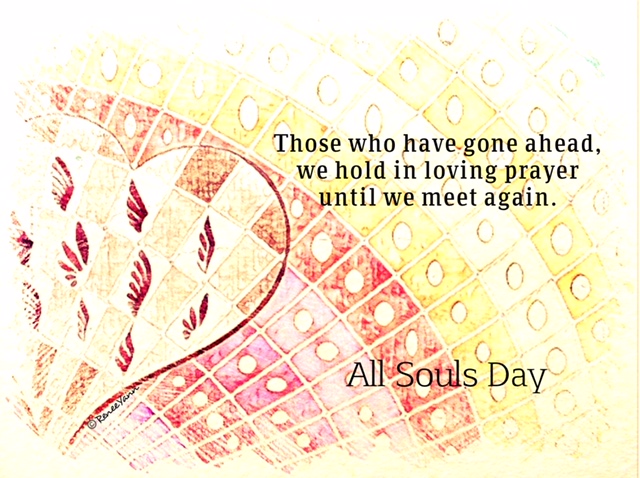

Today, in God’s Lavish Mercy, the whole Church joins in praying for the wholeness of the Communion of Saints. We all desire to be together again, with everyone we have loved, in eternal life.


This morning, as I prepare the reflection for All Souls Day, I consider how much religious practice can change in one’s lifetime. The Church and we are always growing in understanding and truth if we have open hearts. This graced understanding is exactly what the Church seeks in the current Synod on Synodality. Yet, as with all growth, we may tend to resist.


Today, I am taken (waaay) back to how All Souls Day was commemorated in my youth. My teachers impressed me with the idea that this special day was a time when repentant souls could be released from Purgatory if I prayed hard enough. I thought the process was similar to Amazon Prime Day where costs/penalties dropped and the early and persistent pray-er could snag a lot of souls for heaven.


(not us, but close enough)

We always had off from school on All Souls Day, so Janie McFadden and I would meet up about 5:45 AM to begin our marathon of Masses.  We had four parish priests so at three Masses a piece, Janie and I were set for the next few hours of liberating prayer. About 7:00 AM, Harry diNicolo finally showed up but he certainly didn’t get full credit like me and Janie!


The scene was somber.  The priests wore black vestments then, spoke mostly in Latin, and turned their backs to the participating congregation. There were a lot of candles and not very much real light that early in the morning. You guessed it – Janie and I took turns falling asleep. About every 10 minutes, one would punch the other in an effort to rev up purgatorial releases. Still not sure if any of that worked. Harry, by the way, went back home about 7:15 because he was hungry for breakfast.

One year, after the third Nicene Creed or so, Janie fainted. Sister Eucharistica told her not to do the All Souls Marathon again without drinking “a wee bit of milk before you come to Church”. Given our understanding of Divine Law at the time, requiring total fasting, we fourth graders were pretty sure Sr. Eucharistica would be the next soul we were praying out of Purgatory!


But as I think of her now, she was exactly the kind of person we need today for a “synodal Church”. She was a woman full of wisdom, courage, and common sense. She knew how to prioritize human needs long before the institutional Church figured it out. She knew Jesus desired communion with someone who wasn’t in a dead faint!

I think she probably knew too that we hadn’t come to Mass on that cold 1955 morning just to help “release” folks from purgatory.  We had come to remember people we loved who had gone ahead of us, to reflect on their lives, to miss them, love them, and to learn from both their lights and their shadows. 

We were young kids who, in our own small way, wanted to honor and face the meaning of death in human life. We wanted to know that God cared about our sadness over losing Grandmom or Uncle Joe. We wanted to know that God cared about us even though we too would face the same mysterious completion of our earthly lives.

Unfortunately, the Tridentine Mass didn’t provide much of that spiritual enrichment. But Sr. Eucharistica did. God bless her!


Today, in a language still very heavy with 16th-century concepts, the Catholic Encyclopedia defines purgatory as a place or condition of temporal punishment for those who, departing this life in God’s grace, are, not entirely free from venial faults, or have not fully paid the satisfaction due to their transgressions.

That language doesn’t do much for me either. I choose to think that most of us do the best we can with our lifetimes, but maybe there are a few who don’t. They don’t quite create the space in themselves to receive and eternally embrace God.  “Purgatory” is their second chance, a “time out” God gives them to get their heads together and realize how much they have been missing. Then, violà, they like all the saints are flooded with glory.


My dear friend Janie has long ago gone to the heavenly understanding.  I’m not sure what happened to Harry, even though we dated off and on well into high school.  I think he finally found somebody who liked to eat more than she liked to go to Mass. Meanwhile, my likes were going in a different direction.


Prose: from Pope Francis’s homily on November 2, 2022

Brother and sisters, let us feed our expectation for Heaven, let us exercise the desire for paradise. Today it does us good to ask ourselves if our desires have anything to do with Heaven. Because we risk continuously aspiring to passing things, of confusing desires with needs, of putting expectations of the world before expectation of God. But losing sight of what matters to follow the wind would be the greatest mistake in life.


Remembering Our Merion Mercy Family – lyrics below

We lovingly remember these dear Sisters and Associates who shared Mercy life with us and who have gone home to God in 2023.

One day in the love of Christ
we’ll meet once again
We’ll laugh as we celebrate a life with no end
Where death has been overcome by our Risen Lord

And there are no more goodbyes,
no more tears, no more loneliness,
and no more fear

Our pain turns to joy
darkness to light
in God’s heaven
there are no more goodbyes

No words tell the gratitude
we have for the gift
your life was to each of us
We’ll never forget

May angels now
lead you home
to our Risen Lord

And there are no more goodbyes,
no more tears, no more loneliness,
and no more fear

Our pain turns to joy
darkness to light, in God’s heaven
there are no more goodbyes

Though now with our heavy hearts
we go separate ways
we trust in the certain hope
there will come a day
we’ll join you in paradise
with our risen Lord

There will be no more goodbyes,
no more tears, no more loneliness,
and no more fear
Our pain turns to joy
darkness to light God’s heaven
there are no more goodbyes

Neighbor

Monday of the Twenty-seventh Week in Ordinary Time
October 9, 2023

Today’s Readings:

https://bible.usccb.org/bible/readings/100923.cfm


Today, in God’s Lavish Mercy, get ready for a three-day cruise with Jonah and a radical journey down the Jericho road with the Good Samaritan.

The message of Jonah is clear: all people, even hated Ninevites, are children of God’s Mercy. Resisting that understanding can be catastrophic to our spiritual life.


Patricia Tull, Rhodes Professor Emerita of Old Testament at Louisville Seminary, summarizes the Book of Jonah like this:

A postexilic book, Jonah’s story is atypical for prophetic works. Not only is it a narrative about the prophet rather than his speeches, but it also rebuffs Jonah for his refusal to preach to foreign enemies. Jonah’s story portrays foreigners as more than ready to repent and turn to God. The book uses humor, hyperbole, and irony to make its parabolic point.

Our Gospel gives us one of the most beloved yet challenging parables of Jesus – who is our “neighbor”. The infinite dimensions within this parable continue to unfold for us as we deepen in our mercy spirituality.

God does not see anyone as a “foreigner”. Every human being lives with the breath of God. We are “neighbors” because we share that breath, that “neighborhood” of God’s boundless Love.


But, oh my God, how we have forgotten or rejected that common bond of reverence for one another! Just yesterday, one of our sisters brought up the subject of a recent hit-and-run accident in Philadelphia. It now seems to be the common practice to leave the scene of such an occurrence, abandoning the victim to his fatal circumstance. She wondered, incredulously, how anyone could be that callous.


Our Gospel parable describes that callousness. Notice that both the priest and the Levite pass the victim by “on the opposite side“. The phrase implies that if I can build a wall to make you invisible to me, I can more easily ignore your claim on my merciful neighborliness.

The Samaritan lived without those walls. He did not see a Jew, or a foreigner, or an expendable “other”. He saw a human being, like himself – a neighbor who was struggling to live.

The Good Samaritan (1880) by Aimé Morot


Jesus’ parable of the Good Samaritan is a clear example of the call of the Gospel to neighborliness. In the story, such a call is an inconvenient truth because it summons outside the comfortable community to find the neighbor among the not-well-regarded “others.” 

Walter Brueggemann, Health Progress, January – February 2010

We don’t want to be like resistant Jonah, nor like the prejudicially blinded priest and Levite of our parable. But it is hard. The world conspires to separate us into the haves and the have-nots, the deserving and the undeserving, the winners and the losers, the sinners and the saints. Mercy not only resists but dismantles such walls. Do we have the courage to examine our own prejudices and to step across from “the opposite side” for the sake of our neighbor?


Poem: Neighbor – Iain Crichton Smith

Build me a bridge over the stream
to my neighbour’s house
where he is standing in dungarees
in the fresh morning.
O ring of snowdrops
spread wherever you want
and you also blackbird
sing across the fences.
My neighbor, if the rain falls on you,
let it fall on me also
from the same black cloud
that does not recognize gates.

Music: JJ Heller – Neighbor

Sometimes it's easier to jump to conclusions
Than walk across the street
It's like I'd rather fill the blanks with illusions
Than take the time to see
You are tryna close the back door of your car
You are balancing the groceries and a baby in your arms
You are more than just a sign in your front yard
You are my neighbor
I can get so lost in the mission
Of defending what I think
I've been surfing on a sea of opinions
But just behind the screen
You are grateful that the work day's finally done
You are stuck in miles of traffic, looking at your phone
You are tryin' to feel a little less alone
You are my neighbor
When the chasm between us feels so wide
That it's hard to imagine the other side
But we don't have to see things eye to eye
For me to love you like you are my neighbor
My neighbor
Oh, to fear the unfamiliar
Is the easy way to go
But I believe we are connected more than we might ever know
There's a light that shines on both the rich and poor
Looks beyond where we came from and who we voted for
'Til I can't see a stranger anymore
I see my neighbor
May my heart be an open door to my neighbor
You are my neighbor

Hope and Resilience

Friday of the Twentieth Week in Ordinary Time
August 25, 2023

Today’s Readings:

https://bible.usccb.org/bible/readings/082523.cfm


Today, in God’s Lavish Mercy, we read the tender and beloved story of Ruth and Naomi. We have come to love the beautiful exchange between these two women, filled with devotion and selfless love:

But Ruth said to Naomi, “Do not ask me to abandon or forsake you!
For wherever you go, I will go, wherever you lodge I will lodge,
your people shall be my people, and your God my God.
Where you die I will die,
and there be buried.
May the LORD do thus to me, and more,
if even death separates me from you!”

Ruth 1: 16-17

Who doesn’t long to be devoutly loved the way Ruth loved Naomi?
Who, especially in elder years or lonely times, isn’t filled with gratitude for the faithful companionship of dear ones?
Who isn’t moved at a wedding ceremony when young couples make brave promises like Ruth’s, having no idea what their vow will require down the years?


Reading the story of Ruth from these perspectives can carry us to deep reflection, but it can also leave us with an insubstantial or idealized perception of the infinite Love mirrored in this Scripture.

The Book of Ruth is so much more than an admirable devotion.

In the Book of Ruth, significant theological formation occurs, presenting a beautifully written story placed distinctively between the chaos of the Book of Judges and the epic struggle between the prophet Samuel and the intractable King Saul in the first book of Samuel. Nestled in between this chaotic downward spiral and the recalcitrance of Saul, Ruth exhibits resilience amidst vulnerability, an outsider grafted into the Davidic lineage and its climactic conclusion in Christ. A theology of hope for those found outside the normative structures of patriarchal, religious, and cultural normative spheres.

Bradford Parker: Ruth: A Theology of Resilience Amidst Vulnerability

Various authors suggest a host of underlying theological themes in Ruth:

  • the community is responsible for those who are hungry;
  • the experience of despair cannot be ignored;
  • people young and old are to be cared for; and
  • the marginalized are to push to the center, and those at the center are to move toward the marginalized. (Katherine Doob Sakenfeld: Ruth, Interpretation)

Another writer sees “Ruth is herself the “mirror of God” by reflecting Yahweh through her actions of devotion throughout the narrative.” (John C. Holbert: Preaching the Old Testament)

Andre LaCocque argues that “Ruth belongs to the extraordinary. She is characterized by hesed (Mercy).” (Ruth: Continental Commentary)


The Book of Ruth, on surface appearance, is a simple yet compelling story. But reading under its words, we will find astounding depth:

  • a faithful elder who now feels abandoned by God (Naomi),
  • a vulnerable young woman who chooses to act for mercy and justice (Ruth)
  • a man who, by aligning himself unselfishly to the Law, allows the continuation of the familial line which will lead through Obed to David and ultimately to Jesus.(Boaz)

Naomi teaches us how to respond from the depths of loss, sadness, diminishment, or fear. Ruth shows us how courage, fidelity, and mercy act in the everyday world.
Boaz models faithfulness, responsibility, and justice given without question when needed.


It is not a stretch to say that Ruth is a Christ figure, foreshadowing the Merciful Jesus who accompanies us in our vulnerabilities and who, by loving us, teaches us how to love:

“Teacher, which commandment in the law is the greatest?”
He said to him,
“You shall love the Lord, your God, with all your heart,
with all your soul, and with all your mind.
This is the greatest and the first commandment.
The second is like it:
You shall love your neighbor as yourself.
The whole law and the prophets depend on these two commandments.”

Matthew 22:36-40

Poetry: Rather than choose a single poem for you, here is the link to a series of thoughtful, poetic reflections on the characters in the Book of Ruth.

Poems from the Velveteen Rabbit blog

Music: Ruth’s Song – Misha and Marty Goetz

The Other Mary

Monday in the Octave of Easter
April 10, 2023

Today’s Readings:

https://bible.usccb.org/bible/readings/041023.cfm

Today, in God’s Lavish Mercy, our readings remind us that the witness of others, and their faithful companionship, are incalculable gifts to strengthen our faith.


In the passage from Acts, Peter summons the ancient witness of David in attestation to the Resurrection. David is the perfect exponent, because Peter is speaking to the Jews whose faith is built on David’s heritage.

My brothers and sisters, one can confidently say to you
about the patriarch David that he died and was buried,
and his tomb is in our midst to this day.
But since he was a prophet and knew that God had sworn an oath to him
that he would set one of his descendants upon his throne,
he foresaw and spoke of the resurrection of the Christ,
that neither was he abandoned to the netherworld
nor did his flesh see corruption.

Acts 2: 29-31

Our Responsorial Psalm recalls David’s Resurrection testimony, particularly these lines:

Therefore my heart is glad and my soul rejoices,
my body, too, abides in confidence;
Because you will not abandon my soul to the nether world,
nor will you suffer your faithful one to undergo corruption.

You will show me the path to life,
fullness of joys in your presence,
the delights at your right hand forever.

Psalm 16: 9-11

Matthew’s Gospel retells the witness scene John gave us, allowing us a slightly different slant on the story:

Mary Magdalene and the other Mary went away quickly from the tomb,
fearful yet overjoyed,
and ran to announce the news to his disciples.
And behold, Jesus met them on their way and greeted them.
They approached, embraced his feet, and did him homage.
Then Jesus said to them, “Do not be afraid.
Go tell my brothers to go to Galilee, 
and there they will see me.”

Matthew 28:7-10

The Two Marys Watch the Tomb – James Tissot


Matthew incorporates the “other Mary” as a first witness to the Resurrection. How wonderful for that faithful disciple whoever she was!

We may not know her full name but we can be rather certain of this – she was Mary Magdalen’s treasured friend. “Other Mary” was the one Magdalen went to when she was just a little too afraid to go find Jesus all by herself. And “Other Mary” was close enough to Jesus that he chose her too to be a “First Witness” of the Resurrection.

“Other Mary” didn’t have the notoriety that Mary Magdalen had. Magdalen was prominent enough that she carried the name of her hometown. “Other Mary” didn’t have such a designation. She was probably a quieter, less recognized, but nevertheless invaluable contributor to the early Christian community.

We know the kind of person “Other Mary” was. We may be blessed with such friends and companions in our own lives, always there, always supportive, always faithful.

Perhaps we want to spend a little time in prayer with “Other Mary”, asking her to help us gratefully recognize those who have companioned us in our faith life.

We might ask her too to help us deepen our own steadfast presence to others in faith, hope and love.


Poetry: An Easter Flower Gift – John Greenleaf Whittier

O dearest bloom the seasons know,
Flowers of the Resurrection blow,
Our hope and faith restore;
And through the bitterness of death
And loss and sorrow, breathe a breath
Of life forevermore!

The thought of Love Immortal blends
With fond remembrances of friends;
In you, O sacred flowers,
By human love made doubly sweet,
The heavenly and the earthly meet,
The heart of Christ and ours!

Music: Bridge Over Troubled Waters – Simon and Garfunkel