Holding Hands with God

Picture two people, who love each other deeply, walking along a quiet beach. They may be a child and parent, committed spouses or devoted friends. They are walking, fully in each other’s presence. But at times, one or the other may wander off to study a shell or watch a sandpiper while the other continues slowly walking. Still, they are completely with each other and will often reconnect to share snatches of thought and imagination. In many ways, this image captures the meaning of the epistolary admonition, “Pray always.” On the beach of our lives, we are walking with God always.


But there are times in that walk when, for some reason, we will reach for the other’s hand. We will intensify and focus our attention to each other. The reason may be an awareness of something beautiful, poignant, frightening, joyful or overwhelming. We will remember these moments as specific experiences such as:

  • • “It was the time we saw the magnificent sunrise.”
  • • “It was the time we were frightened by the unexpected storm.”

In our lifelong walk with God, this reaching for and holding each other’s hands is a good image for the act of prayer. It may be initiated by God or by us, or perhaps by both at once. It may be vocal or silent. It is an experience which has a beginning and an end. Like the shared moments on the beach, these acts of prayer are definite moments, for example:

  • • “It was the time I was overwhelmed with gratitude for God’s gift of my family and prayed that gratitude as I watched them around our family table.”
  • • “It was the time I became aware of the call to greater generosity and service and prayed aloud for God’s guidance and support.”

These acts of prayer change us. They open us to greater depth in our journey with God. They deepen the sense of God’s presence within our total experience. They thin the veil which separates us from the Divine.

To become pray-ers like this, we must first become constant listeners. God is whispering to us in every moment and experience of our lives. As we learn to hear God in our own lives, we become better at hearing God in other’s hearts. Our prayers become a response to that Voice which first and constantly speaks to us.

Some music for you all:

Tony O’Connor – Whispering Sea
Friday of the Seventh Week of Easter

Memorial of Saint Charles Lwanga and Companions, Martyrs

June 3, 2022

festus
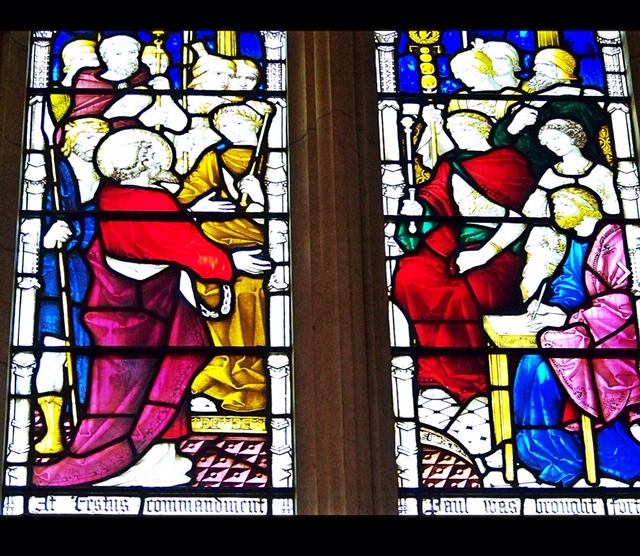
Window in St. Paul’s Cathedral, Melbourne – Paul Pleads His Case (Festus in yellow)

Today, in God’s Lavish Mercy, Paul’s case goes before Festus and King Herod Agrippa. Just in case you are confused, like I was, about just who this particular Herod is, this family tree from Wikipedia helped:

chart

This King Agrippa was Marcus Julius Agrippa II (A.D. 27-100), son of Agrippa I (Acts 12:1-25) and great-grandson of Herod the Great (Mt 2:1-23). 

I offer these facts for no real spiritual reason, but they remind me that these biblical characters were real people, like us, engaging (or not) a real life of faith. (Also, I thought it was fun to see how uncreative they were in naming their babies )


In our Gospel, Jesus once again prepares Peter for his tremendous responsibility in the building of that faith. Jesus asks Peter three times, “Do you love Me?”. By the third interrogation, Peter’s answer sounds a little intense:

“Lord, you know everything; you know that I love you.”

Hearing this response, Jesus lays the full burden of Peter’s life upon his shoulders. Not only must Peter “feed” the faith of Jesus’s followers, he must do so by giving over all control to God:

“Amen, amen, I say to you, when you were younger,
you used to dress yourself and go where you wanted;
but when you grow old, you will stretch out your hands,
and someone else will dress you
and lead you where you do not want to go.”

hand

Like Peter,
we too are given the gift and responsibility
of living a faithful life.
Like Peter, we all learn through the years,
that life comes to us in unexpected ways.
In reality, life often chooses us
rather than the other way around.


As we pray with these passages, we might want to look back over our lives for those points where life challenged or unbalanced us. What unexpected blessings came from those surprises/shocks? When God’s plan contradicted our own, how were we eventually blessed with courage, hope, gratitude, and insight?

We are the person we are today because of how we responded to God’s mysterious plan for our lives. Did we reach out our hand and let God lead us? Do we still need to do some letting go in order to enjoy that kind of freedom?


Rather than a poem today, I will be offering second post. It is a reflection I wrote many years ago for healthcare ministers and other chaplains. I think you might enjoy it. Watch for it later today – “Holding Hands with God”


Music:  Precious Lord, Take My Hand – written by Thomas A. Dorsey, sung here by the Great Mahalia Jackson

When my way groweth drear

Precious Lord, linger near-ear

When my li-ight is almost gone

Hear my cry, hear my call

Hold my ha-and lest I fa-all

Take my hand, precious Lor-ord

Lead me on

Precious Lord, take my hand

Lead me on, let me sta-and

I am tired, I’m weak, I am worn

Through the storm, through the night

Lead me on to the li-ight

Take my ha-and, precious Lor-ord

Lead me home

When my work is all done

And my race here is are you-un

Let me see-ee by the light

Thou hast shown

That fair city so bright

Where the lantern is the li-ight

Take my ha-and, precious Lor-ord

Lead me on

Precious Lord, take my hand

Lead me on, let me sta-and

I am tired, I’m weak, I am worn

Through the storm, through the night

Lead me on to the li-ight

Take my ha-and, precious Lor-ord

Lead me home