Leadership: Service not Status

Saturday of the Twentieth Week in Ordinary Time
August 26, 2023

Today’s Readings:

https://bible.usccb.org/bible/readings/082623.cfm


Today, in God’s Lavish Mercy, we continue with the story of Ruth, prototype of the Servant Christ. And we pray our first reading in the light of today’s Gospel in which Jesus teaches his disciples a key lesson in servant leadership:
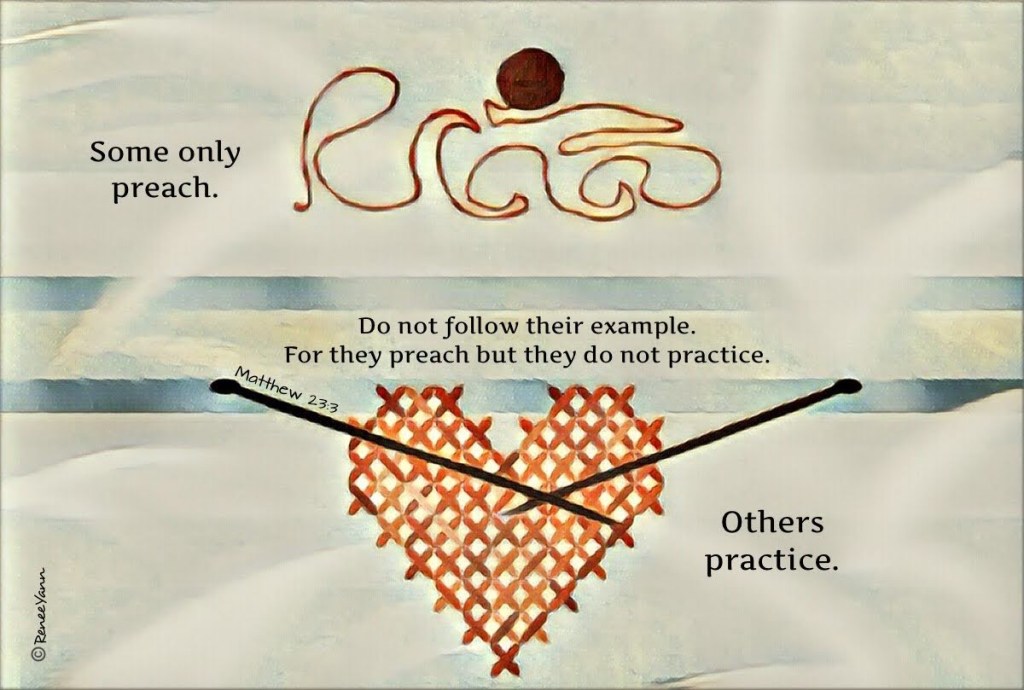
Jesus spoke to the crowds and to his disciples, saying,
“The scribes and the Pharisees
have taken their seat on the chair of Moses.
Therefore, do and observe all things whatsoever they tell you,
but do not follow their example.
For they preach but they do not practice.
They tie up heavy burdens hard to carry
and lay them on people’s shoulders,
but they will not lift a finger to move them.
All their works are performed to be seen.
They widen their phylacteries and lengthen their tassels.
They love places of honor at banquets, seats of honor in synagogues,
greetings in marketplaces, and the salutation ‘Rabbi.’

Matthew 23: 1-7

Jesus is so clear in this teaching. How is it that, even after 2000 years, we still don’t get it!

Stop and think about our culture – how we worship glitz, and bling, and “blow-em-up”! Listen to some of our political rhetoric filled with narcissistic “me-ism” and violent braggadocio. Look at some of the people in leadership positions around the world! They are tangled in their “phylacteries and tassels” and tripping us up with them.

Yes, even in our churches, we sometimes encounter supposed leaders who delight in places of honor and who lay burdens on the faithful rather than lift them.


Our first reading offers us humble Ruth who led and healed by selfless love.

Our Gospel reminds us that the Christian life is one of servant leadership fueled in a God-centered community to which all belong as sisters and brothers.

As for you, do not be called ‘Rabbi.’
You have but one teacher, and you are all brothers.
Call no one on earth your father;
you have but one Father in heaven.
Do not be called ‘Master’;
you have but one master, the Christ.
The greatest among you must be your servant.
Whoever exalts himself will be humbled;
but whoever humbles himself will be exalted.

Matthew 23:8-12

History is the story of our struggle to find that balance of leadership and community that will foster the life of all people. It is the great struggle between sin and goodness, between a life lived only for self and a life lived generously with others.

As we deepen our spiritual understanding with today’s readings, we may see ways that we want to act and choose more intentionally around the ministry of leadership – as it is exercised by ourselves and by others.


Prayer: from Jesuit Resources at Xavier University.org

A Leader’s Prayer

Leadership is hard to define.
Lord, let us be the ones to define it with justice.
Leadership is like a handful of water.
Lord, let us be the people to share it with those who thirst.
Leadership is not about watching and correcting.
Lord, let us remember it is about listening and connecting.
Leadership is not about telling people what to do.
Lord, let us find out what people want.
Leadership is less about the love of power,
and more about the power of love.

Lord, as we continue to undertake the role of leader let us be
affirmed by the servant leadership we witness in your son Jesus.
Let us walk in the path He has set and let those who will, follow.

Let our greatest passion be compassion.
Our greatest strength love.
Our greatest victory the reward of peace.

In leading let us never fail to follow.
In loving let us never fail.


Hymn: Prayer of St. Francis
Choosing Goodness

Monday of the Thirty-second Week in Ordinary Time
November 7, 2022

Today’s Readings:

https://bible.usccb.org/bible/readings/110722.cfm

Today, in God’s Lavish Mercy, our readings raise and answer some powerful questions. How does faith inspire moral responsibility? What is the relationship between moral commitment and leadership? How do we measure a person’s “communal righteousness”?

Paul asks these questions with respect to bishops and presbyters, and the standards are stringent – extending even to the leader’s family.

… appoint presbyters in every town, as I directed you,
on condition that a man be blameless,
married only once, with believing children
who are not accused of licentiousness or rebelliousness

In our Gospel, Jesus is direct and practical about how morally good a leader needs to be:

Jesus said to his disciples,
“Things that cause sin will inevitably occur,
but woe to the one through whom they occur.
It would be better for him if a millstone were put around his neck
and he be thrown into the sea
than for him to cause one of these little ones to sin.

Choosing leaders, trusting them, moving forward with them to a chosen future is something we do not only in our faith communities, but also in the civic arena. Even though we try mightily to separate religion and politics, these will inevitably touch because they so significantly affect the human person.

I find it interesting that these readings permeate my thoughts and prayers as many of us in the United States prepare to vote tomorrow. How might my faith direct me to choose those candidates who lead toward inclusivity, peace, mutual charity, and care for the vulnerable?

What I need as I ponder these questions is exactly what the disciples requested of Jesus. In our Gospel, Jesus instructs the disciples on sin, repentance and forgiveness — all of which we encounter within the struggling community of faith. Hearing him, the  disciples immediately realize what it is they most need to engage the challenges before them:

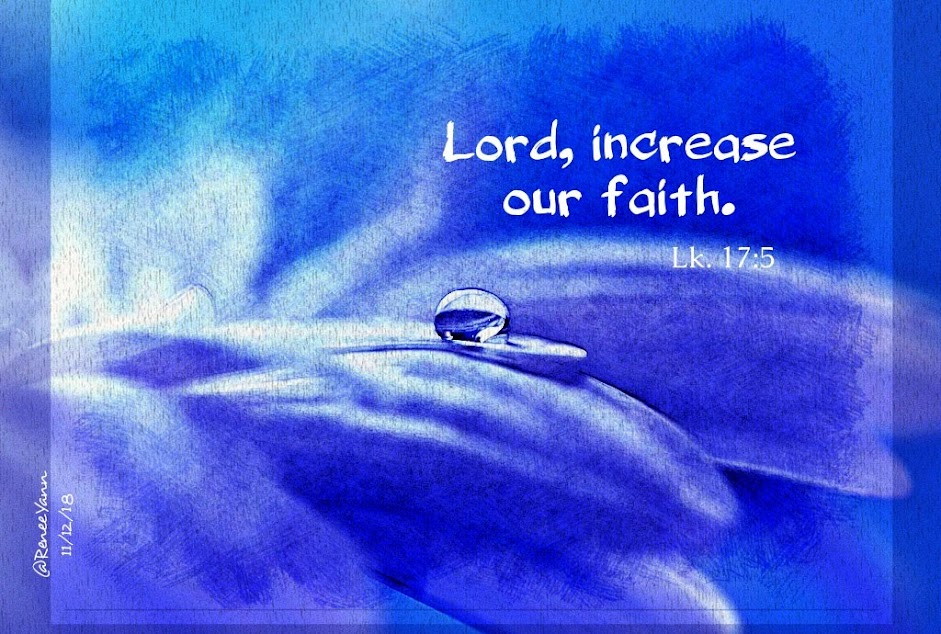
Lord, increase our faith!

Let us join their prayer today for unity and love in our faith and civic communities.


Thought: By voting, we help answer Pope France’s prayer:

I beg the Lord to grant us more politicians 
who are genuinely disturbed
by the state of society,
the people, the lives of the poor!

Joy of the Gospel (205)

 Renee Yann, RSM

The Sacred Legacy of MLK

Monday of the Second Week in Ordinary Time

January 20, 2020

Click here for readings

MLKJPG

Today, in Mercy, as we memorialize the life and legacy of Dr. Martin Luther King, Jr., our readings speak about leadership and its continuing call to renew the world in the image of its Creator.

In our first reading, Samuel relays God’s displeasure to Saul who, though a conquering hero, has failed in humility and obedience before the Lord. 

In the story, God has given a clear direction to Saul to obliterate Israel’s centuries-old enemy, the Amalekites. Instead Saul, after executing the masses, keeps the enemy king alive as a war trophy. He appropriates the cattle as personal spoil. He also sets up a shrine to commemorate the victory as his own.

God is not happy. When we profess to lead in God’s name we must act as God directs us. In order to understand God’s direction, we must cultivate an honest, just and merciful heart.


Martin Luther King was such a leader. By his faithful obedience to God’s inspiration, Martin, at the ultimate cost, turned the tides of history toward justice and freedom.

But the tides still need turning, because there will always be those who seek “war trophies”, and personal spoil, and domination for themselves. Our times are tortured by such selfish and failed leadership, just as all of history has been from ancient Israel until 1968 and until now.

Today, as we pray with this great prophet and leader, we ask that selfless, merciful and faith-impelled souls continue to hear the call to justice in our day. May Martin’s witness strengthen and inspire us.


Music: Precious Lord, Take My Hand – Mahalia Jackson (Lyrics below)

Per Dr. King’s request, his good friend Mahalia Jackson sang his favorite hymn, “Take My Hand, Precious Lord”, though not as part of the morning funeral service but later that day at a second open-air service at Morehouse College.

https://www.youtube.com/watch?v=N1ceCpU25vA&feature=youtu.be

Precious Lord, take my hand
Lead me on, let me stand
I am tired, I am weak, I am worn
Through the storm, through the night
Lead me on through the light
Take my hand, precious Lord
And lead me home

When my way grows dreary
Precious Lord, lead me near
When my life is almost gone
At the river I will stand
Guide my feet, hold my hand
Take my hand, precious Lord
And lead me home

Say But the Word

Memorial of Saints Cornelius, Pope, and Cyprian, Bishop, Martyrs

Monday, September 16, 2019

Click here for readings

Today, in Mercy, both our readings today offer us pivotal lessons about what nourishes true leadership: faith, humility, generosity, and inclusivity.

Many of us have been blessed, especially in our young lives, with the gift of wise and loving mentors. Certainly our parents, families and teachers are among the first and most critical.

A little later, our circle of mentors widens. We look for great coaches, wise employers, guiding trainers, caring councilors, trusted friends.

Paul’s letters to Timothy and Titus are biblical examples of such mentorship. In them, the author is guiding young ministers in the art and science of loving, Christ-like leadership.

Key to such leadership in today’s reading is a steadfast commitment to prayer which covers, blesses and includes all people.

In our Gospel, the centurion demonstrates that he is a leader who values these virtues.

The Jews urging Jesus to visit the centurion say that he deserves Christ’s attention because “he loves our nation and he built the synagogue for us.

 My guess is that Jesus wasn’t impelled by this argument, but solely by his splancha – his merciful gut response to the man’s plea.

When the centurion enters the story, his humility is immediately evident: 

Lord, do not trouble yourself,
for I am not worthy to have you enter under my roof.
Therefore, I did not consider myself worthy to come to you;
but say the word and let my servant be healed.

The miracle healing, of course, is granted but that is not the most important part of the story.

!Tim2_5 bridgeJPG

This civil leader’s acknowledgement of Christ’s sovereignty is an act of faith which serves as a model for all of us – to the extent that millennia later we echo his prayer as we prepare to receive Christ in communion.

His is a faith that places Christ at the center of all Creation, commanding the flow of grace and mercy to all creatures. That faith allows the centurion to care even for a suffering servant. It allowed him to support the worship even of a dominated people.

Timothy and Titus have shown that kind of faith. They are the next generation who will carry Christ’s legacy passed to them by Paul. He wants them to understand that humility, largeness of heart, kindness and steadfastness open the way for God’s life-giving will for all people.

Whether, in our current life state, we are leader, or protégé, or both, how do these readings help us to make a clearer way for God in the world? That’s what real leadership is all about. And, as Paul says, we learn it in prayer.

Video: a representation of Luke’s version of this Gospel story:

Faith of Centurion