Mary Magdalen: Spiritual Sfumato

July 22, 2026

Of the many techniques an artist might use in painting, among the most alluring is Sfumato.

Sfumato refers to a painting technique that blends one tone into another rather than using a clear outline. The word derives from the Italian sfumare, meaning “to evaporate,” and is related to the Italian word for smoke (fumo). Like smoke, a form rendered in sfumato tends to evaporate or disappear into the air surrounding it. Leonardo da Vinci used the term to describe how the edges of the Mona Lisa seem to blend into the surrounding shadows.
(from merriam-webster.com)

Today is the Feast of St. Mary Magdalen, a woman painted in sfumato across salvation history’s canvas. 

She is mentioned by name fourteen times in the New Testament across all four Gospels. She is explicitly identified as a key follower of Jesus who supported his ministry, witnessed his crucifixion, visited the empty tomb, was the first to see the risen Christ, and to proclaim the Resurrection. 

Nevertheless, other than her hometown of Magdala, the outlines of Mary’s life remain mysterious. Who were her parents, her siblings? Was she married? Who were her friends?

We know about Peter. He was married, had a mother-in-law, and was a fisherman from a family of fishermen.

We know about the feisty brothers, John and James. Their father was Zebedee, their mother Salome. They were “the Sons of Thunder”.

We know that Andrew, Philip, and Nathaniel were neighborhood friends.

But we have no such scriptural colors to paint our picture of Mary Magdalen.

What we know about Mary is her passion for God, a passion that allowed her to be released from seven devils and to radically bond her heart to the heart of Jesus.

Yes, the “seven devils”, those undefined spiritual hindrances that caused Pope Gregory to mistakenly connect Mary to the sinful woman of Luke, chapter 7.

The number seven is interesting, and might lead one to consider the seven deadly sins against which we all struggle in our lives: pride, envy, wrath, gluttony, lust, sloth, and greed. Might it be that Mary, so captured by the sacred magnetism of Jesus, was freed of these inclinations and sanctified in a unique way for the Gospel mission? Might it be that this “ultra-Baptism” prepared her to be the Apostle to the Apostles, first witness and proclaimer of the Resurrection?
Albert Edelfelt

As I pray with Mary Magdalen today, I remember a quote once shared with me. It is the response of an octogenarian nun when asked about her spiritual life:

I am in Love now. 
I have entered the Fire. 
I am one with the Flame.

She seems to have perfectly described the “spiritual Sfumato” for which Mary Magdalen is an inspiring icon.


Poem: The Magdalen, a Garden and This by Kathleen O’Toole

She who is known by myth and association 

as sinful, penitent, voluptuous perhaps…

but faithful to the last and then beyond.

A disciple for sure, confused often with Mary,

sister of Lazarus, or the woman caught

in adultery, or she who angered the men

by anointing Jesus with expensive oils.

She was the one from whom he cast out seven

demons—she’s named in that account.

Strip all else away and we know only

that she was grateful, that she found her way

to the cross, and that she returned

to the tomb, to the garden nearby, and there,

weeping at her loss, was recognized,

became known in the tender invocation

of her name. Mary: breathed by one

whom she mistook for the gardener, he

who in an instant brought her back to herself—

gave her in two syllables a life beloved,

gave me the only sure thing I’ll believe

of heaven, that if it be, it will consist

in this: the one unmistakable

rendering of your name.

Music: You Know My Name by The Holy Studio (lyrics below)

I sit in rooms
Where no one asks
How long I’ve stayed
Behind the glass
My hands grow tired
My voice grows thin
I wonder if
You’ve noticed me

I don’t have to be loud
To be known
I don’t have to prove
I’m here

You know my name
You know my name
Before I speak
Before I break
You know my name
I don’t have to earn
Your gaze
You see me whole
You know my name

The world moves fast
It doesn’t wait
For tired bones
Or quiet faith
I scroll through faces
None are mine
I set the table
Just for one

I am not invisible
To You
I am not strange
For feeling small

You know my name
You know my name
Not for the things
That I have done
But for the way
You chose to stay
You see my face
You know my name

And every night
I wasn’t seen
You were the one
Still watching me
Every word
I didn’t say
You heard them all
You know my name
You know my name
You know my name

You know my name
You know my name
I don’t have to be
Interesting to be kept
I don’t have to shine
To be held
You called me Yours
Before I knew
You know my name
That is enough


Suggested Scripture: John 20:11-16


For Your Reflection:

  • What feelings or reactions do I have after reading this reflection?
  • Do my feelings or reactions remind me of any passage or event in scripture, especially in the life of Christ? 
  • What actions might I take today because of my response to these readings?

Alleluia: My Redeemer Lives

Feast of St. Mary Magdalen
July 22, 2022

Today’s Readings:

https://bible.usccb.org/bible/readings/072222.cfm

Edited in Prisma app with Huawei HiAI

Alleluia, alleluia.
Tell us Mary, what did you see on the way?
I saw the glory of the risen Christ,
I saw his empty tomb.

Modern scripture scholarship recognizes Mary Magdalen as a disciple and companion of Jesus.  She is present in stories throughout all four Gospels, and most notably, as one who remained with Jesus at the foot of the Cross. Mary is the first witness to the Resurrection who then announces the Good News to the other disciples.

Over the centuries, Mary Magdalen has been confused with the many other Marys in the Gospel, as well as with the unnamed repentant woman who washes Jesus’ feet with her tears. These confusions have inclined us to think of Mary Magdalen as a reformed prostitute. This erroneous concept has supported a diminished understanding of the role of women in the ministry of Jesus and done a huge disservice to Mary’s vital role as beloved disciple.

The Gospel passage for the feast captures the powerful moment when the Resurrected Jesus is first revealed to the world. The scene also portrays the deep love, trust and friendship between Jesus and Mary Magdalen – a relationship which serves as a model for all of us who want to be Christ’s disciples. I imagined the scene like this in an past reflection:


 Rabbouni

 The Upper Room on Holy Saturday evening: a place filled with sadness, silence and seeking. Jesus was dead. Believers around Jerusalem, scattered to their various houses to keep Shabbat, murmur their shocked questions under their shaky prayers.

 We have all been in rooms like this. They enclose a special kind of agony – one teetering between hope and doubt, between loss and restoration. It may have been a surgical waiting room or the hallway outside the courtroom. Sometimes, such a space is not bricks and mortar.  It can be the space between a sealed envelope and the news inside. It is the hesitant pause between a heartfelt request and the critical response. In each of these places, we exist as if in a held breath, hoping against hope for life, freedom, and wholeness.

 It was from such a room that Mary Magdalen stole away in the wee hours. A woman unafraid of loneliness, she walked in tearful prayer along the path to Jesus’ tomb. Scent of jasmine rose up on the early morning mist. Hope rose with it that his vow to return might be true. Then she saw the gaping tomb, the alarm that thieves had stolen him to sabotage his promise. She ran to the emptiness seeking him. She was met by angels clothed in light and glory, but they were not enough to soothe her.

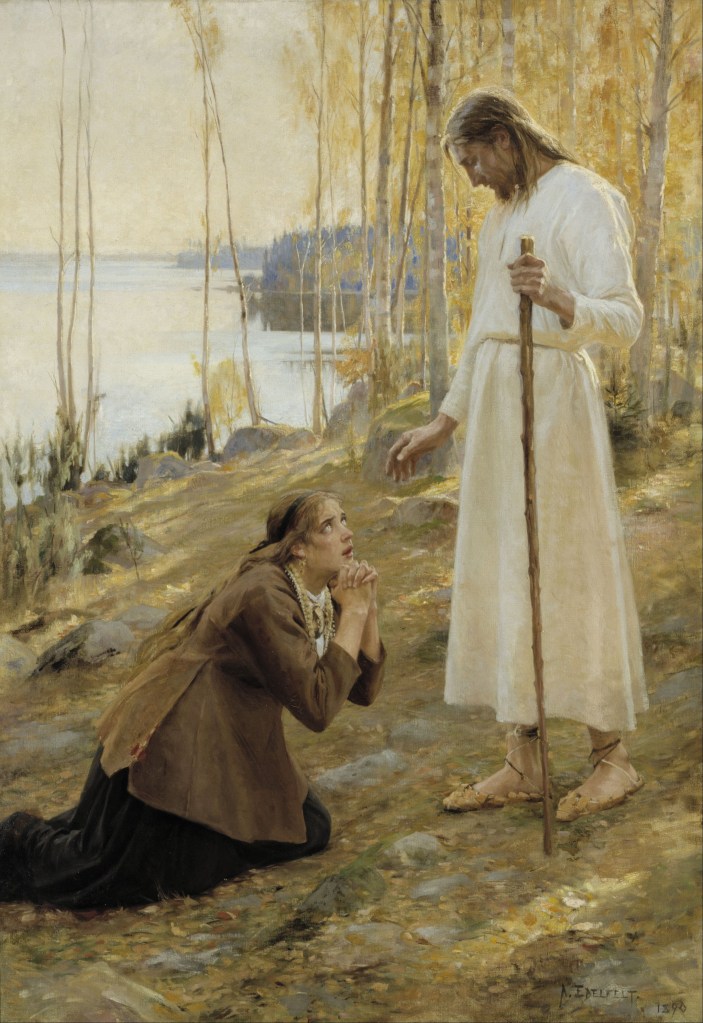
Turning from them, she bumped against a gardener whom she begged for word of Jesus, just so she might tend to him again. A single word revealed his glory, “Mary”. He spoke her name in love.

As we seek the assurance of God’s presence in our lives, we too may be unaware that God is already with us. The deep listening of our spirit, dulled with daily burdens, may not hear our name lovingly spoken in the circumstances of our lives. God is standing behind every moment. All we need do is turn to recognize him.

 Turn anger into understanding. Turn vengeance into forgiveness. Turn entitlement into gratitude. Turn indifference into love. All we need do is turn to recognize him.


For a comprehensive and enlightening lecture on the current theological and scriptural thinking on Mary Magdalen, follow this link to an Elizabeth Johnson, CSJ lecture at Fordham.
There is a long intro, but you can slide to the 14 minute mark for Elizabeth’s start.

https://www.library.fordham.edu/digital/collection/VIDEO/id/824


Music: I Know That My Redeemer Liveth

Feast of Saint Mary Magdalen

Thursday, July 22, 2021

Today, in God’s Lavish Mercy, we pray with Psalm 63, a prayer of both longing and fulfillment.

O God, you are my God whom I seek;
for you my flesh pines and my soul thirsts
like the earth, parched, lifeless and without water.

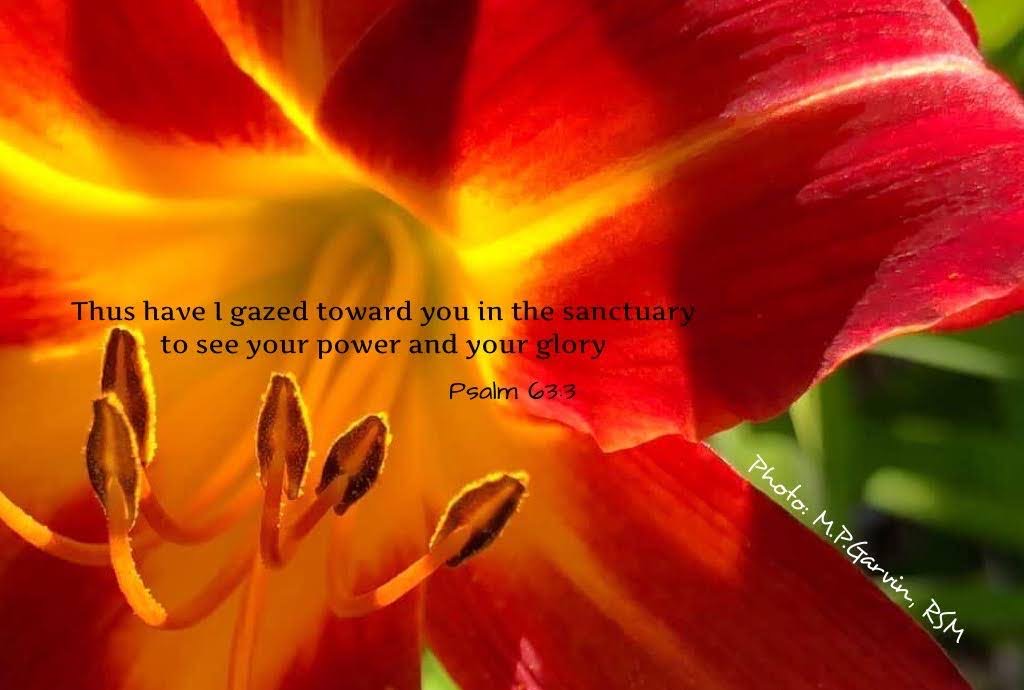
Thus have I gazed toward you in the sanctuary
to see your power and your glory,
For your kindness is a greater good than life;
my lips shall glorify you.

Psalm 63: 2-4

And isn’t our spiritual life exactly like that?
We feel our lives caressed by God,
and yet we long for greater oneness
with Infinite Love.

Mary Magdalen is the embodiment of that longing and embrace. And so the Church applies to her the powerful intimacy of our first reading:

The Bride says:
On my bed at night I sought him
whom my heart loves–
I sought him but I did not find him.
I will rise then and go about the city;
in the streets and crossings I will seek
Him whom my heart loves.
I sought him but I did not find him.
The watchmen came upon me,
as they made their rounds of the city:
Have you seen him whom my heart loves?
I had hardly left them
when I found him whom my heart loves.

Song of Songs 3:1-4

Within each one of us is a sacred mystic who longs for and seeks God’s embrace. Perhaps that mystic hibernates like a little bear hidden under all the distractions of our lives. But if we give ourselves to silence and holy waiting, the sleeping hermit will awake! 😴 

We might pray with beautiful Mary Magdalen today to let that seeker in us reach for God Who is also waiting.


Poem: Song of the Soul That Is Glad to Know God by Faith – St. John of the Cross

English version by Antonio T. de Nicolas
Original Language Spanish

Well I know the fountain that runs and flows,
though it is night!


This eternal fountain is hidden deep.
Well I know where it has its spring,
Though it is night!

In this life’s dark night,
Faith has taught where this cold fountain lies,
Though it is night!

Its origin I cannot know, it has none,
And I know all origins come from it,
Though it is night!

And I know there can be nothing more fair,
The heavens and earth drink there,
Though it is night!

And I know it has no bed,
And I know no one can cross its depths,
Though it is night!

Its clarity is never clouded,
And I know all light shines from it,
Though it is night!

I know her streams swell so abundantly,
They water people, heaven and even hell,
Though it is night!

The current born of this fountain
I know to be wide and mighty,
Though it is night!

And from these two another stream flows,
And I know neither comes before,
Though it is night!

I know Three in only one water live,
And each the other feeds,
Though it is night!

This eternal fountain is hiding from sight
Within this living bread to give us life,
Though it is night!

He calls all creatures to this light,
And of this water they drink, though in the dark,
Though it is night!

This living fountain I desire,
I see it here within this living bread,
Though it is night!


Music: I Found My Beloved – John Michael Talbot

So I found my beloved in the mountains
On the lonely and far distant isles
O’er resounding waters
I heard the whispering of love’s breezes
To heal my broken heart
Oh tranquil evening, silent music
And the sounding solitude of the rising dawn
It is there that I hear You
There that I taste of You
In love’s banquet to fill my heart
Chorus:
And I found Your footprints
In the sands by the sea
And like Your maiden
I ran along the way to a secret chamber
And there you gave to me
There you taught me, O so well
And I drank of your sweet spiced wine
The wine of God
And there I gave to You
Keeping nothing for myself
And I promised You forever
To be your bride
(Repeat Chorus)
So I have abandoned
All I ever sought to be
And in dying
My spirit has been released

Psalm 63 A Passionate Prayer

Feast of Saint Mary Magdalen

July 22, 2020

Today, in God’s Lavish Mercy, we pray with Psalm 63, a perfect prayer for the Feast of Saint Mary Magdalen, who longed for and loved God with all her heart.

My soul is thirsting for you, O Lord my God.

Psalm 63, in the verses quoted today, is a love song. The psalmist longs for God, body and soul. Experience has taught her that without God her whole being is a desert.

O God, you are my God whom I seek;
for you my flesh pines and my soul thirsts
like the earth, parched, lifeless and without water.

And so she fixes her eyes on God, her heart on God. She looks for God’s Presence in the sanctuary of her life, in the temple of her soul.

Thus have I gazed toward you in the sanctuary
to see your power and your glory,
For your kindness is a greater good than life;
my lips shall glorify you.

The psalmist promises to bless God – to be grateful and attentive to God’s affectionate grace in all the circumstances of her life:

Thus will I bless you while I live;
lifting up my hands, I will call upon your name.
As with the riches of a banquet shall my soul be satisfied,
and with exultant lips my mouth shall praise you.

In her serene and confident prayer, she is like the fragile hatchling, protected under her Divine Mother’s wing. She clings to God’s merciful hand, no doubt kissing it in a prayer of grateful love.

You are my help,
and in the shadow of your wings I shout for joy.
My soul clings fast to you;
your right hand upholds me.


Poetry: The Living Flame Of Love – St. John of the Cross
Some find John of the Cross’s poetry challenging, if not shocking because, as well as being deeply mystical, it is often clearly erotic. But we are both mystical and erotic human beings made so by God in Whom Love has infinite dimensions. John channeled all his mystical erotic power into his profound love for God. His poems may help us to open that holy power to God as well.

Songs of the soul in the intimate communication of loving union with God.

O living flame of love
that tenderly wounds my soul
in its deepest center! Since
now you are not oppressive,
now consummate! if it be your will:
tear through the veil of this sweet encounter!

O sweet cautery,
O delightful wound!
O gentle hand! O delicate touch
that tastes of eternal life
and pays every debt!
In killing you changed death to life. 

O lamps of fire!
in whose splendors
the deep caverns of feeling,
once obscure and blind,
now give forth, so rarely, so exquisitely,
both warmth and light to their Beloved.

How gently and lovingly
you wake in my heart,
where in secret you dwell alone;
and in your sweet breathing,
filled with good and glory,
how tenderly you swell my heart with love.

Music:  Living Flame of Love – John Michael Talbot

Oh, Living Flame of Love
Tenderly wound my soul
To its deepest inner heart
Without oppression!

Come consumate our love
Tear through the veil of our union
If it be your will, come and rend
The veil of the temple!

Oh, lamps of fire
In deep caverns of feeling
Once obscured and blind
Are now leading
In the warmth and the passion
Of your love
(x2)

Yet gently Your hand does wound
As You rend through the veil of my temple
Come and take this life that I give
So that I might come to live in this our dying

Oh, Living Flame of Love
Tenderly wound my soul
To its deepest inner heart
Without oppression!