Psalm 119: Guide Me, Lord

Tuesday of the Twenty-fifth Week in Ordinary Time

September 22, 2020


Today, in God’s Lavish Mercy, we pray with another of the Torah Psalms, Psalm 119. It is the prayer of one who delights in and lives by the Torah, the sacred law. ( See yesterday’s reflection for some scholarly words on the Torah Psalms.)
In today’s verses, with lovely antiphonal lilt, the psalmist describes the holy person, then asks for the virtues to become one.

  • Blessed are the blameless….. so guide me in your ways.
  • I want to meditate on your deeds …. so make me understand.
  • I want to observe your laws … so give me discernment
  • I delight in your path …. so lead me on it.
  • I will keep your law forever …. if you will just guide me.

I don’t think God can resist a sincere prayer like this. The psalmist is saying, “I want to love you, God, with my whole life. But you, Almighty, must help my weakness.”

Notice the guy on the right 🙂

As we pray today with Psalm 119, we might let a similar prayer rise up in our hearts.

We, too, want to love God well – completely. We, too, need Divine guidance to discern God’s continuing call in the complexities of our lives. We, too, long to deepen in discernment and commitment.


The psalmist gives us good example. Just tell God like it is. Tell God what you really want, what you really need to love as God wishes us to love.

If you hear yourself making requests for power, money, fame, security in any of their selfish forms, you better start all over again!😉

Remember the beginning of the psalm, the foundation of our prayer:

Blessed are they whose way is blameless,
who walk in the law of the LORD.

In the Christian scriptures, that foundation is proclaimed like this:

One of the teachers of the law came and heard them debating. Noticing that Jesus had given them a good answer, he asked him, “Of all the commandments, which is the most important?”
 “The most important one,” answered Jesus, “is this: ‘Hear, O Israel: The Lord our God, the Lord is one. Love the Lord your God with all your heart and with all your soul and with all your mind and with all your strength.’ The second is this: ‘Love your neighbor as yourself.’ There is no commandment greater than these.”


Let’s ask God for  the courage to offer a blameless prayer. The simple prayer of the Gospel centurion comes to mind:
Lord, I do believe. 
Help my unbelief.
Mark 9:24

Poetry: Morning Hymn by Charles Wesley, brother of John Wesley. They are considered founders of the Methodist religion.

Christ, whose glory fills the skies, 
Christ, the true, the only light, 
Sun of Righteousness, arise, 
Triumph o’er the shades of night:  
Day-spring from on high, be near:  
Day-star, in my heart appear.
  
Dark and cheerless is the morn  
Unaccompanied by thee,  
Joyless is the day’s return,  
Till thy mercy’s beams I see;  
Till thy inward light impart,  
Glad my eyes, and warm my heart.
  
Visit then this soul of mine,  
Pierce the gloom of sin, and grief,  
Fill me, Radiancy Divine,  
Scatter all my unbelief,  
More and more thyself display,  
Shining to the perfect day.

Music: Help My Unbelief – Audrey Assad
Psalm 119: Divine Thread

Monday of the Twenty-second Week in Ordinary Time

August 31, 2020


Today, in God’s Lavish Mercy, we pray with Psalm 119, a song of the wisdom that comes from holiness.

Your command has made me wiser than my enemies,
for it is ever with me.
I have more understanding than all my teachers
when your decrees are my meditation.
I have more discernment than the elders,
because I observe your precepts.

Psalm 119: 97-98

And we’ve all met them, haven’t we – those grounded, simple, wise and joyful people whose spirits are tied to that Sacred Thread running through all Creation. These blessed souls may be young or old, schooled or not. No matter – they shine with the reflection of Wisdom Itself.

Paul humbly claims such wisdom in our first reading. It is not a worldly persuasiveness, but rather a demonstration of truth and power grounded in the Spirit.

… my message and my proclamation
were not with persuasive words of wisdom,
but with a demonstration of spirit and power,
so that your faith might rest not on human wisdom
but on the power of God.

1 Corinthians 2: 4-5

In our Gospel, Jesus chooses his hometown synagogue to announce that he is the fulfillment of Isaiah’s prophecy, the Spirit and Wisdom of God:

The Spirit of the Lord is upon me,
because he has anointed me
to bring glad tidings to the poor.
He has sent me to proclaim liberty to captives
and recovery of sight to the blind,
to let the oppressed go free,
and to proclaim a year acceptable to the Lord.

Luke 4: 18-19 (Isaiah 61: 1-2)

Jesus is the Incarnation of Wisdom, the Divine Spirit that surpasses all human understanding.

Many turned away from Jesus at this proclamation. May we never be among them.

From every evil way I withhold my feet,
that I may keep your words.
From your ordinances I turn not away,
for you have instructed me.

Psalm 119: 101-102

Poetry: Wisdom by Rumi

I have one small drop of knowing in my soul. 
Let it dissolve in Your ocean.


Music: Be Thou My Vision – Eden’s Bridge ( On the video, you can drop the menu you down using the little arrowhead on the right under the picture. The Irish and English lyrics will then be displayed.)

Psalm 119: Sweet Word

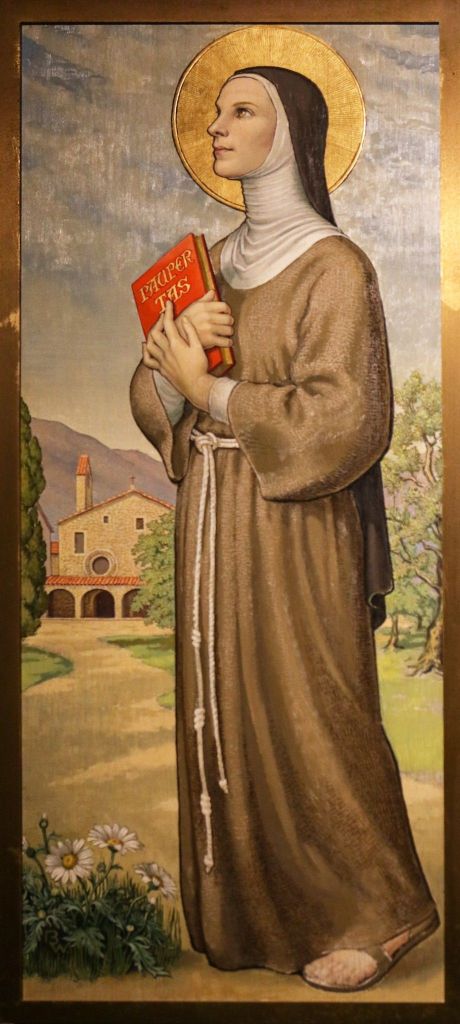
Memorial of Saint Clare, Virgin

August 11, 2020


Today, in God’s Lavish Mercy, on this feast of the beautiful St. Clare, we pray with Psalm 119. How perfect is the response phrase from our psalm!

How sweet to my taste is your promise!


Last night, we watched an old Colombo movie in which one of the characters was a vintner who had developed a peerless taste for fine wine. He could identify every detail – year, grape, region, price. He was the consummate connoisseur.

As I prayed this morning’s psalm, it struck me that through the intentional practice of prayer, we become connoisseurs of the spirit. We are able to discern ever more delicately those realities which carry grace to our souls.

How sweet to my palate are your promises,
sweeter than honey to my mouth!


As we deepen in spirit, we purify our taste from all that is not peace, goodness, justice, mercy, and charity. We let go of things that distract our souls from Love.

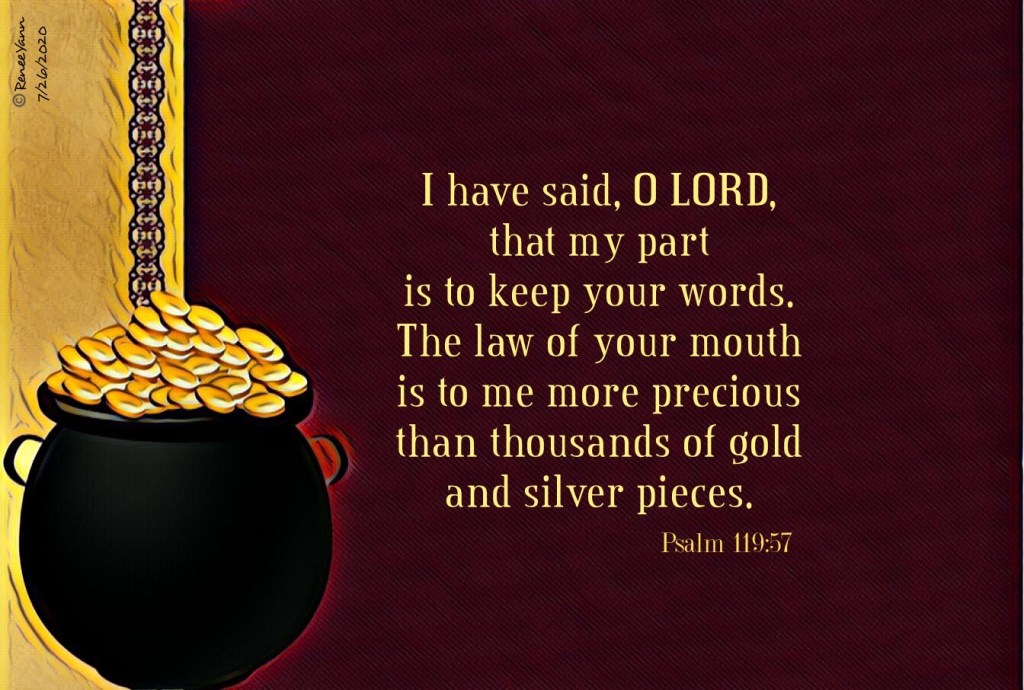
The law of your mouth is to me more precious
than thousands of gold and silver pieces.


By our choices for what is truly precious, we build a legacy of sacred joy which sustains us throughout our lives:

Your decrees are my inheritance forever;
the joy of my heart they are.


from National Shine, Detroit

Poetry: from Clare of Assisi 

We become what we love 
and who we love shapes what we become. 
If we love things, we become a thing. 
If we love nothing, we become nothing. 
Imitation is not a literal mimicking of Christ, 
rather it means becoming the image of the beloved, 
an image disclosed through transformation. 
This means we are to become vessels
of God's compassionate love for others.

Music: Mirror of Eternity (Clare of Assisi) – sung by John Michael Talbot

Place your mind before the mirror of eternity!
Place your soul in the brilliance of glory!
Place your heart in the figure of the divine substance!
And transform your whole being into the image of the Godhead Itself
      through contemplation!
So that you too may feel what His friends feel
      as they taste the hidden sweetness
      which God Himself has reserved
      from the beginning
      for those who love Him
~ Clare of Assisi

Psalm 119: The Truth

Monday of the Eighteenth Week in Ordinary Time

August 3, 2020


Today, in Mercy, we pray for a persevering faith. Sometimes, it is very late into our prayer that the unexpected answer comes to us. May we recognize it and welcome it out of the darkness. We pray especially for those who have endured long years of prayerful waiting: for those with chronic illnesses, for the elderly, for widows and widowers, for those who want to believe but can’t.

from 2016

Today, in God’s Lavish Mercy, we pray with a return to Psalm 119. Set today between fascinating passages from both Jeremiah and Matthew, our psalm presents us with a particularly strong challenge:

Let my heart be perfect in your statutes,
that I be not put to shame.

In our first reading, the false prophet Hananiah tries to put Jeremiah to shame by preaching a rosy prophecy in contradiction to Jeremiah’s difficult but truthful “fire and brimstone” warnings. Hananiah eventually gets caught in his own lies.

In Matthew’s Gospel, Peter discovers another dimension of truth – that without faith, he cannot endure the storm


Psalm 119’s verses are a prayer to stay true to the Law, the Word, even in difficulty and storm. 

The psalmist recognizes our human propensity sometimes to create the world we want rather than face the one we have. We do it by lying to ourselves and others until, eventually, our alternative universe falls apart – just like Hananiah’s.

Because, like Peter, we focus on ourselves and our fears, we miss Jesus’s invitation to walk in faith over our life’s rough waters.


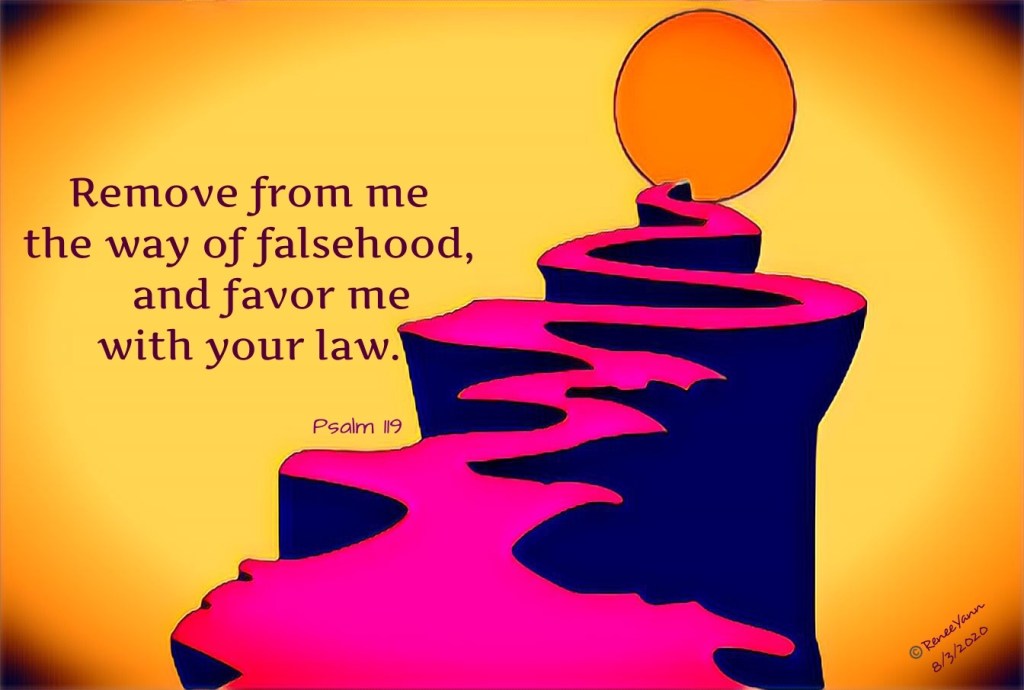
Our psalm today voices our prayer not to get twisted on life’s road, to have the courage to embrace the truth of ourselves, our environment, and our world. That truth is revealed when we love and live God’s Law by our justice and mercy toward all Creation.

From your ordinances I turn not away,
for you have instructed me.


Poetry: from Robert Frost

Two roads diverged in a yellow wood,
And sorry I could not travel both
And be one traveler, long I stood
And looked down one as far as I could
To where it bent in the undergrowth;

Then took the other, as just as fair,
And having perhaps the better claim,
Because it was grassy and wanted wear;
Though as for that the passing there
Had worn them really about the same,

And both that morning equally lay
In leaves no step had trodden black.
Oh, I kept the first for another day!
Yet knowing how way leads on to way,
I doubted if I should ever come back.

I shall be telling this with a sigh
Somewhere ages and ages hence:
Two roads diverged in a wood, and I—
I took the one less traveled by,a
And that has made all the difference.

Music: Long and Winding Road – Beatles song sung by David Archuleta

Psalm 119:Acrostic Prayer

Seventeenth Sunday in Ordinary Time

July 26, 2020


Today, in Mercy, we pray with young Solomon, as God asks him to carry the weight of leadership. Of all that Solomon might have asked from God, he requested only wisdom, which is described in James 3:17. “But the wisdom that comes from heaven is first of all pure; then peace-loving, considerate, teachable, full of mercy and good fruit, impartial and sincere.” We pray for wisdom for ourselves in the discharge of our responsibilities. We pray for this gift for all who hold power in our world.

from 2017 – 17th Sunday in Ordinary Time

Today, in God’s Lavish Mercy, we pray with Psalm 119, the longest psalm, and a meticulously constructed poem. It is one of about twelve acrostic poems in the Bible, employing the twenty-two characters of the Hebrew alphabet to teach a lesson about love of the Torah, the Law.

Acrostic poems have been popular throughout history because they let the reader examine a theme from multiple, memorable perspectives. Although often tricky to compose, they are simple to read, and sometimes so commonplace as to be transparent.

Here is an example of an acrostic poem from 19th century America


So why did the psalmist take the trouble to compose a complicated verse like Psalm 119? The answer seems apparent, I think. The love of the Law was that important to the writer. It was the one true treasure, and he wanted others to share the treasure.

The theme of “treasure” ties together all of our Sunday readings.

In our first reading, young Solomon could have asked God for anything. But Solomon already treasures the Wisdom of God:

The LORD was pleased that Solomon made this request.
So God said to him:
“Because you have asked for this—
not for a long life for yourself,
nor for riches,
nor for the life of your enemies,
but for understanding so that you may know what is right—
I do as you requested.


Our second reading confirms that those who love God, like Solomon did, are blessed with the treasure of confidence and peace:

We know that all things work for good
for those who love God.


Matthew’s Gospel tells us to seek that treasure buried in the field of our lives. When we find it, we should give everything to make it our own:

When he finds a pearl of great price,
he goes and sells all that he has and buys it.


Praying Psalm 119 allows us to appreciate the treasure of God’s Law, God’s heartbeat, in our lives. It holds the Word up before us, facet by facet, the way we would lift a diamond to the Light. When we come to love Wisdom/Word/Law as Solomon did, we give everything to possess it fully.


Poetry: Last Hike Before Leaving Montana by Patricia Traxler.
In this poem, the poet is ostensibly talking about a bear, but listen a little deeper and she is talking about God.

Late winter, almost spring. It's like finding a diamond;
now I don't want to leave. I sit in the dirt and put my hands
in your tracks. For the first time in a long time I don't
doubt. Now I know I always knew you were here. You
are the beginning of disclosure, the long-felt presence

Suddenly incarnate. Behind me my friend warns, If we
see the bear, get into a fetal position. No problem,
I tell her, I'm always in a fetal position—I was born
in a fetal position. Did you know, she says, the body
of a shaved bear looks exactly like a human man?
I skip a stone, feel a sudden bloat of grief, then laugh.
I ask her, Who would shave a bear? We climb

Farther up Rattlesnake Creek, watch winter sun glitter
off dark water. No matter how high we go I look higher.
Sometimes absence can prove presence. That's not exactly
faith, I know. All day, everywhere, I feel you near at hand.
There's so much to understand, and everything to prove.
Up high the air is thin and hard, roars in the ears like love.

Music: Lord, You Are More Precious Than Silver – Divine Hymns

Incline My Heart

Tuesday, February 12, 2019

Click here for Readings

Today, in Mercy, we launch into about two weeks of readings from Genesis and from Mark.

Adam and Eve


The story of Genesis is one of the first Bible stories we learn as children. Because of this, some of us, myself included, tend to read Genesis on a simplistic level, picturing the now unattainable Garden, the first animals, and the humans ultimately dressed in their grassy outfits. 


These two weeks offer us a great opportunity to take our understanding of this beautiful book up a notch.

Imagine what the Genesis story meant to the first community to hear it! Their faith had been invested in an array of gods, both friendly and inimical, who seemed to control their daily experiences. Many times, these gods were in competition among themselves with disastrous results for humans!

By contrast, the God of Genesis is One God, All-Powerful and All-Knowing – the Author of all Creation. Human beings are created in the image of this One God with Whom they are in unique and special covenant. 

Roger Nam, Associate Professor of Biblical Studies at George Fox Evangelical Seminary in Portland, Oregon, summarizes this special character of Genesis. I found his description helpful to my prayer:

As you consider the wondrous nature of creation, it is important to recognize the radical, remarkable, and revolutionary nature of the Genesis creation in its original context. This presentation of God comes as a wonderful relief and assurance to the family of ancient Israel.

The God of Genesis 1-2:4a provides assurance to those who work to raise crops against their numerous natural challenges. The God of Genesis 1-2:4 brings peace to the nation struggling for survival against the numerous encroaching enemies from all sides. God is one. God is powerful. And God created us in his image. This opening passage of our Bible constitutes the essence of good news.

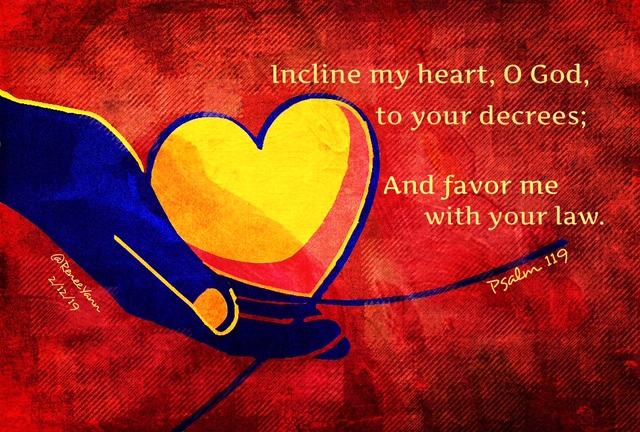
As we pray today, we might ask God to conform our hearts to the perfect order of Creation, the Law and Covenant of Mutual Love. We pray with today’s responsorial psalm:

Ps119 incline my heart

Instead of music today, a reflective reading from Genesis: