
Monday of the Third Week of Easter
April 24, 2023
Today’s Readings:
https://bible.usccb.org/bible/readings/042423.cfm
Today, in God’s Lavish Mercy, our readings remind us that being a Christian is simple, but not easy.
Stephen, presented to us in our reading from Acts, must have been a beautiful, simple person — almost angelic according to Acts’ description:
Stephen, filled with grace and power,
Acts 6:8
was working great wonders and signs among the people.
All those who sat in the Sanhedrin looked intently at him
Acts 6:15
and saw that his face was like the face of an angel.
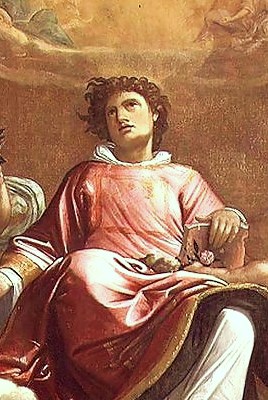
St. Stephen – Giacomo Cavedone – c. 1601
Despite his goodness, Stephen became an object of hate and persecution by many:
Certain members of the so-called Synagogue of Freedmen,
Acts 6:9-11
Cyreneans, and Alexandrians,
and people from Cilicia and Asia,
came forward and debated with Stephen,
but they could not withstand the wisdom and the Spirit with which he spoke.
Then they instigated some men to say,
“We have heard him speaking blasphemous words
against Moses and God.”
This is such a revealing passage! Stephen’s persecutors cannot challenge his preaching themselves, so they create a web of poisonous lies and entangle some other men in its venom. They instigate these men to spread false allegations against Stephen which will eventually lead to his martyrdom.
There is a vital lesson here for us. Truth matters. Lies matter. They are the engines that drive not only our relationships and actions, but our very culture. And a hard look at our modern culture suggests that we are becoming a culture of lies.
I don’t need to give examples here. We know just from glancing at the newspaper, or perhaps – unfortunately – from reflecting on our own experiences.
We know the people who pretend they are what they are not.
We know who pretends that they are not what they actually are.
Jesus is a Truth Teller. In our Gospel, he gently confronts a bunch of people who are “pretending” their faith. Jesus tells them they’re not so much interested in the Truth he preaches as in the food he provided just yesterday. After all, everybody loves a good picnic!
Jesus answered them and said,
John 6: 26-27
“Amen, amen, I say to you, you are looking for me
not because you saw signs
but because you ate the loaves and were filled.
Do not work for food that perishes
but for the food that endures for eternal life,
which the Son of Man will give you.
For on him the Father, God, has set his seal.”
These bread seekers in our Gospel hear Jesus’s challenge so they ask him
“What can we do to accomplish the works of God?”
Jesus answered and said to them,
“This is the work of God,
that you believe in the one he sent.”
Just believe. Doing so will lead us to Truth and to a holy simplicity like that which radiated from Stephen. It’s that simple …. and that hard.
Poetry: A Christmas Hymn – by Richard Wilbur
Although the following poem is out of season, and does not mention Stephen, its refrain references his method of martyrdom: “every stone shall cry”. The poem is also a succinct and lyrical summary of the life of Christ and its meaning for us — a good thing to consider during this Eastertide.
A stable lamp is lighted
whose glow shall wake the sky;
the stars shall bend their voices,
and every stone shall cry.
And every stone shall cry,
and straw like gold shall shine;
a barn shall harbour heaven,
a stall become a shrine.
This child through David’s city
shall ride in triumph by;
the palm shall strew its branches,
and every stone shall cry.
And every stone shall cry,
though heavy, dull and dumb,
and lie within the roadway
to pave his kingdom come.
Yet he shall be forsaken,
and yielded up to die;
the sky shall groan and darken,
and every stone shall cry.
And every stone shall cry
for gifts of love abused;
God’s blood upon the spearhead,
God’s blood again refused.
But now, as at the ending,
the low is lifted high;
the stars shall bend their voices,
and every stone shall cry.
And every stone shall cry
in praises of the child
by whose descent among us
the worlds are reconciled.
Music: Every Stone Shall Cry – Steve Bell musically interprets Wilbur’s poem.

 Lavish Mercy