Sing Out Your Joy

Third Sunday of Advent
Gaudete Sunday
December 17, 2023

Today’s Readings:

https://bible.usccb.org/bible/readings/121723.cfm


Today, in God’s Lavish Mercy, what glorious readings we have, capturing our exuberant hope. In our Responsorial Psalm, Mary proclaims the profound re-ordering of the world in justice and mercy.

Walter Brueggemann says “the song of Mary (the Magnificat; Luke 1:46–55) is about the unthinkable turn in human destinies when all seemed impossible: “For with God nothing will be impossible” (v. 37).

Our God has filled the hungry with good things,
and sent the rich away empty;.
has come to the help of our people
and remembered the promise of mercy…

Luke 1:63-64

With Isaiah, the whole earth sings out: “GAUDETE’ – REJOICE”, because the Divine Light breaks on the horizon. Isaiah imagines the self-proclamation of this glorious Messiah Who rises out of history’s darkness:

The spirit of the Lord GOD is upon me,
because the LORD has anointed me;
he has sent me to bring glad tidings to the poor,
to heal the brokenhearted,
to proclaim liberty to the captives
and release to the prisoners,
to announce a year of favor from the LORD
and a day of vindication by our God.

I rejoice heartily in the LORD,
in my God is the joy of my soul;
for he has clothed me with a robe of salvation
and wrapped me in a mantle of justice,
like a bridegroom adorned with a diadem,
like a bride bedecked with her jewels.
As the earth brings forth its plants,
and a garden makes its growth spring up,
so will the Lord GOD make justice and praise
spring up before all the nations.

Isaiah 61: 1-2A;10-12

Finally, in our Gospel, John the Baptist instructs his questioning followers about finding “the One Who is to come”. His words give us a precious insight into how we will find this emergent Savior in our own lives:

John answered them,
“I baptize with water;
but there is one among you whom you do not recognize,
the one who is coming after me,
whose sandal strap I am not worthy to untie.”
This happened in Bethany across the Jordan,
where John was baptizing.

John 1:20-28

The jubilant grace of Gaudete Sunday may be this:

  • the spiritual energy to find God, as John did, in the shrouded complexities of our lives and times
  • to believe, as Mary did, that God will enact an incredible restoration of Creation
  • to rejoice heartily with Isaiah in the One who is the “joy of my soul”

Prose: Willa Cather in Death Comes for the Archbishop

The miracles of the church seem to me to rest not so much upon faces or voices or healing power coming suddenly near to us from afar off, but upon our perceptions being made finer, so that for a moment our eyes can see and our ears can hear what is there about us always.


Music: Rejoice in the Lord Alway – Henry Purcell

Praying with the Prophets

Saturday of the Second Week of Advent
December 16, 2023

Today’s Readings:

https://bible.usccb.org/bible/readings/121623.cfm


Today, in God’s Lavish Mercy, we think about John the Baptist. For several days in this middle part of Advent, our Gospel makes reference to John, the Precursor of the Messiah.

411px-Saint_John_The_Baptist_Preaching_In_The_Wilderness_by_Anton_Raphael
John the Baptist by Anton Raphael Mengs

Faithful Jews had an expectation that there would be a Messiah, and that a fiery Precursor would announce him. They identified this forerunner with the prophet Elijah, based on writings like today’s from Sirach:

How awesome are you, Elijah, in your wondrous deeds!
Whose glory is equal to yours?
You were taken aloft in a whirlwind of fire,
in a chariot with fiery horses.
You were destined, it is written, in time to come
to put an end to wrath before the day of the LORD…

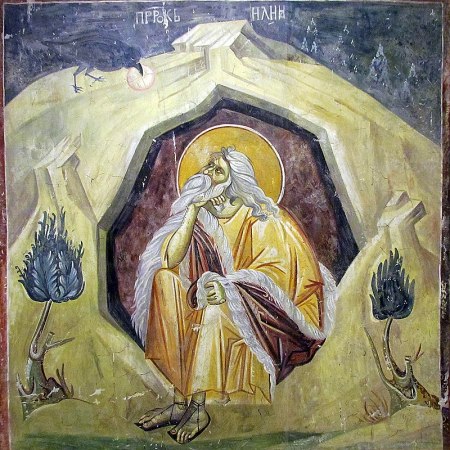
800px-Elijah,_a_prophet_and_a_miracle_worker
Elijah, a prophet and a miracle worker, Gračanica monastery

In our Gospel, Jesus indicates that John the Baptist is the new Elijah, preparing the way for Jesus’s ministry.

As they were coming down from the mountain,
the disciples asked Jesus,
“Why do the scribes say that Elijah must come first?”
He said in reply, “Elijah will indeed come and restore all things;
but I tell you that Elijah has already come,
and they did not recognize him but did to him whatever they pleased.
So also will the Son of Man suffer at their hands.”
Then the disciples understood
that he was speaking to them of John the Baptist.

Matthew 17: 9-13

As we pray today with these two greatest prophets, we might examine our own readiness to receive God’s revealing grace in our lives:

  • What is it in my life that prepares me to receive God in my heart?
  • What inspires me “prepare the way of the Lord” in the many “worlds” that I touch?
  • Am I attuned to God’s “announcements”, those quiet inklings that tell me God is trying to make something new in my life?

Jesus says that Elijah “has already come” but has been rejected by the people.

  • Are there habits and choices in my life that make it hard for God to get through to me?
  • Maybe God is sending an “Elijah”or “Baptist” my way today. Will I recognize that Precursor? Will I be open to the message?

Poetry: The Cup of Eliyahu – Marge Piercy

Eliyahu is a masculine Hebrew given name and surname of biblical origin. It means “My God is Yahweh” and derives from the prophet Elijah who, according to the Bible, lived during the reign of King Ahab (9th century BC).

In life you had a temper.
Your sarcasm was a whetted knife.
Sometimes you shuddered with fear
but you made yourself act no matter
how few stood with you.
Open the door for Eliyahu
that he may come in.
Now you return to us
in rough times, out of smoke
and dust that swirls blinding us.
You come in vision, you come
in lightning on blackness.
Open the door for Eliyahu
that he may come in.
In every generation you return
speaking what few want to hear
words that burn us, that cut
us loose so we rise and go again
over the sharp rocks upward.
Open the door for Eliyahu
that he may come in.
You come as a wild man,
as a homeless sidewalk orator,
you come as a woman taking the bima,
you come in prayer and song,
you come in a fierce rant.
Open the door for Eliyahu
that she may come in.
Prophecy is not a gift, but
sometimes a curse, Jonah
refusing. It is dangerous
to be right, to be righteous.
To stand against the wall of might.
Open the door for Eliyahu
that he may come in.
There are moments for each
of us when you summon, when
you call the whirlwind, when you
shake us like a rattle: then we
too must become you and rise.
Open the door for Eliyahu
that we may come in.

Music: Days of Elijah – Robin Mark

The commentary in the Worship & Song Leader’s Edition contains a good summary of this hymn’s text: “This is a song of victory and of hope, of God’s triumph forever over death and of Christ’s eternal reign. It also calls believers to stand fast, even in the face of troubles, and to witness to the promised coming of Christ.”

Fuller Every Day

Friday of the Second Week of Advent
December 15, 2023

Today’s Readings:

https://bible.usccb.org/bible/readings/121523.cfm


Today, in God’s Lavish Mercy, Isaiah paints a poetic picture of the soul fully taught by God. He describes that sacred obedience, or heart’s listening to God, which leads to fullness of joy, peace, and eternal life.

I, the LORD, your God,
teach you what is for your good,
and lead you on the way you should go.
If you would hearken to my commandments,
your prosperity would be like a river,
and your vindication like the waves of the sea;
Your descendants would be like the sand,
and those born of your stock like its grains,
Their name never cut off
or blotted out from my presence.

Isaiah 48:17-19

When looking for music to complement Isaiah’s passage, I found a hymn written in 1876 by Frances R. Havergal, an English Anglican poet and hymn writer.

Her hymn Like a River Glorious, although written in older style language, spoke to me. It contains several beautiful metaphors, many reflective of today’s passage from Isaiah.

You might want to pray with one or two of these images today as you think about your own relationship with God and the Advent hopes flowing in your heart:

river
A river of grace – perfect, yet deepening
stand_anchor
Our hearts “stayed” upon God, anchored in faith
chick
Being hidden in the hollow of God’s hand
wind
“no blast of hurry” to disturb our peace (so appropriate to this busy season)
sundial
Our joys and sorrows falling like shadows
across the sundial of our lives

Throughout the ages, believers have used images to open their hearts to the graces of prayer. Think about the magnificent stained glass windows in the world’s churches — and of the centuries of our ancestors who have prayed beside them.

I hope you enjoy praying with this hymn, and the accompanying pictures, as much as I did.


Music: Like a River Glorious – Frances R. Havergal – 1876; performed here by the Parkview Mennonite Church. Follow the images and verses below.

river
A river of grace – perfect, yet deepening

Like a river glorious is God’s perfect peace,
Over all victorious, in its bright increase;
Perfect, yet it floweth fuller every day,
Perfect, yet it groweth deeper all the way.

stand_anchor
Our hearts “stayed” upon God, anchored in faith

Refrain:
Stayed upon Jehovah, hearts are fully blest
Finding, as He promised, perfect peace and rest.

chick
Being hidden in the hollow of God’s hand

Hidden in the hollow of His blessed hand,
Never foe can follow, never traitor stand;

wind
“no blast of hurry” to disturb our peace (so appropriate to this busy season)

Not a surge of worry, not a shade of care,
Not a blast of hurry touch the spirit there.

sundial
Our joys and sorrows falling like shadows across the sundial of our lives

(Refrain then …)

Every joy or trial falleth from above,
Traced upon our dial by the Sun of Love;
We may trust Him fully, all for us to do;
They who trust Him wholly find Him wholly true.

Rain Down the Just One

Memorial of Saint John of the Cross, Priest and Doctor of the Church
Thursday of the Second Week of Advent
December 14, 2023

Today’s Readings:

https://bible.usccb.org/bible/readings/121423.cfm


Today, in God’s Lavish Mercy, Isaiah offers us polar opposites for our prayer: some charmless metaphors and some beautiful lyricism.

In a graphic attempt to alert us to our spiritual weakness, Isaiah suggests that we are worms and maggots whom God still loves. It’s a comparison I get, but I choose not to linger on in my prayer.

Still, I don’t want to miss the point. No matter how unimportant we may feel in human estimation, we are ardently cared for by God who does not want us to be afraid. God wants us to turn from our worrisome self-estimation toward the hope that God’s Love promises:

The afflicted and the needy seek water in vain,
their tongues are parched with thirst.
I, the LORD, will answer them;
I, the God of Israel, will not forsake them.
I will open up rivers on the bare heights,
and fountains in the broad valleys;
I will turn the desert into a marshland,
and the dry ground into springs of water.
I will plant in the desert the cedar,
acacia, myrtle, and olive;
I will set in the wasteland the cypress,
together with the plane tree and the pine,
That all may see and know,
observe and understand,
That the hand of the LORD has done this,
the Holy One of Israel has created it.

Isaiah 41:17-20

In our Gospel, Jesus praises John the Baptist, a preacher who could get a little wormy too at times. But John’s core message bursts with hope as does Isaiah’s. Their messages sound like this in my spirit:

Your soul is a window into eternity!
Stop looking in your unlit mirror!
Repent! Turn your heart toward God!
Believe in the New Dawn
rising in Jesus Christ!


Imagery:


As our Alleluia Verse charges us:

R. Alleluia, alleluia.
Let the clouds rain down the Just One,
and the earth bring forth a Savior.
R. Alleluia, alleluia.


Music: Window of the Soul – Chuck Loeb

Look Up!

Memorial of Saint Lucy, Virgin and Martyr
Wednesday of the Second Week of Advent
December 13, 2023

Today’s Readings:

https://bible.usccb.org/bible/readings/121323.cfm


St. Lucy – Giovanni Ricca (1603-56)

Today, in God’s Lavish Mercy, we venerate St. Lucy, beloved and popular martyr of the 3rd century. Here is an encapsulation of her story from Wikipedia:

The oldest record of her story comes from the fifth-century Acts of the Martyrs. The single fact upon which various accounts agree is that a disappointed suitor accused Lucy of being a Christian, and she was executed in Syracuse, Sicily, in the year 304 during the Diocletianic Persecution. Her veneration spread to Rome, and by the sixth century to the whole Church. (Wiki)

The suitor was disappointed because Lucy chose to give her dowry to the poor - apparently the only reason he was marrying her. Tradition maintains that, at her martyrdom, Lucy's eyes were gouged out, an added violence of Diocletian who was angered at her prophecy of his impending downfall.

Isn’t it a bit amazing that an ordinary human story, as dramatic as it might have been, can endure for 2000 years?

We human beings treasure the witness of those whose courage and goodness we wish to imitate. They give us hope and wisdom. They light life’s way that is sometimes overshadowed by our worries. And we pass our confidences down to the generations we love hoping to strengthen them in faith.

The name “Lucy” comes from the Latin word “lux” which means “light”. St. Lucy’s life has inspired and illuminated the path for countless generations of believers, particularly those whose physical or spiritual sight or insight has been darkened or violated.


The same God who fired Lucy’s heart summons us today in the words of Isaiah. How fitting that we are called to lift up our eyes – to see, as Lucy did, beyond mere physical appearances, that our eternal Creator sustains us.

To whom can you liken me as an equal?
says the Holy One.
Lift up your eyes on high
and see who has created these things:…

… Do you not know
or have you not heard?
The LORD is the eternal God,
creator of the ends of the earth.
He does not faint nor grow weary,
and his knowledge is beyond scrutiny.
He gives strength to the fainting;
for the weak he makes vigor abound.
Though young men faint and grow weary,
and youths stagger and fall,
They that hope in the LORD will renew their strength,
they will soar as with eagles’ wings;
They will run and not grow weary,
walk and not grow faint.

Isaiah 40:24-41, excerpts

Poetry: Saint Lucie’s Day by Thomas Merton

Lucy, whose day is in our darkest season,
(Although your name is full of light,)
We walkers in the murk and rain and flesh and sense,
Lost in the midnight of our dead world's winter solstice
Look for the fogs to open on your friendly star.
We have long since cut down the summer of our history;
Our cheerful towns have all gone out like fireflies in October.
The fields are flooded and the vines are bare:
How have our long days dwindled, and now the world is frozen!
Locked in the cold jails of our stubborn will,
Oh, hear the shovels growling in the gravel.
This is the way they'll make our beds forever,
Ours, whose Decembers have put out the sun:
Doors of whose souls are shut against the summertime!
Martyr, whose short day sees our winter and our Calvary,
Show us some light, who seem forsaken by the sky;
We have so dwelt in darkness that our eyes are screened
and dim,
And all but blinded by the weakest ray.
Hallow the vespers and December of our life,
O martyred Lucy:
Console our solstice with your friendly day.

Music: Candlelight Carol – John Rutter

St. Lucy’s inextinguishable faith was fired by the Light Whom we await this Advent. As we kindle our Advent candles, our hearts sing in renewed hope.

Deed of Hope

Feast of Our Lady of Guadalupe
December 12, 2023

Today’s Readings:

https://bible.usccb.org/bible/readings/121223.cfm


Today, in God’s Lavish Mercy, we pray in praise of Mary, with a passage from the Book of Judith as our Responsorial Psalm:

Blessed are you, daughter, by the Most High God,
above all the women on earth;
and blessed be the LORD God, 
the creator of heaven and earth.JUDITH 13:18

Judith rescues her people’s future by an act of heroism against the enemy. That “deed of hope” saves the whole community from deadly oppression.

You are the highest honor of our human race.
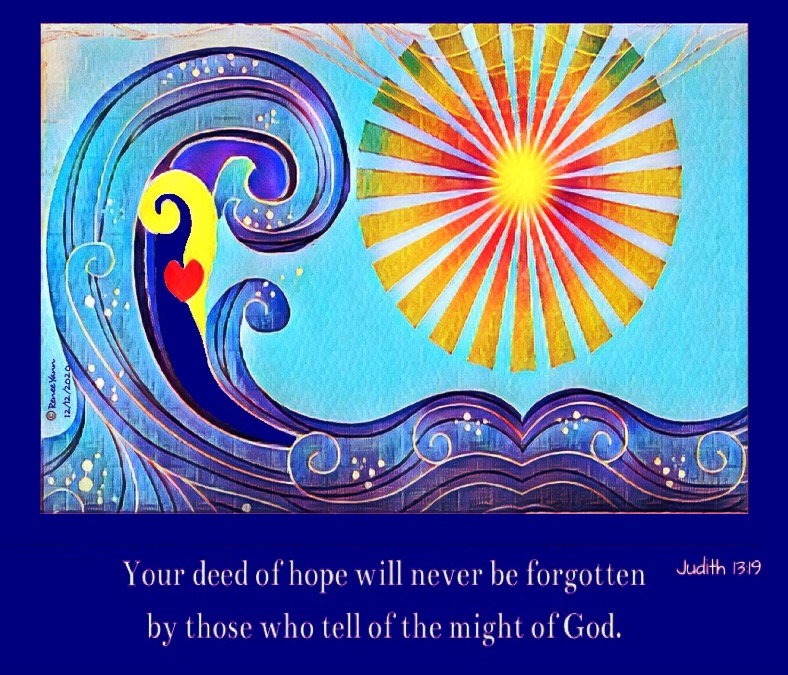
Your deed of hope will never be forgotten
by those who tell of the might of God.JUDITH 13:19


Judith’s deeds foreshadow Mary’s sublime obedience to the power of God. Her dynamic faith and trust free Mary to respond to God’s outrageous willingness to become flesh for our salvation.

Mary said, 
“Behold, I am the handmaid of the Lord.
May it be done to me according to your word.”LUKE 1:38


Down through history, Mary continues to inspire that kind of faith in God’s People. Today, we remember two such inspired individuals:

Saint Juan Diego who, in receiving graces from Our Lady of Guadalupe, offered a “deed of hope” for the Mexican people.


Venerable Catherine McAuley, our beloved founder who , on this date in 1831, released the “deed of hope” ever afterward known as “the Sisters of Mercy”. 


What “deed of hope” wants firing 
in your heart today? 
Let’s look to Mary,
and the saints she has inspired,
to encourage us!


Poetry: from Hafiz

Light
Will someday split you open
Even if your life is now a cage,

For a divine seed, the crown of destiny,
Is hidden and sown in an ancient fertile plain
You hold the title to.

Love will surely burst you wide open
Into an unfettered, blooming new galaxy…
A life–giving radiance will come,
The Beloved’s gratuity will come…..


Music: Sub Tuum Praesidium- “Beneath Thy Protection” – is the oldest preserved extant hymn to the Blessed Virgin Mary. (mid-3rd century). The Latin version has been set to music in the West many times, notably by Marc-Antoine Charpentier, Jan Dismas Zelenka, Antonio Salieri, Wolfgang Amadeus Mozart, and Ludwig van Beethoven.

Sub tuum praesidium
confugimus,
Sancta Dei Genetrix.
Nostras deprecationes ne despicias
in necessitatibus nostris,
sed a periculis cunctis
libera nos semper,
Virgo gloriosa et benedicta.

We fly to Thy protection,
O Holy Mother of God;
Do not despise our petitions
in our necessities,
but deliver us always
from all dangers,
O Glorious and Blessed Virgin.

Incredible Things

Monday of the Second Week of Advent
December 11, 2023

Today’s Readings:

https://bible.usccb.org/bible/readings/121123.cfm


Today, in God’s Lavish Mercy, Isaiah speaks to a weary and forlorn people, a people captive in the desolate land of their conquers. He tells them that the brown dust of their lives will blossom like a magical garden. He tells the wobbly, weakened masses that they will be rejuvenated beyond their wildest dreams:

Strengthen the hands that are feeble,
make firm the knees that are weak,
Say to those whose hearts are frightened:
Be strong, fear not!
Here is your God,
he comes with vindication;
With divine recompense
he comes to save you.
Then will the eyes of the blind be opened,
the ears of the deaf be cleared;
Then will the lame leap like a stag,
then the tongue of the mute will sing.

Isaiah 35:3-6

In our Gospel, Jesus tells the crowd the same thing.

In that crowd, there is a dynamic mix of believers and unbelievers. On the one hand, we have the spiritually stodgy Pharisees who like rules better than miracles. On the other hand, we have these outrageously hopeful young men who are willing to blow the roof off to place their friend under Jesus’s miraculous gaze.

Then the scribes and Pharisees began to ask themselves,
“Who is this who speaks blasphemies?
Who but God alone can forgive sins?”
Jesus knew their thoughts and said to them in reply,
“What are you thinking in your hearts?
Which is easier, to say, ‘Your sins are forgiven,’
or to say, ‘Rise and walk’?
But that you may know
that the Son of Man has authority on earth to forgive sins”–
he said to the one who was paralyzed,
“I say to you, rise, pick up your stretcher, and go home.”

He stood up immediately before them,
picked up what he had been lying on,
and went home, glorifying God.

Luke 5:21-25

Wouldn’t you just love to have been a fly on the wall when that paralyzed kid got up and skipped home! The stunned expressions on the pharisaical faces! The grateful oohs and aahs of those who wanted to believe! The profound awe of his disciples as they realize more deeply who it is that they have come to love!


Throughout the centuries, those with a deep and sincere desire to believe have seen incredible things. The eyes of faith have allowed them to see beyond the dusty surface of appearances.. For those who refuse to believe, even the miracles right in front of them are invisible.


I think that seeing the miracles in our lives is a little bit like seeing a meteor shower. First of all, we have to go outside. We have to look UP! We have to keep our eyes open. And we have to wait.

All moments, maybe especially the dark ones, hold a heavenly cascade of grace. During this holy time, as we await the Infinite Miracle of Love, let’s focus our hearts on watching, waiting, and celebrating these incredible yet daily graces:

  • that we have been given the gift of life
  • that our minds and hearts have the insight to seek God in prayer
  • that we are capable of giving and receiving love
  • that we can hope and heal
  • that we have been touched and changed by Mercy
  • that we are infinitely loved by God

Each one of our lists goes on and on. Pray yours today with the scriptural encouragement of Jesus and Isaiah!


Poetry: The Lord Will Come and not be Slow – John Milton

The Lord will come and not be slow,
his footsteps cannot err;
before him righteousness shall go,
his royal harbinger.
Truth from the earth, like to a flower,
shall bud and blossom then;
and justice, from her heavenly bower,
look down on mortal men.
Surely to such as do him fear
salvation is at hand!
And glory shall ere long appear
to dwell within our land.
Rise, God, judge thou the earth in might,
this wicked earth redress;
for thou art he who shalt by right
the nations all possess.
The nations all whom thou hast made
shall come, and all shall frame
to bow them low before thee, Lord,
and glorify thy Name.
For great thou art, and wonders great
by thy strong hand are done:
thou in thy everlasting seat
remainest God alone.

Music: Miracles – Kari Jobe

Renewal Offer

Second Sunday of Advent
December 10, 2023

Today’s Readings:

https://bible.usccb.org/bible/readings/121023.cfm


Today, in God’s Lavish Mercy, our readings ask us, for an Advent moment, to disentangle ourselves from time and space, and to see the world as God sees it.


Isaiah, hearing God’s insistence in his prophet’s heart, assures us of God’s mercy and of our deliverance from the world’s confusions:

Handel: Messiah / Part 1 – “Comfort ye, My people… Ev’ry Valley shall be exalted”
Conducted by Sir Neville Mariner

Comfort, give comfort to my people,
says your God.
Speak tenderly to Jerusalem, and proclaim to her
that her service is at an end,
her guilt is expiated;
indeed, she has received from the hand of the LORD
double for all her sins.

Isaiah 40: 1-2

Isaiah analogizes these confusions in rich terrestrial metaphors: a desert, a wasteland, a depressed valley, a rough road. Probably most of us have been in one or two of these spots in the past year. Am I right?

A voice cries out:
In the desert prepare the way of the LORD!
Make straight in the wasteland a highway for our God!
Every valley shall be filled in,
every mountain and hill shall be made low;
the rugged land shall be made a plain,
the rough country, a broad valley.
Then the glory of the LORD shall be revealed,
and all people shall see it together;
for the mouth of the LORD has spoken.

Isaiah 40:3-5

But just how is our deliverance from these dead-end places to be accomplished? Peter offers an answer – it is accomplished through repentance.

Do not ignore this one fact, beloved,
that with the Lord one day is like a thousand years
and a thousand years like one day.
The Lord does not delay his promise, as some regard “delay,”
but he is patient with you,
not wishing that any should perish
but that all should come to repentance.

2 Peter 3:8-9

If we were lost in a desert or trapped in an unscalable valley, all we would want is to get out. We might not pause to ask ourselves, “How did I get here?”, or “How can I avoid a return?”. The same thing might be true of our spiritual deserts and valleys.

Isaiah, Peter, and Jesus tell us that it is our resistance to God’s vision, our sinfulness, that captures us in our desolations – and that “repentance” is the antidote.

Since everything is to be dissolved in this way,
what sort of persons ought you to be,
conducting yourselves in holiness and devotion,
waiting for and hastening the coming of the day of God,
because of which the heavens will be dissolved in flames
and the elements melted by fire.
But according to his promise
we await new heavens and a new earth
in which righteousness dwells.
Therefore, beloved, since you await these things,
be eager to be found without spot or blemish before him, at peace.

2 Peter 3:11-14

In our Gospel, John the Baptist also tells us to repent. And, honestly, when I first read his Advent proclamation every year, I find myself telling God something like this:

You know, dear God, I’m not really that bad off that I need to — well, you know…. like actually REPENT!!!! I’ve been doing the best I can. I’m one of the “Goodies” in this bad, bad world! You see that, don’t You?

Then Isaiah’s gentle Shepherd comes along, lifts me into those comforting arms, and convinces me that the world can be transformed if I will let myself see it as God sees it. All the normalized uncharities of my life — the judgments, the ungenerous hesitations, the excused prejudices, the unforgiven mistakes, the selfish expectations. Yes, all those deserts and valleys that we dismiss unresolved will just accumulate and stagnate in our listless spirits! It is from these crooked ways that God offers to deliver us once again in this year’s Advent reimagining.


So, what a wonderful invitation we receive in today’s readings! It is time to begin again – fresh, reinvigorated, and amazed at the power of grace in our lives!

Go up on to a high mountain,
Zion, herald of glad tidings;
cry out at the top of your voice,
Jerusalem, herald of good news!
Fear not to cry out
and say to the cities of Judah:
Here is your God!
Here comes with power
the Lord GOD,
who rules by his strong arm;
here is his reward with him,
his recompense before him.
Like a shepherd he feeds his flock;
in his arms he gathers the lambs,
carrying them in his bosom,
and leading the ewes with care.

Isaiah 40:9-11

On this Advent’s Second Sunday, let’s rest with that comforting but convincing Shepherd to learn where graceful change will free us for rebirth.


Poetry: Reminder – Mark Jarman

For God is in heaven, and you upon earth.
—Ecclesiastes 5:2

Don’t take your eyes off the road.
Accept nothing as given.
Watch where you put your hands.
You’re here and God’s in heaven.

Be careful where you step.
The drop-off’s somewhere near.
The fog won’t lift tonight.
God’s in heaven. You’re here.

That word you wish to say,
That score you’d like to even—
Don’t hurry either while
You’re here and God’s in heaven.

The earth says, “Take the wheel.
But no matter how you steer,
I’ll still go round in circles.
God’s in heaven. You’re here.”


Music: Like A Shepherd – John Foley, SJ

Without Cost

Saturday of the First Week of Advent
December 9, 2023

Today’s Readings:

https://bible.usccb.org/bible/readings/120923.cfm


Today, in God’s Lavish Mercy, our readings invite us to consider the state of our world and to imagine its transformation. And more significantly, our Gospel invites us to imagine ourselves as participants in that transformation.


This image is taken from Cassell’s Illustrated Universal History
illustrated by Edmund Ollier (1827)
This amazing book is preserved and can be accessed here:

https://archive.org/details/cassellsillustr02olligoog/page/192/mode/1up


Isaiah prophesied in a time of desperation for Israel. Crushed by the Assyrian Empire, the Jewish people languished in foreign captivity. As all prophets do, Isaiah interprets Israel’s experience in terms of its spiritual meaning – how do one’s present circumstances reveal the evolution of one’s eternal relationship with God.

The entire Book of Isaiah swings back and forth between two poles: the sin of a faithless people counterbalanced by the merciful generosity of a faithful God. Isaiah’s job is to call the people to awareness, repentance, and hope.


Today’s passage is a call to hope. In it, Isaiah describes the glorious peace that will occur when humankind truly repents from sin and turns to God for healing. The prophet assumes God’s voice in an invitation to healing and the restoration of fidelity:

Thus says the Lord GOD,
the Holy One of Israel:
O people of Zion, who dwell in Jerusalem,
no more will you weep;
He will be gracious to you when you cry out,
as soon as he hears he will answer you.
The Lord will give you the bread you need
and the water for which you thirst.
No longer will your Teacher hide himself,
but with your own eyes you shall see your Teacher,
While from behind, a voice shall sound in your ears:
“This is the way; walk in it,”
when you would turn to the right or to the left.

Isaiah 30:19-21

Scripture speaks to us as well as to the audience for whom it was originally written. And surely Isaiah’s world, distanced on a timeline, is amazingly comparable to our own.

Imagine if you can, living in a world that calls good evil and evil good. Imagine a place where the powerful store up money and treasures while the poor and vulnerable go hungry. Imagine a cultural system that applauds immorality and whose icons lead undiscerning masses to open graves of unrestrained greed, lust, and hatred. Obviously, none of us has to work too hard to imagine such a place.
These are not new problems. The book of Isaiah presents a world strangely familiar to our own. Two powerful images emerge. On one hand, is the picture of sin’s ravaging ways; the aftermath is devastating. But filtering through this awful picture is the more powerful vision of deliverance and salvation. Isaiah invites the reader to see this bright vision through eyes of faith.

Robarts, Charme (2003) “By Faith We Can See It Afar: Believing Isaiah’s Word,” Leaven: Vol. 11: Iss. 2, Article 4

In our Gospel, Jesus – like Isaiah and like us – is in the midst of such a wounded world:

Jesus went around to all the towns and villages,
teaching in their synagogues,
proclaiming the Gospel of the Kingdom,
and curing every disease and illness. 
At the sight of the crowds, his heart was moved with pity for them
because they were troubled and abandoned,
like sheep without a shepherd.

Matthew 9:35-36

Jesus tells his disciples – and us – that by selfless generosity, rooted in grace, we become God’s healing agents for our times and communities.

Then he summoned his Twelve disciples
and gave them authority over unclean spirits to drive them out
and to cure every disease and every illness.

Jesus sent out these Twelve after instructing them thus,
“Go to the lost sheep of the house of Israel.
As you go, make this proclamation: ‘The Kingdom of heaven is at hand.’
Cure the sick, raise the dead,
cleanse lepers, drive out demons.
Without cost you have received; without cost you are to give.”

Matthew 9:6-8

Prose: from “Kindness” – The First Gift by John O’Donohue

Despite all the darkness, human hope is based on the instinct that at the deepest level of reality some intimate kindness holds sway. This is the heart of blessing. To believe in blessing is to believe that our being here, our very presence in the world, is itself the first gift, the primal blessing...

... To be born is to be chosen. To be created and come to birth is to be blessed. Some primal kindness chose us and brought us through the forest of dreaming until we could emerge into the clearance of individuality, with a path of life opening before us through the world.

Music: Kindness – Steven Curtis Chapman

She burns …

Solemnity of the Immaculate Conception of the Blessed Virgin Mary
December 8, 2023

Today’s Readings:

https://bible.usccb.org/bible/readings/120823.cfm


Today, in God’s Lavish Mercy, our Gospel offers us the luminous account of Gabriel’s Annunciation to young Mary. In my prayer, I think I would just like to sit beside Mary and wait for the graces God wishes to give me – to wait confidently as she did, and to do so with her guidance.

Annunciation – Edward Burns-Jones


I will use the powerful poem by Scott Cairns to focus my heart. You may want to use it as well.

Deep within the clay, and O my people
very deep within the wholly earthen
compound of our kind arrives of one clear,
star-illumined evening a spark igniting
once again the tinder of our lately
banked noetic fire. She burns but she
is not consumed. The dew lights gently,
suffusing the pure fleece. The wall comes down.
And—do you feel the pulse?—we all become
the kindled kindred of a King whose birth
thereafter bears to all a bright nativity.

Music: Monteverdi – Vespro della Beata Vergine led by John Eliot Gardiner

Claudio Giovanni Antonio Monteverdi (1567 – 1643) was an Italian composer, choirmaster and string player. A composer of both secular and sacred music, and a pioneer in the development of opera, he is considered a crucial transitional figure between the Renaissance and Baroque periods of music history.

The Vespro della Beata Vergine consists of 14 components: an introductory versicle and response, five psalms interspersed with five “sacred concertos”, a hymn, and two Magnificat settings. Collectively these pieces fulfil the requirements for a Vespers service on any feast day of the Virgin.

In March 1964, as a student at King’s College, Cambridge, John Eliot Gardiner led a performance of Monteverdi’s Vespers that not only launched his conducting career, but also his world-renowned Monteverdi Choir.