Anointing

Saturday of the First Week in Ordinary Time
January 13, 2024

Today’s Readings:

https://bible.usccb.org/bible/readings/011324.cfm


Today, in God’s Lavish Mercy, Samuel anoints Saul King of Israel.

Then, from a flask he had with him, Samuel poured oil on Saul’s head;
he also kissed him, saying:
“The LORD anoints you commander over his heritage.
You are to govern the LORD’s people Israel,
and to save them from the grasp of their enemies.

1 Samuel 10:1
1Sam10_1

Throughout Scripture, the act of anointing signifies being blessed, commissioned by grace. The sacred oil heals and strengthens the anointed to do the work of God.

We share in the grace of anointing through the sacraments – Baptism, Confirmation and Anointing of the Sick. We may not think about the power these rituals give us to live our lives in the pattern of Christ. But it is an amazing power which creates saints out of ordinary human beings like you and me!


Caritas_Bruegel
Caritas, The Seven Acts of Mercy, pen and ink drawing by Pieter Bruegel the Elder, 1559. Counter-clockwise from lower right: feed the hungry, give drink to the thirsty, ransom the captive, bury the dead, shelter the stranger, comfort the sick, and clothe the naked

As many of you know, 2023 was a year of unexpected and intense health challenges for me. On three critical occasions, compassionate priests carried the Sacrament of the Sick to me. Both Fr. Lynn and Fr. Gleason gently asked me, “Would you like to be anointed?”. The question reminded me of Jesus when he asks the paralytic, “Do you want to be cured?”.

Clearly, healing isn’t a one-sided enterprise from God. We must be willing to open our hearts to the movement of the Spirit in our lives. The Sacrament of Anointing is a sacred gift to help us to that openness. For me, anointing from these ministers opened my heart to understand that, by grace, suffering had the potential to make me someone new. Sacramental grace invited me to find that newness in the pattern of Jesus Christ.


In a less formal way, we can anoint one another by our acts of generosity, honesty, justice and love. Think of the woman who anointed Jesus with nard from her alabaster jar. How that act strengthened him for the suffering he had to face!

There are so many chaffed and sore places in our world longing for the oil of mercy!

works of Mercy

We can also “anoint” our own life by gratefully remembering God’s abiding presence with us:  the blessings we have received, the challenges we have gracefully met, the love we have both given and received – all that strengthened us to do the work of God over our lifetime.


Poetry: Her Hands, Her Hair by Steve Garnass-Holmes

Mary took a pound of costly perfume made of pure nard,
anointed Jesus’ feet, and wiped them with her hair.
—John 12.3

God does not promise to save you from suffering,
or to remove you from this life and its jagged edges.
God shares your space in it, offers blessing in it,
anointing your nights as well as days.
The cross is no scheme to get you off a hook somewhere;
it’s the Beloved, with you in your pain.
Let the Beloved pour herself out on your troubles,
let her pour out a jar of tears for you,
wipe your aching feet with her hair.
Let the whole house of you be filled
with the fragrance of God’s blessing.
Others don’t feel your pain but she does,
they will flee but she will be with you.
Lay before her your sorrows and your rage.
Feel her hands upon you, her hair, her heart.
You are in the holy of holies.
The world’s derision fades away outside the gate.
She looks at you with love
that will stay with you forever

Music:  Holy, Anointed One – Vineyard Worship
City of God

Friday of the First Week in Ordinary Time
January 12, 2024

Today’s Readings:

https://bible.usccb.org/bible/readings/011224.cfm


www-St-Takla-org--b3h-50-israel-demands-a-king
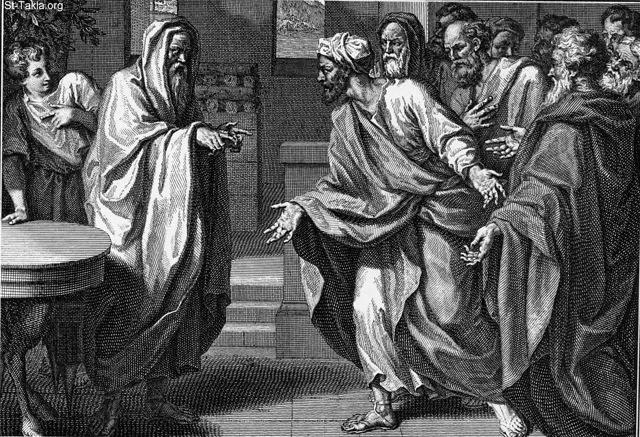
1 Samuel 8:19 – Israel demands a king.- J. Winter
– from “The Bible and its Story” book,
authored by Charles Horne, 1909

Today, in God’s Lavish Mercy, our first reading startles us with how foolish the Israelites are about their leaders.

All the elders of Israel came in a body to Samuel at Ramah
and said to him, “Now that you are old,
and your sons do not follow your example,
appoint a king over us, as other nations have, to judge us.”

Samuel was displeased when they asked for a king to judge them.
He prayed to the LORD, however, who said in answer:
“Grant the people’s every request.
It is not you they reject, they are rejecting me as their king.”

1 Samuel 8: 4-7

Israel is desperate for a “strong man” who will mimic the tyrants leading their enemies. They say a king will “rule us and to lead us in warfare and fight our battles.” They begin to envision a nation of their own design, not God’s.

They believe that having an absolute leader will make them politically strong. They are indifferent to Samuel’s warnings that such a choice will usurp their freedom, and lead to their devastation and enslavement.

lossy-page1-441px-Olivetan_Master_-_Leaf_from_an_Antiphonary-_Historiated_Initial_P_with_the_Prophet_Samuel;_Ar_-_1999.131_-_Cleveland_Museum_of_Art.tif
This leaf is distinguished by a large initial P depicting Samuel, the last and one of the greatest of Israel’s judges. It introduces the text
Preparte corda vestra domino et servite
(“Prepare your hearts for the Lord and serve”).

God tells Samuel that, in rejecting the choice for responsible, spiritually-grounded, and mutually sustained leadership, the people are rejecting God and God’s plan for them.

The people, however, refused to listen to Samuel’s warning and said,
“Not so! There must be a king over us.
We too must be like other nations,
with a king to rule us and to lead us in warfare
and fight our battles.”

1 Samuel 8:9-20

In a nutshell, Israel’s problem is this: they have forgotten who and whose they are. For the sake of expected political dominance, they are willing to sacrifice their identity as a people formed and led by God.


Centuries later, in today’s Gospel, Jesus comes among these dispirited people. Their choice hasn’t worked. They are still a politically dominated nation. Their religious practice has lost its vigor, denigrating into lifeless rules and practices. A corrupt religious class manipulates every aspect of their lives by a self-serving manipulation of the Law.


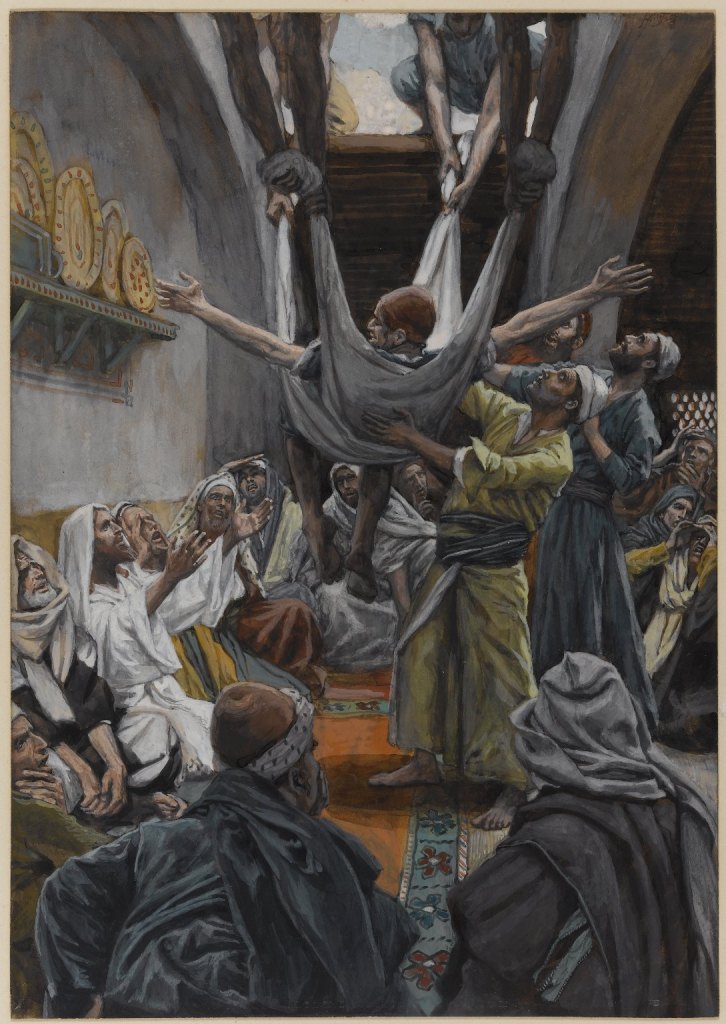
Jesus Cures the Palsied Man – James Tissot

Jesus, ignoring their religiously manufactured limitations, cures a paralyzed man. The scribes are scandalized. But Jesus confronts their equivocation:

Jesus said, “Why are you thinking such things in your hearts?
Which is easier, to say to the paralytic,
‘Your sins are forgiven,’
or to say, ‘Rise, pick up your mat and walk’?
But that you may know
that the Son of Man has authority to forgive sins on earth”
–he said to the paralytic,
“I say to you, rise, pick up your mat, and go home.”
He rose, picked up his mat at once,
and went away in the sight of everyone.
They were all astounded
and glorified God …

Mark 2: 8-12

What would the world be like if we remained open to God’s grace, mercy, and infinite possibility? Can we even imagine such freedom and trust? Can we even imagine the marriage of our faith and politics to the point that we all live for the common good?

Ps89 name_justice

Thought for today: from “The City of God” by St. Augustine. This book was written in response to allegations that Christianity brought about the decline of Rome. It is considered one of Augustine’s most important works, standing alongside The Confessions, The Enchiridion, On Christian Doctrine, and On the Trinity.

“Indeed, the only cause of their [Rome] perishing was
that they chose for their protectors gods condemned to perish.”

from City of God by Augustine of Hippo

Music: Come, Holy Spirit – Bright City

Of Course!

Thursday of the First Week in Ordinary Time
January 11, 2024

Today’s Readings:

https://bible.usccb.org/bible/readings/011124.cfm


Mk1_41-of-course
This is the Greek word for “Of course!”

Today, in God’s Lavish Mercy, Jesus shows us how to live a merciful life – through loving, generous, joyfully responsive service.

A leper came to him and kneeling down begged him and said,
“If you wish, you can make me clean.”
Moved with pity, he stretched out his hand,
touched the leper, and said to him, 
“I do will it. Be made clean.”

Mark 1: 40-41

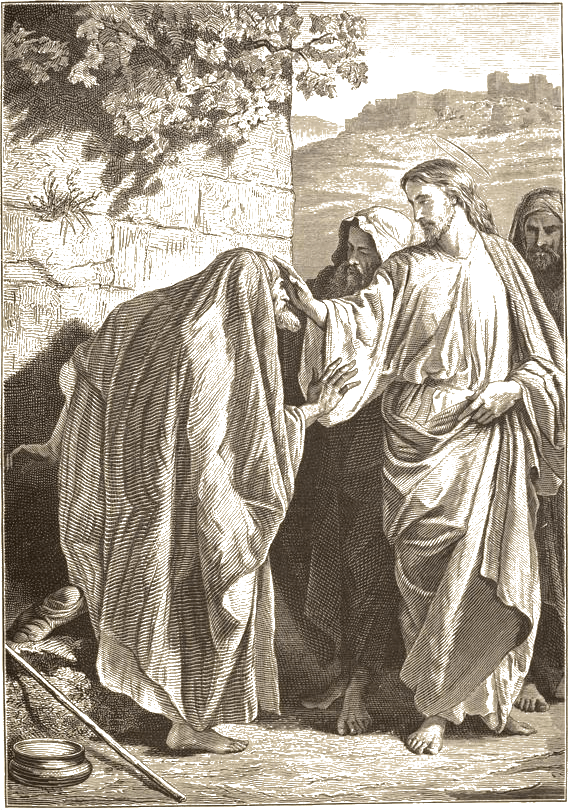
A pitiable leper interrupts Jesus on his journey to ask for help. People like this man were scorned, feared, and isolated. Their leprosy impoverished them, making them annoying beggars. Their cries usually met with indifference at best and banishment at worst.

But when this leper poses his proposal to Jesus – “If you want to, you can heal me.” — Jesus gives the spontaneous answer of a true, merciful heart: “Of course I want to!”

Jesus heals the Leper – Alexandre Bida

There is no annoyance, no suggestion that other concerns are more important. There is just the confirmation that – Yes- this is my life’s purpose: to heal, love, and show mercy toward whatever suffering is in my power to touch. There is simply the clear message that “You, too, poor broken leper, are Beloved of God.”


What an example and call Jesus gives us today! We are commissioned to continue this merciful touch of Christ along the path of our own lives. When circumstances offer us the opportunity to be Mercy for another, may we too respond with enthusiasm, “Of course I want to!” May we have the eyes to see through any “leprosy” to find the Beloved of God.


Poetry: from Naming the Leper – Christopher Lee Manes

Between 1919 and 1941, five relatives of Christopher Lee Manes were diagnosed with an illness then referred to as “leprosy” and now known as Hansen’s disease. After their diagnosis, the five Landry siblings were separated from their loved ones and sent to the National Leprosarium in Carville, Louisiana, where they remained in quarantine until their deaths. Drawing on historical documents and imaginative reconstructions, Naming the Leper tells through poetry this family’s haunting story of exile and human suffering.

Manes won the Summerlee Book Prize for his work. Here is an excerpt that conveys the aimless desolation felt by “the leper” — likely felt by Jesus’s leper too.

” the trouble with this place…”

Dear Claire,
The trouble with this place
is getting out of bed to live
through the corpse of another day;
letting the world roll as God wants it,
while we sit on the front porch
and wave flies
from our face.

Isn’t it a wonder
more of us do not go crazy,
forced to live brooding over these
unfortunate conditions;
thrown into a contact so intimate and prolonged 
we let go our reflections in the river,
and our loved ones—but most importantly,
the very children we’ve begotten—
forget us.

Music: Compassion Hymn – Kristyn and Keith Getty

Bridges

Wednesday of the First Week in Ordinary Time
January 10, 2024

Today’s Readings:

https://bible.usccb.org/bible/readings/011024.cfm


Today, in God’s Lavish Mercy, we read about God’s call of Samuel, Hannah’s son.

New things are about to happen in Israel. The People have lived under the questionable leadership of a series of Judges. But now, threats from inside and outside loom. So God chooses to move in a new way among the community.

1Sam speak Lord

Samuel is going to be God’s bridge to that new way. In today’s reading and subsequent verses, he hears God’s call, listens, receives a vision, and prophesies to Eli.


In our reading from Mark, Jesus is the Divine Bridge to a new reality. Early now in his ministry, his call is blossoming in his heart, as he realizes that he must go all over Israel preaching and healing.

When Simon told Jesus the local villagers were looking for him, Jesus told them,

“Let us go on to the nearby villages
that I may preach there also.
For this purpose have I come.”
So he went into their synagogues,
preaching and driving out demons

throughout the whole of Galilee.”

Mark 1:38-39

Jesus continues his healing and enlightening mission through all who call themselves Christian. He calls each of us in different ways to be a “Bridge” with him to the Reign of God.

How are we hearing and listening to our particular call every day? Maybe, like Samuel, by the time God calls us three times, we may understand!😉


Music: Two songs today and no poem.

Since I mentioned “bridge”, I can’t help including one of my favorite songs, Bridge Over Troubled Water by Simon and Garfunkel. It’s not really a religious song, but their popular song actually was inspired by a great Gospel song,  Oh Mary, Don’t You Weep and its one freely interpreted verse very near the end: “I’ll be your bridge over deep water/If you trust in my name.’ 

Bridge Over Troubled Waters

Oh, Mary Don’t You Weep (Lyrics below. They are VERY liberally interpreted by these wonderful Gospel singers.)

Lord, I’m singing . . . (solo)
Oh, Mary, don’t you weep. (group)
Tell Martha not to mourn. (solo)
Tell Martha not to mourn. (group)
Listen, Mary, (solo)
Oh, Mary, don’t you weep. (group)
Tell Martha not to mourn. (solo)
Tell Martha not to mourn. (group)
Pharaoh’s army, (solo)
Oh, Mary, don’t you weep. (group)
They got drownded in the sea, (solo)
Drowned in the Red Sea. (group)
Jesus said, Mary, (solo)
Oh, Mary, don’t you weep. (group)
Tell Martha not to mourn. (solo)
Tell Martha not to mourn. (group)
Can’t you hear me singing, Mary? (solo)
Oh, Mary don’t you weep. (group)
I want you to know, Martha don’t have to mourn. (solo)
Tell Martha not to mourn. (group)
Oh, listen, Mary, (solo)
Oh, Mary don’t you weep. (group)
Tell Martha not to mourn. (solo)
Tell Martha not to mourn. (group)
Pharaoh’s army, (solo)
Oh, Mary, don’t you weep, (group)
They got drownded in the sea, (solo)
Drowned in the Red Sea. (group)
Jesus said, Mary, (solo)
Oh, Mary don’t you weep, (group)
Tell Martha not to mourn, (solo)
Tell Martha not to mourn, (group)
Lord, and if I could tonight, (solo)
If I could, (group)
I want to tell you I surely would right now. (solo)
Surely would, (group)
I would stand on the rock. (solo)
Stand on the rock, (group)
Right on the rock where Moses stood. (solo)
Moses stood, (group)
Pharaoh’s army, (solo)
Oh, Mary don’t you weep (group)
They got drownded in the sea, (solo)
Drowned in the Red Sea. (group)
Jesus say, Mary, (solo)
Oh, Mary don’t you weep. group)
He said Mary . . . (solo)
Oh, Mary don’t you weep .(group)
Oh, Mary . . . (solo)
Oh, Mary, don’t you weep. group)
Tell Martha not to mourn. (solo)
Tell Martha not to mourn. group)

Petitioning God

Tuesday of the First Week in Ordinary Time
January 9, 2023

Today’s Reading:

https://bible.usccb.org/bible/readings/010924.cfm


Today, in God’s Lavish Mercy, we resume our journey through “Ordinary Time”. Advent and Christmastide of 2023 seem to have passed very swiftly! Just a week or so beyond the New Year, life resumes the “everyday-ness” that can be either comforting or humdrum.

The Church calls this “everyday-ness” Ordinary Time. It is a time during which we are invited to recognize the extraordinary gift of each day by praying with the ordinary lives of ancient Israel and early Christianity. Key to their lives, and to ours, is this: God abides with us. Praying with the Scriptures helps us to recognize and deepen within that Presence.


Now and for several weeks, we will read from the Books of Samuel. These Books present a point of profound change in the character of ancient Israel. Before 1 Samuel, Israel is a disorganized group of tribes with an amorphous societal infrastructure. After II Samuel, Israel is characterized by a power and theology centralized around a king and kingly political power.

We could read these books simply as history, or as a fictionalized narrative, but that would be unfortunate. Praying with the Books of Samuel, and all scripture, allows us to witness God’s intervention in the human heart. We can learn from and compare our challenges to those of these ancient believers. Samuel – and his mother Hannah – is an engaging place to begin.


As 1 Samuel opens in our reading today, Israel is a mess. Externally, they are mortally threatened by the Philistines. Internally, they have devolved into a brutal, amoral, rudderless gaggle. They ache for the Leader who will restore their safety and prosperity.

The Prayer of Hannah – Julius Schnorr von Carolsfeld


Samuel’s mother, Hannah, is the first inkling of that restoration. Frustrated with her barrenness, she turns in desperation to God. She makes the ultimate promise of returning the child God might give her. Her desolation is met with mercy. With the conception of Samuel, Hannah sets in motion the dynamic line that will lead through David to Jesus, the Messiah.

Hannah rose after a meal at Shiloh,
and presented herself before the LORD;
at the time, Eli the priest was sitting on a chair
near the doorpost of the LORD’s temple.
In her bitterness she prayed to the LORD, weeping copiously,
and she made a vow, promising: “O LORD of hosts,
if you look with pity on the misery of your handmaid,
if you remember me and do not forget me,
if you give your handmaid a male child,
I will give him to the LORD for as long as he lives;


This passage is a pre-figuring of Mary and the Son she will give back to God. It offers us so many ways to pray as we live to gratefully return our lives to the Creator.

  • As we consider Hannah as an expression of Israel’s journey, where do we stand on our journey into God’s grace?
  • How do we respond to frustration in our lives, especially when our prayers seem unanswered?
  • How do we place our frustrations before God? How do we wait for an answer?
  • How do we live out and fulfill our promises, vows, and covenants with God and neighbor?
  • Are we aware, and reverent of, the influence of our salvation journey on the journeys of those around us?

It matters how we live our ordinary time. We are not just place markers in history. Like Hannah, how we live, pray, and love affects the whole flow of Creation. Like Hannah, by our faithful relationship with God, we influence a future we do not yet see.


Poetry and Music: MARBLE FLOOR – (A song in Hannah’s voice) by Alicia Jo Rabins

The composer writes that this is a song about Hannah – and what it means to ask for what you need. The story of Hannah appears in I Samuel 1-2. Hannah (Chana in Hebrew) prayed so hard her lips moved, but no sound came out; the priest threw her out of the temple, thinking she was drunk. But not only was Hannah’s prayer answered, she also became the model for the Amidah, one of the most important moments in the Jewish prayer service.
The chorus is inspired by the Chassidic story of the holiest prayer being that of the illiterate man who only knew the alphabet but recited it with perfect intention.

I opened my mouth but no words came
I lay down to sleep but I did not dream
I looked up at the stars but the sky was dark
like a mirror held up to my heart
A B C, D E F

Take away this alphabet
it’s heavy on my tongue

You can want a thing so bad it seems
That you lose yourself and everybody else
So I got down on my knees on the marble floor
And I cried until my throat was sore
A B C D, E F G

Tell me what you want from me
I’ll do it all I swear
I was not drunk, I was awake
I could not open so I had to break
to let the light come in
A B C D, E F G
Take away this alphabet from me
it’s heavy on my tongue

Washed in Grace

The Baptism of the Lord
January 8, 2023

Today’s Readings:

https://bible.usccb.org/bible/readings/010824.cfm


Today, in God’s Lavish Mercy, Jesus makes a remarkable debut! 

Picture the scene. It is a beautiful morning in the Judean Valley where the Jordan River runs fresh and sparkling. Most scholars place the Baptism of Jesus sometime in January, which means the weather would have been relatively cool. But perhaps, like our own weather, an unusually warm day may have snuck in.

Rustic, fiery preacher John is baptizing in the Jordan River. Crowds have come to hear what he has to say. Some are convinced and dive into the cool water under his hand. Others rim the hillside, not so sure John isn’t one of the many who have glorious visions but few facts.

Then, out from the pines on the far side of the river, comes Jesus, flanked by some of the Twelve. While his companions chat away to Jesus, his eyes are focused on John. In an instant, Jesus realizes that this is the moment for his revelation. In that same instant, all Creation realizes the same thing.

As Jesus walks slowly toward John, the birds and little animals speak to him, “My Lord and my God…”.  Wind whistling through the trees becomes an Oratorio praising him. All the surrounding colors deepen, breaking forth in unimaginable light.

John is stunned by the cosmic change he senses but cannot describe. Heart trembling, he looks into Jesus’s eyes and catches a glimpse of heaven. “I need to be baptized by you”, John says,”and yet you are coming to me?

Jesus smiles at his cousin, replying, 

“Let it be so now; 
it is proper for us to do this 
to fulfill all righteousness.”

Then John consented.

Perhaps those in the crowd, schooled in the ancient scriptures, heard Isaiah’s voice in the charged atmosphere:

Here is my servant whom I uphold,
my chosen one with whom I am pleased,
upon whom I have put my spirit;
he shall bring forth justice to the nations,
not crying out, not shouting,
not making his voice heard in the street.
a bruised reed he shall not break,
and a smoldering wick he shall not quench,
until he establishes justice on the earth;
the coastlands will wait for his teaching.

Matthew tells us:

As soon as Jesus was baptized, he went up out of the water.

the-baptism-of-jesus-jeff-haynie
The Baptism Of Jesus is a painting by Jeff Haynie For purchase, see:https://fineartamerica.com/featured/the-baptism-of-jesus-jeff-haynie.html

Can you see him light-heartedly splashing John as he shakes his dark curls free of the chilly water? Can you see his transfigured face as he hears his Father speak Love over him?

At that moment heaven was opened, 
and he saw the Spirit of God descending like a dove and alighting on him.
And a voice from heaven said, 

“This is my Son, whom I love; with him I am well pleased.”

What a beautiful moment in time! Don’t we wish we might have been there in the blessed and awe-struck crowd? We can. Let your prayer of imagination take you there.


Video: The Baptism of Jesus

Find Your Star

The Epiphany of the Lord
January 7, 2023

Today’s Readings:

https://bible.usccb.org/bible/readings/010724.cfm


Today, in God’s Lavish Mercy, and on this glorious feast, we pray with Psalm 72.

The kings of Tarshish and the Isles shall offer gifts;
the kings of Arabia and Seba shall bring tribute.
All kings shall pay him homage,
all nations shall serve him.

For he shall rescue the poor when he cries out,
and the afflicted when he has no one to help him.
He shall have pity for the lowly and the poor;
the lives of the poor he shall save.

Psalm 72: 10-13

It is a gorgeous psalm that fills our senses with lights, and scents, and the tactile experience of an ancient and sacred world:

  • we inhale the flower of justice
  • wrap ourselves in its profound peace
  • gaze on a distant, moonless universe
  • stretch our prayer from sea to sea,
  • and our praise to the ends of the earth

We see the ancient nations gather in homage,
carrying the gems, spices and bounty of their homelands.

We, too, kneel in astounded wonder that this vulnerable child, 
hidden in the far reaches of both geography and imagination, 
carries to us the Promise of the Ages.

We, too, trust the star, rising in our own hearts.


Psalm 72 echoes our beautiful first reading from Isaiah, another masterpiece that, in itself, is enough simply to read and savor:

Rise up in splendor, Jerusalem!  
Your light has come,
the glory of the Lord shines upon you.
See, darkness covers the earth,
and thick clouds cover the peoples;
but upon you the LORD shines,
and over you appears his glory.

Isaiah 60: 1-2

In Isaiah, these magnificent verses follow two chapters of gloom and darkness. They break forth in true epiphany to say, “Your Light has come!” – now your life must begin to shine as well.

Epiphany is not simply about kings and camels. It is not simply about a  crèche and a star. 

It is about Divine Revelation hovering over our dailyness. It is about us, opening our eyes in faith and responsiveness to our ever-present God.

The feast of Epiphany reminds us:

Look at your life today. 
The star did not pass you by. 
Open your eyes and find it. 
Once you have seen it, 
live in its Light.


Poetry: The Journey of the Magi – T.S. Eliot

Eliot wrote the poem after his conversion to Anglicanism ( He had been a Unitarian.) The poem conveys his struggle to grow in the light of his new faith. The “journey” is life-long and demanding in a world that often  contradicts that faith.

“A cold coming we had of it,
Just the worst time of the year
For a journey, and such a long journey:
The ways deep and the weather sharp,
The very dead of winter.”
And the camels galled, sore-footed, refractory,
Lying down in the melting snow.
There were times we regretted
The summer palaces on slopes, the terraces,
And the silken girls bringing sherbet.
Then the camel men cursing and grumbling
And running away, and wanting their liquor and women,
And the night-fires going out, and the lack of shelters,
And the cities hostile and the towns unfriendly
And the villages dirty and charging high prices:
A hard time we had of it.
At the end we preferred to travel all night,
Sleeping in snatches,
With the voices singing in our ears, saying
That this was all folly.

Then at dawn we came down to a temperate valley,
Wet, below the snow line, smelling of vegetation;
With a running stream and a water-mill beating the darkness,
And three trees on the low sky,
And an old white horse galloped away in the meadow.
Then we came to a tavern with vine-leaves over the lintel,
Six hands at an open door dicing for pieces of silver,
And feet kicking the empty wine-skins.
But there was no information, and so we continued
And arrived at evening, not a moment too soon
Finding the place; it was (you may say) satisfactory.
All this was a long time ago, I remember,
And I would do it again, but set down
This set down
This: were we led all that way for
Birth or Death? There was a Birth, certainly,
We had evidence and no doubt. I had seen birth and death,
But had thought they were different; this Birth was
Hard and bitter agony for us, like Death, our death.
We returned to our places, these Kingdoms,
But no longer at ease here, in the old dispensation,
With an alien people clutching their gods.
I should be glad of another death.

Music: The People that Walk in Darkness – Bob Dufford, SJ

The people that walk in darkness 
 have seen, have seen a great light.
 And on those who dwell in endless gloom, 
 a light has shone.
 
Refrain: 
For a Child is born this day: 
Rejoice, rejoice.
Daughter of Zion, awake. 
The glory of God is born.
 
And they shall name Him counselor, 
shall call Him mighty God.
And He shall rule from age to age: 
Prince of Peace.
 
Refrain
 
Darkness covers the earth; 
thick clouds govern its pe0ple.
But the Lord will bring them light; 
the Lord will bring them light.
 
Refrain
 
The people that walk in darkness 
have seen, have seen a great light.
And on those who dwell in endless gloom, 
a light has shone.
 

Refrain

Family Trees

Christmas Weekday
January 6, 2024

Today’s Readings:

https://bible.usccb.org/bible/readings/010624.cfm


Today, in God’s Lavish Mercy, our readings are laced together with a genealogy theme.

In our first reading, John describes our most fundamental and powerful lineage: we are children of God with the gift of eternal life.

And this is the testimony:
God gave us eternal life,
and this life is in his Son.
Whoever possesses the Son has life;
whoever does not possess the Son of God does not have life.
I write these things to you so that you may know
that you have eternal life,
you who believe in the name of the Son of God.

1 John 5: 11-13

The Church offers alternative Gospels for reading today. One describes the Baptism of Jesus and one delineates his patriarchal lifeline.

Mark’s Gospel, which will most likely be read at Mass today, presents Jesus as the Son of God:

It happened in those days that Jesus came from Nazareth of Galilee
and was baptized in the Jordan by John.
On coming up out of the water he saw the heavens being torn open
and the Spirit, like a dove, descending upon him.
And a voice came from the heavens,
“You are my beloved Son; with you I am well pleased.”

Mark 1: 9-11

Today’s alternative Gospel of Luke presents Jesus as the descendant of a long patriarchal line including Adam, David, and “as was thought” Joseph. It emphasizes Jesus’s place in the human family (In contrast to Matthew’s genealogy which emphasizes Jesus’s place in the Hebrew history.)

When Jesus began his ministry he was about thirty years of age.
He was the son, as was thought, of Joseph, the son of Heli,
the son of Matthat, the son of Levi, the son of Melchi,
the son of Jannai, the son of Joseph, the son of Mattathias,……

Luke 3:23-38

What are we supposed to learn today from this impressive array of scriptures? This is where my prayer took me:

Jesus Christ, human and divine, took flesh to share eternal life with me through Baptism. Through him, I gain the sacred pedigree that reaches through time to God’s eternal womb.


Poetry: Jesus’s Baptism – Malcolm Guite

Beginning here we glimpse the Three-in-one;
The river runs, the clouds are torn apart,
The Father speaks, the Sprit and the Son
Reveal to us the single loving heart
That beats behind the being of all things
And calls and keeps and kindles us to light.
The dove descends, the spirit soars and sings
‘You are belovèd, you are my delight!’
In that quick light and life, as water spills
And streams around the Man like quickening rain,
The voice that made the universe reveals
The God in Man who makes it new again.
He calls us too, to step into that river
To die and rise and live and love forever.

Music: Epiphany on the Jordan – Steve Bell and Malcolm Guite

Steve Bell worked with Malcolm Guite converting the poem above into this inspiring song. As we approach the Season of Light, revealed in Epiphany and Baptism, this meditative song is a great companion to our prayer.

The heavens split and the water spilled
And streamed around the man like a quickening rain
A quickening rain
The Word behind all worlds revealed
That God in man makes everything new again
New again
This word of God to his beloved
Has settled on me like a dove…
He calls us too, to step into that river
To die and rise to life and love forever
And so graciously extends to me, a sinner
To tread the sacred waters of
The mystery of love
What can be said about a mystery
Except to say that the last word can never be said
Never said
Best leave that to poetry
Kindling words for quickening the dead
The living dead
Pure, single heart behind all things
Each to the other, by the spirit sing
He calls us too, to step into that river…

Back to the Fig Tree

Memorial of Saint John Neumann, Bishop
January 5, 2024

Today’s Readings:

https://bible.usccb.org/bible/readings/010524.cfm


Today, in God’s Lavish Mercy, John gives us this powerful verse:

Beloved, if our hearts do not condemn us,
we have confidence in God.


In our Gospel, we meet Nathaniel who has been sitting under a fig tree, perhaps examining his heart in the manner that John describes. I have frequently sat under the fig tree with Nathaniel because his was the name I was given over sixty years ago when I began my religious life.

I had never heard of him before that, nor at least had I paid attention to him. When Mother Bernard solemnly pronounced his name over me, it fell with a thud into my consciousness. Who was this guy anyway??? And what happened to “Regina”, “James Marita”, and “Eleanor Mary” – the names I had humbly requested! I imagine my eyebrows knit into a skeptical question mark!

I remember Mother Anthony peeking over Mother Bernard’s shoulder, encouraging me to smile as the superior’s hands rested on my head in blessing. Later she told me that she wasn’t so sure I would like the name, but that Mother Bernard really did. So I decided that I would learn to really like it too. That’s when I first met Nathaniel under the multi-trunked tree where he sat pondering his life.


Oddly enough at that first meeting, Nathaniel was young like I was then. He was trying to figure out, and plot out, his whole life in that one afternoon, much like I used to do when I was very young. I wanted to make the right decisions to set my life on a perfect course. So did Nathaniel I think.

Well. over the years since, both Nathaniel and I have met Jesus who has intervened in our self-interested ponderings. Jesus has called us beyond our mirror-bound reflections to the “greater things” of God’s vision for us and for Creation.

Nathaniel said to him, “How do you know me?”
Jesus answered and said to him,
“Before Philip called you, I saw you under the fig tree.”
Nathaniel answered him,
“Rabbi, you are the Son of God; you are the King of Israel.”
Jesus answered and said to him,
“Do you believe
because I told you that I saw you under the fig tree?
You will see greater things than this.”

John 1:47-50

When I meet Nathaniel these days under the aging fig, we too have aged and mellowed. Asking God’s sustaining intervention for just the day or the hour has become sufficient. Now as the plump fruit falls occasionally from the limb, we listen more than we think or speak. Jesus has joined us there under the leaves’ broad shadows. We share the fruit that has been given to us. And yes, Jesus still knows us in ways that amaze, challenge, and comfort.


Poetry: Seeing for a Moment – Denise Levertov

I thought I was growing wings—
it was a cocoon.

I thought, now is the time to step
into the fire—
it was deep water.

Eschatology is a word I learned
as a child: the study of Last Things;

facing my mirror—no longer young,
the news—always of death,
the dogs—rising from sleep and clamoring and howling, howling,

nevertheless
I see for a moment
that’s not it: it is
the First Things.

Word after word
floats through the glass.
Toward me.

Music: Under the Fig Tree – Lake Isabel

Let No One Deceive You

Memorial of Saint Elizabeth Ann Seton, Religious
January 4, 2024

Today’s Readings:

https://bible.usccb.org/bible/readings/010424.cfm


Today, in God’s Lavish Mercy, John is gentle but scathingly direct in his teaching:

Children, let no one deceive you.
The person who acts in righteousness is righteous,
just as God is righteous.
Whoever sins belongs to the Devil,
because the Devil has sinned from the beginning.

1 John 3: 7-8

John tells us that good is good, and bad is bad. Don’t let anyone fool you. And don’t make excuses when you fool yourself!

John gives us a clear measuring stick to test alignment with his teaching:

In this way,
the children of God and the children of the Devil are made plain;
no one who fails to act in righteousness belongs to God,
nor anyone who fails to love their sisters and brothers.

1 John 3:10

It’s so simple but so hard to be the kind of person John calls us to be!

In our deep hearts, we know what righteousness looks like. It looks like peace, forgiveness, reverence, truth-telling, kindness, service, faithfulness, hope.

And we know what unrighteousness looks like. It looks like war, vengeance, brutality, bigotry, manipulation, indifference, greed, selfishness, megalomania, dishonesty, fear-mongering.


How has our society gotten so mixed up that we allow unrighteousness to parade in the costume of justice! How have we gotten so lazy, greedy, or indifferent that we refuse to look for and remedy the root causes of our societal grievances? For example, when I dig deeper in my prayerful thinking, I might realize that:

  • Thousands of immigrants are not crossing their borders just to bother me or take my job! They are in fear for their lives and well-being because of a lopsided global economy and a classist devaluation of life.
  • The armament and weapons industries are not founded on a mission to protect me and my loved ones. Like all businesses, they operate to make money. The more guns they sell, and the more expensive and destructive they are, all the better. We are their marketplace not their protectorate.

The Scriptures are God’s living Word. They are not to be read and set aside as a completed devotional practice meaningless for today’s world.

They teach us about the past but they speak to us of the present. As we pray with them, we are called to be changed by them into persons who more clearly reflect Jesus and the Gospel. That is the hard work of righteousness – work that is the everyday stuff of our lives.

Deeply internalizing John’s teaching today is a good place to start our transforming prayer.


Poetry: And 2morrow – Tupac Shakur, (1971 – 1996), was an American rapper. He is widely considered one of the most influential and successful rappers of all time. Shakur is among the best-selling music artists, having sold more than 75 million records worldwide. Much of Shakur’s music has been noted for addressing contemporary social issues that plagued inner cities. His life was filled with violence and eventually, he was murdered, but his creative work revealed a deep though conflicted longing for justice and peace.

Today is filled with anger
fueled with hidden hate
scared of being outcast
afraid of common fate
Today is built on tragedies
which no one wants 2 face
nightmares 2 humanities
and morally disgraced
Tonight is filled with rage
violence in the air
children bred with ruthlessness
because no one at home cares
Tonight I lay my head down
but the pressure never stops
knawing at my sanity
content when I am dropped
But 2morrow I c change
a chance 2 build a new
Built on spirit intent of Heart
and ideals
based on truth
and tomorrow I wake with second wind
and strong because of pride
2 know I fought with all my heart 2 keep my
dream alive

Music: Beauty for Brokenness (God of the Poor) – Graham Kendrick