
Memorial of Saint Scholastica, Virgin
Saturday of the Fifth Week in Ordinary Time
February 10, 2024
Today’s Readings:
https://bible.usccb.org/bible/readings/021024.cfm

Today, in God’s Lavish Mercy, we finish with the Book of Kings. And, as several of my readers have told me, they’ll be glad for it. There may have been points in our journey through Samuel and Kings, when you thought, “WHY am I even reading this! Who cares about Rehoboam, Jeroboam or any other “boams”!
I understand, but here are two of my “WHY”s:
The Hebrew Scriptures show us how human beings deepened, over thousands of years, in their understanding of God. Throughout that extended deepening, God remains unchangingly faithful. Even though the cultural context of some Old Testament stories may upset, befuddle, or offend us, they still express the human attempt to find God in one's experience.
The Hebrew Scriptures inform and underlie the theology of the Christian Scriptures, and the culture in which Jesus lived and taught. Like a butterfly is the fulfillment of the chrysalis, Jesus was the fulfillment of the Promise to Abraham. Without an appreciation of that Promise, and how Israel lived out its long realization, our comprehension of Christ's meaning is limited.
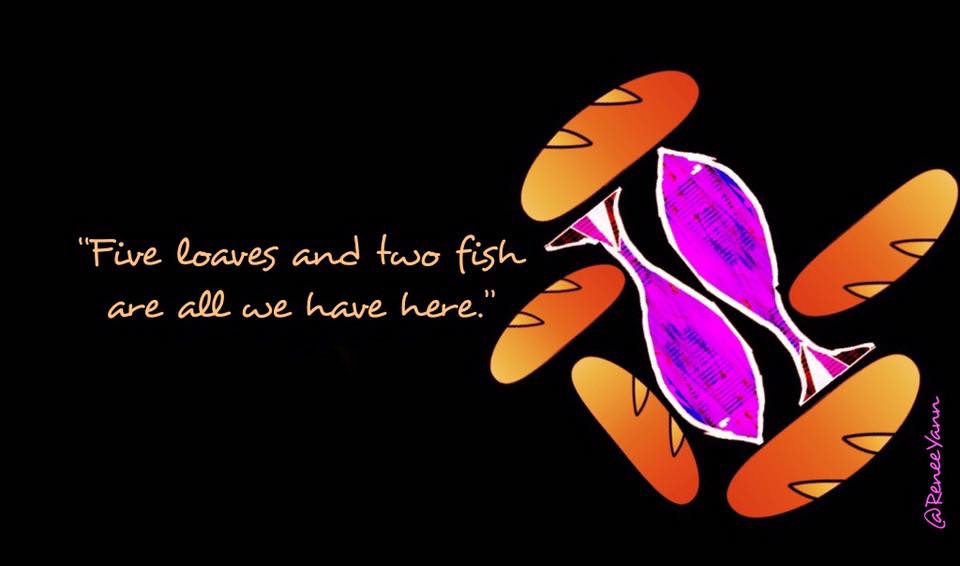
Our Gospel today gives us the familiar story of the feeding of the multitude. Mark describes a large crowd engaged in the search for God. They follow Jesus for three days, listening, learning, and being amazed at his miracles. They are so hungry to find something to believe in that they forget to feed their human hungers!
I love the compassionate way Jesus takes notice of their predicament:
“My heart is moved with pity for the crowd,
because they have been with me now for three days
and have nothing to eat.
If I send them away hungry to their homes,
they will collapse on the way,
and some of them have come a great distance.”
In this pivotal miracle, Jesus teaches a core lesson of faith.
In Christ, we are given the gift of full and abundant life. Our hearts then must become like his, moved in mercy toward those who are still hungry, both spiritually and physically.
The miracle of the loaves and fishes calls the faithful community to the practice of shared abundance. It invites us to notice the hungers around us and within our world. It moves us to understand the distances people experience from love, inclusion, respect, security, and peace. It convinces us that the need to have more and more will only yield less and less for our spirits.
Our culture works to convince us that we can never work hard enough or accumulate enough. It deludes us to believe that we matter because of what we have, not because of who we are. In this miracle, Jesus models another way to live in relationship with God, ourselves and with Creation:
Trust in and respect for the abundant generosity of God’s Creation
His disciples answered him, “Where can anyone get enough bread
to satisfy them here in this deserted place?”
Still he asked them, “How many loaves do you have?”
They replied, “Seven.”
He ordered the crowd to sit down on the ground.
Deep reverence and gratitude for God’s Presence in all life
Then, taking the seven loaves he gave thanks, broke them,
and gave them to his disciples to distribute,
and they distributed them to the crowd.
They also had a few fish.
He said the blessing over them
and ordered them distributed also.
They ate and were satisfied.
Acknowledgement of our need to replenish our spirits in rest and solitude
He dismissed the crowd and got into the boat with his disciples
and came to the region of Dalmanutha.
Somewhere in each of our lives, we might find a few loaves or minnows hidden away. Or we might be the famished one with an empty basket after a long journey. Today’s Gospel tells us to invite God’s transformative grace into our needs, hungers, inhibitions, or emptiness. Like this amazed Gospel crowd, we might be wowed at what God can do with our generous hearts!
Poetry: In the Storm – Mary Oliver
Some black ducks
were shrugged up
on the shore.
It was snowing
hard, from the east,
and the sea
was in disorder.
Then some sanderlings,
five inches long
with beaks like wire,
flew in,
snowflakes on their backs,
and settled
in a row
behind the ducks --
whose backs were also
covered with snow --
so close
they were all but touching,
they were all but under
the roof of the duck's tails,
so the wind, pretty much,
blew over them.
They stayed that way, motionless,
for maybe an hour,
then the sanderlings,
each a handful of feathers,
shifted, and were blown away
out over the water
which was still raging.
But, somehow,
they came back
and again the ducks,
like a feathered hedge,
let them
crouch there, and live.
If someone you didn't know
told you this,
as I am telling you this,
would you believe it?
Belief isn't always easy.
But this much I have learned --
if not enough else --
to live with my eyes open.
I know what everyone wants
is a miracle.
This wasn't a miracle.
Unless, of course, kindness --
as now and again
some rare person has suggested --
is a miracle.
As surely it is.
Music: Krystian Zimerman – Beethoven: Piano Concerto No. 5 in E Flat Major, Op. 73: II. Adagio un poco moto
A lovely piece to accompany our reflection on faith, miracles, and abundance.
 Lavish Mercy
❣️
LikeLike
Especially love the music. Thanks Renee!
LikeLike
Beautiful! Thanks Renee! ❤️🙏
LikeLiked by 1 person
❤️🙏 Think of you gratefully every day in prayer, Lucille.
LikeLike