Stay with the Journey

Friday of the Thirty-fourth Week in Ordinary Time
November 25, 2022

Today’s Readings:

https://bible.usccb.org/bible/readings/112522.cfm


Today, in God’s Lavish Mercy, we pray with Psalm 84, a praise and pilgrimage hymn. 

It is a perfect prayer for us if we have any small sense of alienation, loss, or confusion in our own pilgrimage.

And, honestly, who doesn’t!?

Even in the best of times, life can be a twist! And in “pandemic” times, politically charged times, economically shaky times??? Never a better time to say, “God help us!”


But Psalm 84 orients us. It announces what the journey is really about … the desire to find a resting place in God. Once we realize that, the road slowly straightens with the power of faith.

In Psalm 84, the pilgrim’s heart, hungry for God, sets out on the spiritual journey.

My soul yearns and pines 
for the courts of the LORD.
My heart and my flesh
cry out for the living God.

There can be a deep trust in our journeying heart because “even the sparrow” finds a home in God’s tender care.

Even the sparrow finds a home,
and the swallow a nest
in which she puts her young–
Your altars, O LORD of hosts,
my king and my God!


The secret, though, is constancy.:

  • We pilgrims must stay with the essence of our journey – the deep desire for God. 
  • We must listen to scripture’s “directions” about where God dwells – with the poor, humble, and merciful. 
  • We must not let the flashy road signs of the “Me Culture” distract us.


“The Narcissism Epidemic,” 
by psychologists Jean M. Twenge and W. Keith Campbell 
studies the increase of narcissism or “me-ism” in our culture. 
Here’s an excerpt:

Although these seem like a random collection of current trends, all are rooted in a single underlying shift in the American psychology: the relentless rise of narcissism in our culture. Not only are there more narcissists than ever, but non-narcissistic people are seduced by the increasing emphasis on material wealth, physical appearance, celebrity worship, and attention seeking. Standards have shifted, sucking otherwise humble people into the vortex of granite countertops, tricked-out MySpace pages, and plastic surgery. A popular dance track repeats the words “money, success, fame, glamour” over and over, declaring that all other values have “either been discredited or destroyed.”


Let’s pray today for “staying power”. We have been given the grace to seek God in our lives. Let’s dwell in that seeking, moving from strength to strength in any twists life tosses in front of us.

Blessed they who dwell in your house!
continually they praise you.
Blessed are we whose strength you are!
They go from strength to strength.


Poetry: The Journey – Tagore

The morning sea of silence broke into ripples of bird songs; 
and the flowers were all merry by the roadside;
and the wealth of gold was scattered through the rift of the clouds
while we busily went on our way and paid no heed.

We sang no glad songs nor played;
we went not to the village for barter;
we spoke not a word nor smiled;
we lingered not on the way.

We quickened our pace more and more as the time sped by.
The sun rose to the mid sky and doves cooed in the shade. 
Withered leaves danced and whirled in the hot air of noon.

The shepherd boy drowsed and dreamed in the shadow of the banyan tree, 
and I laid myself down by the water
and stretched my tired limbs on the grass.

My companions laughed at me in scorn;
they held their heads high and hurried on;
they never looked back nor rested;
they vanished in the distant blue haze.
They crossed many meadows and hills,
and passed through strange, far-away countries.

All honor to you, heroic host of the interminable path!
Mockery and reproach pricked me to rise, 
but found no response in me.

I gave myself up for lost
in the depth of a glad humiliation
—in the shadow of a dim delight.

The repose of the sun-embroidered green gloom 
slowly spread over my heart.
I forgot for what I had traveled,
and I surrendered my mind without struggle 
to the maze of shadows and songs.

At last, when I woke from my slumber and opened my eyes, 
I saw thee standing by me, flooding my sleep with thy smile. 
How I had feared that the path was long and wearisome, 
and the struggle to reach thee was hard!


Music: How Lovely Is Your Dwelling Place – Jesuit Music

Faithful Forever

Wednesday of the Thirty-fourth Week in Ordinary Time
November 23, 2022

Today’s Readings:

https://bible.usccb.org/bible/readings/112322.cfm

Today, in God’s Lavish Mercy,  our Responsorial Verse captures the essence of all the readings:

Rev 2_10JPG

It’s one of those scripture passages that makes one want to say, “Oh, really? Is that all?” 

Because, you know, it’s a pretty tall order to remain faithful until death. Sometimes it’s a real pinch to remain faithful for a week! 


Remember that exercise bike you bought in January 2020? Yeah, that one with your yoga pants, umbrella, and assorted tote bags hanging on it.

Or what about that South Beach diet book you’re using to prop open the closet door? How did all that faithfulness work out?

So, given our very human condition, what is the “faithfulness” these readings enjoin?

I believe it is not a faithfulness that never fails.

Rather, it tries. When it does fail, it believes in and seeks forgiveness. It trusts, even in its weakness. It is grateful, abiding, and loving. It is not afraid to begin again and again, because our faithfulness depends on God’s mercy not our strength.


When we were young nuns making our final vows, this phrase was part of our commitment: 

“… and to persevere, until death …” 

One of our wise leaders, Mother Bernard, told us, “Don’t pray for final perseverance. Pray to be worthy of it.”


I think we become worthy of perseverance by that trusting faithfulness which turns again and again into Mercy’s waiting, understanding arms. It is a faithfulness that fully believes these words from the Book of Lamentations:

The steadfast love of the Lord never ceases;
God’s mercies never come to an end;
they are new every morning;
so great is your faithfulness.

Lamentations 3: 22-23

Poetry: What God Hath Promised – Annie Johnson Flint (1866-1932) was born in Vineland, NJ. Incapacitated by severe arthritis, she started composing religious poetry, and became “a renowned writer across the Christian world.” Her popular poems include He Giveth More Grace and Christmas Carols, which were published in Christian Endeavour World and Sunday School Times. (Wikipedia)

God hath not promised skies always blue,
Flower strewn pathways all our lives through;
God hath not promised sun without rain,
Joy without sorrow, peace without pain.

But God hath promised strength for the day,
Rest for the labor, light for the way,
Grace for the trials, help from above,

Unfailing sympathy, undying love.


Music: Great Is Thy Faithfulness – Westminster Abbey

This is probably not the most perfect rendition of this beautiful hymn, but I just love seeing all these various people singing their praise. Imagine all of the stories and histories of faith woven through this worshipping congregation — and each one of them grateful for God’s faithfulness. As Catherine McAuley would say, “Oh what a joy even to think of it!”

The Winepress

Memorial of Saint Cecilia, Virgin and Martyr
November 22, 2022

Today’s Readings:

https://bible.usccb.org/bible/readings/112222.cfm

Rev 14_19 furyJPG

Today, in God’s Lavish Mercy, we are struck, once again, with Revelation’s images of the end time!

  • a crowned Christ wielding a sharp sickle
  • angels commanding the final harvest of the earth

and perhaps the most powerful

  • the earth’s vintage thrown into the great winepress of God’s fury!

This author could write! We can almost imagine the scene, filmed with all the pyro-technics of today’s computer age.

But besides the amazing imagery,
what does the passage say to our hearts?

In Biblical symbolism, the winepress almost always stands for judgment. The passage reminds us that we all will be judged.  The divine winepress will compress the sinful gaps that plague our human existence.  In the end time, there will be no “other” — no judgmental spaces separating us from one another.  We will all be one, like wine mingled.

We will be judged on how we lived that oneness in this life, on where we have stood in the worldly gap between the:

  • rich and poor
  • well and sick
  • citizen and refugee
  • abled and disabled
  • powerful and vulnerable

The questions for us as we pray today amy be these:

  • Do we live in ignorance or indifference to those who suffer on the other side of the human scale?
  • Have we been impervious to the imbalances of justice and charity in this world?
  • And how do we respond?

The passage suggests that we do some weeding of our spiritual gardens before the harvest of our souls. The intention of this fiery writer is to tell us that we still have a little time to do so.

Photo by Yan Krukov on Pexels.com

Poetry: Barnfloor and Winepress – Gerard Manley Hopkins

And he said, If the Lord do not help thee, whence shall I help thee?
out of the barnfloor, or out of the winepress? 
2 Kings VI: 27

Thou that on sin's wages starvest, 
Behold we have the joy in harvest: 
For us was gather'd the first fruits, 
For us was lifted from the roots, 
Sheaved in cruel bands, bruised sore, 
Scourged upon the threshing-floor; 
Where the upper mill-stone roof'd His head, 
At morn we found the heavenly Bread, 
And, on a thousand altars laid, 
Christ our Sacrifice is made! 
Thou whose dry plot for moisture gapes, 
We shout with them that tread the grapes: 
For us the Vine was fenced with thorn, 
Five ways the precious branches torn; 
Terrible fruit was on the tree
In the acre of Gethsemane; 
For us by Calvary's distress
The wine was racked from the press; 
Now in our altar-vessels stored
Is the sweet Vintage of our Lord.
In Joseph's garden they threw by 
The riv'n Vine, leafless, lifeless, dry: 
On Easter morn the Tree was forth, 
In forty days reach'd heaven from earth; 
Soon the whole world is overspread; 
Ye weary, come into the shade.
The field where He has planted us
Shall shake her fruit as Libanus, 
When He has sheaved us in His sheaf, 
When He has made us bear his leaf. - 
We scarcely call that banquet food, 
But even our Saviour's and our blood, 
We are so grafted on His wood. 

Music:  The Day Is Surely Drawing Near – written by the prolific 16th century Lutheran hymnist Bartholomaüs Ringwaldt. This piece is a majestic instrumental rendering, but if you would like to see the words, they are below. 

1 The day is surely drawing near
When Jesus, God’s anointed,
In all His power shall appear
As judge whom God appointed.
Then fright shall banish idle mirth,
And flames on flames shall ravage earth
As Scripture long has warned us.

2 The final trumpet then shall sound
And all the earth be shaken,
And all who rest beneath the ground
Shall from their sleep awaken.
But all who live will in that hour,
By God’s almighty, boundless pow’r,
Be changed at His commanding.

3 The books are opened then to all,
A record truly telling
What each has done, both great and small,
When he on earth was dwelling,
And ev’ry heart be clearly seen,
And all be known as they have been
In thoughts and words and actions.

4 Then woe to those who scorned the Lord
And sought but carnal pleasures,
Who here despised His precious Word
And loved their earthly treasures!
With shame and trembling they will stand
And at the judge’s stern command
To Satan be delivered.

5 My Savior paid the debt I owe
And for my sin was smitten;
Within the Book of Life I know
My name has now been written.
I will not doubt, for I am free,
And Satan cannot threaten me;
There is no condemnation!

6 May Christ our intercessor be
And through His blood and merit
Read from His book that we are free
With all who life inherit.
Then we shall see Him face to face,
With all His saints in that blest place
Which He has purchased for us. 

7 O Jesus Christ, do not delay,
But hasten our salvation;
We often tremble on our way
In fear and tribulation.
O hear and grant our fervent plea;
Come, mighty judge, and make us free
From death and ev’ry evil.

Time Passes

Memorial of The Presentation of the Blessed Virgin Mary
November 21, 2022

Today’s Readings:

https://bible.usccb.org/bible/readings/112122.cfm

Today, in God’s Lavish Mercy, our first reading from Revelation describes what has come to be known in modern culture as “the Rapture”. It’s a concept probably more popularized by modern fiction than by our devotion to scripture.

Rev 4_1 rapture

Maybe you are one of the  60 million readers of the “Left Behind” books by Jenkins and LaHaye. This popular series captures our fascination with “the end times”. 

The writer of Revelation is doing the same thing. This highly imaginative ancient author – adept at symbols, allegory, and poetry – writes to awake and engage us in our own salvation.

Whether or not his visions predict facts is not the point. The point is that there will come an end time to every life. When it comes to us, we want to have already become God’s familiar and beloved friend.

A second point is that this world, as we know it, is passing. We should not make our heart’s investment here. Our lasting treasure lies in God’s realm which, while present here, is often rendered invisible by our human hungers and distractions.

Revelation enjoins us to wake up, see beyond the visible, and live a life worthy of eternity. 

How? The true and simple answer is in today’s Gospel:

“When Jesus looked up he saw some wealthy people
putting their offerings into the treasure
and he noticed a poor widow putting in two small coins.
He said, “I tell you truly,
this poor widow put in more than all the rest;
for those others have all made offerings from their surplus wealth,
but she, from her poverty, has offered her whole livelihood.”

This blessed widow, even in her impoverished circumstances, understood where her true treasure lay. She was already counted among the sainted  “hundred and forty-four thousand”.


Poetry: The Rapture – Mary Oliver

All summer
I wandered the fields
that were thickening 
every morning, 
every rainfall, 
with weeds and blossoms, 
with the long loops
of the shimmering, and the extravagant-
pale as flames they rose
and fell back, 
replete and beautiful-
that was all there was-
and I too
once or twice, at least, 
felt myself rising, 
my boots
touching suddenly the tops of the weeds, 
the blue and silky air-
listen, 
passion did it, 
called me forth, 
addled me, 
stripped me clean
then covered me with the cloth of happiness-
I think there is no other prize, 
only rapture the gleaming, 
rapture the illogical the weightless-
whether it be for the perfect shapeliness
of something you love-
like an old German song-
or of someone-
or the dark floss of the earth itself, 
heavy and electric.
At the edge of sweet sanity open 
such wild, blind wings. 

Music: When I read these apocalyptic passages, I like to imagine the scene by listening to compatible music. One of my favorite accompaniments is Richard Wagner: Ride of the Valkyries. Just imagine Jesus riding into our lives on these exalted melodies!

Love’s Crown

The Solemnity of Our Lord Jesus Christ, King of the Universe
Sunday, November 20, 2022

Today’s Readings:

https://bible.usccb.org/bible/readings/112022.cfm

Today, in God’s Lavish Mercy, we celebrate the Solemnity of Christ the King. This feast was established in 1925 by Pope Pius XI by his encyclical Quas Primas. The Pope was acutely aware of the secularization of society and culture. He wanted this feast and devotion to bring people a deep awareness that Christ is the center of all Creation.

The images, language and metaphors surrounding the feast are ones that spoke to the people in the early 20th century. They may ring differently to us. Concepts of king”, “empire”, “dominion”, “subjection” tend to engender negative connotations for many of us. But our readings today can direct us to a deeper understanding of the characteristics Pius sought to highlight, ones that may speak more clearly to us in our time.


Our first reading from Samuel presents the anointing of David as King of Israel. Anointed by those who were “his own bone and flesh”, David prefigured the Incarnate Christ who, by the power of the Holy Spirit, took our flesh to redeem us.


Col1_15 image

The magnificent passage from Colossians offers exultant praise to the Creator for 

…delivering us from the power of darkness
and transferring us to the kingdom of the beloved Son,
in whom we have redemption …


And our Gospel gives us our precious Jesus on the Cross, teaching us the paradoxical truth of what his “Kingdom” really means – not oppressive dominion, but rather a sacrificial love that gives everything for the life of the beloved.

van eyck
Van Eyck’s painting of Christ King and his follower Petrus Christus’s Christ Suffering (15th C.)

Many cannot recognize such “kingship”. They cannot see the holy power within Christ’s sacrifice. They are, as Pius XI recognized for his time, blinded by a secularized culture and a dispirited life.

Let us pray today with the “justly condemned”, but spiritually enlightened, man in our Gospel who asked his Crucified King,

“Lord Jesus,
remember me
when you come into Kingdom!”


Poetry: As Kingfishers Catch Fire – Gerard Manley Hopkins

As kingfishers catch fire, dragonflies draw flame; 
As tumbled over rim in roundy wells 
Stones ring; like each tucked string tells, each hung bell's 
Bow swung finds tongue to fling out broad its name; 
Each mortal thing does one thing and the same: 
Deals out that being indoors each one dwells; 
Selves — goes itself; myself it speaks and spells, 
Crying Whát I dó is me: for that I came. 

I say móre: the just man justices; 
Keeps grace: thát keeps all his goings graces; 
Acts in God's eye what in God's eye he is — 
Chríst — for Christ plays in ten thousand places, 
Lovely in limbs, and lovely in eyes not his 
To the Father through the features of men's faces. 

Music: Jesus Remember Me

 Renee Yann, RSM

The Times of Our Lives

Saturday of the Thirty-third Week in Ordinary Time
November 19, 2022

Today’s Readings:

https://bible.usccb.org/bible/readings/111922.cfm

Today, in God’s Lavish Mercy, our readings are challenging. 

Revelation, a very complex book of the Bible, uses symbols, prophecies and allegorical references to make its point. There are huge bodies of scholarship written in the attempt to interpret these passages.

Our Gospel has Jesus describing what it will be like in heaven – when our human perceptions will be erased and we will finally be absorbed into God’s understanding.

These are BIG thoughts and my mind, at least, needs some more manageable inspirations for my morning prayer.  So here’s how I prayed with these readings today.

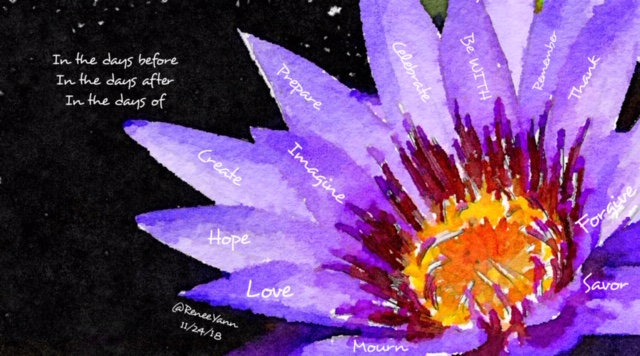
Lit yr flowerJPG

What both passages share are continual references to time – past, present and future. They reference then-time, now-time, and to-be-time. These passages, and others in Scripture like them, talk about time like this:

  • “in the days before” (then time)
  • “in the days after” (to -be time)
  • “in the day of” (now time)

So what is this day, November 19th, for me?
How is God revealing Love to me in this, my time? 

Today is among “the days after” the last memorable thing that happened in my life – maybe a good thing, maybe not so much. In “the days after”, we spend time with a completed event – learning, savoring, or perhaps regretting and recovering. The “days after” are a time to pray for grace and blessing over what cannot be changed.

Today is also among “the days before” the next big events of my life. So my prayer includes a petition for new and continued courage, hope and enthusiasm for life.

And, most importantly, today is “a day of”. I ask God to help me see and receive the graces of this present moment – not to miss them because I am looking only back or forward. Let me look God square in the eye on this day, which is the only place that I can really find the God Who is always Now.


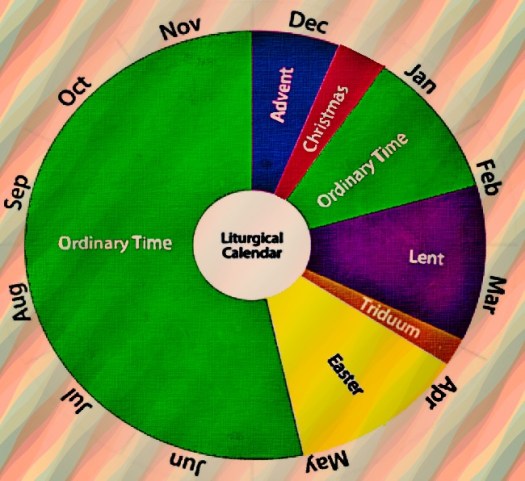
The entire liturgical year is built on this understanding of time. 

  • Advent and Lent are “the days before”, the days of preparation, anticipation, imagining, creating, hoping.
  • The feasts like Christmas, Easter and Pentecost are “the days of”, days of celebrating, loving, being with.
  • The various Octaves are “the days after”, days of remembering, thanking, appreciating, understanding, mourning, forgiving and savoring
lit yr

Where are you today in the times of your life? It may be in a very different place from what is printed on the calendar. The events of our lives create their own personal liturgies.

No matter where that happens to be, let us meet God there with full and open hearts.


Poetry: from Burnt Norton by T.S. Eliot

Time present and time past
Are both perhaps present in time future,
And time future contained in time past.
If all time is eternally present
All time is unredeemable.
What might have been is an abstraction
Remaining a perpetual possibility
Only in a world of speculation.
What might have been and what has been
Point to one end, which is always present.
Footfalls echo in the memory
Down the passage which we did not take
Towards the door we never opened
Into the rose-garden. My words echo
Thus, in your mind.
But to what purpose
Disturbing the dust on a bowl of rose-leaves
I do not know.
Other echoes
Inhabit the garden. Shall we follow?


Music: God of All My Days – Casting Crowns

Promises, Promises!

Friday of the Thirty-third Week in Ordinary Time
November 18, 2022

Today’s Readings:

https://bible.usccb.org/bible/readings/111822.cfm

Today, in God’s Lavish Mercy, we pray with our longest Psalm 119. 

This morning, we take one little morsel from its extended string of reflections :


The word “promise” can evoke a range of responses from us. Indeed, they are sweet as the psalmist says. But they can also be elusive, ephemeral, and easily broken. I know I’ve have made a few promises in my lifetime that have fizzled away unfulfilled. Haven’t you?

On the other hand, there are some promises, kept, that have rooted and defined my life. These, made in the bud, have blossomed in a long, tendered fidelity. They have dug the deep roots of trust for the essential relationships of my life with God, beloved neighbor, and all Creation.


Such vital promises can be made and kept when we act in the image of God, the loving and faithful Promise Keeper described in Psalm 119:

Your word, LORD, stands forever;
it is firm as the heavens.
Through all generations your truth endures;
fixed to stand firm like the earth.Psalm 119: 89 – 90


Like the psalmist, we pray:

  • to be imitators of God who is always faithful.
  • to be promise-keepers in response to the trust God has placed in us by the gift of our creation.
  • to meditate on, and understand in our hearts, the divine order of God’s immutable Law of Love

Poetry: Psalm 119 – Christine Robinson

Dear God, The seed of your love is deep within
every molecule of the universe, and it abides through time.
The laws of the cosmos serve your purpose to the end.
If I remember this, I can abide all manner of trouble.
If I delight in this, it gives me life.
I belong to you to my very core.
Holding firm to that knowledge, I can live my life in love.
All things will come to and end.
And in the end all will be One
My mind is filled with your Way
Making me wise like a teacher or an elder.
Mastering my life in your way gives me purpose.
Many times I use it to guide my steps.
My mouth waters and my heart softens to consider your Way.

Music: God Hath Not Promised – Annie Johnson Flint

This charming 19th century hymn captures the faithful spirit of it composer whose life, though beset by suffering, radiated faith and joy. 

Read more about her life here

A Dance of Praise

Memorial of St. Elizabeth of Hungary
November 17, 2022

Today’s Readings:

https://bible.usccb.org/bible/readings/111722.cfm

Today, in God’s Lavish Mercy, we pray with Psalm 149 which calls the community to sing and dance because God has delivered them.

This happy, celebratory summons is set, contrastingly, between two readings that mention weeping.

Then I saw a mighty angel who proclaimed in a loud voice,
“Who is worthy to open the scroll and break its seals?”
But no one in heaven or on earth or under the earth
was able to open the scroll or to examine it.
I shed many tears because no one was found worthy
to open the scroll or to examine it.

Revelation 5: 2-4

As Jesus drew near Jerusalem,
he saw the city and wept over it, saying,
“If this day you only knew what makes for peace–
but now it is hidden from your eyes.

Luke 19: 41-42

The readings leave us with a sense that there is a secret to eternal life –
a secret to which only grace can open our eyes and hearts.


John writes that “the Lion of Judah” has the key:

One of the elders said to me, “Do not weep.
The lion of the tribe of Judah, the root of David, has triumphed,
enabling him to open the scroll with its seven seals.”

Revelation 5: 5-6

Jesus, Uncreated Grace, is the Lion of Judah. He has incarnated the sacred key in his Life, Death, and Resurrection. For those who receive him and share his life, the door is opened, the scroll unrolled.

So what is the path to such union with Jesus? 


Our psalm contains a brief line tucked at its center which foreshadows the entire message of the Gospel. 

Let them praise God’s name in the festive dance,
let them sing praise with timbrel and harp.
For the LORD loves us,
and adorns the lowly with victory.

We will find a dancing, singing joy when we give ourselves to these truths:

  • God loves us irrevocably
  • We can fully receive this great love to the degree that we become like Christ whose image we find among the poor, lowly, and suffering.

Poetry: Dance from Rumi

Come to me, and I shall dance with you
In the temples, on the beaches, through the crowded streets
Be you man or woman, plant or animal, slave or free
I shall show you the brilliant crystal fires, shining within
I shall show you the beauty deep within your soul
I shall show the path beyond Heaven.
Only dance, and your illusions will blow in the wind
Dance, and make joyous the love around you
Dance, and your veils which hide the Light
Shall swirl in a heap at your feet.

Music:  Psalm 149 – Antonín Dvořák

Our Splendid God

Wednesday of the Thirty-third Week in Ordinary Time
November 16, 2022

Today’s Readings:

https://bible.usccb.org/bible/readings/111622.cfm

Today, in God’s Lavish Mercy, we move deeper into the final weeks of Ordinary Time. Our readings continue to offer us images about what it will be like at the end of time.  

In our passage from Revelation, we are given an ornate and exuberant description of how the author envisions God’s “headquarters”, so to speak. With all its gems and thrones and crowns and flaming torches, the passage can be a little overwhelming. But what is the core message? I think it is this:

God is the Splendid Creator. Despite time’s destruction, Creation will be ultimately perfected by our Perfect God. Believing this, we are called to awe-filled worship and gratitude, as spoken in these two verses from the passage:

“Holy, holy, holy is the Lord God almighty,
who was, and who is, and who is to come.”

Revelation 4:8

“Worthy are you, Lord our God,
to receive glory and honor and power,
for you created all things;
because of your will they came to be and were created.”

Revelation 4:11

Today’s Gospel about the talents reminds us that we each have been given particular gifts with which to build up God’s Creation. Like the watchful Master, God expects – and needs – us to use these gifts, and to increase their value by sharing them with our sisters and brothers.

Sometimes we think we have no real gifts to give. But the witness of a simple, faithful, generous life is beyond price.

We may want to spend some prayer time reflecting on the many gifts we have been given – by God and by those who love us, and how we might offer these in worship to our Splendid Generous God.


Poetry: Advice to a ProphetRichard Wilbur (1921 – 2017) was an American poet and literary translator. One of the foremost poets of his generation, Wilbur’s work, composed primarily in traditional forms, was marked by its wit, charm, and gentlemanly elegance. He was appointed the second Poet Laureate Consultant in Poetry to the Library of Congress in 1987 and received the Pulitzer Prize for Poetry twice, in 1957 and 1989.

In Wilbur’s poem, we get a different vision of what the end of times might be like, and how we might respond to the prophet who describes such times.

When you come, as you soon must, to the streets of our city,
Mad-eyed from stating the obvious,
Not proclaiming our fall but begging us
In God's name to have self-pity,

Spare us all word of the weapons, their force and range,
The long numbers that rocket the mind;
Our slow, unreckoning hearts will be left behind,
Unable to fear what is too strange.

Nor shall you scare us with talk of the death of the race.
How should we dream of this place without us?—
The sun mere fire, the leaves untroubled about us,
A stone look on the stone's face?

Speak of the world's own change. Though we cannot conceive
Of an undreamt thing, we know to our cost
How the dreamt cloud crumbles, the vines are blackened by frost,
How the view alters.  We could believe,

If you told us so, that the white-tailed deer will slip
Into perfect shade, grown perfectly shy,
The lark avoid the reaches of our eye,
The jack-pine lose its knuckled grip

On the cold ledge, and every torrent burn
As Xanthus once, its gliding trout
Stunned in a twinkling.  What should we be without
The dolphin's arc, the dove's return, 

These things in which we have seen ourselves and spoken?
Ask us, prophet, how we shall call
Our natures forth when that live tongue is all
Dispelled, that glass obscured or broken

In which we have said the rose of our love and the clean
Horse of our courage, in which beheld
The singing locust of the soul unshelled,
And all we mean or wish to mean.

Ask us, ask us whether with the worldless rose
Our hearts shall fail us; come demanding
Whether there shall be lofty or long standing
When the bronze annals of the oak-tree close.

Music: We Have Gifts to Share – Susan Kay Wyatts – This is a childlike song, but the point is profound. For those with young children and Grands, you might like to share this song with them.