John, the Lover

Feast of Saint John, Apostle and evangelist
December 27, 2023

Today’s readings:

https://bible.usccb.org/bible/readings/122723.cfm

Today, in God’s Lavish Mercy, we begin a three-week immersion in John’s magnificent first letter. At the same time, our Gospels will take us on a somewhat random journey with Jesus through his very early years.

Today’s Gospel, however, differs from the expected pattern and – yes, right here in the Christmas season – gives us an account of the Resurrection!

Early in the morning, on the first day of the week,
Mary Magdalene ran and went to Simon Peter
and to the other disciple whom Jesus loved, and told them,
“They have taken the Lord from the tomb,
and we do not know where they put him.”
So Peter and the other disciple went out and came to the tomb.
They both ran, but the other disciple ran faster than Peter
and arrived at the tomb first;
he bent down and saw the burial cloths there, but did not go in.
When Simon Peter arrived after him,
he went into the tomb and saw the burial cloths there,
and the cloth that had covered his head,
not with the burial cloths but rolled up in a separate place.
Then the other disciple also went in,
the one who had arrived at the tomb first,
and he saw and believed.
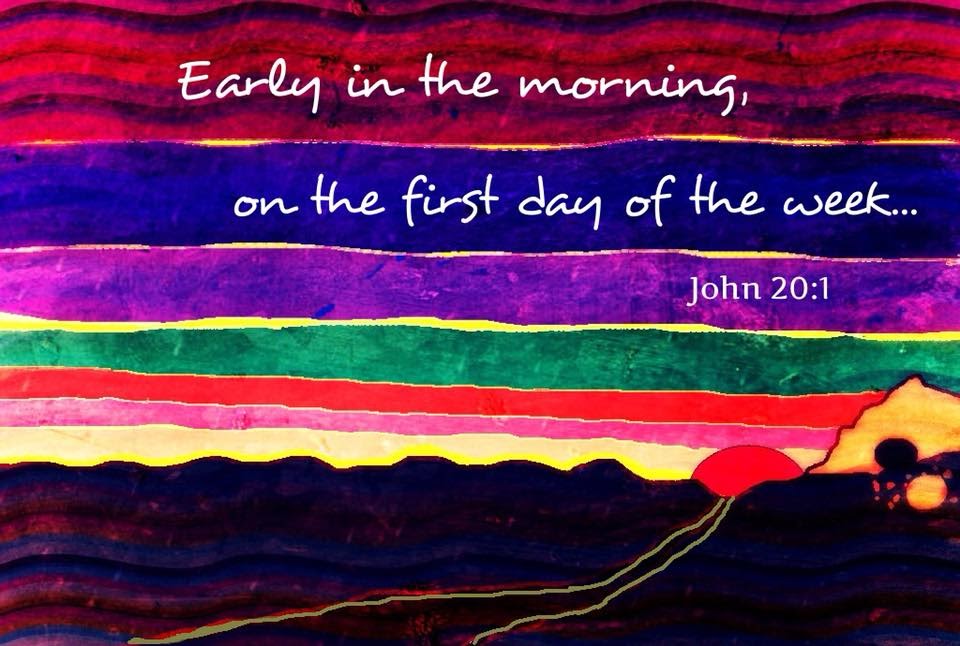
John 20: 1-8

Did somebody get mixed up? Did someone think it was the Octave of Easter, not Christmas! No, of course not. I think the choice of this Gospel, at this point in the Liturgical Year, serves at least two purposes:

  • From the start of Christ’s life, it establishes how his days will end. Therefore, throughout the ensuing year, we are to read and interpret all of the Gospel in the glorious light of the Resurrection.
  • Placing this Gospel here, to accompany our first reading, clarifies exactly who John is — the one who indeed saw, heard, and touched the Word of God made visible in Jesus Christ and therefore is eminently qualified to testify to Christ.

Beloved:
What was from the beginning,
what we have heard,
what we have seen with our eyes,
what we looked upon
and touched with our hands
concerns the Word of life —
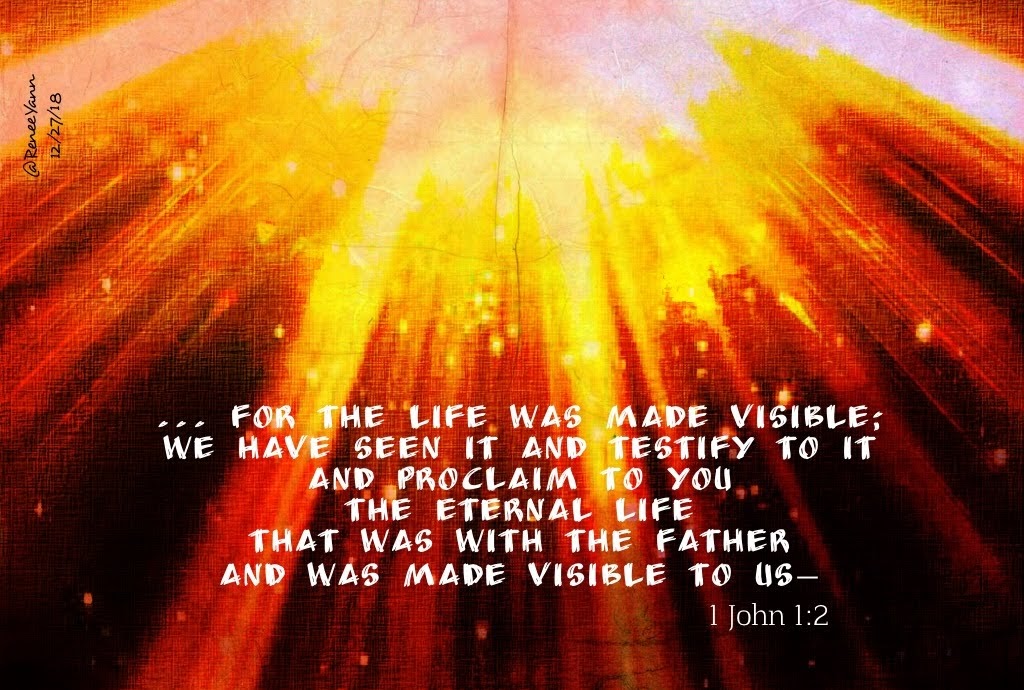
for the life was made visible;
we have seen it and testify to it
and proclaim to you the eternal life
that was with the Father and was made visible to us—

1 John 1:1-2

One very popular form of both fiction and non-fiction is the love letter. Some of the most wonderful books are in the genre. Three of my favorites fit the category:

  • 84, Charing Cross Road – Helene Hanff
  • The Love Letters – Madeleine L’Engle
  • A Green Journey – John Hassler

Reading such literature evokes a reverence for the lives we touch in the gathered words. We read what is said and imagine what is unsaid. We witness the depth of another’s self-donation and we ponder our own capacity for such a gift.


In 1 John, we are granted the privilege of reading John’s love letters to his God and to his community. John’s love is profoundly deep yet simply expressed. We might tend to skip through his rich but clipped phrases. But to truly plumb them requires us to suspend time and rest with his words until they open in us like flowers in sunlight.


Poetry: The Living Word – Herman Hesse

The sun speaks to us through light.
Flowers give voice to fragrance and colour.
The air communes through clouds, snow, and rain.
From the sacred center of the world
streams forth an irrepressible desire
to overcome the silence between things.
Art, the ever flowing fountain, reveals
the secret of life through word and gesture, colour and sound.

The world wants to be known to spirit
and find expression for timeless wisdom.
All life longs for a language.
Deep intuitions wish to surface,
find words and numbers, lines and tones,
always evolving forms of understanding.

The red and blue of flowers
and the verses of the poet
point to the inner workings of creation,
always pregnant with beginning and never-ending.
When word and sound marry,
where songs soar and art unfolds
all life is brimmed again with spirit.
And every melody and book
and every painting is a revelation,
is another fresh attempt
to unfold the harmony of life.
Poetry and music invite you
to understand the splendors of creation.
A look into a mirror will confirm it.
What disturbs us often as disjointed
becomes clear and simple in a poem:
Flowers start laughing, the clouds release their rain,
the world regains its soul, and silence speaks.

Music: Love Letter – Anthony Nelson

Preventing One Another

Tuesday of the Thirty-first Week in Ordinary Time
November 7, 2023

Today’s Readings:

https://bible.usccb.org/bible/readings/110723.cfm


Today, in God’s Lavish Mercy, Paul gives us one of his most heartfelt and beautiful passages, and Jesus offers us a puzzling parable about the kingdom.

Rms12_10 honor

Paul’s exhortation to sincere holiness is a passage that warrants frequent reading. At any given point in our lives, one or another of its encouragements will seem to ring profoundly true with our circumstances.

One of the lines that I particularly cherish goes like this in the old Douay-Rheims version, which is where I first encountered it as a young girl:

Love one another with fraternal charity:
with honor preventing one another.

The bolded phrase fascinated me. I didn’t understand what it meant. From what were we to prevent one another?

It was not until I came to the convent that I begin to discern the power of this verse. At the time (during the Dark Ages, of course), the Sisters lived under the 1952 Constitutions of the Sisters of Mercy, an adaptation of the ancient Rule of St. Augustine. As postulants, we each received a 4×6, 128 page copy of the Rule. In direct and intentional language, it set the frame for our whole lives.

I nearly memorized it, especially Chapter 14 on Union and Charity. Right in the middle of the Chapter, I found this precious line:

They (the Sisters) shall sincerely respect one another. The young shall reverence the old and all shall unceasingly try in true humility to promote constant mutual cordiality and deference, “with honor preventing one another”.

Sister Inez, our dear early instructor, explained that this meant to anticipate the needs of our beloved sisters, especially the elderly; to do for them what might be difficult for them before they had to ask. In other words, to prevent their need. She said that this anticipatory charity should mark our service toward everyone, especially the poor, sick and ignorant whom we would vow to serve.


The more all of us can live together with this mutual love and respect, the closer we come to the kingdom of God, to the banquet table described in today’s Gospel. Jesus came to gather us all around this table. Pity on those who resist his invitation because their lives are entangled in self-interested endeavors. Their places are taken by “the poor, the crippled, the blind and the lame” and all those on the margins of society.

As we join our sisters and brothers at the banquet of life, may we love and serve one another sincerely, always with honor preventing one another.


Poetry: Emily Dickinson

If I can stop one heart from breaking,
I shall not live in vain;
If I can ease one life the aching,
Or cool one pain,
Or help one fainting robin
Unto his nest again,
I shall not live in vain.

Music: a little motion mantra this morning. Maybe you might want to get up outta’ that chair and join in🤗

The Key of Knowledge

Memorial of Saints John de Brébeuf and Isaac Jogues
Thursday of the Twenty-eighth Week in Ordinary Time
October 19, 2023

Today’s Readings:

https://bible.usccb.org/bible/readings/101923.cfm


Today, in God’s Lavish Mercy, “the Law” plays a central role in our readings.

At their best, laws are those commonly agreed-upon markers that guide the human community on its shared journey. Ideally conceived in the context of justice, every law will lead to a balance of well-being for all concerned.


It is in the human administration of law that we meet challenges. Such administration rests in the hands of “superiors” who are, like all of us, subject to prejudice, ignorance, domination, and arrogance. These individuals can regress to an interpretation of law that benefits only themselves and those they favor.

In our Gospel, Jesus vociferously condemns this corruption of the Law by the very people who have been entrusted with its integrity:

Woe to you, scholars of the law!
You have taken away the key of knowledge.
You yourselves did not enter and you stopped those trying to enter.

Luke 11:52

What is that “key of knowledge” Jesus refers to? I think it is this: that the Law is only peripheral. While it must be respected, it must also be transcended so that we live beyond it and into the Spirit Who generates it.


In our first reading, Paul makes an astounding statement that surely knocked the pharisaical legalists on their pins! Paul says that God’s righteousness is not found in the Law but solely in faith in Jesus Christ.

Now the righteousness of God has been manifested apart from the law,
though testified to by the law and the prophets,
the righteousness of God through faith in Jesus Christ
for all who believe.

Romans 3:21-22

This passage in Romans is critical to the Christian understanding of “righteousness”. No one can achieve righteousness apart from the grace of God which is given to us solely as gift and not reward for our actions. But it is also essential that a person create an inner receptivity to grace, a receptivity achieved through the personal exercise of faith, hope, and love – that is, by the works of mercy.


Since the early 16th century, various Christian denominations have been trying to split the hair of this argument which is dubbed “Sola Fide (faith alone)”. The argument asks, “Are we made right with God by faith alone, or by faith demonstrated in good works?”.

Paul and Jesus addressed the question fifteen hundred years before anybody even thought up the Sola Fide conundrum. They did so in direct and simple language so that their listeners could learn and feel confident in their faith life.


The debate around “sola fide” can devolve into theological hair-splitting, an exercise that seems almost like an intellectual game. Contrary to hair-splitting, our faith life is fostered by a theology deeply rooted in spirituality and evidenced in reverent, grateful, and charitable living. Laws can help us with that pursuit but they can’t accomplish it. Only an active, loving faith, responsive to God’s grace, can unlock that door.


Prose: Excerpt from Lumen Fidei (The Light of Faith), the first encyclical of Pope Francis (June 29, 2013)

(This passage and the encyclical as a whole are so beautiful that I hope you will take time to savor the words, even in small doses. I broke it up into small sections because that’s the way I best prayed with it.)

Since faith is a light, it draws us into itself, 
inviting us to explore ever more fully 
the horizon which it illumines, 
all the better to know the object of our love. 

Christian theology is born of this desire. 
Clearly, theology is impossible without faith; 
it is part of the very process of faith, 
which seeks an ever deeper understanding 
of God’s self-disclosure culminating in Christ. 

It follows that theology is more 
than simply an effort of human reason 
to analyze and understand, 
along the lines of the experimental sciences. 
God cannot be reduced to an object. 
He is a subject who makes himself known 
and perceived in an interpersonal relationship. 

Right faith orients reason to open itself 
to the light which comes from God, 
so that reason, guided by love of the truth, 
can come to a deeper knowledge of God. 

The great medieval theologians and teachers 
rightly held that theology, as a science of faith, 
is a participation in God’s own knowledge of himself. 
It is not just our discourse about God, 
but first and foremost the acceptance and the pursuit 
of a deeper understanding 
of the word which God speaks to us, 
the word which God speaks about himself, 
for he is an eternal dialogue of communion, 
and he allows us to enter into this dialogue. 

Theology thus demands the humility 
to be "touched" by God, 
admitting its own limitations before the mystery, 
while striving to investigate, 
with the discipline proper to reason, 
the inexhaustible riches of this mystery.

Music: Spirit Seeking Light and Beauty – Janet Erskine Stuart, RSCJ

The Lie and The Truth

Memorial of Saint Ignatius of Antioch, Bishop and Martyr
Tuesday of the Twenty-eighth Week in Ordinary Time
October 17, 2023

Today’s Readings:

https://bible.usccb.org/bible/readings/101723.cfm


Today, in God’s Lavish Mercy, both Paul and Jesus speak forcefully against an endemic human fault: dishonesty.


Paul castigates “those who suppress the truth by their wickedness”:

The wrath of God is indeed being revealed from heaven
against every impiety and wickedness
of those who suppress the truth by their wickedness.
For what can be known about God is evident to them,
because God made it evident to them.
Ever since the creation of the world,
his invisible attributes of eternal power and divinity
have been able to be understood and perceived in what he has made.

Romans 1:18-20

These “truth suppressors” are guilty for one reason – they know better! God’s Truth is evident to them in Creation yet they deny and pervert it for the sake of their own selfish ends.

As a result, they have no excuse;
for although they knew God
they did not accord him glory as God or give him thanks.
Instead, they became vain in their reasoning,
and their senseless minds were darkened.
While claiming to be wise, they became fools
and exchanged the glory of the immortal God
for the likeness of an image of mortal man
or of birds or of four-legged animals or of snakes.

Romans 1:20-23

Jesus defines this untruth more clearly. He says that it presents itself in pretense – the external dissimulation which masquerades narcissistic motivations:

The Pharisee (who had invited Jesus to dinner) was amazed to see
that Jesus did not observe the prescribed washing before the meal.
The Lord said to him, “Oh you Pharisees!
Although you cleanse the outside of the cup and the dish,
inside you are filled with plunder and evil.
You fools!
Did not the maker of the outside also make the inside?
But as to what is within, give alms,
and behold, everything will be clean for you.”

Luke 11:38-41

Jesus indicates that charity is the perfect “cleanser” for dirty cup interiors (and dingy moral codes). Sounds easy enough, doesn’t it? Well, maybe not so easy but certainly clear and simple.

Charity is rooted in the interior recognition that we are all children of our Creator and that we have a responsibility for one another’s welfare. Acting on that recognition is “almsgiving” which comes from the same Greek root, “eleemosyne“, as the word mercy.


Our world, like Paul’s, is challenged by the suppression of truth. Much of our visible culture is based on lies and pretense. Political hoodwinking, media non-objectivity, economic duplicity, and exploitive advertising conspire to convince us that:

  • we ourselves never are or have enough
  • anyone not “like us” is a threat to our insufficiency
  • foreigners are dangerous
  • power grants sovereignty
  • the poor are solely responsible for their poverty.

Jesus and Paul tell us that we must resist such lies, purify our hearts of their influence, and live a Gospel life of truth, charity, and mercy.


Prose: from the Catholic Encyclopedia:

I found this definition of almsgiving very thought-provoking because it indicates that “almsgiving or “mercy” is more than an act or actions. It is an attitude and lifestyle, a lens through which we consider all things in the light of the Gospel for the sake of the poor:

Any material favor done to assist the needy, and prompted by charity, is almsgiving. It is evident, then, that almsgiving implies much more than the transmission of some temporal commodity to the indigent. According to the creed of political economy, every material deed wrought by humans to benefit the needy is almsgiving. According to the creed of Christianity, almsgiving implies a material service rendered to the poor for Christ’s sake. Materially, there is scarcely any difference between these two views; formally, they are essentially different. This is why the inspired writer says: “Blessed is the one that considers the needy and the poor” (Psalm 40:2) — not the one that gives to the needy and the poor.


Music: The Prisoners’ Chorus – from Beethoven’s only opera Fidelio

Fidelio is inspired by a true story from the French Revolution. It centers on a woman, Leonore, whose husband Florestan has been unjustly imprisoned by his political rival – the villainous Don Pizarro. In the magnificent “Prisoners’ Chorus”, the prisoners sing powerfully about the gift and need for freedom.

Oh what joy, in the open air
Freely to breathe again!
Up here alone is life!
The dungeon is a grave.

FIRST PRISONER
We shall with all our faith
Trust in the help of God!
Hope whispers softly in my ears!
We shall be free, we shall find peace.

ALL THE OTHERS
Oh Heaven! Salvation! Happiness!
Oh Freedom! Will you be given us?

Neighbor

Monday of the Twenty-seventh Week in Ordinary Time
October 9, 2023

Today’s Readings:

https://bible.usccb.org/bible/readings/100923.cfm


Today, in God’s Lavish Mercy, get ready for a three-day cruise with Jonah and a radical journey down the Jericho road with the Good Samaritan.

The message of Jonah is clear: all people, even hated Ninevites, are children of God’s Mercy. Resisting that understanding can be catastrophic to our spiritual life.


Patricia Tull, Rhodes Professor Emerita of Old Testament at Louisville Seminary, summarizes the Book of Jonah like this:

A postexilic book, Jonah’s story is atypical for prophetic works. Not only is it a narrative about the prophet rather than his speeches, but it also rebuffs Jonah for his refusal to preach to foreign enemies. Jonah’s story portrays foreigners as more than ready to repent and turn to God. The book uses humor, hyperbole, and irony to make its parabolic point.

Our Gospel gives us one of the most beloved yet challenging parables of Jesus – who is our “neighbor”. The infinite dimensions within this parable continue to unfold for us as we deepen in our mercy spirituality.

God does not see anyone as a “foreigner”. Every human being lives with the breath of God. We are “neighbors” because we share that breath, that “neighborhood” of God’s boundless Love.


But, oh my God, how we have forgotten or rejected that common bond of reverence for one another! Just yesterday, one of our sisters brought up the subject of a recent hit-and-run accident in Philadelphia. It now seems to be the common practice to leave the scene of such an occurrence, abandoning the victim to his fatal circumstance. She wondered, incredulously, how anyone could be that callous.


Our Gospel parable describes that callousness. Notice that both the priest and the Levite pass the victim by “on the opposite side“. The phrase implies that if I can build a wall to make you invisible to me, I can more easily ignore your claim on my merciful neighborliness.

The Samaritan lived without those walls. He did not see a Jew, or a foreigner, or an expendable “other”. He saw a human being, like himself – a neighbor who was struggling to live.

The Good Samaritan (1880) by Aimé Morot


Jesus’ parable of the Good Samaritan is a clear example of the call of the Gospel to neighborliness. In the story, such a call is an inconvenient truth because it summons outside the comfortable community to find the neighbor among the not-well-regarded “others.” 

Walter Brueggemann, Health Progress, January – February 2010

We don’t want to be like resistant Jonah, nor like the prejudicially blinded priest and Levite of our parable. But it is hard. The world conspires to separate us into the haves and the have-nots, the deserving and the undeserving, the winners and the losers, the sinners and the saints. Mercy not only resists but dismantles such walls. Do we have the courage to examine our own prejudices and to step across from “the opposite side” for the sake of our neighbor?


Poem: Neighbor – Iain Crichton Smith

Build me a bridge over the stream
to my neighbour’s house
where he is standing in dungarees
in the fresh morning.
O ring of snowdrops
spread wherever you want
and you also blackbird
sing across the fences.
My neighbor, if the rain falls on you,
let it fall on me also
from the same black cloud
that does not recognize gates.

Music: JJ Heller – Neighbor

Sometimes it's easier to jump to conclusions
Than walk across the street
It's like I'd rather fill the blanks with illusions
Than take the time to see
You are tryna close the back door of your car
You are balancing the groceries and a baby in your arms
You are more than just a sign in your front yard
You are my neighbor
I can get so lost in the mission
Of defending what I think
I've been surfing on a sea of opinions
But just behind the screen
You are grateful that the work day's finally done
You are stuck in miles of traffic, looking at your phone
You are tryin' to feel a little less alone
You are my neighbor
When the chasm between us feels so wide
That it's hard to imagine the other side
But we don't have to see things eye to eye
For me to love you like you are my neighbor
My neighbor
Oh, to fear the unfamiliar
Is the easy way to go
But I believe we are connected more than we might ever know
There's a light that shines on both the rich and poor
Looks beyond where we came from and who we voted for
'Til I can't see a stranger anymore
I see my neighbor
May my heart be an open door to my neighbor
You are my neighbor

Money is Not Enough

Friday of the Twenty-fourth Week in Ordinary Time
September 22, 2023

Today’s Readings:

https://bible.usccb.org/bible/readings/092223.cfm


Today, in God’s Lavish Mercy, we pray with Psalm 49, the point of which according to Walter Brueggemann is this:

The point is that death is the great equalizer, 
and those who are genuinely wise 
should not be impressed by or committed to 
that which the world over-values.

Walter Brueggemann: From Whom No Secrets Are Hid

We may have heard the sentiment stated more succinctly by an anonymous scholar:

You can’t take it with you.


This is the core message Paul imparts to Timothy in our first reading:

For the love of money is the root of all evils,
and some people in their desire for it have strayed from the faith
and have pierced themselves with many pains.

1 Timothy 6:10

The advice is about more than money, or “dollar-bucks” as my 7-year-old grandnephew calls them.


The instruction is about our priorities – 
whom, why and what 
we love, value, and sacrifice for.

Walter Brueggemann

The opposite of this “love of money” is an unselfish, sacrificial love for others. This is the love Jesus hopes for in his disciples as he blesses them in today’s Gospel.

It takes courage to live such discipleship. As human beings, we tend to fear any kind of deprivation. We crave security, and sometimes we think money and possessions can give us that. Our readings today redirect that all too common misperception.

The world can be a very dark place, and of course, we will have fears and worries. Paul and our psalmist direct us to the right place to calm these concerns. Jesus calls us to believe in and live in the Light which is our true security.

Our psalm reminds us to keep our eyes on the eternal promise we have all been given.

But God will redeem my life,
will take me from the hand of Darkness.

Psalm 49:16

Poetry: Accepting This – Mark Nepo

Yes, it is true. I confess,
I have thought great thoughts,
and sung great songs—all of it
rehearsal for the majesty
of being held.
The dream is awakened
when thinking I love you
and life begins
when saying I love you
and joy moves like blood
when embracing others with love.
My efforts now turn
from trying to outrun suffering
to accepting love wherever
I can find it.
Stripped of causes and plans
and things to strive for,
I have discovered everything
I could need or ask for
is right here—
in flawed abundance.
We cannot eliminate hunger,
but we can feed each other.
We cannot eliminate loneliness,
but we can hold each other.
We cannot eliminate pain,
but we can live a life
of compassion.
Ultimately,
we are small living things
awakened in the stream,
not gods who carve out rivers.
Like human fish,
we are asked to experience
meaning in the life that moves
through the gill of our heart.
There is nothing to do
and nowhere to go.
Accepting this,
we can do everything
and go anywhere.

Music: His Eye is on the Sparrow (You might recall this version from the movie “Sister Act II”)

Worthy of the Call

Feast of Saint Matthew, Apostle and evangelist
September 21, 2023

Today’s Readings:

https://bible.usccb.org/bible/readings/092123.cfm

Today, in God’s Lavish Mercy, we pray with Paul and Matthew that we may deepen our reverence for the call we have received.

I, a prisoner for the Lord,
urge you to live in a manner worthy of the call you have received,
with all humility and gentleness, with patience,
bearing with one another through love,
striving to preserve the unity of the Spirit
through the bond of peace:
one Body and one Spirit,
as you were also called to the one hope of your call;
one Lord, one faith, one baptism;
one God and Father of all,
who is over all and through all and in all.

But grace was given to each of us
according to the measure of Christ’s gift. 

Ephesians 4:1-7

Many of us think of a “call” as a one-time event, for example, the moment we say “yes” to a marriage proposal, or the profession of vows in religious commitment.

Our Gospel describes such a life call for Matthew:

As Jesus passed by,
he saw a man named Matthew sitting at the customs post.
He said to him, “Follow me.”
And he got up and followed him.

Matthew 9:9

But we can be certain that this was not Matthew’s only and final call. Jesus kept calling Matthew every day of his life to move deeper and deeper into the heart of God.

Like Matthew, we are all sitting at the table of life sometimes unaware of God’s power passing right in front of us. Matthew looked up from his tax sheets just in time to see Jesus’s all-knowing, all-loving glance. And that moment changed everything for Matthew. The call, crystalized in that sacred moment, had unfolded for years and would continue to unfold throughout Matthew’s life.


Maybe we spend a lot of our time fiddling with life’s calculations like Matthew did. We need to make our checkbooks balance, our calendars synchronize, our recipes succeed, our bills resolve. Sometimes we have so much ciphering going on that we don’t even glance up to see real Life passing by.


Jesus teaches that the underlying calculus of our lives must be mercy. He wants us to see where mercy is needed and to spend ourselves in its name. When Matthew’s buddies criticized him for following his call, Jesus confronted them with their own call, “Go and learn…”

The Pharisees saw this and said to his disciples,
“Why does your teacher eat with tax collectors and sinners?”
He heard this and said,
“Those who are well do not need a physician, but the sick do.
Go and learn the meaning of the words,
I desire mercy, not sacrifice.
I did not come to call the righteous but sinners.”

Matthew 9:11-13

I hope those pharisaical critics listened. I hope I do too.


Poetry: The Calling of St. Matthew – James Lasdun

This beautiful, thought-provoking poem by James Ladsun suggests that Matthew had prepared himself, over many years and through many choices, to hear the call when it finally came. The poet imagines that Matthew had completed a slow emptying of his life in charity and thus left the space for God’s voice.

Lasdun wrote the poem referencing a painting of the same name by Caravaggio. ‘The painting was completed in 1599–1600 for the Contarelli Chapel in the church of the French congregation, San Luigi dei Francesi in Rome, where it remains. This painting, by the way, is a favorite of Pope Francis. He has said he went often to contemplate it on his earlier visits to Rome.

Not the abrupt way, frozen
In the one glance of a painter’s frame
Christ in the doorway pointing. Matthew’s face
Bright with perplexity, the glaze
Of a lifetime at the countinghouse
Cracked in the split second’s bolt of being chosen.

But over the years, slowly,
Hinted at, an invisible curve;
Persistent bias always favoring
Backwardly the relinquished thing
Over the kept, the gold signet ring
Dropped in a beggar’s bowl, the eye not fully

Comprehending the hand, not yet;
Heirloom damask thrust in a passing
Stranger’s hand, the ceremonial saddle
(Looped coins, crushed clouds of inline pearl)
Given on an irresistible
impulse to a servant. Where it sat

A saddle-shaped emptiness
Briefly, obscurely brimming … Flagons
Cellars of wine, then as impulse steadied
into habit, habit to need,
Need to compulsion, the whole vineyard
The land itself, graves, herds, the ancestral house,

Given away, each object’s
Hollowed-out void successively
More vivid in him than the thing itself,
As if renouncing merely gave
Density to having; as if
He’s glimpsed in nothingness a derelict’s

Secret of unabated,
Inverse possession … And only then,
Almost superfluous, does the figure
Step softly to the shelter door;
Casual, foreknown, almost familiar,
Calmly received, like someone long awaited.

Music: The Call – Vaughan Williams

Come, my Way, my Truth, my Life:
Such a Way, as gives us breath:
Such a Truth, as ends all strife:
Such a Life, as killeth death

Come, My Light, my Feast, my Strength:
Such a Light, as shows a feast:
Such a Feast, as mends in length:
Such a Strength, as makes his guest

Come, my Joy, my Love, my Heart:
Such a Joy, as none can move:
Such a Love, as none can part:
Such a Heart, as joys in love

Responsible Membership

Memorial of Saints Andrew Kim Tae-gŏn, Priest,
and Paul Chŏng Ha-sang, and Companions, Martyrs
September 20, 2023

Today’s Readings:

https://bible.usccb.org/bible/readings/092023.cfm


Today, in God’s Lavish Mercy, our readings lead us in prayer to the concept of responsible membership in community, specifically the Church.

Paul counsels Timothy in this regard, reminding the Ephesian community, whom Timothy shepherded, how profoundly graced they are in their Church membership :

… you should know how to behave in the household of God,
which is the Church of the living God,
the pillar and foundation of truth.
Undeniably great is the mystery of devotion,
Who was manifested in the flesh,
vindicated in the spirit,
seen by angels,
proclaimed to the Gentiles,
believed in throughout the world,
taken up in glory.


In today’s Gospel, Jesus assesses the “membership potential” of the surrounding crowd and finds it wanting. He compares them to a gaggle of immature children taunting and gossiping in the streets:

Jesus said to the crowds:
“To what shall I compare the people of this generation?
What are they like?
They are like children who sit in the marketplace and call to one another,

‘We played the flute for you, but you did not dance.
We sang a dirge, but you did not weep.’


Membership in any community is a serious commitment. It requires our sincere and charitable investment in the daily give-and-take of life.

As a creature of God, Who exists in the Trinitarian Community, every human being – even a hermit in the desert – subsists in some dimension of sustaining community. We live, and exchange life, in our families, neighborhoods, countries, world, and universe. We choose communities of faith, ministry, political belief, philosophical understanding, and social interaction. We have a bearing on the lives of those with whom we share the gifts of time and space.


These commitments, to be life-giving, demand our sincere, honest, and reverent participation. Community is never a perfect circle, but more like an interlaced wreath requiring courage to navigate, as David Whyte describes here:

Courage is the measure of our heartfelt participation with life, with another, with a community, a work; a future. To be courageous is not necessarily to go anywhere or do anything except to make conscious those things we already feel deeply and then to live through the unending vulnerabilities of those consequences.


Pope Francis has called all of us to a “culture of encounter”, a way of living together in compassionate community:

An invitation to work for “the culture of encounter”, in a simple way, “as Jesus did”: not just seeing, but looking; not just hearing, but listening; not just passing people by, but stopping with them; not just saying “what a shame, poor people!”, but allowing yourself to be moved with compassion; “and then to draw near, to touch and to say: ‘Do not weep’ and to give at least a drop of life”.

Pope Francis, in a 2016 homily on the Gospel of the Widow of Nain

Pope Francis has also said that the most common and insidious way to kill this culture of encounter is the evil of gossip:

Gossip is a weapon and it threatens the human community every day; it sows envy, jealousy and power struggles. It has even caused murder. Therefore, discussing peace must take into account the evil that can be done with one’s tongue.

Sometimes we become so used to gossip that we don’t even recognize it in ourselves and others. Sometimes our motivations, unexamined, seem innocent enough. However, consider this:

Some bad motivations are more wicked than others. Backstabbing gossip bent on revenge is birthed in malice and threatens to sink whole fellowships (2 Corinthians 12:19–13:2; 3 John 9–10). That kind of gossip is worse than being a busybody who is too interested in other peoples’ business (2 Thessalonians 3:11; 1 Peter 4:15). Yet Jesus said that we will give an account for every careless word we have spoken (Matthew 12:36), not just for the malicious ones.

Matt Mitchell, author – Resisting Gossip: Winning the War on the Wagging Tongue

We don’t want to be like the thoughtless children mocking and teasing in the streets. I know that, for me, it warrants taking a good look at myself, my investment in my many communities, and the reverence of my conversations about them.


Poetry: A Word by Emily Dickinson

A word is dead
When it is said,
Some say.
I say it just
Begins to live
That day.

Music: Neighbor, Neighbor – Jimmy Hughes

While this song presents a rather isolationist interpretation of relationships, it still has its valid points — and definitely a great beat to wake up your morning. 😉

Neighbor, neighbor, don’t wonder what goes on in my home
You’re always lookin’ for somethin’ to gossip about
You’re goin’ around from door to door
Runnin’ your mouth about things you don’t know
Neighbor, neighbor, don’t wonder what goes on in my home

[Verse 2]
Neighbor, neighbor, don’t worry how I make my bread
‘Cause my success is drivin’ you out of your head
You got in those troubles, my trouble, too
Something bad’s gonna happen to you
Neighbor, neighbor, don’t worry what goes on in my home

[Guitar Solo]

[Verse 3]
Neighbor, neighbor, don’t worry how I treat my wife
Quit tellin’ ev’rybody we fuss and fight ev’ry night
You’re sweepin’, peepin’ through the hall
Keepin’ your big ears glued to my wall
Neighbor, neighbor, don’t worry what goes on in my home

[Verse 4]
Neighbor, neighbor, don’t worry who knocks on my front door
You’re walkin’, a-talkin’, a-pacin’ all over the floor
You’re sweepin’, peepin’ through the hall
Keepin’ your big ears glued to my wall
Neighbor, neighbor, don’t worry who goes in and out of my door

Remember and Love Generously

Memorial of Saint Clare, Virgin
August 11, 2023
Friday of the Eighteenth Week in Ordinary Time

Today’s Readings:

https://bible.usccb.org/bible/readings/081123.cfm


Today, in God’s Lavish Mercy, our readings continue to take us through Deuteronomy, and for the next two weeks, through Joshua, Judges, and Ruth.

The word “Deuteronomy” means “second law” because the book is a reiteration and refinement of the Law given in Exodus. The Book of Deuteronomy is basically three big speeches by Moses, the commissioning of Joshua as Israel’s next leader, and a recounting of the death of Moses.


Today’s speech is powerful and beautiful. Moses calls on the people to remember and give thanks for the immense blessings they have received at the hand of God.

Ask now of the days of old, before your time,
ever since God created man upon the earth;
ask from one end of the sky to the other:
Did anything so great ever happen before?
Was it ever heard of? 
Did a people ever hear the voice of God
speaking from the midst of fire, as you did, and live?

Deuteronomy 4:32-33

At length, Moses recounts the sacred history of the people and tells them that, because of it, they are called to respond in covenanted fidelity.

This is why you must now know, and fix in your heart,
that the LORD is God in the heavens above and on earth below,
and that there is no other.
You must keep his statutes and commandments which I enjoin on you today,
that you and your children after you may prosper,
and that you may have long life on the land
which the LORD, your God, is giving you forever.”

Deuteronomy 4: 39-40

Moses offered these encouraging and directive speeches because he sensed he was near the end of his life and that Israel was moving into a new phase of its life.

In our Gospel, Jesus feels the same way. In the section immediately preceding today’s reading, Matthew says this:

From that time on, Jesus began to show his disciples that he must go to Jerusalem and suffer greatly from the elders, the chief priests, and the scribes, and be killed and on the third day be raised


In today’s passage, Jesus calls his disciples to live in covenanted fidelity by imitating his life.

Whoever wishes to come after me must deny himself,
take up his cross, and follow me.
For whoever wishes to save his life will lose it,
but whoever loses his life for my sake will find it.
What profit would there be for one to gain the whole world
and forfeit his life?
Or what can one give in exchange for his life?

Matthew 16: 25-26

I’ve read this Gospel passage a thousand times in the past sixty or seventy years. And I ask myself each time, “Do you really take this seriously? Do you really understand that your life is not for yourself but for God and all of God’s beloved creatures?”

It takes radical courage to live that kind of understanding. But continually remembering God’s Presence and Promises throughout our own lives strengthens us. That’s what Moses was trying to tell his people. That’s what Jesus is encouraging his disciples to recognize.

Jesus promises that, at the end of time, each will be repaid according to the level of their generosity. But the repayment doesn’t wait for the end times. Remembering our lives in grateful prayer will convince us of this: there is no true happiness, no deep joy, unless we learn to live beyond our own self-interests.


Poetry: Unless a Grain of Wheat Falls into the Ground and Dies – Malcolm Guite

Oh let me fall as grain to the good earth
And die away from all dry separation,
Die to my sole self, and find new birth
Within that very death, a dark fruition,
Deep in this crowded underground, to learn
The earthy otherness of every other,
To know that nothing is achieved alone
But only where these other fallen gather.

If I bear fruit and break through to bright air,
Then fall upon me with your freeing flail
To shuck this husk and leave me sheer and clear
As heaven-handled Hopkins, that my fall
May be more fruitful and my autumn still
A golden evening where your barns are full.

Music: Unless a Grain of Wheat – Bernadette Farrell


Unless a grain of wheat shall fall upon the ground and die,
it remains but a single grain with no life.

If we have died with him then we shall live with him;
if we hold firm, we shall reign with him.
Unless a grain of wheat shall fall upon the ground and die,
it remains but a single grain with no life.

If anyone serves me then they must follow me;
wherever I am my servants will be.
Unless a grain of wheat shall fall upon the ground and die,
it remains but a single grain with no life.

Make your home in me as I make mine in you;
those who remain in me bear much fruit.
Unless a grain of wheat shall fall upon the ground and die,
it remains but a single grain with no life.

If you remain in me and my word lives in you,
then you will be my disciples.
Unless a grain of wheat shall fall upon the ground and die,
it remains but a single grain with no life.

Those who love me are loved by my Father;
we shall be with them and dwell in them.
Unless a grain of wheat shall fall upon the ground and die,
it remains but a single grain with no life.

Peace I leave with you, my peace I give to you;
peace which the world cannot give is my gift.
Unless a grain of wheat shall fall upon the ground and die,
it remains but a single grain with no life.

Give Cheerfully

Feast of Saint Lawrence, deacon and martyr
August 10, 2023

Today’s Readings:

https://bible.usccb.org/bible/readings/081023.cfm


Today, in God’s Lavish Mercy, we pray with Psalm 112, particularly chosen for the Feast of St. Lawrence

Blessed the one who fears the LORD,
    who greatly delights in God’s commands.
That one’s posterity shall be mighty upon the earth;
    the upright generation shall be blessed.
Well for the one who is gracious and lends,
    who conducts all affairs with justice;
That person shall never be moved;
    the just one shall be in everlasting remembrance.


After the martyrdom of Pope Sixtus II in 258 AD, the prefect of Rome demanded that Lawrence turn over the riches of the Church. St. Ambrose is the earliest source for the narrative that Lawrence asked for three days to gather the wealth. He worked swiftly to distribute as much Church property to the indigent as possible, so as to prevent its being seized by the prefect. On the third day, at the head of a small delegation, he presented himself to the prefect, and when ordered to deliver the treasures of the Church he presented the indigent, the crippled, the blind, and the suffering, and declared that these were the true treasures of the Church. One account records him declaring to the prefect, “The Church is truly rich, far richer than your emperor.” This act of defiance led directly to his martyrdom.

– Wikipedia

There are many lessons for us in the life of St. Lawrence. The most striking for me is his gift for seeing the most vulnerable people as the Church’s greatest treasures.

Praying Psalm 112 today, we might ask God to deepen in us that gift of sublime generosity which imitates God’s own Mercy:

Lavishly they give to the poor, 
    Their generosity shall endure forever;
    Their name shall be exalted in glory.


Poetry: Khalil Gibran- On Giving

You give but little when you give of your possessions.
It is when you give of yourself that you truly give. 
For what are your possessions but things you keep 
and guard for fear you may need them tomorrow?

And tomorrow, what shall tomorrow bring 
to the over-prudent dog burying bones in the trackless sand 
as he follows the pilgrims to the holy city?

And what is fear of need but need itself? 
Is not dread of thirst when your well is full, 
the thirst that is unquenchable?

There are those who give little of the much which they have–
and they give it for recognition and their hidden desire 
makes their gifts unwholesome.

And there are those who have little and give it all.
These are the believers in life and the bounty of life, 
and their coffer is never empty.

There are those who give with joy,
and that joy is their reward.
And there are those who give with pain,
and that pain is their baptism.

And there are those who give and know not pain in giving, 
nor do they seek joy, nor give with mindfulness of virtue;
They give as in yonder valley
the myrtle breathes its fragrance into space.
Through the hands of such as these God speaks, 
and from behind their eyes, He smiles upon the earth.

It is well to give when asked, 
but it is better to give unasked, through understanding;
And to the open-handed 
the search for one who shall receive is joy greater than giving.

And is there aught you would withhold?
All you have shall some day be given;
Therefore give now, that the season of giving 
may be yours and not your inheritors’.

You often say, “I would give, but only to the deserving.”
The trees in your orchard say not so, nor the flocks in your pasture.
They give that they may live, for to withhold is to perish.

Surely he who is worthy to receive his days and his nights, 
is worthy of all else from you.
And he who has deserved to drink from the ocean of life 
deserves to fill his cup from your little stream.

And what desert greater shall there be, 
than that which lies in the courage and the confidence, 
nay the charity, of receiving?
And who are you that the poor should rend their bosom and unveil their pride, 
that you may see their worth naked and their pride unabashed?

See first that you yourself deserve to be a giver, and an instrument of giving.
For in truth it is life that gives unto life 
while you, who deem yourself a giver, are but a witness.

And you receivers… and you are all receivers…  assume no weight of gratitude, 
lest you lay a yoke upon yourself and upon him who gives.
Rather rise together with the giver on his gifts as on wings;
For to be overmindful of your debt, is to doubt his generosity 
who has the freehearted earth for mother, and God for father.


Music: God Loves a Cheerful Giver – Steve Green has fun with the kids. I hope you do too!