Holy Thursday 2022

April 14, 2022
Holy Thursday

Today, in God’s Lavish Mercy, as supper time falls slowly from east to west over the Earth, so will Christians worldwide seek communion with Christ and the believing community.

A great surge of intentional communion will join us in an irrepressible wave of faith. The evening skies will echo with the precious words that, despite whatever distances, gather us into one people in Christ:

Jesus took bread, and, after he had given thanks,
broke it and said, “This is my body that is for you.
Do this in remembrance of me.”
In the same way also the cup, after supper, saying,
“This cup is the new covenant in my blood.
Do this, as often as you drink it, in remembrance of me.

Our Gospel reminds us that there are two equally significant dimensions to a full understanding of Eucharist:

  • the Body and Blood we share in Eucharist
  • the sacrificial service we live daily among the People of God
    who are the living Body of Christ for us.

In these times of worldly suffering and war, that second dimension sustains us.

foot

Eucharist is offered when we wash the feet of our sisters and brothers:

  • by those who tend and comfort the sick, poor, war ravaged, and desolate.
  • by the suffering themselves who endure in faith and hope 
  • by those who serve other’s needs for sustenance and safety
  • by those who pray for the healing, courage and restoration of all Creation 
  • by each one of us as we turn from self toward the good of the Whole

As Jesus leans to wash the feet of his disciples, so may we lean in service over our suffering world. Jesus asks us:

Do you realize what I, your Lord and Master, have done for you?

bowl

We do not realize fully, Lord, what You have done for us.

But we are daily learning a new depth of understanding.

The realization rises like a slow dawn over the shadows of our selfishness.
It is a sunrise which continues throughout our lives.
Please help us to rise with You no matter how the darkness weighs on us.

Like the fragile bread and fluid wine which hide your Omnipotent Presence,
may we become holy nourishment and joy for one another
– a true and living memorial to your infinite act of love for us.


Prose Prayer: excerpts from Mass on the World – Pierre Teilhard De Chardin, SJ

Receive, O Lord, this all-embracing host which your whole creation, moved by your magnetism, offers you at this dawn of a new day.


This bread, our toil, is of itself, I know, but an immense fragmentation; this wine, our pain, is no more, I know, than a draught that dissolves. Yet in the very depths of this formless mass you have implanted — and this I am sure of, for I sense it — a desire, irresistible, hallowing, which makes us cry out, believer and unbeliever alike:
‘Lord, make us one.’


You have come down, Lord, into this day which is now beginning. But alas, how infinitely different in degree is your presence for one and another of us in the events which are now preparing and which all of us together will experience! In the very same circumstances which are soon to surround me and my fellow-men you may be present in small measure, in great measure, more and more or not at all.
Therefore, Lord, that no poison may harm me this day, no death destroy me, no wine befuddle me, that in every creature I may discover and sense you, I beg you: give me faith.


Music: Pange Lingua – Chant of the Mystics
Written by St. Thomas Aquinas in the 13th century
English lyrics below

Sing, my tongue, the Saviour’s glory,
Of His Flesh, the mystery sing;
Of the Blood, all price exceeding,
Shed by our Immortal King,
Destined, for the world’s redemption,
From a noble Womb to spring.

Of a pure and spotless Virgin
Born for us on earth below,
He, as Man, with man conversing,
Stayed, the seeds of truth to sow;
Then He closed in solemn order
Wondrously His Life of woe.

On the night of that Last Supper,
Seated with His chosen band,
He, the Paschal Victim eating,
First fulfils the Law’s command;
Then as Food to all his brethren
Gives Himself with His own Hand.

Word-made-Flesh, the bread of nature
By His Word to Flesh He turns;
Wine into His Blood He changes:
What though sense no change discerns.
Only be the heart in earnest,
Faith her lesson quickly learns.

Down in adoration falling,
Lo, the sacred Host we hail,
Lo, o’er ancient forms departing
Newer rites of grace prevail:
Faith for all defects supplying,
When the feeble senses fail.

To the Everlasting Father
And the Son who comes on high
With the Holy Ghost proceeding
Forth from each eternally,
Be salvation, honor, blessing,
Might and endless majesty.
Amen.
Lent: Reaching for Peace

March 28, 2022
Monday of the Fourth week of Lent

Today, in God’s Lavish Mercy, we receive a perfect encouragement from Isaiah:

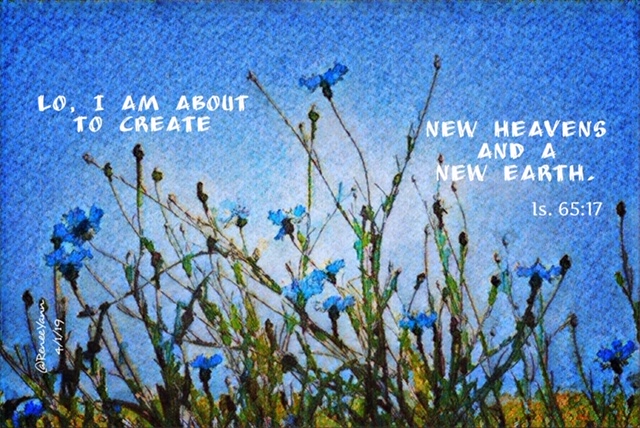
Is65_new heavens

Walter Brueggemann calls Isaiah 65 “a glorious artistic achievement”. Indeed, these images confirm his statement:

  • a new heavens and a new earth;
  • constant rejoicing and happiness
  • people will be a delight
  • no weeping or crying;
  • long life for all
  • everyone with a home
  • enough for all to eat

As we pray with this passage today, we may experience a longing for a return to our beautiful, safe world – a world before pandemic, a world before the specter of WW III. In today’s violent and besieged environment, we all pray from a place of anxiety, loss, constraint, or some degree of suffering. 

Isaiah’s community prayed from the same place. All the beautiful images were a promise not yet realized. The prophetic poetry of Isaiah is a call to courageous hope, not a description of current circumstances.

upside

Faith invites us, even as we experience a bittersweet longing, to trust that God is with us, teaching us and leading us deeper into the Divine Understanding. Even as circumstances turn our world upside down, God will guide the falling pieces to a blessed place if we commit to find God in the tumbling.

I don’t think many of us would deny that the world has needed fixing for a long, long time. The systems we have built leave many in deficit throughout the world, and we have failed to address the wound.

War, pandemic, forced migration of the poor, climate catastrophe all have laid that failure bare.

As we pray for resolutions to these sufferings, may we be opened to an irrevocable awareness of our common humanity and responsibility for one another.

Only by such an outcome will we move closer to Isaiah’s peaceful Kingdom. Only by our courage to embrace it, can God fulfill the Promise in us.


Poetry: by Emily Dickinson

I many times thought Peace had come
When Peace was far away —
As Wrecked Men — deem they sight the Land —
At Centre of the Sea —

And struggle slacker — but to prove
As hopelessly as I —
How many the fictitious Shores —
Before the Harbor lie —


Music: O Day of Peace – Carl P. Daw

Lent: Releasing Praise

March 26, 2022
Saturday of the Third Week of Lent

Today, in God’s Lavish Mercy, we are encouraged to pray. Hosea tells us:

Come, let us return to the LORD,
it is he who has rent, but he will heal us;
… the LORD will come to us like the rain,
like spring rain that waters the earth.


Let the image of that truth sink into your parched spirit.

rain

Our Gospel leads us to pray humbly:

But the tax collector stood off at a distance
and would not even raise his eyes to heaven
but beat his breast and prayed,
‘O God, be merciful to me a sinner.’

As we pray humbly today, let us ask for God’s refreshment for all our sisters and brothers across the earth. In good times and in trials, let us always praise God.


I would like to share one of my own poems with you today, as we kneel before God with all struggling Creation begging God for humanity to be washed in Mercy.

        All Creation    

 All Creation kneels,
a Single Being,
to praise God.

 From its immense heart,
it sings myriad songs at once,
Morning and Evensong,
Praise and Dirge,
Alas and Alleluia,
intermingled

 It sings even over its own scars,
where the chasms cry out for balm.
It sings both the remembrance
and the hope of blessing.
It sings the endurance of faith
and the confidence of love.

 In roar and silence,
darkness and light,
Creation kneels,
a Single Being,
to praise God.


Music: Total Praise sung by the Brooklyn Tabernacle Choir.  Just watching these faith-filled people lifts my heart and gives me hope.  I trust it will do the same for you, dear friends as we pray for one another.

Lent: Faith’s Legacy

March 23, 2022
Wednesday of the Third Week of Lent

Today, in God’s Lavish Mercy, our readings lead us to thank God for our heritage of faith. They remind us how precious that heritage is.


Moses, after reiterating the history of God’s goodness to Israel, enjoins the People:

Take care and be earnestly on your guard
not to forget the things which your own eyes have seen,
nor let them slip from your memory as long as you live,
but teach them to your children and to your children’s children.

Deuteronomy 4:6

Jesus, too, acknowledges the importance of his religious heritage:

Do not think that I have come to abolish the law or the prophets.
I have come not to abolish but to fulfill.
Amen, I say to you, until heaven and earth pass away,
not the smallest letter or the smallest part of a letter
will pass from the law,
until all things have taken place.

Matthew 5:17

Readings such as these move us to remember, consider and appreciate our own faith story – that personal unfolding of grace-filled circumstances which have led us to our present relationship with God.

For many of us, faith planted itself in us through the seeds of our family. We simply “inherited” the faith from our parents, grandparents and extended family. That community of blessings was extended through our parish and through our Christian education.

Take time to remember:

  • Who taught you your childhood prayers?
  • Who told you Bible stores?
  • Who prepared you for the sacraments?
  • Who served as a example to you of what a good Christian is like?

The answers will not be some big religious events. They will be simple memories that, at the time, you might not have even recognized as important to your faith life. I remember, for example, that every day in Lent my father walked with me to 6:30 AM Mass. Because many of the laborers had to be in work by 7:00 AM, the priest distributed communion for them before the Mass began. Just after the Gospel, Dad and all the other workmen would quietly exit to get to work on time. No fanfare. No preachy words. Just deep faith and devotion.

I can’t exactly put that lesson into words. All I know is that it deeply affected my faith and my profound appreciation for the Eucharist — and for my Dad.


And as you grew up and grew older:

  • Who has sincerely engaged with you on your questions of faith and morality?
  • Who has encouraged you to live a life of Christian service and social justice?
  • Who has modeled everyday holiness for you?
  • Who challenges and invites you to deeper spirituality and Christian witness?

The names and faces who have come into your prayer as you considered these questions — these people are the “fathers” and “mothers’ of your faith.


And of course, these questions may lead us
to ask ourselves how we have done these things
for the generations now depending on us
for the transmission of faith?


Poetry: On Religion – Kahlil Gibran (1883-1931)

And an old priest said, Speak to us of Religion.
And he said:
Have I spoken this day of aught else?
Is not religion all deeds and all reflection,
And that which is neither deed nor reflection, but a wonder and a surprise ever springing in the soul, even while the hand hew the stone or tend the loom?
Who can separate his faith from his actions, or his belief from his occupations?
Who can spread his hours before him, saying, “This for God and this for myself’ This for my soul, and this other for my body?”
All your hours are wings that beat through space from self to self.
He who wears his morality but as his best garment were better naked.
The wind and the sun will tear no holes in his skin.
And he who defines his conduct by ethics imprisons his song-bird in a cage.
The freest song comes not through bars and wires.
And he to whom worshipping is a window, to open but also to shut, has not yet visited the house of his soul whose windows are from dawn to dawn.

Your daily life is your temple and your religion.
Whenever you enter into it take with you your all.
Take the plough and the forge and the mallet and the lute,
The things you have fashioned in necessity or for delight.
For in revery you cannot rise above your achievements nor fall lower than your failures.
And take with you all men:
For in adoration you cannot fly higher than their hopes nor humble yourself lower than their despair.

And if you would know God be not therefore a solver of riddles.
Rather look about you and you shall see Him playing with your children.
And look into space; you shall see Him walking in the cloud, outstretching His arms in the lightning and descending in rain.
You shall see Him smiling in flowers, then rising and waving His hands in trees.


Music: e Will Serve the Lord

Lent: Healing the Wounds

March 4, 2022
Friday after Ash Wednesday

Today, in God’s Lavish Mercy, Isaiah cuts his listeners no slack — and, remember, we too are his listeners.

In this powerful passage, the prophet shatters the pretenses of those who make a show of religion. Speaking with God’s voice, Isaiah lambastes those who fast and pray but practice no works of justice and mercy.

Lo, on your fast day you carry out your own pursuits,
and drive all your laborers.
Yes, your fast ends in quarreling and fighting,
striking with wicked claw.

These “fake fasters” are left wondering why God doesn’t answer their prayers. The prophet tells them that God isn’t fooled by their pretenses:

Is this the manner of fasting I wish,
of keeping a day of penance:
That a man bow his head like a reed
and lie in sackcloth and ashes?


Isaiah says that God’s not into sackcloth and ashes. God’s into good works of mercy and justice. These are the actions that change our hearts, opening us to deeper relationship with God.

This, rather, is the fasting that I wish:
releasing those bound unjustly,
untying the thongs of the yoke;
Setting free the oppressed,
breaking every yoke;
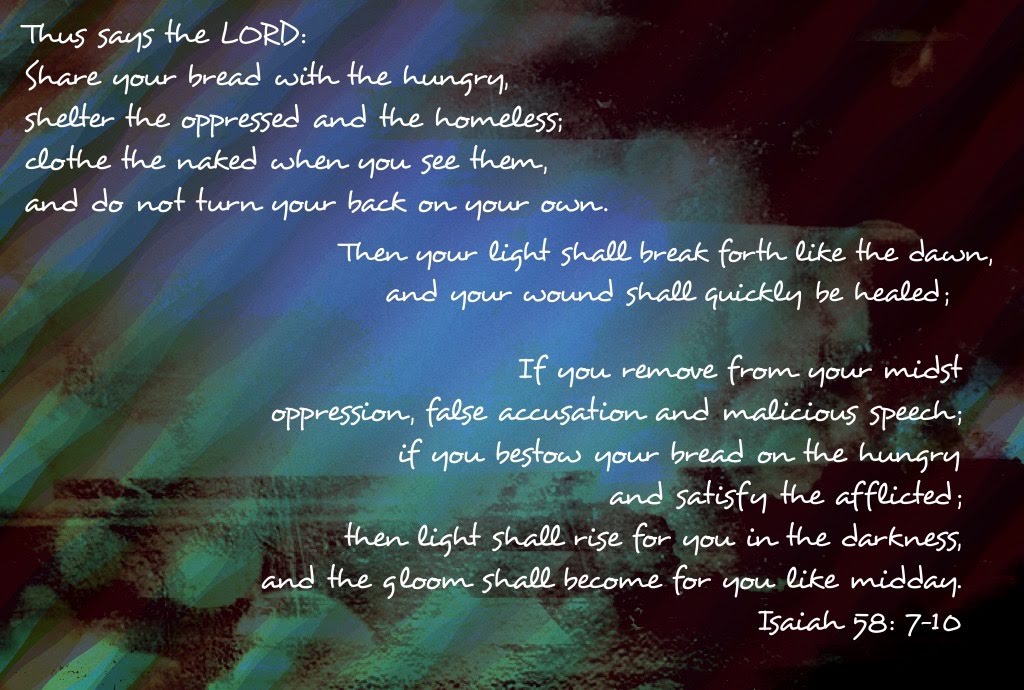
Sharing your bread with the hungry,
sheltering the oppressed and the homeless;
Clothing the naked when you see them,
and not turning your back on your own.


Listen, dear friends. It can’t be clearer than that.

In a world full of “prosperity gospels”, false piety and pretend religion – used to justify all kinds of injustice – we may get mixed up sometimes about what pleases God.

Let’s really open our hearts to Isaiah’s message and try to rid our own lives of any pretense about these things.

Let’s confront such hypocrisy when we see it used to subtly oppress rather than to lift up others.

Then your light shall break forth like the dawn,
and your wound shall quickly be healed.


Perhaps we might spend sometime today thinking about that “wound” we need healed. Might there be some harbored prejudice, indifference, fear, or ignorance that distances us from others who are different, vulnerable, or in need?

Isaiah cautions that until that wound is healed,
we will never hear God’s true answer to our prayers.


Poetry: from Gitanjali by Rabindranath Tagore

Then said a rich man, “Speak to us of Giving”.

And he answered:
“You give but little when you give of your possessions.
It is when you give of yourself that you truly give.
For what are your possessions but things you keep and guard
for fear you may need them tomorrow?
And tomorrow, what shall tomorrow bring
to the overprudent dog burying bones in the trackless sand
as he follows the pilgrims to the holy city?

And what is fear of need but need itself?
Is not dread of thirst when your well is full, thirst that is unquenchable?

There are those who give little of the much which they have

and they give it for recognition and their hidden desire
makes their gifts unwholesome.
And there are those who have little and give it all.
These are the believers in life and the bounty of life,
and their coffer is never empty.

There are those who give with joy, and that joy is their reward.
And there are those who give with pain, and that pain is their baptism.
And there are those who give and know not pain in giving,
nor do they seek joy, nor give with mindfulness of virtue;
They give as in yonder valley the myrtle breathes its fragrance into space.
Through the hands of such as these God speaks,
and from behind their eyes He smiles upon the earth.

It is well to give when asked,
but it is better to give unasked, through understanding;
And to the open-handed
the search for one who shall receive is joy greater than giving.

And is there aught you would withhold?
All you have shall some day be given;
Therefore give now, that the season of giving
may be yours and not your inheritors’.

You often say, “I would give, but only to the deserving.”
The trees in your orchard say not so, nor the flocks in your pasture.
They give that they may live, for to withhold is to perish.

Surely he who is worthy to receive his days and his nights
is worthy of all else from you.
And he who has deserved to drink from the ocean of life
deserves to fill his cup from your little stream.
And what desert greater shall there be than that which lies
in the courage and the confidence, nay the charity, of receiving?

And who are you that men should rend their bosom and unveil their pride,
that you may see their worth naked and their pride unabashed?
See first that you yourself deserve to be a giver,
and an instrument of giving.
For in truth it is life that gives unto life –
while you, who deem yourself a giver, are but a witness.

And you receivers – and you are all receivers –
assume no weight of gratitude,
lest you lay a yoke upon yourself and upon him who gives.
Rather rise together with the giver on his gifts as on wings;
For to be overmindful of your debt, is to doubt his generosity
who has the free-hearted earth for mother, and God for father.

Music: Respond – Collin Campbell (Lyrics below)

Oh how long will you cry out
And never truly seek my face
You come to me with heavy hearts
But you ignore what makes mine break

I see your thoughts, I hear your words
And I have watched you as you’ve prayed
I’ve told you my desires
But you don’t follow all the way

Children, I’m crying out
Break the chains
Let the oppressed go free
Empty yourselves to those in need
Be my hands Be my feet
What you do unto them You do unto Me

Every day you lift your voice
And await my swift response
But I see only what’s inside
And it’s (what i see on the inside) an offering I don’t want

Children, I’m crying out
Break the chains
Let the oppressed go free
Empty yourselves to those in need
Be my hands Be my feet
What you do unto them You do unto Me

Then your Salvation will come like the dawn
And my glory will be your shield
When you call on My name I will not turn away
I am Your God And I am here
And your light it will shine from the dark
You will be like a free flowing stream
And when you call on My name I will not turn away
I am your God And I am here

Love and Mercy

February 20, 2022
Seventh Sunday in Ordinary Time

Today, in God’s Lavish Mercy, our reading from 1 Samuel tells the intriguing tale of David’s magnanimity toward Saul. Saul is enraged and jealous of David whom Samuel has anointed as king to replace Saul. David is continually in Saul’s crosshairs.

David Spares Saul – William Brassey Hole

But one night, David stealthily enters Saul’s camp. Even though he has a chance to kill Saul, David spares his life out of respect for his kingship.

While it’s not exactly “love for his enemies”, David does demonstrate a largeness of spirit that foretells today’s Gospel. This gracious spirit demonstrates that David is in right relationship (covenant) with God.

Our Gospel is part of Jesus’s Great Sermon in which he restates and renews the covenant of right relationship. If our spirits are true to God, we will love as God loves. We are to be merciful as God is merciful.

This Law of Love is the essence of life in Christ. It is a profoundly challenging call.

How hard it must have been for David as he stood, spear in hand, over his sleeping enemy – over the one trying to kill him!

How hard it is for us not to be vengeful, retaliatory, and parsimonious when we feel threatened or exploited.

But we are called, in Christ, to the New Covenant of love. By that call, we are endowed with a right spirit.

Today, Jesus asks us to love, forgive, and judge all others as we ourselves would want to be treated. He asks us to live with a divinely magnanimous heart.

Let us pray for the strength to respond.

Prose: from To Love as God Loves by Roberta C. Bondi, professor emerita of church history and spirituality, Candler School of Theology, Emory University.

Love as a disposition 
does not primarily act
on abstract principle.
Instead it is a way of seeing
habitually and responding
to the real, separate, individual needs
of each of the people we encounter
in our lives every single day.

Music: O Mercy – Stu Garrard, Matt Maher and Audrey Assad

Sailing home…

February 7, 2022
Monday of the Fifth Week in Ordinary Time

Today, in God’s Lavish Mercy, our readings are woven through with the theme of “coming home”.

In 1 Kings, Solomon believes he has constructed the perfect home for God:

Then Solomon said, “The LORD intends to dwell in the dark cloud;
I have truly built you a princely house,
a dwelling where you may abide forever.”

1 Kings 8:13

Psalm 132 invites God to dwell in that home, and in the home of the psalmist’s heart:

Lord, go up to the place of your rest!

Psalm 132: 8

And in our Gospel, Jesus sails toward a quiet, homey place for peace and quiet:

After making the crossing to the other side of the sea,
Jesus and his disciples came to land at Gennesaret
and tied up there.

Mark 6:53

Thinking of home, and sailing, and sea, my prayer this sunny morning is filled with thoughts of Ann. We, with fifty other young and vibrant souls, entered the convent together almost 60 years ago.

Among us, Ann was probably the only one who had ever sailed a boat. She was the child of surf and sand while most of us were children of bricks and trolley tracks.

She told me way back then how much she loved and missed the sea spray anointing her face as she sailed. She was then, and remained, a ray of freedom and delight.

Ann died a week ago after a Sunlit Life in God’s Mercy. I can almost see her grave from my window behind the Motherhouse, especially on this brilliant morning.

Reading Mark today, and picturing Jesus tie up his boat at the golden shore, I think of Ann on heaven’s morning – Spirit’s seaspray and sunlight come fully home.

Poem: Prayer – Renee Yann, RSM

You wait for me
to find morning’s
Eternal Edge.

Coiled prayer
slowly unwinds
within and around.

I see that You
sail forever
toward me.

Come,
tie up now
at my heart.

Music: Sailing

Where Does God Live?

January 27, 2022
Thursday of the Third Week in Ordinary Time

Today, in God’s Lavish Mercy, we might take this question to our prayer: where does God dwell for me?

In our reading from Samuel, David had received an oracle (divine message) through the prophet Nathan. (see 2 Samuel 7:1-17) The essence of the three-way conversation is this: David is putting on the trappings of his kingship, including some fancy housing. He decides that God deserves a great house too and that David is going to build it. God says something like, “Hold up, David! — I’m the Divine Architect and Builder.” David is forcefully reminded that everything he has depends on God. In today’s passage, David humbly acknowledges all this while begging God to stay true to the promise of Israel’s prosperity:

Who am I, Lord GOD,
and who are the members of my house,
that you have brought me to this point?
Yet even this you see as too little, Lord GOD;
you have also spoken of the house of your servant
for a long time to come:
this too you have shown to man, Lord GOD

You have established for yourself your people Israel
as yours forever, and you, LORD, have become their God.
And now, LORD God, confirm for all time
the prophecy you have made
concerning your servant and his house,
and do as you have promised.

2 Samuel 7:18; 24-25

While these chapters tell us the great story of emerging kingship and messianic hope in the Judeo-Christian tradition, they also offer us some simpler thoughts for our prayer this morning.

Through our Baptism, we have been made temples of the Holy Spirit. We are made so by the grace and power of God so that we can reflect God’s Presence in our times. We are not all that different from David (except maybe we’re an uncrowned mini-version!)

It’s crucial to remember Who it is that built my “house” or “temple”.
I have not built a house for God.
God has built a house for me,
crafted from Baptismal Grace,
Confirmational Hope and
Eucharistic Love.

As God promised David, so God promises me, within the community of faith, to faithfully answer my prayer which might echo David’s:

Your servant now finds the courage to make this prayer to you.
And now, Lord GOD, you are God and your words are truth;
you have made this generous promise to your servant.
Do, then, bless the house of your servant
that it may be before you forever;
for you, Lord GOD, have promised,
and by your blessing the house of your servant
shall be blessed forever.”

2 Samuel 7:28-29

Poetry: Rabindranath Tagore

While God waits
for his temple
to be built of love,
men bring stones.

Music: Dwelling Place – John Foley

  1. I fall on my knees to the father of Jesus,
    The Lord who has shown us the glory of God.
  2. May he in his love give us strength for our living
    The strength of his spirit the glory of God.

Refrain
May Christ find a dwelling place of faith in our hearts.
May our lives be rooted in love, rooted in love.

  1. May grace and peace be yours in God our father
    and in his son (Refrain)
  2. I fall on my knees to the father of Jesus,
    The Lord who has shown us the glory of God (Refrain)

The Flame

January 26, 2022
Memorial of Saints Timothy and Titus, Bishops

Today, in God’s Lavish Mercy, we have the beautiful letter from Paul to Timothy, filled with tenderness, encouragement, hope and the sweet suggestion of loving memories.

Paul, an Apostle of Christ Jesus by the will of God
for the promise of life in Christ Jesus,
to Timothy, my dear child:
grace, mercy, and peace from God the Father
and Christ Jesus our Lord.

2 Tim 1:1

On life’s road, what an indescribable blessing to have even one companion who loves us the way Paul loved Timothy — to care for our whole life, our whole soul, and our whole “forever”.


Timothy and His Mother, Eunice – Henry Lejeune

In his letter, Paul reveals that Timothy has been immensely blessed with such love throughout his life. Timothy’s mother and grandmother, Eunice and Lois have already – for many years – tendered Timothy in the faith.

I think gratefully of my own mother today, on the 34th anniversary of her death. How indescribably blessed I have been by her love and faith!


In this heartfelt epistle, Paul notes that he prays for Timothy daily. Perhaps as you read his words you may, like me, think of those who have nurtured and cared for you in a way similar to Paul’s love for Timothy; to Eunice’s and Lois’s love for him.

Do we pray for those who have blessed us and loved us in our lives? Do we tell them so, if they are living? Do we thank and remember them if they have gone home to God?


Paul closes this part of his letter with such a powerful charge to Timothy:

For this reason,
I remind you to stir into flame
the gift of God that you have
through the laying on of my hands.

In other words, it is not enough just to be grateful for such gifts. We must use them to light and warm a next generation of believers and faith-filled lovers.

Many people have rested the hands
of blessing on our spirits, our hearts.
May we be filled with generous gratitude
today and everyday.


For those who have done otherwise, may we forgive them and, as best we can, release them to God’s Mercy. Perhaps they, by the grace of God, have left us with another kind of “gift” — as Mary Oliver has written:

Someone I loved once gave me
a box full of darkness.
It took me years to understand
that this, too, was a gift.

Poetry: God’s Grandeur – Gerard Manley Hopkins

The world is charged with the grandeur of God.
    It will flame out, like shining from shook foil;
    It gathers to a greatness, like the ooze of oil
Crushed. Why do men then now not reck his rod?
Generations have trod, have trod, have trod;
    And all is seared with trade; bleared, smeared with toil;
    And wears man's smudge and shares man's smell: the soil
Is bare now, nor can foot feel, being shod.

And for all this, nature is never spent;
    There lives the dearest freshness deep down things;
And though the last lights off the black West went
    Oh, morning, at the brown brink eastward, springs —
Because the Holy Ghost over the bent
    World broods with warm breast and with ah! bright wings.


Music: for your remembering prayer: James Last – Coulin

Persevering Faith

January 14, 2022
Friday of the First Week in Ordinary Time

Today, in God’s Lavish Mercy, our readings burst with lessons for our faith. We might center our prayer on these three dynamic elements:

Power
Praise
Perseverance


Power

In our first reading, Israel is in the midst of a profound power shift. Until this time, Israel has thrived in “covenantal localism” which released possibility and initiative within the broad community. But now, perhaps stressed by the Philistine threat, the elders lobby for the establishment of a kingship – a centralization of power, wealth, land control, and local self-determination.
( based on Walter Brueggemann: First and Second Samuel: Interpretation: A Bible Commentary for Teaching and Preaching)


The Elders Ask Samuel for a King

Samuel isn’t happy with the elders’ suggestion and, apparently, neither is God. Samuel tells the elders so in a passionate speech against regalism. He pronounces that when the king has usurped all their rights, God will not deliver them as they once were delivered from a similar bondage in Egypt:

When this takes place,
you will complain against the king whom you have chosen,
but on that day the LORD will not answer you.

1 Samuel 8:18

The lesson for us is that the use and organization of power must always be for the sake of communal justice and well-being. Fostering these universal goods is the perpetual struggle of nations and institutions. As part of any community, we are called advocate for a just distribution of power for all people.


Praise
Our Responsorial Psalm counsels that in all such human interactions, our focus must be on God and God’s Will for universal wholeness and peace – a peace evidenced in justice, joy, and praise.

Blessed the people who know the joyful shout;            
in the light of your countenance, O LORD, they walk.
At your name they rejoice all the day,            
and through your justice they are exalted.

Psalm 89:16-17


Perseverance

Mark’s story of the cure of a paralyzed man demonstrates the power of faithful perseverance. This man’s community – his friends – persist until he fully benefits from God’s desire for his wholeness.

Unable to get near Jesus because of the crowd, they opened up the roof above him.
After they had broken through,
they let down the mat on which the paralytic was lying.
When Jesus saw their faith, he said to him,
“Child, your sins are forgiven.”

Mark 2:4-5

Such is our responsibility to pursue our own wholeness and the wholeness of our global community.


Poetry: Ozymandias – Percy Bysshe Shelley

(The poem explores the fate of history and the ravages of time: even the greatest men and the empires they forge are impermanent, their legacies fated to decay into oblivion. (Wikipedia)

I met a traveller from an antique land
Who said: ‘Two vast and trunkless legs of stone
Stand in the desert. Near them, on the sand,
Half sunk, a shattered visage lies, whose frown,
And wrinkled lip, and sneer of cold command,
Tell that its sculptor well those passions read
Which yet survive, stamped on these lifeless things,
The hand that mocked them and the heart that fed:
And on the pedestal these words appear:
“My name is Ozymandias, king of kings:
Look on my works, ye Mighty, and despair!
”Nothing beside remains. Round the decay
Of that colossal wreck, boundless and bare
The lone and level sands stretch far away.’


Music: Aria – composed by Friedrich Gulda, played by Tomoko Inoue