Hidden

Monday of the Fifth Week of Lent
March 18, 2024

Today’s Readings:

https://bible.usccb.org/bible/readings/031824.cfm


One day, while the elders were waiting for the right moment,
she entered the garden as usual, with two maids only.
Susanna decided to bathe, for the weather was warm.
Nobody else was there except the two elders,
who had hidden themselves and were watching her.
“Bring me oil and soap,” she said to the maids,
“and shut the garden doors while I bathe.”

Daniel 13:15-18

“Let the one among you who is without sin
be the first to throw a stone at her.”
Again he bent down and wrote on the ground.
And in response, they went away one by one,
beginning with the elders.
So he was left alone with the woman before him.
Then Jesus straightened up and said to her,
“Woman, where are they?

John 8: 7-10

We encounter so much in life that is hidden – motives, ambitions, agendas, pasts, judgments, reactions. We hide these things for all kinds of reasons. The lustful elders hid their actions for fear of discovery and condemnation. The Gospel stone throwers hid their pasts to exonerate themselves by judgment of another.

Today, in God’s Lavish Mercy:

We are reminded that with God nothing is hidden. And nothing needs to be. We can place our lusts, false judgments, and any other shadow-laden weaknesses in God’s Light because that Light is Forgiveness and Healing. That Light will free us to become forgivers and healers ourselves.


Poetry: Peter Quince at the Clavier – Wallace Stevens

Wallace Steven’s poem and Handel’s oratorio indicate the extent to which the tale of Susanna has been culturally interpreted down through the ages.

Just as my fingers on these keys 
Make music, so the selfsame sounds 
On my spirit make a music, too. 

Music is feeling, then, not sound; 
And thus it is that what I feel, 
Here in this room, desiring you, 
Thinking of your blue-shadowed silk, 
Is music. It is like the strain 
Waked in the elders by Susanna: 
Of a green evening, clear and warm, 
She bathed in her still garden, while 
The red-eyed elders, watching, felt 
The basses of their beings throb 
In witching chords, and their thin blood 
Pulse pizzicati of Hosanna. 
                                              II 
In the green water, clear and warm, 
Susanna lay. 
She searched 
The touch of springs, 
And found 
Concealed imaginings. 
She sighed, 
For so much melody. 
Upon the bank, she stood 
In the cool 
Of spent emotions. 
She felt, among the leaves, 
The dew 
Of old devotions. 
She walked upon the grass, 
Still quavering. 
The winds were like her maids, 
On timid feet, 
Fetching her woven scarves, 
Yet wavering. 
A breath upon her hand 
Muted the night. 
She turned— 
A cymbal crashed, 
And roaring horns. 

                                           III 

Soon, with a noise like tambourines, 
Came her attendant Byzantines. 
They wondered why Susanna cried 
Against the elders by her side; 
And as they whispered, the refrain 
Was like a willow swept by rain. 
Anon, their lamps' uplifted flame 
Revealed Susanna and her shame. 
And then, the simpering Byzantines 
Fled, with a noise like tambourines. 

                                             IV 

Beauty is momentary in the mind— 
The fitful tracing of a portal; 
But in the flesh it is immortal. 
The body dies; the body's beauty lives. 
So evenings die, in their green going, 
A wave, interminably flowing. 
So gardens die, their meek breath scenting 
The cowl of winter, done repenting. 
So maidens die, to the auroral 
Celebration of a maiden's choral. 
Susanna's music touched the bawdy strings 
Of those white elders; but, escaping, 
Left only Death's ironic scraping. 
Now, in its immortality, it plays 
On the clear viol of her memory, 
And makes a constant sacrament of praise.

Music: Guilt trembling spoke my doom – George Frideric Handel

Susanna is an oratorio by George Frideric Handel. Handel composed the music in the summer of 1748 and premiered the work the next season at Covent Garden theatre, London, on 10 February 1749. (Lyrics below.)

Guilt trembling spoke my doom,
And vice her joy display’d,
Till truth dispell’d the gloom
And came to virtue’s aid.
Kind Heav’n, my pray’rs receive,
They’re due alone to thee,
Oppression’s left to grieve,
And innocence is free.

Calf

Thursday of the Fourth Week of Lent
March 14, 2024

Today’s Readings:

https://bible.usccb.org/bible/readings/031424.cfm


The LORD said to Moses,
“Go down at once to your people
whom you brought out of the land of Egypt,
for they have become depraved.
They have soon turned aside from the way I pointed out to them,
making for themselves a molten calf and worshiping it,
sacrificing to it and crying out,
‘This is your God, O Israel,
who brought you out of the land of Egypt!’

Exodus 32: 7-8

Today’s readings give us Moses and John the Baptist, each serving as a bridge over the chasm between a faithful God and a faithless people. Both met blockades in their attempts to lead the people to their God, just as Jesus meets opposition in today’s Gospel.

For Moses, the blockade was the golden calf, symbol of all the fragile pretensions we substitute for a true and committed faith. Real faith is dangerous. It asks us to risk ourselves on realities we cannot see. Glittering gold, even in the form of a beast, feels so much more secure!

Today, in God’s Lavish Mercy:

Let’s have the courage to look for the golden calves in our lives

  • a greed for control, power which limits others’ freedom
  • any form of disrespect or indifference toward another’s dignity
  • the lust for, or abuse of money or goods
  • willfulness that limits my own spiritual growth, or the spiritual joy of others

Poetry: The Golden Calf – John Newton (1725-1807), also author of “Amazing Grace”.

When Israel heard the fiery law,
From Sinai's top proclaimed;
Their hearts seemed full of holy awe,
Their stubborn spirits tamed.
Yet, as forgetting all they knew,
Ere forty days were past;
With blazing Sinai still in view,
A molten calf they cast.
Yea, Aaron, God's anointed priest,
Who on the mount had been
He durst prepare the idol-beast,
And lead them on to sin.
Lord, what is man! and what are we,
To recompense thee thus!
In their offence our own we see,
Their story points at us.
From Sinai we have heard thee speak,
And from mount Calv'ry too;
And yet to idols oft we seek,
While thou art in our view.
Some golden calf, or golden dream,
Some fancied creature-good,
Presumes to share the heart with him,
Who bought the whole with blood.
Lord, save us from our golden calves,
Our sin with grief we own;
We would no more be thine by halves,
But live to thee alone.

Music: Song of the Golden Calf from the opera Faust by Charles Gounod

Water

Tuesday of the Fourth Week of Lent
March 12, 2024

https://bible.usccb.org/bible/readings/031224.cfm


There is a stream whose runlets gladden the city of God,
the holy dwelling of the Most High.
God is in its midst; it shall not be disturbed;
God will help it at the break of dawn.

Psalm 46:5-6

Our Psalm today connects two readings centered around life-giving water.

Ezekiel’s watery vision offers a symbolic interpretation of the life-force flowing from God’s heart (symbolized by the Temple) to all Creation.

In our Gospel, a man waits for decades beside the waters of an inaccessible pool until Jesus cures him – until Jesus himself becomes the “Water of Life”.


Today, in God’s Lavish Mercy:

Imagine yourself being blessed by life-giving water – maybe a cool swim on a blistering day, or a warm bath on a frosty one.

Imagine walking in a gentle summer rain, no umbrella, no puddle prohibitions.

If you love the ocean, imagine diving under soft waves at flood tide, belly-riding them back, again and again, to a warm, quiet beach.

Now imagine that all that water is God’s Love for you, because it is. And let your heart pray with a joy similar to today’s psalmist!


Poetry: The Waterfall – Henry Vaughan (1621-1695)

With what deep murmurs through time’s silent stealth
Doth thy transparent, cool, and wat’ry wealth
Here flowing fall,
And chide, and call,
As if his liquid, loose retinue stay’d
Ling’ring, and were of this steep place afraid;
The common pass
Where, clear as glass,
All must descend
Not to an end,
But quicken’d by this deep and rocky grave,
Rise to a longer course more bright and brave.

Dear stream! dear bank, where often I
Have sate and pleas’d my pensive eye,
Why, since each drop of thy quick store
Runs thither whence it flow’d before,
Should poor souls fear a shade or night,
Who came, sure, from a sea of light?
Or since those drops are all sent back
So sure to thee, that none doth lack,
Why should frail flesh doubt any more
That what God takes, he’ll not restore?

O useful element and clear!
My sacred wash and cleanser here,
My first consigner unto those
Fountains of life where the Lamb goes!
What sublime truths and wholesome themes
Lodge in thy mystical deep streams!
Such as dull man can never find
Unless that Spirit lead his mind
Which first upon thy face did move,
And hatch’d all with his quick’ning love.
As this loud brook’s incessant fall
In streaming rings restagnates all,
Which reach by course the bank, and then
Are no more seen, just so pass men.
O my invisible estate,
My glorious liberty, still late!
Thou art the channel my soul seeks,
Not this with cataracts and creeks.

Music: How Deep Is the Ocean
As you listen to the smooth jazz of Diana Krall, let yourself be in love with God who raises you from beside whatever pool where you’ve been lingering.

Piety

Saturday of the Third Week of Lent
March 9, 2024

Today’s Readings:

https://bible.usccb.org/bible/readings/030924.cfm


Your piety is like a morning cloud,
like the dew that early passes away.

Hosea 6:4

_______

… the tax collector stood off at a distance
and would not even raise his eyes to heaven
but beat his breast and prayed,
‘O God, be merciful to me a sinner.’
I tell you, the latter went home justified, not the former;
for everyone who exalts himself will be humbled,
and the one who humbles himself will be exalted.”

Luke 18: 13-14

I think the word “Piety” has taken on a rather saccharine connotation because we mistake it for an overly sentimental, and sometimes insincere, devotion. However, the word piety comes from the Latin word pietas, the noun form of the adjective pius (which means “devout” or “dutiful”).

Today, in God’s Lavish Mercy:

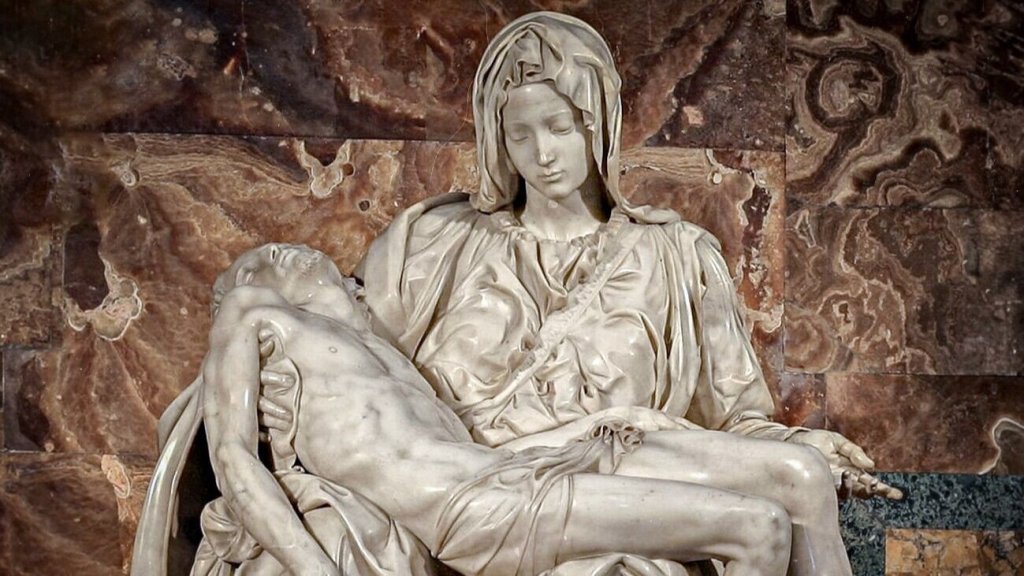
Picture Michelangelo’s Pieta. Let yourself feel the emotion captured in the heart of that sculpture. That is pietas/piety – a deep, penetrating presence and love that cannot fully be put into words. A humble, sincere prayer like that of the tax collector is the fruit of such piety.

Most of us are not great sinners. We just make some mean – and perhaps continual – choices that can block the flow of grace into our hearts. God stands beside us as we make such choices, ready to hear us when we turn and ask for the Mercy that will free and deepen us.


Prose: from Point Counterpoint by Aldous Huxley

Aldous Huxley (1894 – 1963) was an English writer and philosopher. His bibliography spans nearly 50 books, including novels and non-fiction works, essays, narratives, and poems.
By the end of his life, Huxley was widely acknowledged as one of the foremost intellectuals of his time. He was nominated for the Nobel Prize in Literature nine times.

From the quote below, Huxley obviously had strong opinions about religion but especially about false piety. Although Jesus would never have put it this way, the sentiments echo those in today’s readings.


“In the abstract you know that music exists and is beautiful. But don’t therefore pretend, when you hear Mozart, to go into raptures which you don’t feel. If you do, you become one of those idiotic music-snobs … unable to distinguish Bach from Wagner, but mooing with ecstasy as soon as the fiddles strike up. 

It’s exactly the same with God. The world’s full of ridiculous God-snobs. People who aren’t really alive, who’ve never done any vital act, who aren’t in any living relation with anything; people who haven’t the slightest personal or practical knowledge of what God is. But they moo away in churches, they coo over their prayers, they pervert and destroy their whole dismal existences by acting in accordance with the will of an arbitrarily imagined abstraction which they choose to call God.

Just a pack of God-snobs. They’re as grotesque and contemptible as the music-snobs … but nobody has the sense to say so. The God-snobs are admired for being so good and pious and Christian. When they’re merely dead and ought to be having their bottoms kicked and their noses tweaked to make them sit up and come to life.” 

Division

Thursday of the Third Week of Lent
March 7, 2024

Today’s Readings:

https://bible.usccb.org/bible/readings/030724.cfm


Jesus was driving out a demon that was mute,
and when the demon had gone out,
the mute man spoke and the crowds were amazed.
Some of them said, “By the power of Beelzebul, the prince of demons,
he drives out demons.”
Others, to test him, asked him for a sign from heaven.
But he knew their thoughts and said to them,
“Every kingdom divided against itself will be laid waste
and house will fall against house.

Luke 11: 14-17

Today’s readings point us to the virtue of spiritual integrity. Several times in the Gospel, Jesus proclaims that we can’t give our allegiance to two contradictory worlds. (Remember, “One can’t serve God and mammon.”?)

Today, in God’s Lavish Mercy:
As our Verse before the Gospel advises, God wants our whole heart. We can’t be “with” God sometimes. We’re either with God or we’re not – always. Our challenge in life is to make sure we recognize those elements pretending to be gods, so that we don’t give our hearts foolishly.


Poetry: My Kingdom – Louisa May Alcott whom you will recognize as the author of Little Women. Alcott was the daughter of strong transcendentalists. Her father’s opinions on education, severe views on child-rearing, and moments of mental instability shaped young Louisa’s mind with a desire to achieve perfection, a goal of the transcendentalists. (cf: wikipedia) Those sensibilities are reflected in the pious 19th-century style of this poem. Still the poem captures the struggles and awarenesses many have in understanding the Kingdom of Heaven within us.

A little kingdom I possess
Where thoughts and feelings dwell,
And very hard I find the task
Of governing it well;
For passion tempts and troubles me,
A wayward will misleads,
And selfishness its shadow casts
On all my words and deeds.
How can I learn to rule myself,
To be the child I should,
Honest and brave, nor ever tire
Of trying to be good?
How can I keep a sunny soul
To shine along life's way?
How can I tune my little heart
To sweetly sing all day?
Dear Father, help me with the love
That casteth out my fear;
Teach me to lean on thee, and feel
That thou art very near,
That no temptation is unseen
No childish grief too small,
Since thou, with patience infinite,
Doth soothe and comfort all.
I do not ask for any crown
But that which all may win
Nor seek to conquer any world
Except the one within.
Be thou my guide until I find,
Led by a tender hand,
Thy happy kingdom in myself
And dare to take command.

Music: Monastery of La Rabida – Vangelis

Accepted

Monday of the Third Week of Lent
March 4, 2024

Today’s Readings:

https://bible.usccb.org/bible/readings/030424.cfm


Jesus said to the people in the synagogue at Nazareth:
“Amen, I say to you,
no prophet is accepted in his own native place.
Indeed, I tell you, there were many widows in Israel
in the days of Elijah
when the sky was closed for three and a half years
and a severe famine spread over the entire land.
It was to none of these that Elijah was sent,
but only to a widow in Zarephath in the land of Sidon.

Luke 4: 24-26

In our Gospel today, Jesus is not accepted among his neighbors. That lack of acceptance impels Jesus to move his mission out to the wider community.

“Acceptance” can be seen as a passive word suggesting that we just put up with something we cannot change.

On the other hand, it can be a positive condition in our spirituality by which we prepare ourselves to hospitably receive that which we had not expected. Such positive acceptance suggests a non-judgmental, wise, and discerning heart. The folks in today’s Gospel lacked such hearts.

Today, in God’s Lavish Mercy:

How open are we to grace when it comes to us in new and unexpected ways – new attitudes, new relationships, new awarenesses and responsibilities?

Do we let ourselves be surprised by God? Or are we pretty sure we have God down pat?

Do we seek new and deeper understandings of God’s Word in our lives by widening our circle of experience and understanding? Or is our “faith” a closed and limited system such as the one displayed by the synagogue listeners toward Jesus?


Poetry: Y’Did Nefesh

Yedid Nefesh (‘beloved of the soul’) is the title of a 16th-century Jewish liturgical poem. It is usually sung on Shabbat, the Jewish day of rest and celebration that begins on Friday before sunset and ends on the following evening after nightfall.


Beloved of the soul, Compassionate Father, 
draw Your servant to Your will.
Then Your servant will hurry like a hart
to bow before Your majesty.
To me Your friendship will be sweeter
than the dripping of the honeycomb.
Majestic, beautiful, radiance of the universe, 
my soul is heart-sick for your love.
Please O God, heal her now
by showing her the pleasantness of Your radiance.
Then she will be strengthened and healed
and eternal gladness will be hers.
All worthy One — may Your mercy be aroused 
and please take pity on Your beloved,
because it is so very long that I have yearned intensely
to see the splendor of Your strength,
only these my heart desired,
so please take pity and do not conceal Yourself.
Please be revealed and spread upon me, my Beloved, 
the shelter of Your peace
that we may rejoice and be glad with You.
Hasten, Beloved, for the time has come,
and show us grace as in days of old.

Music: Y’Did Nefesh

Prodigal

Saturday of the Second Week of Lent
March 2, 2024

Today’s Readings:

https://bible.usccb.org/bible/readings/030224.cfm


Who is there like you, the God who removes guilt
and pardons sin for the remnant of his inheritance;
Who does not persist in anger forever,
but delights rather in clemency,
And will again have compassion on us,
treading underfoot our guilt?

Micah 7:18-19

We are all familiar with the powerful story of the Prodigal Son.

The word “prodigal”, like many words, can have both light and dark connotations. Its definition, according to Oxford Languages, is twofold:

  • spending resources recklessly
  • giving on a lavish scale

On the darker side, many of us interpret the parable from the viewpoint of the son, considering him “prodigal” because he is excessive in the abuse of his inheritance.
Others see the “Father” as an expression of God’s Lavish Mercy and Prodigal Love toward us even when we make life-changing mistakes.

Today, in God’s Lavish Mercy:

We might choose to pursue both understandings of the word “prodigal” in our prayer today:

  • to ask God’s forgiveness and healing for any sinful prodigality in our lives
  • to imitate God’s Prodigal Generosity in our interactions and relationships

Poetry: The Prodigal – Nancy Cardozo

Prodigal of prayer am I,
Prodigal of tear,
But I have used God sparingly —
I think He does not hear.
Stars to wish on flicker flash
And I know stars will wear;
But I doubt and if I weep,
Stars will never care.
I have let my prayer sift down
Through a starry sieve;
Will God gather up the dust
If I believe?

Music: He Ran To Me’ (The Prodigal Son) – Phillips, Craig and Dean

Barren

Thursday of the Second Week of Lent
February 29, 2024

Today’s Readings:

https://bible.usccb.org/bible/readings/022924.cfm


Cursed is the one who trusts in human beings,
who seeks strength in flesh,
whose heart turns away from the LORD.
Such a person is like a barren bush in the desert
that enjoys no change of season,
But stands in a lava waste,
a salt and empty earth.

Jeremiah 17: 5-6

Have you encountered a person who is spiritually languishing, or even dead? The light of their spirit has gone out. There is no joy, hope, delight, or generosity in them. Sometimes their barrenness is buried under false hilarity or bravado, but after leaving them we find ourselves confused, saddened, empty, tired, or even a little angry.

Today, in God’s Lavish Mercy:

Let’s pray for any barren spirit we have encountered. They badly need our prayers.
And let’s ask God for the merciful freshening of our own spirit, seeking it by prayer, loving silence, and honest reflection on our choices and actions.


Poetry: What the Fig Tree Said – Denise Levertov

Literal minds! Embarrassed humans! His friends
were blurting for Him
in secret: wouldn’t admit they were shocked.
They thought Him
petulant to curse me!—yet how could the Lord
be unfair?—so they looked away,
then and now.
But I, I knew that
helplessly barren though I was,
my day had come. I served
Christ the Poet,
who spoke in images: I was at hand,
a metaphor for their failure to bring forth
what is within them (as figs
were not within me). They who had walked
in His sunlight presence,
they could have ripened,
could have perceived His thirst and hunger,
His innocent appetite;
they could have offered
human fruits—compassion, comprehension—
without being asked,
without being told of need.
My absent fruit
stood for their barren hearts. He cursed
not me, not them, but
(ears that hear not, eyes that see not)
their dullness, that withholds
gifts unimagined.

Music: Happy Sad Empty Full – The Gothard Sisters

Snow …

Tuesday of the Second Week of Lent
February 27, 2024

Today’s Readings:

https://bible.usccb.org/bible/readings/022724.cfm


Come now, let us set things right,
says the LORD:
Though your sins be like scarlet,
they may become white as snow;
Though they be crimson red,
they may become white as wool.

Isaiah 1:18

The greatest among you must be your servant.
Whoever exalts himself will be humbled;
but whoever humbles himself will be exalted.

Matthew 22:12

Today’s readings are studies in contrasts – white/scarlet; exaltation/humility.

Isaiah promises a transformative grace changing scarlet sins to snow-white goodness. In our Gospel, Jesus teaches the crowds that the way to holiness is in exact contrast to the practices of the Pharisees. The Gospel turns the patterns of the world upside down. Lent is the time to enter that turning.

Today, in God’s Lavish Mercy:

Let’s pray for the humility that will allow us to open ourselves to God’s transforming grace – that wash of insight over our spirits, cleansing us of spiritual confusion.

Humility can be a tricky virtue. Its essence is not a sense of worthlessness or “less-ness”. Humility is instead a profound awareness that all belongs to God, and that we are privileged to share in that Abundant Life. Humility does not concentrate on the Self. It looks at the Other in grateful and expectant obedience.


Poetry: A Woman in Winter – from In Wisdom’s Path: Discovering the Sacred in Every Season by Jan L. Richardson.

A woman in winter
is winter:
turning inward,
deepening,
elemental force,
time’s reckoning;
sudden frost
and fire’s warming,
depth of loss
and edge of storming.
She is avalanche,
quiet hungering,
utter stillness,
snowfall brewing;
hollowed, hallowed,
shadows casting,
field in fallow,
wisdom gathering.
Waiting, watching,
darkness craving,
shedding, touching,
reaching, laboring;
burning, carrying fire
within her,
a woman turning,
becoming winter.

Music: White As Snow – Maranatha Singers

Mountain

Second Sunday of Lent
February 25, 2024

Today’s Readings:

https://bible.usccb.org/bible/readings/022524.cfm


“Take your son Isaac, your only one, whom you love, 
and go to the land of Moriah.
There you shall offer him up as a holocaust 
on a mountain that I will point out to you.”


Jesus took Peter, James, and John 
and led them up a high mountain apart by themselves.
And he was transfigured before them, 
and his clothes became dazzling white, 
such as no fuller on earth could bleach them.


Often it is at the height of our joy, or the height of our sorrow that we feel closest to God. Intense experiences can bring us unequaled grace and opportunity for spiritual growth.

Today, in God’s Lavish Mercy:

In our prayer, we may gratefully remember the “mountains” of our lives, those times when joy, hope, pain, or anxiety built almost insurmountably in our hearts. How did God meet us in those moments? How did we meet God? How have our “mountains” transformed our lives?


Poetry: Unveiling the Heart’s Mirror – Rumi

All through eternity
Beauty unveils His exquisite form
in the solitude of nothingness;
He holds a mirror to His Face
and beholds His own beauty.
he is the knower and the known,
the seer and the seen;
No eye but His own
has ever looked upon this Universe.
His every quality finds an expression:
Eternity becomes the verdant field of Time and Space;
Love, the life-giving garden of this world.
Every branch and leaf and fruit
Reveals an aspect of His perfection.
The cypress gives hint of His majesty,
The rose gives tidings of His beauty.
Whenever Beauty looks,
Love is also there;
Whenever beauty shows a rosy cheek
Love lights Her fire from that flame.
When beauty dwells in the dark folds of night
Love comes and finds a heart
entangled in tresses.
Beauty and Love are as body and soul.
Beauty is the mine, Love is the diamond.
They have together
since the beginning of time-
Side by side, step by step.
I swear, since seeing Your face,
the whole world is fraud and fantasy
The garden is bewildered as to what is leaf
or blossom. The distracted birds
can’t distinguish the birdseed from the snare.
A house of love with no limits,
a presence more beautiful than venus or the moon,
a beauty whose image fills the mirror of the heart.

Music: God on the Mountain – Lynda Randle