Alleluia: Bear Fruit!

Feast of Saint James, Apostle
July 25, 2022

Today’s Readings

https://bible.usccb.org/bible/readings/072522.cfm

Alleluia, alleluia.
I chose you from the world,
to go and bear fruit that will last,
says the Lord.

Today, in God’s Lavish Mercy, we celebrate the feast of one of Christ’s closest companions and the first Apostle to be martyred. James, and his brother John, held a special place in Jesus’s friendship as only they, with Peter, were invited to witness the Transfiguration.

James, John and Peter astounded at the Transfiguration

What a journey James took in his short life: from his father Zebedee’s fishing boat, to that glorious transfiguring mountain, through the world-changing Paschal events, to a martyr’s testimony against Herod’s sword.
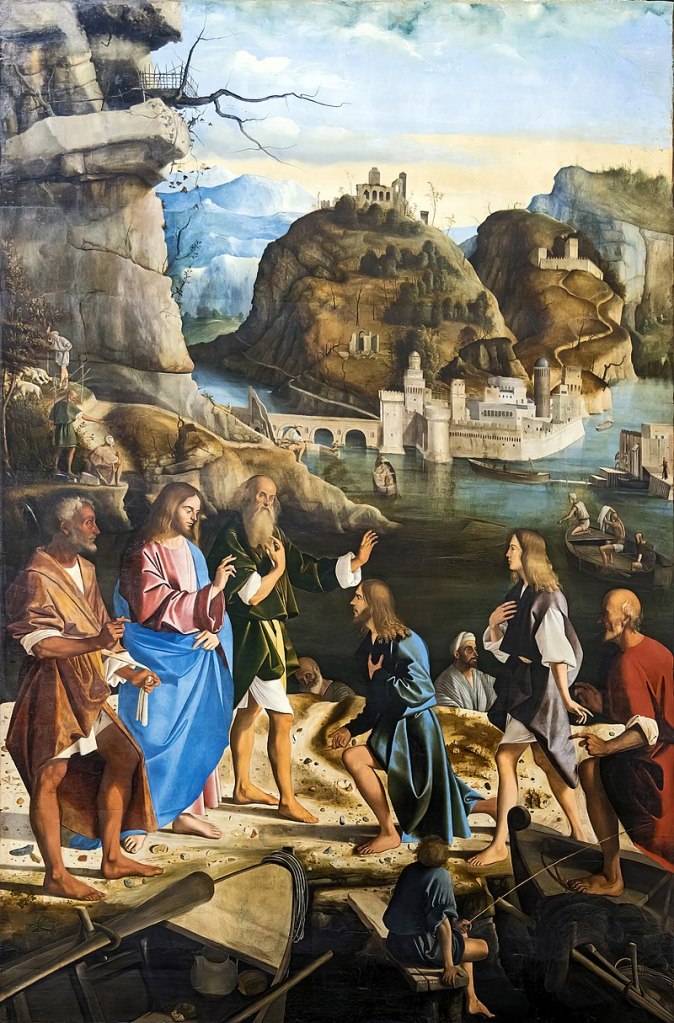
Call of the Sons of Zebedee – Marco Basaiti

James’s discipleship is fired by a willingness to change and grow at God’s call. Jesus dubbed James and John with the nickname “Boanerges”, meaning “Sons of Thunder”. One can imagine them as tough and tumble, boisterous young men. Jesus captured their fire and used it to form a pillar of the faith.


In our first reading from Corinthians, Paul highlights the essence of such pure discipleship as he writes to the early Church:

For God who said, “Let light shine out of darkness,” has shone in our hearts to bring to light the knowledge of the glory of God on the face of Jesus Christ.

We hold this treasure in earthen vessels,
that the surpassing power may be of God and not from us.

….

Everything indeed is for you,
so that the grace bestowed in abundance on more and more people
may cause the thanksgiving to overflow for the glory of God.


As we pray with James today, may we be strengthened in the grace of true discipleship – reflecting God’s glory even through the “earthen vessel” of our fragile humanity. May we use our gifts – even the “thunderous” ones – to bless others with the fruits of generous and vibrant faith.


Poetry: St. James Day – John Keble

Sit down and take thy fill of joy
At God's right hand, a bidden guest,
Drink of the cup that cannot cloy,
Eat of the bread that cannot waste.
O great Apostle! rightly now
Thou readest all thy Saviour meant,
What time His grave yet gentle brow
In sweet reproof on thee was bent.

"Seek ye to sit enthroned by me?
Alas! ye know not what ye ask,
The first in shame and agony,
The lowest in the meanest task -
This can ye be? and came ye drink
The cup that I in tears must steep,
Nor from the 'whelming waters shrink
That o'er Me roll so dark and deep?"

"We can--Thine are we, dearest Lord,
In glory and in agony,
To do and suffer all Thy word;
Only be Thou for ever nigh." -
"Then be it so--My cup receive,
And of My woes baptismal taste:
But for the crown, that angels weave
For those next Me in glory placed,

"I give it not by partial love;
But in My Father's book are writ
What names on earth shall lowliest prove,
That they in Heaven may highest sit."
Take up the lesson, O my heart;
Thou Lord of meekness, write it there,
Thine own meek self to me impart,
Thy lofty hope, thy lowly prayer.

If ever on the mount with Thee
I seem to soar in vision bright,
With thoughts of coming agony,
Stay Thou the too presumptuous flight:
Gently along the vale of tears
Lead me from Tabor's sunbright steep,
Let me not grudge a few short years
With thee t'ward Heaven to walk and weep:

Too happy, on my silent path,
If now and then allowed, with Thee
Watching some placid holy death,
Thy secret work of love to see;
But, oh! most happy, should Thy call,
Thy welcome call, at last be given -
"Come where thou long hast storeth thy all
Come see thy place prepared in Heaven."

Music: Gloria for the Mass of St. James – Guillaume Dufay (1397 – 1474) was a French composer and music theorist of the early Renaissance

Alleluia: God’s Own Children

Seventeenth Sunday in Ordinary Time
July 24, 2022

Today’s Readings:

https://bible.usccb.org/bible/readings/072422.cfm

Today, in God’s Lavish Mercy, a dominant theme connects all our readings: We are, and are loved as, God’s very own children.

Alleluia, alleluia.
You have received a Spirit of adoption,
through which we cry, Abba, Father.

God’s own children … hmmm.

In our reading from Genesis, some folks aren’t doing too well with that. Imagine being so bad that God would have to come down and check you out! Yikes! Not good! It’s like when you and your cousins were pillow-fighting in the basement and your Mom called down the stairs, “Don’t make me come down there!

Don’t Make Me Come Down There!!!!

You knew what to do, didn’t you? Just cut it out! Apparently, Moses isn’t quite so sure that his buddies will behave, but nevertheless does his level best to save the few good apples in the barrel.

This highly anthropomorphic story still carries a very solid truth:

God loves us without reservation
and wants us to return that love
by growing in God’s likeness.

Paul tells the Colossians that God has forgiven, redeemed and raised them with Christ

You were buried with him in baptism,
in which you were also raised with him
through faith in the power of God,
who raised him from the dead.

In our Alleluia Verse from Romans,
Paul describes our new status
as one of “adoption”,
allowing us to call God “Abba”.

Jesus shows us how to be God’s children by sharing with us the intimacies of his talks with his Father.

Father, hallowed be your name,
your kingdom come.
Give us each day our daily bread
and forgive us our sins
for we ourselves forgive everyone in debt to us,
and do not subject us to the final test.

Jesus indicates that we can put this prayer in action by being forgiving and selfless people.

If you then, who are inclined toward selfishness,
know how to give good gifts to your children,
how much more will the Father in heaven
give the Holy Spirit to those who ask him?”


Poetry: O Magne Pater – Hildegard of Bingen

O magne Pater,
in magna necessitate sumus.
Nunc igitur obsecramus, obsecramus te
per Verbum tuum
per quod nos constituisti
plenos quibus indigemus.
Nunc placeat tibi, Pater,
quia te decet, ut aspicias in nos
per adiutorium tuum,
ut non deficiamus, et
ne nomen tuum in nobis obscuretur,
et per ipsum nomen tuum
dignare nos adiuvare.
O Father great,
in great necessity we are.
Thus we now beg, we beg of you
according to your Word,
through whom you once established us
full of all that we now lack.
Now may it please you, Father,
as it behooves you—look upon us
with your kindly aid,
lest we should fail again
and, lost, forget your name.
By that your name we pray—
please kindly help and bring us aid!
thanks to hildegard-society.org

Music: O Magne Pater – Hildegard of Bingen

Alleluia: Welcome the Word

Saturday of the Sixteenth Week in Ordinary Time
July 23, 2022

Today’s Readings 

https://bible.usccb.org/bible/readings/072322.cfm

Today, in God’s Lavish Mercy, we are reminded that God’s Word dwells in us and will bear fruit according to our “welcome” – that is, to the degree that we nourish it.

Alleluia, alleluia.
Humbly welcome the word 
that has been planted in you
and is able to save your souls.


Our readings ask and answer the question “Where does God’s Word dwell?”.

  • In the compassionate heart. 
  • In the mutuality of sincere community. 
  • In reverence for all Creation.

And there are conditions for that indwelling.  Jeremiah defines them clearly:

Only if you thoroughly reform your ways and your deeds;
if each of you deals justly with the neighbor;
if you no longer oppress the resident alien,
the orphan, and the widow;
if you no longer shed innocent blood in this place,
or follow strange gods to your own harm,
will I remain with you in this place,
in the land I gave your forbears long ago and forever.


Jesus tells us that our desire to meet such conditions will be tested by a selfish and sinful culture, like the good wheat which struggles to thrive amidst the weeds.

He says that only at the harvest will the crop’s value be affirmed, indicating that we must be patient, persevering and steadfast even in the moral confusions of our world.

“Master, did you not sow good seed in your field?
Where have the weeds come from?”
He answered, “An enemy has done this.”
His slaves said to him, “Do you want us to go and pull them up?”
He replied, “No, if you pull up the weeds
you might uproot the wheat along with them.
Let them grow together until harvest;
then at harvest time I will say to the harvesters,
‘First collect the weeds and tie them in bundles for burning;
but gather the wheat into my barn.’”


Psalm 84 beautifully captures our longing to be this kind of dwelling place for God. You might wish to pray with the following interpretation of this psalm.

Poetry: Psalm 84 – Ease by Christine Robinson 

The sparrow has a place in the rafters.
The swallow raises her young in the nest she has made.
They live and move easily in their places.
They flit and soar around Your world altar.
They are home.

It is not so easy for me.
I long for that ease of being and pray
for the grace to live in the world as at Your altar.

Happy are they who live in the Pilgrim way;
They walk through desolate landscapes
and find your springs.
They toil through mountains and discover your peaks.
They set themselves to the tasks of love and service
and know deep satisfaction

One day lived in this grace is better than a thousand spent
at our own devices.
When we walk our appointed path in peace,
We find our home and our way.

Music: How Lovely Is Your Dwelling Place – Jesuit Music Ministry 

Alleluia: My Redeemer Lives

Feast of St. Mary Magdalen
July 22, 2022

Today’s Readings:

https://bible.usccb.org/bible/readings/072222.cfm

Edited in Prisma app with Huawei HiAI

Alleluia, alleluia.
Tell us Mary, what did you see on the way?
I saw the glory of the risen Christ,
I saw his empty tomb.

Modern scripture scholarship recognizes Mary Magdalen as a disciple and companion of Jesus.  She is present in stories throughout all four Gospels, and most notably, as one who remained with Jesus at the foot of the Cross. Mary is the first witness to the Resurrection who then announces the Good News to the other disciples.

Over the centuries, Mary Magdalen has been confused with the many other Marys in the Gospel, as well as with the unnamed repentant woman who washes Jesus’ feet with her tears. These confusions have inclined us to think of Mary Magdalen as a reformed prostitute. This erroneous concept has supported a diminished understanding of the role of women in the ministry of Jesus and done a huge disservice to Mary’s vital role as beloved disciple.

The Gospel passage for the feast captures the powerful moment when the Resurrected Jesus is first revealed to the world. The scene also portrays the deep love, trust and friendship between Jesus and Mary Magdalen – a relationship which serves as a model for all of us who want to be Christ’s disciples. I imagined the scene like this in an past reflection:


 Rabbouni

 The Upper Room on Holy Saturday evening: a place filled with sadness, silence and seeking. Jesus was dead. Believers around Jerusalem, scattered to their various houses to keep Shabbat, murmur their shocked questions under their shaky prayers.

 We have all been in rooms like this. They enclose a special kind of agony – one teetering between hope and doubt, between loss and restoration. It may have been a surgical waiting room or the hallway outside the courtroom. Sometimes, such a space is not bricks and mortar.  It can be the space between a sealed envelope and the news inside. It is the hesitant pause between a heartfelt request and the critical response. In each of these places, we exist as if in a held breath, hoping against hope for life, freedom, and wholeness.

 It was from such a room that Mary Magdalen stole away in the wee hours. A woman unafraid of loneliness, she walked in tearful prayer along the path to Jesus’ tomb. Scent of jasmine rose up on the early morning mist. Hope rose with it that his vow to return might be true. Then she saw the gaping tomb, the alarm that thieves had stolen him to sabotage his promise. She ran to the emptiness seeking him. She was met by angels clothed in light and glory, but they were not enough to soothe her.

Turning from them, she bumped against a gardener whom she begged for word of Jesus, just so she might tend to him again. A single word revealed his glory, “Mary”. He spoke her name in love.

As we seek the assurance of God’s presence in our lives, we too may be unaware that God is already with us. The deep listening of our spirit, dulled with daily burdens, may not hear our name lovingly spoken in the circumstances of our lives. God is standing behind every moment. All we need do is turn to recognize him.

 Turn anger into understanding. Turn vengeance into forgiveness. Turn entitlement into gratitude. Turn indifference into love. All we need do is turn to recognize him.


For a comprehensive and enlightening lecture on the current theological and scriptural thinking on Mary Magdalen, follow this link to an Elizabeth Johnson, CSJ lecture at Fordham.
There is a long intro, but you can slide to the 14 minute mark for Elizabeth’s start.

https://www.library.fordham.edu/digital/collection/VIDEO/id/824


Music: I Know That My Redeemer Liveth

Alleluia: Innocence!

Thursday of the Sixteenth Week in Ordinary Time
July 21, 2022

Today’s Readings:

https://bible.usccb.org/bible/readings/072122.cfm

Today, in God’s Lavish Mercy, Jeremiah images Israel as a bride, the sacred betrothed of God:

I remember the devotion of your youth,
how you loved me as a bride,
Following me in the desert,
in a land unsown.
Sacred to the LORD was Israel,
the first fruits of his harvest;
Should any presume to partake of them,
evil would befall them, says the LORD.

Jeremiah 2: 1-3

These passionate verses portray a heartbroken and angry God lamenting Israel’s ingratitude and unfaithfulness.

Be amazed at this, O heavens,
and shudder with sheer horror, says the LORD.
Two evils have my people done:
they have forsaken me, the source of living waters;
They have dug themselves cisterns,
broken cisterns, that hold no water.

Jeremiah 2:12-13

This reading from Jeremiah is about a loss of innocence, and the spiritual fragmentation it can bring. Our Alleluia Verse, on the other hand, leads to a Gospel that proclaims the restoration of an “eternal innocence” rooted in “knowledge of the mysteries of the Kingdom of heaven”.

Alleluia, alleluia.
Blessed are you, God,
Creator of heaven and earth;
you have revealed to little ones
the mysteries of the Kingdom.

There is a human innocence that comes from not knowing any better, a kind of blind trust that hasn’t yet been “burned”.

But don’t confuse “innocence” with naïveté.

The Gospel innocence Jesus describes isn’t blind and it isn’t naive. It does know better. It recognizes and chooses the cost of a faithful life. That recognition and choice yield a profound spiritual freedom that is the ultimate innocence.

Blessed are your eyes, because they see,
and your ears, because they hear.
Amen, I say to you, many prophets and righteous people
longed to see what you see but did not see it,
and to hear what you hear but did not hear it.

Matthew 13: 16-17

Poetry: The Divine Image – William Blake

from The Project Gutenberg
To Mercy, Pity, Peace, and Love,
All pray in their distress,
And to these virtues of delight 
Return their thankfulness.

For Mercy, Pity, Peace, and Love, 
Is God our Father dear
And Mercy, Pity, Peace, and Love, 
Is man, his child and care.

For Mercy has a human heart ; 
Pity, a human face ;
And Love, the human form divine ;
And Peace, the human dress.

Then every man, of every clime,
That prays in his distress, 
Prays to the human form divine :
Love, Mercy, Pity, Peace.

And all must love the human form, 
In heathen, Turk, or Jew,
Where Mercy, Love, and Pity dwell, 
There God is dwelling too.

Music: U2 – A Song for Someone from Songs of Innocence

When you listen to this highly poetic song, could God be your “someone”?

Alleluia: Seedlings

Wednesday of the Sixteenth Week in Ordinary Time
July 20, 2022

Today’s Readings:

https://bible.usccb.org/bible/readings/072022.cfm

Alleluia, alleluia.
The seed is the word of God,
Christ is the sower;
all who come to him will live for ever.

Before I formed you in the womb, I knew you.

Today, in God’s Lavish Mercy, our first reading recounts Jeremiah’s call. Oh, and it has a sovereign ring to it, doesn’t it! You can almost hear trumpets accompanying the words:

The word of the LORD came to me thus:
Before I formed you in the womb I knew you,
before you were born I dedicated you,
a prophet to the nations I appointed you.

Jeremiah 1: 2-3

Long before Jeremiah knew, the Word had been instilled in him. At the appointed time, God called for that Word to bear fruit.


At our creation, God breathed the Divine Word into our hearts too. Jesus says it was like a farmer planting seed. And our humble, patient Creator waits to see if we turn out to be rich soil.

A sower went out to sow.
… some seed fell on the path,
and birds came and ate it up.

Some fell on rocky ground, 
…. the sun rose it was scorched,

Some seed fell among thorns
which choked it.

But some seed fell on rich soil, 
and produced fruit,
a hundred or sixty or thirtyfold.
Whoever has ears ought to hear.
(from Matthew 13: 1-9)

When Jeremiah heard about the Word in his heart, he didn’t immediately have “ears to hear”. At first, he resisted:

“Ah, Lord GOD!” I said,
“I know not how to speak;
I am too young.”

Jeremiah

Every day, God continues to call forth the fruitful Word from us. Sometimes we resist. Our lives can be a little rocky, thorny, or we might just be off the path a bit.

We also might make excuses to ignore the call of grace:

  • too young
  • too old
  • too tired
  • too busy
  • too afraid
  • too weak

We might just too … too… too ourselves into spiritual quicksand!


Our beautiful psalm tells what to say instead of our “too”s:

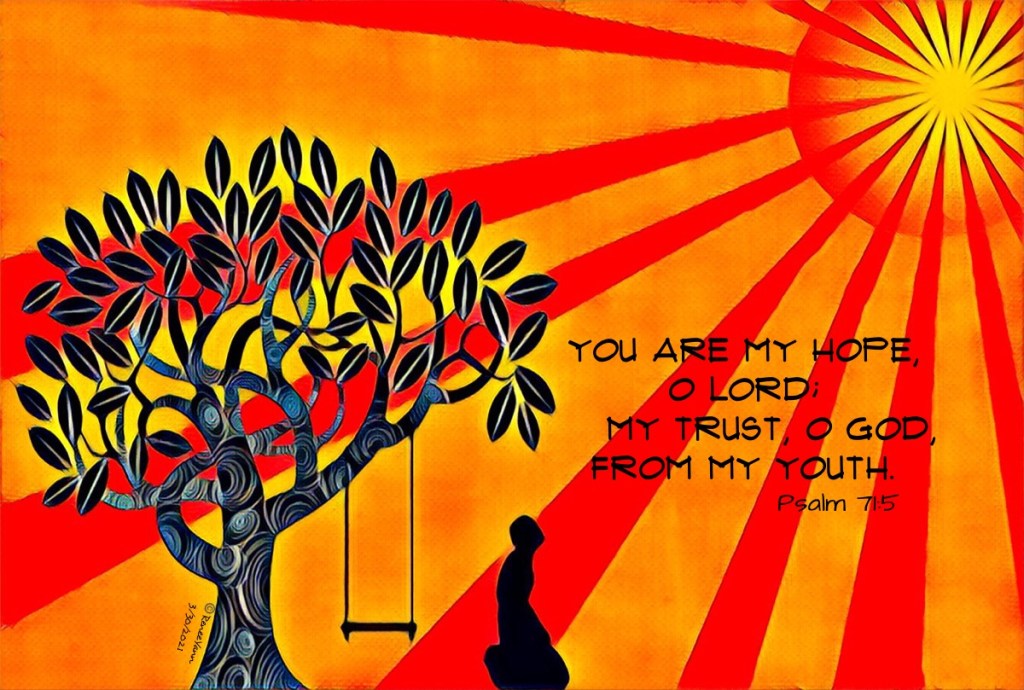
For you are my hope, O Lord;
my trust, O God, from my youth.
On you I depend from birth;
from my mother’s womb you are my strength.

My mouth shall declare your justice,
day by day your salvation.
O God, you have taught me from my youth,
and till the present I proclaim your wondrous deeds.

Psalm 71: 5-6; 15,17

Poetry: Two poems today – one from Wendell Berry and one from me. His is way better. 🙂

The Wild Geese – Wendell Berry

Horseback on Sunday morning,
harvest over, we taste persimmon
and wild grape, sharp sweet
of summer's end.  In time's maze
over the fall fields, we name names
that went west from here, names
that rest on graves.  We open
a persimmon seed to find the tree
that stands in promise,
pale, in the seed's marrow.

Geese appear high over us,
pass, and the sky closes.  Abandon,
as in love or sleep, holds
them to their way, clear,
in the ancient faith: what we need
is here.  And we pray, not
for new earth or heaven, but to be
quiet in heart, and in eye
clear.  What we need is here.

If You Are Mother – Renee Yann, RSM

If you are Mother, God
don’t let us hurt ourselves;
keep freedom in us
as freedom,
not as willfulness,
so that we grow
even if we must grow down
like a dark, hidden root.

Remember,
if life dies in us,
You change.  We are not
isolated seedlings
you left somewhere
in lonely hope one spring.
You are the ground, and the
growth, and the growth’s nourishment.
When we green, it is You
who thrive.

Music: Listen and blossom, dears❤️

Alleluia: Imperative Mood

Monday of the Sixteenth Week in Ordinary Time
July 18, 2022

Today’s Readings

https://bible.usccb.org/bible/readings/071822.cfm

Alleluia, alleluia.
If today you hear God’s voice,
soften your hearts.

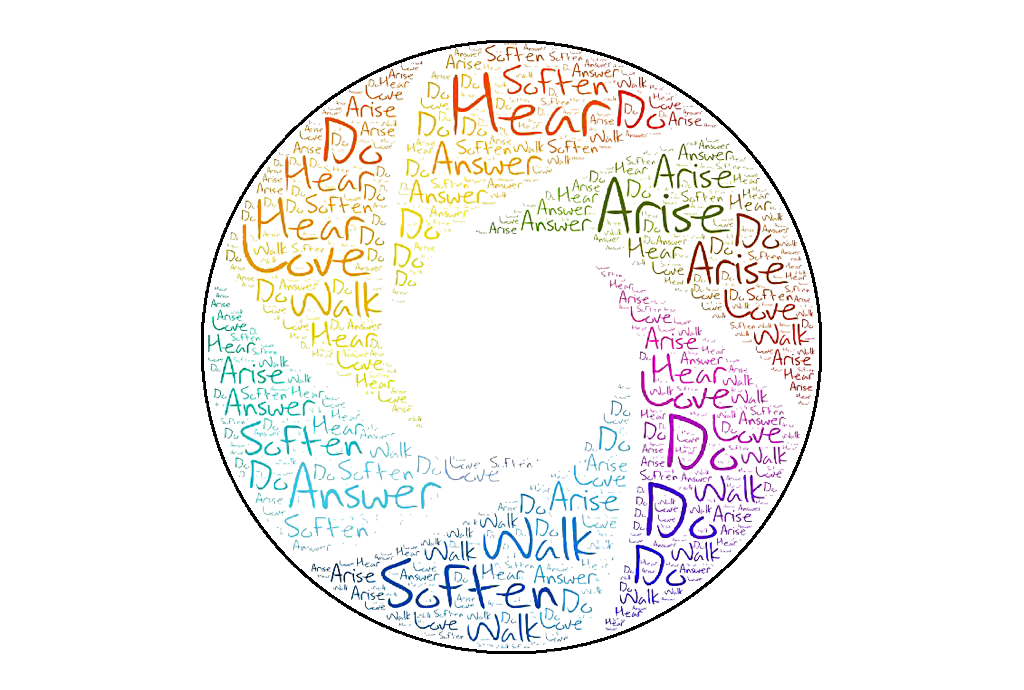
Today, in God’s Lavish Mercy, the readings heighten the familiar imperative of our Alleluia Verse with several more injunctions:

  • Hear
  • Soften
  • Arise
  • Answer 
  • Do
  • Love
  • Walk

God is not shy in telling us what to do in order to grow in holiness – in mutual relationship with God.

We have to DO something, to be responsive in order to unite with God. We can’t be just passive lumps of inactive devotion.

Don’t Be a Spiritual Couch Potato

Each instruction has its own vitality which is meant, in turn, to vitalize our spirits and to make us agents of the Holy One in the world.


Our first reading carries this message clearly to the people of Micah’s time. It’s not about contrived sacrifice. It’s about love and compassion.

With what shall I come before the LORD,
and bow before God most high?
Shall I come before him with burnt offerings,
with calves a year old?
Will the LORD be pleased with thousands of rams,
with myriad streams of oil?
Shall I give my first-born for my crime,
the fruit of my body for the sin of my soul?
You have been told, O Creature, what is good,
and what the LORD requires of you:
Only to do the right and to love goodness,
and to walk humbly with your God.

Micah 6: 6-8

The scribes and Pharisees of Jesus’s time demand a sign before they will listen. Jesus says the only sign they will get is to remember that the Ninevites listened when Jonah delivered God’s message. 

At the judgment, the men of Nineveh will arise with this generation
and condemn it, because they repented at the preaching of Jonah;
and there is something greater than Jonah here.

Matthew 12:42

We don’t have a Micah or a Jonah coaching us to holiness. What we have is the Word present to us in the Gospel and in the community of faith. That Word reveals itself in the circumstances of our lives to which we must respond by:

Hearing God’s invitation 
Softening our hearts from judgments 
Arising from our self-absorption 
Answering the call to holiness
Doing good
Loving compassionately 
Walking humbly with our God


Poetry: from Rumi

Discard yourself 
and thereby regain yourself. 
Spread the trap of humility 
and ensnare Love.

Music: Act Justly – Pat Barrett

Alleluia: The Promise

Sixteenth Sunday in Ordinary Time
July 17, 2022

Today, in God’s Lavish Mercy, our readings are all about making and keeping promises.

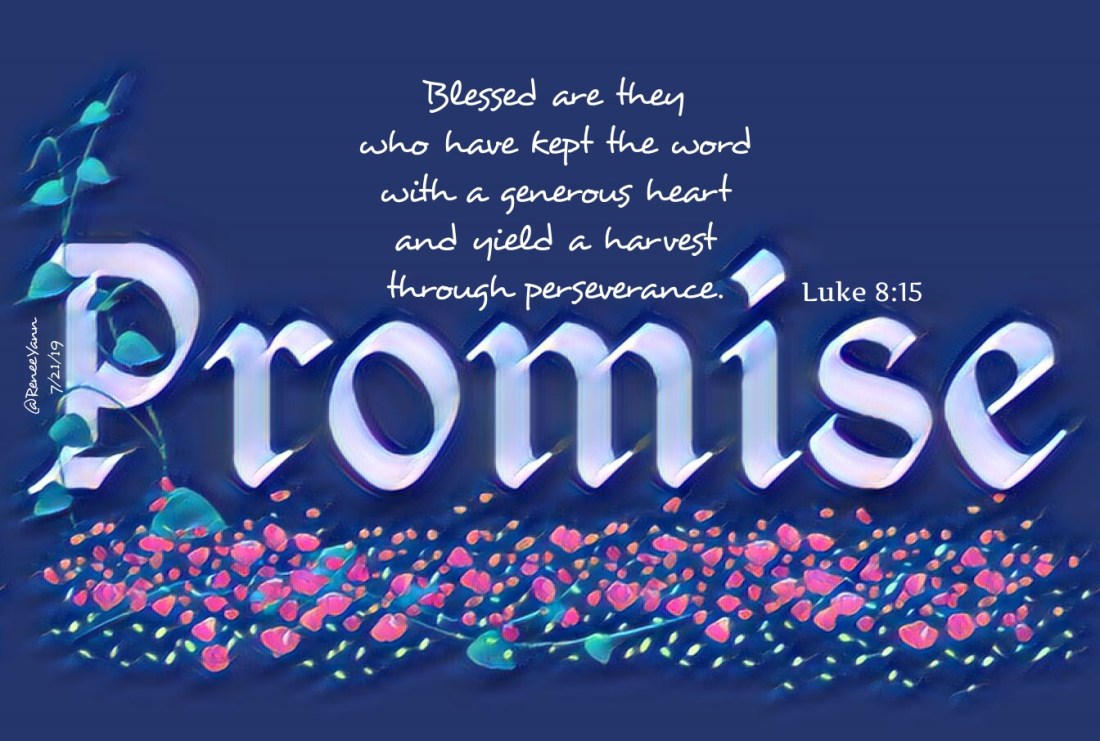
Luke8_15 promise

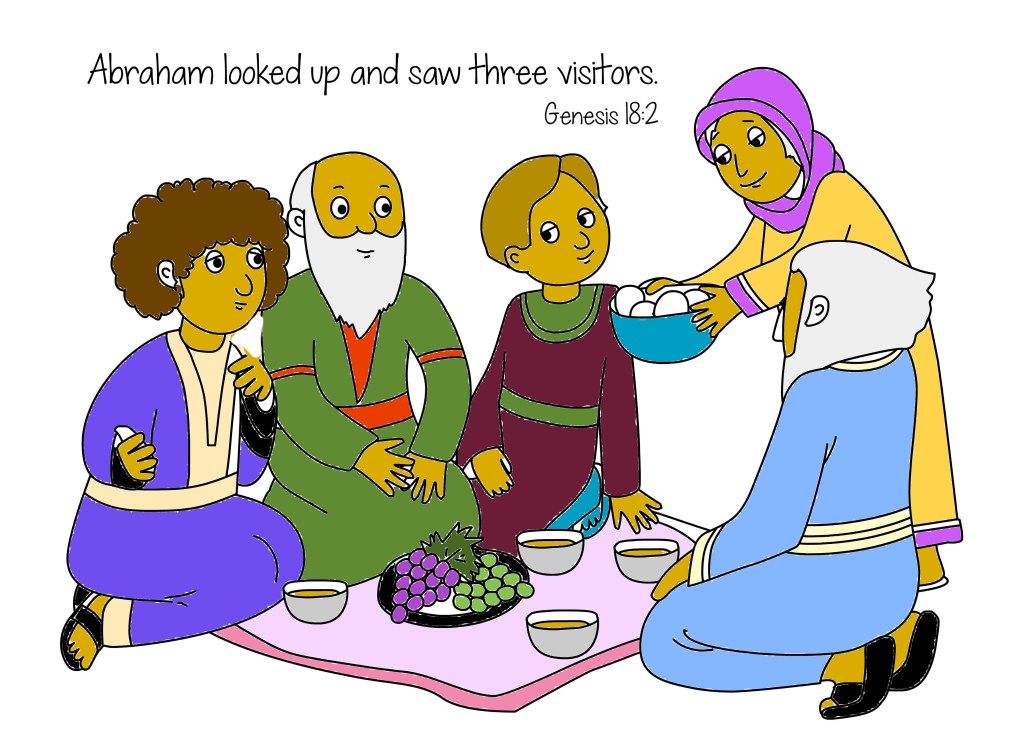
Our first reading refers to Genesis and God’s promise to Abraham of land and posterity. Through his hospitality to three disguised angels, Abraham secures God’s promise to bless Sara and him with a child.


In today’s second reading from Colossians, Paul assures us that God has brought that promise to its full completion in the gift of Jesus Christ living in us.

…the mystery hidden from ages and from generations past
has now been manifested to his holy ones,
to whom God chose to make known the riches of the glory
of this mystery among the Gentiles;
it is Christ in you, the hope for glory. 

In our Gospel, Jesus encourages Martha to give her attention to the presence of this promise revealed in her life. Mary sees the promise fulfilled in Jesus, the living presence of God. She gives her full heart to it. Martha, maybe like us sometimes, is preoccupied by other distractions.


Our readings invite us to rejoice in God’s promise to us
of “land” and “posterity”. 

In Jesus, we are brought home to God. 
In Jesus, the fruitfulness of our life is eternally secured.


We make promises to God too.

vows

When our Sisters die, our vows rest near us for our wakes – a profound symbol of promises given and promises fulfilled.
Today, as we pray about God’s faithful promises to us, we might want to reflect on and deepen the commitments of our Baptism, our religious profession, our marriage, our covenants to communities of faith and service.

Like Martha, we might hear Jesus encourage us to give our fullest heart to that which is most important.


Poetry: BETHANY DECISIONS (LUKE 10:38–42) – Irene Zimmerman

As Jesus taught the gathered brothers
and Martha boiled and baked their dinner,
Mary eavesdropped in the anteroom
between the great hall and the kitchen.
Her dying mother’s warning words
clanged clearly in her memory—
“Obey your sister. She has learned
the ways and duties of a woman.”

She’d learned her sister’s lessons well
and knew a woman’s place was not
to sit and listen and be taught.
But when she heard the voice of Jesus
call to her above the din
of Martha’s boiling pots and pans,
she made her choice decisively—
took off her apron and traditions,
and walked in.


Music: timeless Motion – Daniel Kobialka

Alleluia: Shadows

Memorial of Saint Bonaventure, Bishop and Doctor of the Church
July 15, 2022

Today’s Readings:

https://bible.usccb.org/bible/readings/071522.cfm

Alleluia, alleluia.
My sheep hear my voice, says the Lord;
I know them, and they follow me.

Today, in God’s Lavish Mercy, our readings are woven through with themes of life and death, time and eternity. These are fundamental realities at the core of our lives. Yet they are so huge in scope that they elude our comprehension.

Photo by Rui Dias on Pexels.com
  • How often do we ask ourselves, “Where did the time, the day, the years go”?
  • Despite all our acts of faith, aren’t we still undone by death and bereavement in our lives?
  • When we try to imagine heaven, doesn’t the image slip through our efforts like a wet sunfish lost back to the sea?

In our first reading, Hezekiah faces the same kind of bewilderment. Informed that he is about to die, he laments:

“O LORD, remember how faithfully and wholeheartedly
I conducted myself in your presence,
doing what was pleasing to you!”
And Hezekiah wept bitterly.

Hezekiah’s pleading gains him another fifteen years. (Would that our prayers could so prevail!) His bonus is delivered accompanied by a sign:

This will be the sign for you from the LORD
that he will do what he has promised:
See, I will make the shadow cast by the sun
on the stairway to the terrace of Ahaz
go back the ten steps it has advanced.


In our Gospel, Jesus doesn’t need bonuses or signs. Jesus himself is the embodiment of Life over death, Eternity over time. In today’s passage, the Pharisees try to judge and limit Jesus’s spiritual freedom by invoking the old law against him:

Jesus was going through a field of grain on the sabbath.
His disciples were hungry
and began to pick the heads of grain and eat them.
When the Pharisees saw this, they said to him,
“See, your disciples are doing what is unlawful to do on the sabbath.”


Jesus tells them clearly that he is the new law of mercy and love. He is beyond time, death, and the judgments of human law:

I say to you, something greater than the temple is here. 
If you knew what this meant, I desire mercy, not sacrifice,
you would not have condemned these innocent men.
For the Son of Man is Lord of the sabbath.

Let’s pray today with our God Who is greater than time, death or human judgments. Let us trust that God has power over any shadow that might darken our lives.


Poetry: The Shadow of Thy Wing – Susan Dickinson (Emily’s sister-in-law)

Weary of life's great mart, its dust and din,
Faint with its toiling, suffering with its sin,
In childlike faith my heart to Thee I bring.
For refuge in "the shadow of thy wing."

Like a worn bird of passage, left behind
Wounded, and sinking, by its faithless kind,
With flight unsteady, seeking needed rest,
I come for shelter to Thy faithful breast.

Like a proud ship, dismantled by the gale,
Her banners lost and rifted every sail,
In the deep waters to Thy love I cling,
And hasten to the refuge of Thy wing.

O Thou, thy people's comforter alway,
Their light in darkness, and their guide by day,
Their anchor 'mid the storm, their hope in calm,
Their joy in pain, their fortress in alarm!

We are all weak, Thy strength we humbly crave;
We are all lost, and Thou alone canst save;
A weary world, to Thy dear arm we cling,
And hope for all a refuge "'neath Thy wing."

- "Original Poetry." Springfield Daily Republican, March 1, 1862

Music: Cavatina’s “The Shadows” played by 2Cellos

Alleluia: Simplicity

Wednesday of the Fifteenth Week in Ordinary Time
July 13, 2022

Today’s Readings

https://bible.usccb.org/bible/readings/071322.cfm

Today, in God’s Lavish Mercy, our Alleluia Verse evokes the tender image of Jesus with innocent little children.

Alleluia, alleluia.
Blessed are you, Father,
Lord of heaven and earth,
you have revealed to little ones
the mysteries of the Kingdom.

The verse is so gentle that it may seem out of place following a ferocious first reading. Without exegeting that passage from Isaiah, let’s just say it is all about PRIDE and ARROGANCE toward God’s Will. These two vices are the downfall of the spiritual life.


Their corrective is diagnosed into today’s Gospel. It is to have the simplicity and trust that makes us spiritually childlike – not “childish” – childlike.

  • This means to recognize that our life is a gift which belongs to our Creator. 
  • It means to trust in that Gift Giver to care for us the way a parent cherishes their child.
  • It means to be faithful even when we don’t understand and to seek to deepen in our understanding through prayer.
  • It means to mature to a deep relationship of mutual love with God.

I give praise to you, Father, Lord of heaven and earth,
for although you have hidden these things
from the wise and the learned
you have revealed them to the childlike.

Matthew 11: 25-26

We may wish to pray today considering the simple beauty of the children in our lives. Here are my “grand” inspirations:

Love, Love, Love and Love!

Quote: Leonardo Da Vinci

Simplicity is the greatest sophistication.

Music: ‘Tis a Gift to Be Simple