Begin …

Monday, January 7, 2019

Click here for readings

Today, in Mercy, in this week after the Epiphany, we continue with John’s inspirational readings. They are intended to deepen us in love, truth and simplicity.

mt4_15

And we also have several Gospels this week that take us with Jesus as he begins his public ministry.

Today’s Gospel opens with a tinge of sadness. Jesus has just heard that John had been arrested. Reality dawns on them both that theirs will be no easy missionary journey. Wouldn’t it have been wonderful if these cousins could have teamed up, gone about preaching unhindered by the fears and bullying of the powerful?

But a free and easy story is not the one God chose to tell us, because our own stories are not always free and easy. Some, yes, more so than others. But all people suffer in some way and we all need a God who understands and shares that suffering.

So, “hearing that John had been arrested”, Jesus bravely begins. He goes to the Capernaum lakeshore where the common people gather to refresh themselves. He will find them hungry, confused, sinful, questioning, bereft, and battered. And he will begin by feeding and soothing them.

Where would Jesus begin with you? If you sat along that seashore in those first days, what would you lay before his tender mercy? Perhaps the need does not belong precisely to you, but to someone you love, someone who needs love in a harsh world.

Picture yourself there this morning. The sun begins to warm the salty edges of the sea. The crowd is large but quiet, as if they think themselves in church. Jesus looks out over all the gathered. But for one moment, his eyes meet yours, and that moment is enough to begin.

Music: Lord, You Have Come to the Lakeshore
What About That Fig Tree?

Saturday, January 5, 2019

Click here for readings

jn1_50 figjpg

Today, in Mercy,  we celebrate the Memorial of Saint John Neumann. 

John Neumann was born in Bohemia on March 20, 1811. Since he had a great desire to dedicate himself to the American missions, he came to the United States as a cleric and was ordained in New York in 1836 by Bishop Dubois.

In 1840, John Neumann entered the Congregation of the Most Holy Redeemer (Redemptorists). He labored in Ohio, Pennsylvania and Maryland. In 1852, he was consecrated bishop of Philadelphia. There he worked hard for the establishment of parish schools and for the erection of many parishes for the numerous immigrants. Bishop Neumann died on January 5, 1860; he was beatified in 1963.
(catholicculture.org)


In our first reading today, John tells us bluntly:

Whoever does not love remains in death.

This kind of statement is what one might  both love and hate about John. We love it because it’s clear, unequivocal- tells us exactly what we need to do.

And we hate it because it’s clear and unequivocal – there’s no evading it, no back door. We must love – everybody- or we are as good as dead. Wow!

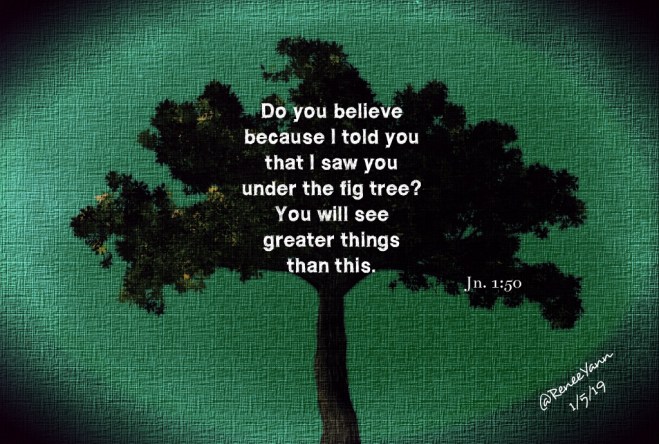
Was this the kind of either-or that Nathaniel struggled with under the fig tree? He sat there pondering some deep challenge or decision and Jesus saw him – and understood-from afar.

The miracle of that moment caused Nathaniel to believe. But Jesus says:

Hold up, you ain’t seen nothin’ yet! Your little wrestling under the fig tree was all about your own small world and vision. I invite you now to see the world with God’s eyes.

We all spend worrying time under the shadow our own little fig trees – most of the time worrying about ourselves – who hurt us, doesn’t like us, gets in our way, misunderstands or annoys us.

Today’s Gospel invites us to stop licking our wounds. It beckons us out of the shadows of our self-absorption to see what God might see today – the beauty, the needs, the challenges and possibilities of the world around us. We are invited to become lovers and healers like Jesus. As John has said, we are invited to leave any shadow of death and to live in love.

Music: Maybe Nathaniel sang a song like this in his heart as he came out from under his fig tree.

Love Like Jesus – Rhett Walker

Come and See

Friday, January 4, 2019

Click here for readings

Jn 1_39

Today, in Mercy, we celebrate the Feast of St. Elizabeth Anne Seton, the first American born saint.

Elizabeth Seton was born on August 28, 1774, of a wealthy and distinguished Episcopalian family. She was baptized in the Episcopal faith and was a faithful adherent of the Episcopal Church until her conversion to Catholicism.

She established her first Catholic school in Baltimore in 1808; in 1809, she established a religious community in Emmitsburg, Maryland. After seeing the expansion of her small community of teaching sisters to New York and as far as St. Loius, she died on January 4, 1821, and was declared a saint by Pope Paul VI on September 14, 1975. She is the first native born American to be canonized a saint.

(from CatholicCulture.org)


In our Gospel, we find the first disciples encountering Jesus. They are curious about him because the Baptist has just described him as “the Lamb of God”.

We can picture Andrew and his unnamed buddy trailing behind Jesus, watching him, listening to him. Finally they hazard a question, “Rabbi, where do you live?”

It’s kind of a loaded question. What it might really mean are things like these:

  • Where did you come from all of sudden?
  • Could you possibly be the Messiah if you’re walking around looking just like us?
  • Do you go back to heaven at night or are you really one of us?
  • Can we just hang out and find out more about you?

Their faith is tentative, hopeful and maybe just a little bit suspicious. Does your faith ever feel like that? 

When we pray, are we convinced that God hears us? When we suffer, do we believe God abides with us? When we choose, act or respond, do we trust that God cares about our actions? Do we believe, in these and all circumstances, that the power of God is present in our lives?

To have that kind of faith, we have to “learn” Christ, to become as close and comfortable with him as with an intimate friend. In our Gospel, Jesus tells us how to do that: “Come and see.” 

In other words:

Spend time with me.
Talk with me about ordinary things.
Watch sunsets and sunrises with me.
Tell me your secrets.
Let me tell you mine.
Laugh with me.
Be silent with me.
Trust that you are never separate from me.

If we do these things, even slowly and steadily as the first disciples, we will eventually say with Andrew, “l have found the Messiah” – and he is living right within my life!

Music: Come and See – Bob Bennett

God’s Beloved Child – You!

Thursday, January 3, 2019

Click here for Readings

Today, in Mercy, we pray with John’s soul-stirring words:

1 jn 3_ 2

Beloved, we are God’s children …

When I pray these words I think of my mother. As a little child, I already bore a clear physical likeness to her. But as I grew into a young woman, and later an older woman, people remarked that we looked like twins. There were even occasions when we were confused with each other.

This visible resemblance gave me great pride. My mother was strong, courageous, funny, wise, and fiercely loving. I wanted to be like her – made of the same stuff as she was.

In our reading today, John tells us that we are made of the very stuff of God – the essence of the Sacred. He suggests that when people look at us they should see God’s features written all over us.

He says that we should see this Divine familial likeness in one another – that we are each imprinted with our Creator’s image.

If we believe John’s words, what tenderness we would bear toward ourselves and others! How could we ever belittle, hate or kill one another? How could we ever do these things to ourselves?

Music: How Can Anyone Ever Tell You – Shaina Knoll

Often, when I think of Christ on the Cross, I can hear God the Mother singing this song to Jesus, reaching from heaven to console Him in His pain.

This morning, we might ask God to sing this song over our wounded world which has so obscured God’s likeness – perhaps to sing it over us if we are in particular pain.

In our heart’s deep forgiveness, we might sing this song over anyone who has hurt us – the meanness coming from their failure to recognize their own beauty.

(PS:  Speaking about my mother has inclined me to offer a second post today … a reflection I wrote 10 years ago.  I thought some of you might enjoy reading it. You will receive it in a separate mailing.)

Faith from the Beginning

Wednesday, January 2, 2019

Click here for readings

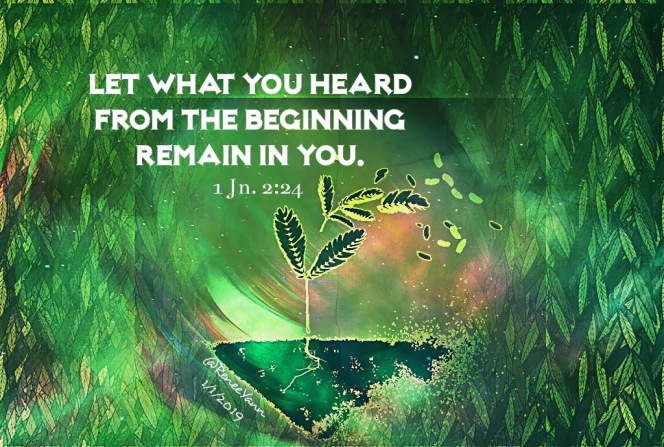
1Jn2_24 beginning

Today, in Mercy, we continue to relish John’s eloquent first letter in which he heartily instructs us in the life of Christian love.

John has written this letter out of concern about false teachings that are cropping up in the early Church. Misguided “teachers” are placing distorted interpretations on the pure, original message of the Gospel.

Human beings have never stopped doing that, have we? Down through the centuries, how many heresies and misinterpretations have woven their way into the Gospel’s central, inviolable thread?

Has it happened to our faith? Have we lost the crisp, clear power of our original belief?

John tells us to hold fast to the core teaching of the Gospel. This is the faith that many of us learned as children from devout parents and teachers. It is a faith that continues to evolve through scriptural prayer and meditation, through openness to theological wisdom, through the holy dialogue of the beloved community.

It is a living faith, stretched and tested by our daily choices for true Christian love for all people, especially the poor, sick and marginalized.

Ultimately, it is a faith rooted in the Cross and transformed by the Resurrection.

Over these next few weeks, let us listen carefully to John as he guides us to the depth of that faith.

Music: some gentle meditation music for your prayer with John:

Herb Ernst – Song of the Inner Child

Now Go in Peace

Saturday, December 29, 2019

Click here for Readings

Lk2_29 Nunc

Today, in Mercy,  our first reading offers us John’s perfect honesty and simplicity:

Whoever says, “I know him,” but does not keep his commandments
is a liar, and the truth is not in him.
But whoever keeps his word,
the love of God is truly perfected in him.
This is the way we may know that we are in union with him:
whoever claims to abide in him ought to walk just as he walked.

Yes, it’s that simple and that hard!

Then, in our Gospel, we meet Simeon who speaks with the holy confidence of a long and well-lived life. His lifelong dream was that he might not die before seeing the Messiah. That dream now fulfilled, Simeon intones one of the most beautiful prayers in Scripture:

Lord, now let your servant go in peace;
your word has been fulfilled:
my own eyes have seen the salvation
which you prepared in the sight of every people,
a light to reveal you to the nations
and the glory of your people Israel.

If we live in the Light, we too will see the Messiah within our life’s experiences. We too will come to our final days confident and blessed by that enduring recognition.

For as John also assures us:

Whoever says he is in the light,
yet hates his brother or sister is still in the darkness.
But whoever loves his brother and sister remains in the light …

Let’s pray today for those who are dying, that they may know this kind of peace.

Let us pray for ourselves, that when our time comes, we too may experience this confidence.

Music:  Nyne Otpushchayeshi ~Sergei Rachmaninoff (translated Nunc Dimittis, Now Let Your Servant Go). This was sung at Rachmaninoff’s funeral, at his prior request. (For musicians among you, point of interest: Nunc dimittis (Nyne otpushchayeshi), has gained notoriety for its ending in which the low basses must negotiate a descending scale that ends with a low B-flat (the third B-flat below middle C).

Church Slavonic text
Ныне отпущаеши раба Твоего,
Владыко, по глаголу Твоему, с миром;
яко видеста очи мои спасение Твое,
еже еси уготовал,
пред лицем всех людей,
свет во откровение языков
и славу людей Твоих Израиля

English translation
Now let Your servant depart in peace,
Lord, by Your word;
My eyes have seen Your salvation,
Which You have prepared,
In view of all the people,
A light revealed to all tongues
and to the glory of Your people, Israel

When I First Believed

Thursday, December 27, 2018
Feast of St. John the Apostle
Click here for readings

1Jun1_3 seenJPG

Today, in Mercy, and for the next two weeks, our first readings take us into the beautiful mind and heart of John the Apostle, whose feast we celebrate today.

John, as I have met him in his Gospel and Letters, is a lover and a poet. He is, at the same time, a precise and exquisite engineer of thought and insight.

Often, a single word or phrase of John’s writing captures more than our minds can hold. Thus, praying with his writings should be a slow savoring, morsel by morsel, of Eternal Light captured for us in an elegant word.

Let these phrases rest with you in prayer today:
“What was from the beginning
Jesus, Uncreated, pre-existent Word of God

what we have heard, …
Whose voice John heard

what we have seen with our eyes, …
Whose acts of love John witnessed

what we looked upon …
Whose crucified body John held

and touched with our hands …
Whose wounds he wept over

concerns the Word of life
…this Jesus is John’s whole life.

And John proclaims this treasure to us today so that our joy may be complete — so that we, too, might find our whole and eternal life in this Beloved Word of God.

In our Gospel, John remembers the moment when he “saw and believed”. It was at the first Easter morning when he was very young. As he writes today’s epistle, John is very old. Thousands of acts of faith have spread across his long life like so many sunrises. But he still remembers that first amazed belief at an empty tomb.

Do you remember your first faith? Do you cherish its many dawns over your life? It might be good to pray with John about these things today.

Music: When I First Believed ~ Mitch Langley

St. Stephen, Protomartyr

Wednesday, December 26, 2018

 Click here for readings

The Demidoff Altarpiece: Saint Stephen
Representation of St. Stephen from The Demidoff Altarpiece by Carlo Crivelli, an Italian Renaissance painter of the late fifteenth century. This many-panelled altarpiece or polyptic painted by Crivelli in 1476, sat on the high altar of the church of San Domenico in Ascoli Piceno, east central Italy. It is now in the National Gallery in London, England.


Today, in Mercy, we celebrate the Feast of St. Stephen, first martyr for the Christian faith. 

The commemoration and readings are a drastic turn from singing angels and worshiping shepherds.The Liturgy moves quickly from welcoming a cooing baby to weeping at the death of innocence. Why?

One thought might be to keep us practical and focused on what life in Christ truly means.

Stephen, like Jesus, “was filled with grace and power, … working great wonders and signs among the people.” He, as Jesus would, met vicious resistance to his message of love and reconciliation. He, as Jesus would, died a martyr’s death while forgiving his enemies.

The Church turns us to the stark truth for anyone who lets Christ truly be born in their hearts. WE will suffer as Jesus did – as Stephen did. The grace and power of Christ in our life will be met with resistance, or at least indifference.

We may not shed blood but, in Christ, we will die to self. When we act for justice for the poor and mercy for the suffering, we will be politically frustrated and persecuted. When we forgive rather than hate, we will be mocked. Powerful people, like the yet unconverted Saul in today’s second reading, may catalyze our suffering by their determined hard-heartedness.

Our Gospel confirms the painful truth:

“You will be hated by all because of my name,
but whoever endures to the end will be saved.”

Tomorrow, the liturgy picks up the poetic readings from John’s letters. These are delights to the soul. 

But for today, it is a hard look, with Stephen, at what Christmas ultimately invites us to.

Music: Gabriel’s Oboe from the movie “The Mission”, played by Henrik Chaim Goldschmidt,  principal oboist of The Royal Danish Orchestra in Copenhagen, Denmark.

God, Face to Face

Saturday, December 1, 2018

Click here for Readings

turin
Section of the Shroud of Turin

Today, in Mercy, we come to the end of our readings from Revelation.  They have been challenging, to say the least.

The passage from Luke’s Gospel today is just as confronting.  These are not easy times.

Our prayer over these past few days has led us to deeper understanding of this hard truth: life as we know it will be transformed and we will be judged at the transformation.

But hopefully our reflections have also assured us that the Master and Judge of Life is the same merciful God who forgave and healed the sinful and suffering.

By our faithfulness to this merciful God, we will be redeemed. Revelation puts it this way:

The servants of God
will look upon his face,
and his name
will be on their foreheads.

When a person is filled with goodness (or evil), we often say it is “written all over her face”.  So it is with those who love and long for God and for God’s peaceable kingdom.

God will recognize us at the judgment because our hope and desire for God are written all over our face. And God’s love for us will be written all over that Divine Countenance.

Music: The Face of God – Karen Drucker

A Simple Faith

Friday, November 30, 2018

Click here for readings

Rom 10_17 Andrew

Today, in Mercy, we celebrate the Feast of St. Andrew, the brother of Peter, also a fisherman, a beloved Apostle and friend of Jesus.

Our Gospel tells the story of Andrew’s call.

Another favorite passage about Andrew is when he points out to Jesus that, in the hungry crowd, there is a young boy with five loaves and two fish. 

How simple and complete was Andrew’s faith! Those seven little items must have seemed so minute among 5000. Can you picture Andrew looking into Jesus’s eyes as if to say, “I know it’s not much but you can do anything!” Maybe it was that one devoted look which prompted Jesus to perform this amazing miracle!

We trust that our deep devotion and faith can move God’s heart too. On this feast of St. Andrew, many people begin a prayer which carries them through to Christmas. Praying it, we ask for particular favors from God.

I love this prayer because it was taught to me by my mother, a woman blessed with simple faith like Andrew’s. As I recite it, I ask to be gifted with the same kind of faith.

( Another reason I love it is this: how often in life do you get a chance to say a word like “vouchsafe“! )

St. Andrew Christmas Novena
Hail and blessed be the hour and moment
in which the Son of God was born of the most pure Virgin Mary,
at midnight, in Bethlehem, in the piercing cold.
In that hour vouchsafe, I beseech Thee, O my God,
to hear my prayer and grant my desires
through the merits of Our Savior Jesus Christ,
and of His blessed Mother. Amen.

There is a very hurting world that needs healing. Let’s fold our Advent prayers around its many wounds.

Music:  Hear my prayer, O Lord is an eight-part choral anthem by the English composer Henry Purcell (1659–1695). The anthem is a setting of the first verse of Psalm 102 in the version of the Book of Common Prayer. Purcell composed it c. 1682 at the beginning of his tenure as Organist and Master of the Choristers for Westminster Abbey.