Breakfast with Jesus

Friday in the Octave of Easter
April 14, 2023

Today’s Readings:

https://bible.usccb.org/bible/readings/041423.cfm
Today, in God’s Lavish Mercy, we once again have readings sprinkled with the names of ancient people who lived in the immediate Resurrection light.

In our first reading from Acts:

After the crippled man had been cured,
while Peter and John were still speaking to the people,
the priests, the captain of the temple guard,
and the Sadducees confronted them,
disturbed that they were teaching the people
and proclaiming in Jesus the resurrection of the dead.

Acts 4:1-2
  • Peter and John, courageously, exuberantly sharing the Word
  • Annas, the retired but still influential high priest to whom Jesus was first brought when arrested
  • Caiaphas, the reigning high priest, who plotted to kill Jesus, condemned him for blasphemy, and sent him for judgment to Pilate
  • John and Alexander, less known priestly trainees, but known well enough to have their names recorded

Christ Before Caiaphas- Matthias Stom


In our Gospel, John names some of the group lolling along the beach one day. It’s interesting how he remembers and identifies them as he tells the story many years later:

  • Simon Peter – remembered with both his original and later Christ-given name
  • Thomas called Didymus – a name meaning “twin”, who was his twin and why is he never mentioned as a disciple?
  • Nathanael from Cana in Galilee – identified here by his home town of Cana. Had it been at his home, perhaps his wedding, that Christ’s first miracle occurred?
  • Zebedee’s sons – John, writer of the Gospel identifies himself and his brother (James) only by their relationship to their very influential father
  • two others of his disciples – what about these two? Why has John, who was there, conveniently forgotten their names? Were they women, whom custom often left unnamed and perhaps overlooked?

Breakfast with Jesus – C.Michael Dudash


These readings offer us rich opportunities to chose one of these people and sit with them as they condition their hearts to the overwhelming truth of the Resurrection.

How does each one respond to their redeemed reality? We have the same choice these ancient persons had. Do we:

  • live and preach the Good News by our choices, as Peter and John did?
  • resist its call to us like the high priests?
  • dive whole-heartedly toward Jesus like half-clad Peter?
  • surrender our doubts and finally believe like Thomas?
  • invite Jesus into our life, home and celebrations like Nathaniel may have?
  • realize how our elders have gifted us with faith and honor them as Zebedee’s sons did?

And what about the “two others of his disciples” left in the unnamed shadows of history? Perhaps we are more like them – quietly doing, praying, loving, hoping to respond with humble hearts to the Easter gift we have been given.


This morning, let’s sit beside Jesus and his barbecued fish to talk about it. Let’s listen to what he hopes for and loves in us.

Jesus said to them, “Come, have breakfast.”
And none of the disciples dared to ask him, “Who are you?”
because they realized it was the Lord.
Jesus came over and took the bread and gave it to them,
and in like manner the fish.
This was now the third time Jesus was revealed to his disciples
after being raised from the dead.

John 21:12-14

Poetry:  Jesus Makes Breakfast: A Poem about John 21:1-14 
– by Carol Penner, Mennonite pastor currently teaching theology at Conrad Grebel University College in Waterloo, Ontario.

I could smell that charcoal fire a long way off
while we were still rowing far from shore.
As we got closer I could smell the fish cooking,
I imagined I could hear it sizzling.
When you’re hungry, your mind works that way.

When the man by the fire called out asking us about our catch,
we held up the empty nets.
And his advice to throw the nets in once more
is something we might have ignored,
except for the smell of cooking fish…
this guy must know something  about catching fish!

The catch took our breath away;
never in my life have we pulled so many in one heave.
I was concentrating on the catch,
but John wasn’t even paying attention,
he was staring at the shore
as if his life depended on it.
Then he clutched my shoulder, crying,
“It is the Lord!”

Suddenly, everything came into focus,
the man, the catch, the voice,
and nothing could stop me,
I had to be with the Master.

There were no words at breakfast,
beyond, “Pass the fish,”
or “I’ll have a bit more bread.”
We sat there, eating our fill,
basking in the sunrise.
We didn’t have to say anything.
Jesus just smiled and served.


Music: Spend some time on that morning beach with Jesus:
Turn toward Light!

Tuesday in the Octave of Easter
April 11, 2023

Today’s Readings:

https://bible.usccb.org/bible/readings/041123.cfm

Today, in God’s Lavish Mercy, we share the heartfelt experience of the early disciples captured in a few poignant comments.

Sometimes words are so full of meaning that they burst in your heart when you read them — when you hear them

Two such phrases rise up from our readings today: 

Cut to the heart

In our first reading, the Easter-liberated Apostles preach the Gospel with gusto! They tell it – exactly like it is- to the crowd gathered in Jerusalem:

On the day of Pentecost, Peter said to the Jewish people,
“Let the whole house of Israel know for certain
that God has made him both Lord and Christ,
this Jesus whom you crucified.”

Acts 2:36

….” this Jesus whom you crucified..”

For those in that crowd, these were shattering words to hear! The feeling is like when you drop a precious vase and it crumbles at your feet! What do you do now? It is too late to redeem the brokenness! They were “cut to the heart” by the realization.

But that is the wonder of the Resurrection. It is never too late! Our life in God is never irrevocably broken!

Peter, motivated by Jesus’ own act of forgiveness from the cross, said to them,

“Repent and be baptized, every one of you,
in the name of Jesus Christ, for the forgiveness of your sins;
and you will receive the gift of the Holy Spirit.
For the promise is made to you and to your children
and to all those far off,
whomever the Lord our God will call.”

Acts 2:38-39

Rabbouni 

Our Gospel extends this theme of restoration and hope. As we pray with its grace-filled drama, we thank John for being the only Evangelist to record this poignant moment between Jesus and Mary.

After Mary had discovered the empty tomb, and summoned the other disciples to see it, she lingers there once they have returned the city. 

She doesn’t know what to do! Feel her confusion, her distress. Easter faith has not yet dawned in her. She thinks the precious body of Jesus has been stolen, perhaps desecrated – again, like a beautiful vessel splintered and lost forever.

Then she turns toward the Light – as we all must do when we are overshadowed in doubt.

She said to the angels, “They have taken my Lord,
and I don’t know where they laid him.”
When she had said this, she turned around and saw Jesus there…

John 20:14

Still, she doesn’t fully recognize him until he lovingly speaks her name. Then she in turn utters the word so full of devotion and love: Rabbouni 

Noli Me Tangere – Antonio Corregio

Think about it! You can imagine how she felt when she said it – just like you would feel if you thought you had lost a Beloved but they returned to you alive and transformed!

Let’s be with Jesus and Mary in this sacred moment, hearing our own name spoken by our Beloved, responding in amazed tenderness from the depths of our heart.


Poetry: Rabboni! by John Banister Tabb (1845 – 1909) an American poet, Roman Catholic priest, and professor of English.

"I bring thee balm, and, lo, Thou art not here!
Twice have I poured mine ointment on Thy brow,
And washed Thy feet with tears. Disdain'st Thou now
The spikenard and the myrrh?"
“Has Death, alas, betrayed Thee with a kiss
That seals Thee from the memory of mine?”
“Mary!” It is the self-same Voice Divine.
"Rabboni!" -- only this.

Music: Rabboni – Ken Young

You were there when the world had turned against me.
When the darkness had possessed my soul,
Your tender mercy made me whole.
When I followed You, my life was filled with meaning
From the morning to the evening.
I’ve seen the face of God.

Chorus:
Rabboni! My Teacher and my God!
You’re alive and my burdens melt away.
Rabboni! Sweet Son of God Most High!
I know death has lost its power
And Your glory’s here to stay. (repeat).

When I close my eyes
I can hear Your voice so clearly saying,
“Father, please forgive them,
For they know not what they do.”
What good reason did they have to do
The things they did to You?

So I come once again bringing all I have to offer,
Just to find a dark and empty tomb,
Your holy frame somehow exhumed.
Then I hear someone say,
“Why are tears so freely falling?
Can’t You hear the voice that’s calling?
A voice that knows Your name.”

The Other Mary

Monday in the Octave of Easter
April 10, 2023

Today’s Readings:

https://bible.usccb.org/bible/readings/041023.cfm

Today, in God’s Lavish Mercy, our readings remind us that the witness of others, and their faithful companionship, are incalculable gifts to strengthen our faith.


In the passage from Acts, Peter summons the ancient witness of David in attestation to the Resurrection. David is the perfect exponent, because Peter is speaking to the Jews whose faith is built on David’s heritage.

My brothers and sisters, one can confidently say to you
about the patriarch David that he died and was buried,
and his tomb is in our midst to this day.
But since he was a prophet and knew that God had sworn an oath to him
that he would set one of his descendants upon his throne,
he foresaw and spoke of the resurrection of the Christ,
that neither was he abandoned to the netherworld
nor did his flesh see corruption.

Acts 2: 29-31

Our Responsorial Psalm recalls David’s Resurrection testimony, particularly these lines:

Therefore my heart is glad and my soul rejoices,
my body, too, abides in confidence;
Because you will not abandon my soul to the nether world,
nor will you suffer your faithful one to undergo corruption.

You will show me the path to life,
fullness of joys in your presence,
the delights at your right hand forever.

Psalm 16: 9-11

Matthew’s Gospel retells the witness scene John gave us, allowing us a slightly different slant on the story:

Mary Magdalene and the other Mary went away quickly from the tomb,
fearful yet overjoyed,
and ran to announce the news to his disciples.
And behold, Jesus met them on their way and greeted them.
They approached, embraced his feet, and did him homage.
Then Jesus said to them, “Do not be afraid.
Go tell my brothers to go to Galilee, 
and there they will see me.”

Matthew 28:7-10

The Two Marys Watch the Tomb – James Tissot


Matthew incorporates the “other Mary” as a first witness to the Resurrection. How wonderful for that faithful disciple whoever she was!

We may not know her full name but we can be rather certain of this – she was Mary Magdalen’s treasured friend. “Other Mary” was the one Magdalen went to when she was just a little too afraid to go find Jesus all by herself. And “Other Mary” was close enough to Jesus that he chose her too to be a “First Witness” of the Resurrection.

“Other Mary” didn’t have the notoriety that Mary Magdalen had. Magdalen was prominent enough that she carried the name of her hometown. “Other Mary” didn’t have such a designation. She was probably a quieter, less recognized, but nevertheless invaluable contributor to the early Christian community.

We know the kind of person “Other Mary” was. We may be blessed with such friends and companions in our own lives, always there, always supportive, always faithful.

Perhaps we want to spend a little time in prayer with “Other Mary”, asking her to help us gratefully recognize those who have companioned us in our faith life.

We might ask her too to help us deepen our own steadfast presence to others in faith, hope and love.


Poetry: An Easter Flower Gift – John Greenleaf Whittier

O dearest bloom the seasons know,
Flowers of the Resurrection blow,
Our hope and faith restore;
And through the bitterness of death
And loss and sorrow, breathe a breath
Of life forevermore!

The thought of Love Immortal blends
With fond remembrances of friends;
In you, O sacred flowers,
By human love made doubly sweet,
The heavenly and the earthly meet,
The heart of Christ and ours!

Music: Bridge Over Troubled Waters – Simon and Garfunkel

Don’t Be Afraid

Monday in the Octave of Easter
April 10, 2023

Today’s Readings:

https://bible.usccb.org/bible/readings/041023.cfm

Today, in God’s Lavish Mercy, we begin to read and relish the post-Resurrection stories.

As I begin my prayer with these stories, I am reminded of a sweet cartoon I recently saw on Facebook. The illustration showed an elderly couple relaxing outside a simple home. The woman is shelling peas; the man whittling some wood. The comment below the picture reads, “If only I could visit my grandparents one more time!”. 

Haven’t we all felt that way about someone dear who has died.  If only we could be with them one more time!


Well, that’s exactly what happens in these post-Resurrection stories. The disciples, and we, get to be with Jesus one more time:

  • to re-hear his Truth more clearly in the light of the Resurrection 
  • to get right the Gospel imperatives we might have missed in our distractions 
  • to heal the doubts which his suffering, and ours, may have caused us
  • to have our faith irrevocably affirmed by his real and transformed Presence

The Three Marys at the Tomb – WILLIAM-ADOLPHE BOUGUEREAU


Mary Magdalene and the other Mary went away quickly from the tomb,
fearful yet overjoyed,
and ran to announce the news to his disciples.
And behold, Jesus met them on their way and greeted them.
They approached, embraced his feet, and did him homage.
Then Jesus said to them, “Do not be afraid.
Go tell my brothers to go to Galilee, 
and there they will see me.”

Mark 28:8-10

Like Mary Magdalen and the “other Mary”, we too might be “fearful but overjoyed” at moments in our faith life – those moments when we are confronted with our own small Calvaries. 

But Jesus, filled with the glory of Resurrection, greets us on our way. He tells us too, “Do not be afraid” —— you will see me, risen in your life. And you will understand.


Prose: from Paula D’Arcy

Who would I be,
and what power

would be expressed in my life,
if I were not dominated by fear.


Music: Don’t Be Afraid – Mac Lynch

Alleluia! Alleluia!

Easter Sunday
April 9, 2023

Today’s Readings:

https://bible.usccb.org/bible/readings/040923.cfm

Today, in God’s Lavish Mercy, our hearts sing the triumphant Alleluia!

The Promise is kept!

Faith is affirmed!

Breath, held in the darkness, is confidently released into the Light!

Jesus Christ is risen from the dead!


This is the central canon of our faith. If we truly believe it and live from that conviction, everything – yes, everything– becomes grace.

If then you were raised with Christ, seek what is above, 
where Christ is seated at the right hand of God.
Think of what is above, not of what is on earth.
For you have died, and your life is hidden with Christ in God.
When Christ your life appears,
then you too will appear with him in glory.

Colossians 3:1-4

In our prayer today, we might want to be with Mary on that early morning, as she walks through the lingering shadows. Is there something she has yet to release into the compassionate heart of God – some doubt or fear she clings to? Some fruitless crutch in her life that blocks her full yielding to God’s Presence?

She sees the stone rolled away? What does it mean to her? What does it mean to us?

As we will find a little later in John’s Gospel, Mary’s recognition of the Resurrected Christ was a slow and tender dawning. Perhaps our is too. Today, and throughout the coming Easter Season, is a time to engage that Holy Sunrise!


Poetry: two poems for Easter

Rabboni – by Herbert Gustav Schmaltz

The Magdalen, A Garden and This – Kathleen O’Toole

She who is known by myth and association 
as sinful, penitent, voluptuous perhaps... 
but faithful to the last and then beyond.

A disciple for sure, confused often with Mary, 
sister of Lazarus, or the woman caught 
in adultery, or she who angered the men

by anointing Jesus with expensive oils.
She was the one from whom he cast out seven 
demons-she's named in that account.

Strip all else away and we know only 
that she was grateful, that she found her way 
to the cross, and that she returned

to the tomb, to the garden nearby, and there, 
weeping at her loss, was recognized, 
became known in the tender invocation

of her name. Mary: breathed by one 
whom she mistook for the gardener, he 
who in an instant brought her back to herself-

gave her in two syllables a life beloved, 
gave me the only sure thing I'll believe 
of heaven, that if it be, it will consist

in this: the one unmistakable 
rendering of your name.

Excerpt from Paradisio – Dante

Like sudden lightning scattering the spirits
of sight so that the eye is then too weak
to act on other things it would perceive,
such was the living light encircling me,
leaving me so enveloped by its veil
of radiance that I could see no thing.
The Love that calms this heaven always welcomes
into Itself with such a salutation,
to make the candle ready for its flame.

Music:  Love Crucified Arose – Michael Card

Long ago, He blessed the earth
Born older than the years
And in the stall the cross He saw
Through the first of many tears

A life of homeless wandering
Cast out in sorrow’s way
The Shepherd seeking for the lost
His life, the price He paid

Love crucified arose
The risen One in splendor
Jehovah’s sole defender
Has won the victory

Love crucified arose
And the grave became a place of hope
For the heart that sin and sorrow broke
Is beating once again

Throughout Your life You’ve felt the weight
Of what You’d come to give
To drink for us that crimson cup
So we might really live

At last the time to love and die
The dark appointed day
That one forsaken moment when
Your Father turned His face away

Love crucified arose
The One who lived and died for me
Was Satan’s nail-pierced casualty
Now He’s breathing once again

Love crucified arose
And the grave became a place of hope
For the heart that sin and sorrow broke
Is beating once again

Love crucified arose
The risen One in splendor
Jehovah’s sole defender
Has won the victory

Saturday of the Seventh Week of Easter Mass in the Morning

June 4, 2022

Today, in God’s Lavish Mercy, on this day before Pentecost, we close the book on both Acts and John’s Gospel, companions we have been praying with since mid-April.


When I read a really great book, I hate it to end. The characters and their story linger in my mind. The places where I’ve pictured them seem real – as if I’ve visited there myself. And the core of their stories becomes part of me, a reference point for my own experience.

Hopefully, the same thing happens when we read and pray with scripture. 

bible

apostles

As we leave Acts today, we should feel like we know the early disciples better, especially Peter, Paul, Barnabas, Stephen, Lydia and others whose story might have touched us. We should better understand the ups and downs of the early Church, the passion for mission, and the evolution of faith – and how these speak to our own times.


Finishing John, we have a slightly different picture of Jesus from that of the Synoptic Gospels of Matthew, Mark, and Luke. We see a Jesus full of Light, his human existence described through the lens of his Divinity. Johannine scholar Raymond E. Brown describes the difference like this:

That Jesus is the center of John’s message is confirmed by even a hasty reading of the Gospel itself. The emphasis on the Kingdom of God, so prominent in the Synoptic Gospels, has yielded in John to an emphasis on Jesus as the embodiment of life, truth, and light. No more is the parabolic language introduced by “The kingdom of God is like,..”; rather we hear the majestic “I am ” Whereas it is the Kingdom that the Synoptic Gospels describe in terms of vineyard, wheat, shepherd and sheep, in John it is Jesus who is the vine, the bread, the shepherd, and the sheepgate.


shepherd
eucharist

Today, in our prayer, we might want to glance back through these books, reminding ourselves of the words, phrases and stories that touched our own experience most deeply. 

John_I

Sketching such phrases – perhaps in a daily prayer journal –  is a good way to let our minds turn them over and over again in prayer, discovering new depths with each turn.


Poetry: As we wait for the dawning of Pentecost, let us pray with William Blake’s powerful poem:

Unless the eye catch fire,
The God will not be seen.
Unless the ear catch fire
The God will not be heard.
Unless the tongue catch fire
The God will not be named.
Unless the heart catch fire,
The God will not be loved.
Unless the mind catch fire,
The God will not be known.

William Blake (1757-1827) from Pentecost


Music:  Cavalleria Rusticana: Easter Hymn – Pietro Mascagni, featuring Australian soprano Kiandra Howarth

I thought we’d close these two wonderful books, and the Easter Season, with a bang.
(Lyrics below)

Lyrics:
LATIN AND ENGLISH:
CHORUS (within the church)
Regina coeli, laetare—Alleluia!
Quia, quem meruisti portare—Alleluia!
Resurrexit sicut dixit—Alleluia!

CHORUS (in the square)
We rejoice that our Saviour is living!
He all-glorious arose from the dead;
Joys of heaven the Lord to us giving,
All the sorrows of darkness are fled!
(The chorus goes out slowly)


ITALIAN:
CORO INTERNO (dalla Chiesa.)
Regina coeli, laetare—Alleluja!
Quia, quem meruisti portare—Alleluja!
Resurrexit sicut dixit—Alleluja!

CORO ESTERNO (sulla piazza.)
Inneggiamo, il Signor non è morto.
Ei fulgente ha dischiuso l’avel,
inneggiamo al Signore risorto
oggi asceso alla gloria del Ciel!
(il Coro esce lentamente)

Friday of the Seventh Week of Easter

Memorial of Saint Charles Lwanga and Companions, Martyrs

June 3, 2022

festus
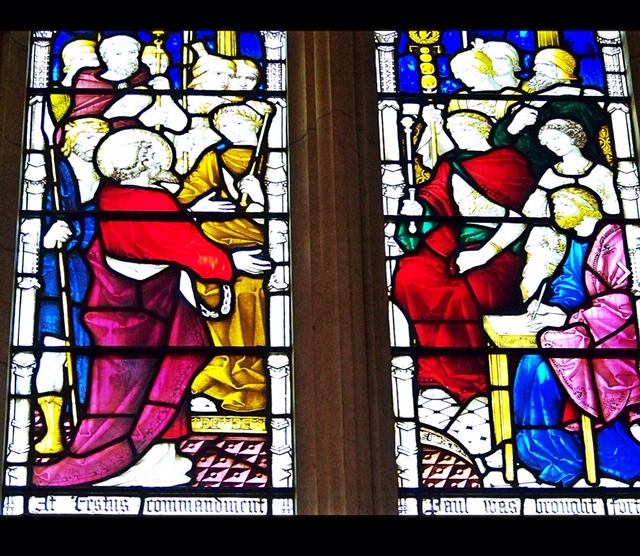
Window in St. Paul’s Cathedral, Melbourne – Paul Pleads His Case (Festus in yellow)

Today, in God’s Lavish Mercy, Paul’s case goes before Festus and King Herod Agrippa. Just in case you are confused, like I was, about just who this particular Herod is, this family tree from Wikipedia helped:

chart

This King Agrippa was Marcus Julius Agrippa II (A.D. 27-100), son of Agrippa I (Acts 12:1-25) and great-grandson of Herod the Great (Mt 2:1-23). 

I offer these facts for no real spiritual reason, but they remind me that these biblical characters were real people, like us, engaging (or not) a real life of faith. (Also, I thought it was fun to see how uncreative they were in naming their babies )


In our Gospel, Jesus once again prepares Peter for his tremendous responsibility in the building of that faith. Jesus asks Peter three times, “Do you love Me?”. By the third interrogation, Peter’s answer sounds a little intense:

“Lord, you know everything; you know that I love you.”

Hearing this response, Jesus lays the full burden of Peter’s life upon his shoulders. Not only must Peter “feed” the faith of Jesus’s followers, he must do so by giving over all control to God:

“Amen, amen, I say to you, when you were younger,
you used to dress yourself and go where you wanted;
but when you grow old, you will stretch out your hands,
and someone else will dress you
and lead you where you do not want to go.”

hand

Like Peter,
we too are given the gift and responsibility
of living a faithful life.
Like Peter, we all learn through the years,
that life comes to us in unexpected ways.
In reality, life often chooses us
rather than the other way around.


As we pray with these passages, we might want to look back over our lives for those points where life challenged or unbalanced us. What unexpected blessings came from those surprises/shocks? When God’s plan contradicted our own, how were we eventually blessed with courage, hope, gratitude, and insight?

We are the person we are today because of how we responded to God’s mysterious plan for our lives. Did we reach out our hand and let God lead us? Do we still need to do some letting go in order to enjoy that kind of freedom?


Rather than a poem today, I will be offering second post. It is a reflection I wrote many years ago for healthcare ministers and other chaplains. I think you might enjoy it. Watch for it later today – “Holding Hands with God”


Music:  Precious Lord, Take My Hand – written by Thomas A. Dorsey, sung here by the Great Mahalia Jackson

When my way groweth drear

Precious Lord, linger near-ear

When my li-ight is almost gone

Hear my cry, hear my call

Hold my ha-and lest I fa-all

Take my hand, precious Lor-ord

Lead me on

Precious Lord, take my hand

Lead me on, let me sta-and

I am tired, I’m weak, I am worn

Through the storm, through the night

Lead me on to the li-ight

Take my ha-and, precious Lor-ord

Lead me home

When my work is all done

And my race here is are you-un

Let me see-ee by the light

Thou hast shown

That fair city so bright

Where the lantern is the li-ight

Take my ha-and, precious Lor-ord

Lead me on

Precious Lord, take my hand

Lead me on, let me sta-and

I am tired, I’m weak, I am worn

Through the storm, through the night

Lead me on to the li-ight

Take my ha-and, precious Lor-ord

Lead me home

Saturday of the Sixth Week of Easter

May 28, 2022

john6_29 Ask

Today, in God’s Lavish Mercy, Jesus once again instructs his disciples to pray “in my Name”.

Amen, amen, I say to you,
whatever you ask the Father in my name he will give you.
Until now you have not asked anything in my name;
ask and you will receive, so that your joy may be complete.

John 16:23-24

What does Jesus really mean by,:

“Ask in My Name”.


There is an idiomatic phrase popular in culture today, “just asking for a friend”. It is used when the questioner feels embarrassed or unsure about the question, or unworthy of posing it oneself, for example: Can you really go to jail for not paying your taxes, just asking for a friend?


What might happen if we prayed like this, taking Jesus seriously in his offer to intervene for us, to stand in the place of our fear, hesitation, confusion, or unworthiness:

  • Dear God, please forgive me for this sinful choice I made. I ask you in the Name of Jesus, my friend.
  • Dear God, will you please comfort my dear one who is suffering. I ask you in the Name of Jesus, my friend.
  • Dear God, will you please intervene to stop the suffering in the world. I ask you in the Name of Jesus, my friend.

How would the addition of this little phrase change my prayer?


magic

The words are not a magic formula for working miracles. They won’t allow us to cure the sick or raise the dead in visible ways. But they will allow us to heal ourselves and others in ways beyond human calculation.

I think the words are a key to unlock our understanding that when we pray in the Name of Jesus, the miracle happens in us, not in our surroundings.


150 cross

We realize that Jesus, in whose Name we pray, changed the world not by magic but by sacrificial love. Becoming his friend and praying in his name demands that we too live our experiences with that kind of unquestioning love.

Such love unveils the glorious mystery of the Cross to us. Even under its shadow, we see through to the triumph of the Resurrection as Jesus did. 


Certainly, suffering was not removed from Jesus’ life nor from that of his followers.

But what was given was abiding faith, hope, love, and the trustworthy promise of eternal life.

Let’s ask for these precious gifts, in the Name of Jesus.


Poetry: Name Of God – by Sant Tukaram Maharaj who was a 17th-century Marathi poet, religious leader, and Hindu sant (saint). He is best known for his devotional poetry called “Abhanga” and community-oriented worship with spiritual songs known as kirtans.

Mahatma Gandhi, in early 20th century, while under arrest in Yerwada Central Jail by the British colonial government for his non-violent movement, read and translated Tukaram’s poetry.


He who utters the Name of God while walking
gets the merit of a sacrifice at every step
His body becomes a place of pilgrimage.
He who repeats God’s Name while working
always finds perfect peace.
He who utters the Name of God while eating
gets the merit of a fast
even though he has taken his meals.
Even if one were to give in charity
the whole world encircled by the seas
it would not equal the merit of repeating the Name,
By the power of the Name
one will know what cannot be known,
One will see what cannot be seen,
One will speak what cannot be spoken,
One will meet what cannot be met.
Tuka says.
Incalculable is the gain that comes
From repeating the Name of God.

Music: In Jesus’ Name I Pray – Charley Pride
(Lyrics below)

In Jesus’ Name I Pray

Father give me strength, to do what I must do.
Father give me courage, to say what I must say.
Let that spirit move me.
I’m nothing on my own.
Father stand by me, I can not stand alone, in Jesus name I pray.

Father open up my eyes to your wonders all around.
Father let me see the good and beauty of this day.
Fill my heart with love, for my fellow man.
And if I’m tempted Father.

Father take my hand, in Jesus name I pray.
Father help me through the troubled days that lie ahead.
Let your life stand before me, that I may find a way.
So let me stumble Father, or fall beneath my load.

Father guide my footsteps.
Hold me to the road, in Jesus name I pray.
Let not hunger be my guide, nor fear be my master.
Father let not envy, be a part of me in any way.

Father search my soul, take away my fear and doubt.
Any moment that you find this,
Father cast it out, in Jesus name I pray.
Ah ah ah Amen.

Friday of the Sixth Week of Easter

May 27, 2022

Today, in God’s Lavish Mercy, Jesus acknowledges the difficulty of living a Christian life in a hostile world, especially without his physical presence to lead the disciples.

John16_22 separation

He knows that his friends are anguished at the thought of being separated from him. He compares their heartbreak to the pain of a mother in labor. The comparison is a perfect one because labor pains yield a gift that washes away the memory of suffering:

… when she has given birth to a child,
she no longer remembers the pain because of her joy
that a child has been born into the world.

John 16:21

Jesus tries to comfort his followers with this analogy, but he doesn’t deny the sorrow they are experiencing. Jesus knows that separation from what we dearly love can be a crushing experience. He knows that change often carries unwanted loss.

joys and sorrows

Our lives are braided into this cycle of labor, birth, love, loss, sorrow and joy. Jesus assures us that if we live this cycle in faith and hope, all things return to him in glory:

But I will see you again, and your hearts will rejoice,
and no one will take your joy away from you.

John 16:22

Poetry: Braid Your Hair With His – Mark Heathcote

God - has many names, 
but ‘Love' is the one that counts 
most aptly ‘Love' … ‘Love' 

‘Just Love' only, one word 
one name like ‘God' isn't it? 

God - has so many names 
each acts as a veil 
but ‘Love' is, ‘Love' only. 
So braid your hair with His 
embrace, lock fingers with His. 

His is a tree twining roots 
His is the first branch you perch on 
His is trees-bough at your centre 
your hearts bead is a locket of amber 
the tree's name is Love. 

At those times in our lives when we more feel the absence of God than the presence, remembering the endurance and bravery of others may help us. Although it’s not a religious song, this melody kept playing itself in my heart as I read today’s Gospel. It opened my spirit to a very comforting prayer time.

Music: We’ll Meet Again – Dame Vera Lynn

Dame Vera Margaret Lynn Welch, CH,DBD, OStJ, was a British singer of traditional popular music, songwriter and actress, whose musical recordings and performances were enormously popular during World War II. She died in 2020 at the age of 103.

She is widely known as “the Forces Sweetheart” and gave outdoor concerts for the troops in Egypt, India and Burma during the warThe songs most associated with her are “We’ll Meet Again”, “The White Cliffs of Dover”, “A Nightingale Sang in Berkeley Square”, and “There’ll Always Be an England”. 

Wednesday of the Sixth Week of Easter

May 25, 2022

Today, in God’s Lavish Mercy, Paul gives a magnificent oration at the Areopagus in Athens. It was a big deal billing!

V&A_-_Raphael,_St_Paul_Preaching_in_Athens_(1515)
St. Paul at the Areopagus by Raphael (c.1515)

Areopagus, earliest aristocratic council of ancient Athens. The name was taken from the Areopagus (“Ares’ Hill”), a low hill northwest of the Acropolis, which was its meeting place.

In pre-classical times (before the 5th century BC), the Areopagus was the council of elders of the city, similar to the Roman Senate. Like the Senate, its membership was restricted to those who had held high public office.

The Areopagus, like most city-state institutions, continued to function in Roman times, and it was from this location, drawing from the potential significance of the Athenian altar to the Unknown God that Paul is said to have delivered the famous speech, “Now what you worship as something unknown I am going to proclaim to you. The God who made the world and everything in it is the Lord of heaven and earth and does not live in temples built by hands.” (Wikipedia)


diamonds


The sermon has so many beautiful lines, like glorious diamonds that can be turned over and over in prayer. Here are a few that glistened for me:


God … does not dwell in sanctuaries made by human hands
(Instead, God dwells within us)


God is not served by human hands because God needs nothing.
(Instead, our everything comes from God)


God made from one the whole human race to dwell on the entire surface of the earth.
(We are all connected in the One Creation)


God fixed the ordered seasons and the boundaries of their regions,
so that people might seek God,
even perhaps grope for him and find him,
though indeed he is not far from any one of us.
(We do grope, sometimes in darkness.)


God has overlooked the times of ignorance,
but now God demands that all people everywhere repent…
(Without Christ, we were in shadows of unknowing. With Christ, we are in Light.)


And my favorite:

Acts17_24 everything

What is the “everything” that God is giving you today? What is the abundance of grace, or hope, or longing in your heart as you pray today? Let God’s fullness embrace any emptiness as you offer God your silence and waiting.


Poetry: Everything – Rumi

Love is
when God says to you
"I have created everything for you",
and you say
"I have left everything for You."

Music: Everything – Lauren Daigle