Table of Comfort

December 1, 2021
Wednesday of the First Week of Advent

Today, in God’s Lavish Mercy, our readings take us to the Lord’s banquet. It is a rich image that threads through scripture and helps us understand what characterizes the perfect reign of God.

The readings, coming just on the heels of Thanksgiving, present familiar images to us. Last week, you may have been part of the preparation of the feast for your family and friends. Maybe you’re the master carver, or brought sides of old family recipes. Or you might be the table decorator or, most important, the clean-up guru!

Or maybe you were the one who steered the conversation so that all felt welcomed and included in the gathering. Maybe you were the one who took someone aside if they needed an extra portion of care. Maybe you were the one who invited someone with no other place to go.


That Thanksgiving meal, and every meal, can be a symbol of the heavenly banquet.

Isaiah’s banquet is all elegance and fullness. He describes an end-time when, despite a path through suffering, all is brought to perfection in God:

On this mountain the LORD of hosts
will provide for all peoples
A feast of rich food and choice wines,
juicy, rich food and pure, choice wines.


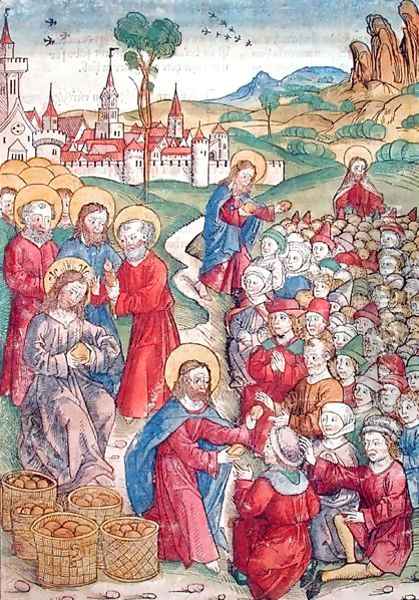
Jesus’s feast is more “now”, and more rustic. He takes the ordinary stuff of present life and transforms it to satisfy the immediate needs of those gathered. With sparse and simple ingredients, Jesus creates the “miracle meal” for the poor and hungry.

He ordered the crowd to sit down on the ground.
Then he took the seven loaves and the fish,
gave thanks, broke the loaves,
and gave them to the disciples,
who in turn gave them to the crowds.
They all ate and were satisfied. 


Christ’s presence with us in the Eucharist is both kinds of meal.

  • It points us to the perfection of heaven, where the “web” will be lifted from our eyes and we will see ourselves as one in Christ.
  • It calls us to be Christ for one another in this world – creating miracles of love and mercy so that all are adequately fed, in body and soul, for the journey we share.

Poetry: Love Bade Me Welcome – George Herbert, (1593 – 1633) – a Welsh-born poet, orator, and priest of the Church of England. His poetry is associated with the writings of the metaphysical poets, and he is recognized as “one of the foremost British devotional lyricists.


Love bade me welcome. Yet my soul drew back 
                              Guilty of dust and sin.
But quick-eyed Love, observing me grow slack 
                             From my first entrance in,
Drew nearer to me, sweetly questioning,
                             If I lacked any thing.
A guest, I answered, worthy to be here:
                             Love said, You shall be he.
I the unkind, ungrateful? Ah my dear,
                             I cannot look on thee.
Love took my hand, and smiling did reply,
                             Who made the eyes but I?
Truth Lord, but I have marred them: let my shame
                             Go where it doth deserve.
And know you not, says Love, who bore the blame?
                             My dear, then I will serve.
You must sit down, says Love, and taste my meat:
                           So I did sit and eat.

Music:  Banquet- Graham Kendrick (Lyrics below)

There’s no banquet so rich
As the bread and the wine
No table more holy
No welcome so kind
There’s no mercy so wide
As the arms of the cross
Come and taste, come and see
Come find and be found

There’s no banquet so rich
For what feast could compare
With the body of Jesus
Blessed, broken and shared?
Here is grace to forgive
Here is blood that atoned
Come and taste, come and see
Come know and be known

Take the bread, drink the wine
And remember His sacrifice
There’s no banquet so rich
As the feast we will share
When God gathers the nations
And dines with us here
When death’s shadow is gone
Every tear wiped away
Come and eat, come and drink
Come welcome that day

There’s no banquet so rich
For our Saviour we find
Present here in the mystery
Of these humble signs
Cleansed, renewed, reconciled
Let us go out as one
Live in love, and proclaim
His death till he comes

That Sweet Light

November 30, 2021
Feast of St. Andrew, Apostle

Today, in God’s Lavish Mercy, we pray with the Apostle Andrew – one who was called and gifted to bring the Good News – and with the Paul, and Isaiah ‘s beautiful song:

As Isaiah has written,
How beautiful are the feet of those who bring the good news!
But not everyone has heeded the good news;
for Isaiah says, Lord, who has believed what was heard from us?
Thus faith comes from what is heard,
and what is heard comes through the word of Christ.
But I ask, did they not hear?
Certainly they did; for

    Their voice has gone forth to all the earth,
        and their words to the ends of the world
.

Romans 10:16-18

 As we stand just past Advent’s front threshold, it is fitting to do so here beside Andrew, on his feast, remembering how one day Jesus invited him to launch out into a whole new world.

Today teases us with something we cannot yet imagine. Tomorrow, it will be December – the last month of 2021. And, as for the past two years, we still wait for the world to be delivered from pandemic. It is a waiting that takes great faith, courage, and perseverance – virtues, at times, difficult to summon.

Still as people of faith, we know that Advent is time to wait in silence for unfathomed miracles. Advent teases us with something we can not yet imagine.

What graces will these days hold for us as we prepare for Christmas?


Jesus teased Andrew and Peter too with the promise to be “fishers of men”. Wading knee-deep in the Galilean Sea, do you think they had any hint of what Jesus was talking about? I don’t. I think they simply caught the faith, hope and love in his eyes the way a match catches flame when it’s struck.

Let’s stand with Andrew today in these beginning hours of Advent, on the edge of the long nights or days of December (depending on our hemisphere)

Let’s trust the fire we find in Christ’s eyes as we pray through this Holy Season. Let’s be very intentional not to miss the point of these sacred days by losing them to the fears or frenzies that may threaten us.


An old devotion that I still love is the St. Andrew Novena. The prayer, prayed from November 30 until December 24th, is meant to remind us of the true meaning of these days leading to Christmas. Because my mother said it with me when I was a little girl, it carries both spiritual and emotional riches for me.

It is traditionally suggested that we say it fifteen times a day. I will confess that I say it only once a day, but I do that slowly, focusing on the sacred mystery held within the words.


Poetry – Prayer

I also have created my personal version without specific petitions. I think God knows what we need and provides for us. God’s Lavish Mercy is enough and everything.


My St. Andrew’s Prayer:

Hail, and blessed be the hour and moment
at which the Son of God was born
of our dear Mother Mary
in a stable
at midnight
in Bethlehem
in the piercing cold.
At that hour, I ask you dear God,
to hear my prayer and grant my hope
that you fill our world again
with your Loving Presence.
Through Jesus Christ and His most Blessed Mother.
Amen
.


Music: We Shall Behold Him – Ron Kenoly (Lyrics below)

I love this hymn, especially the line “the sweet light in his eyes shall enhance those awaiting”. Maybe that’s the light Andrew saw. May we see it too!

Promise Fulfilled

First Sunday of Advent
November 28, 2021

Today, in God’s Lavish Mercy, we begin our Advent journey remembering a promise:

The days are coming, says the LORD, 
    when I will fulfill the promise 
    I made to the house of Israel and Judah.

Jeremiah 33:14

“Promise” is a powerfully dynamic concept whose meaning we sometimes constrict. 

We might say something like, “I promise to pay you back someday” – thereby limiting “promise” to some future event that may or may not happen.

But “promise”, in its richer meaning, is an inward turning toward a journey, each step a necessary component of the ultimate fulfillment. 

In this sense, “promise” is more akin to “vow” or “covenant”. It unfolds as life unfolds. It grows through stages, like a fruit tree from a tiny seed. Its meaning, at first indistinctly seen, blossoms as it is fed with faith, hope, and enduring love.

This is the nature of God’s promise to us. It is not only some salvific event in our future. It is the flowering of grace, again and again, in our life choices for God. 

It is the classic example of that insightful phrase, “The journey is the destination.” In other words, Jesus cannot be born for us on Christmas if He is not born in us every day.


Thus, Psalm 25 is the perfect prayer as we reflect on our journey during Advent.

To you, O Lord, I lift my soul.

Your ways, O LORD, make known to me;
   teach me your paths,
Guide me in your truth and teach me,
   for you are God my savior,
   and for you I wait all the day. 

All Your paths are kindness and constancy
   toward those who keep Your covenant and decrees.
Your friendship is with those 

who hold themselves in awe before You,
   and Your covenant is for their daily instruction.

Psalm 25: 4-5; 10,14

As we begin this Advent,
let us ask God to show us
the promise longing for fulfillment
in each moment and
in every event of our daily lives.
Let us give our hearts to it.

Poetry: Advent Credo from Walking on Thorns by Allan Boesak

It is not true that creation and the human family are doomed to destruction and loss—
This is true: For God so loved the world that He gave his only begotten Son, that whoever believes in Him shall not perish but have everlasting life;

It is not true that we must accept inhumanity and discrimination, hunger and poverty, death and destruction—
This is true: I have come that they may have life, and that abundantly.

It is not true that violence and hatred should have the last word, and that war and destruction rule forever—
This is true: Unto us a child is born, unto us a Son is given, and the government shall be upon his shoulder, his name shall be called wonderful councilor, mighty God, the Everlasting, the Prince of peace.

It is not true that we are simply victims of the powers of evil who seek to rule the world—
This is true: To me is given authority in heaven and on earth, and lo I am with you, even until the end of the world.

It is not true that we have to wait for those who are specially gifted, who are the prophets of the Church before we can be peacemakers—
This is true: I will pour out my spirit on all flesh and your sons and daughters shall prophesy, your young men shall see visions and your old men shall have dreams.

It is not true that our hopes for liberation of humankind, of justice, of human dignity of peace are not meant for this earth and for this history—
This is true: The hour comes, and it is now, that the true worshipers shall worship God in spirit and in truth.

So let us enter Advent in hope, even hope against hope. Let us see visions of love and peace and justice. Let us affirm with humility, with joy, with faith, with courage: Jesus Christ—the life of the world.


Music: Psalm 26 – Kendrick and Redman

The Last Day

November 27, 2021
Saturday of the Thirty-fourth Week in Ordinary Time

Today, in God’s Lavish Mercy, we come – FINALLY – to the last day in Ordinary Time. And, believe me, the readings are as daunting as their predecessors suggested they would be.

They are so daunting that I will leave you to them if you wish, but I choose to close the Liturgical Year with another story I wrote years ago.

May the story inspire you as we stand on beautiful Advent’s doorstep. Within it, may you find love, hope, tenderness, mercy and gratitude to carry with you into the new Church Year.

The Earring

Young Emma, skewered by indecision, had stared into her mother’s jewelry box. She had always loved those bejeweled earrings, a gift to her mother from her grandmother—an heirloom now, a treasure beyond price. She wanted so to wear them on this special date, but they were “hands off” and she knew it. Still, her mother at work and unaware of her desire, Emma had succumbed to temptation.


The dance had been wonderful, a whirlwind of such delight that Emma had not noticed when her left earring had brushed against her partner’s shoulder, tumbling hopelessly under the dancers’ trampling feet. Only at evening’s end, approaching her front door exhausted and dreamy, had she reached up to unclip the precious gems.


Her mother sat waiting for her in the soft lamplight, having already noticed the earrings missing from her dresser. Awaiting retribution, Emma knelt beside her mother and confessed the further sacrilege of loss. But her mother simply cupped Emma’s tearful face in her hands, whispering, “You are my jewel. Of course I forgive you.”  Though accustomed to her mother’s kindness, this act of compassion astonished Emma, filling her with an indescribable, transformative gratitude.


Like Emma, we may be astonished at the graciousness that has been given to us. We may respond by pouring out our thanks to God in a silent act of prayer.

May we also have the courage to become like our merciful God, anticipating the other’s need for our forgiveness and compassion. May we seek the strength not to harbor injury, but too release it to make room for further grace in our hearts.


Advent 2021

I am so excited about Advent – my favorite time of the Church Year! The readings are magnificent — especially lyrical, prophetic Isaiah!

Advent offers us the wonderful call “to relish expectation” – to believe in, to hope for, and to love what we cannot yet see. It is a time of blind but unshakeable trust which teaches us to live within our deep, invisible spirit.

Looking forward to being with all of you tomorrow as we begin the journey through this season of profound hope.


Poetry: I Hear the Oriole’s Always-Grieving Voice – Anna Akhmatova

I chose this poem because it captures a spirit of hope – yet unrealized, but nevertheless convinced.

I hear the oriole’s always-grieving voice,
And the rich summer’s welcome loss I hear
In the sickle’s serpentine hiss
Cutting the corn’s ear tightly pressed to ear.
And the short skirts of the slim reapers
Fly in the wind like holiday pennants,
The clash of joyful cymbals, and creeping
From under dusty lashes, the long glance.

I don’t expect love’s tender flatteries,
In premonition of some dark event,
But come, come and see this paradise
Where together we were blessed and innocent.


Music: Gracias a la Vida – Mercedes Sosa and Joan Baez ( English lyrics below.) Thanks to my friend Beth who shared this lovely song on Facebook today.

Thanks to life, which has given me so much.
It gave me two beams of light, that when opened,
Can perfectly distinguish black from white
And in the sky above, her starry backdrop,
And from within the multitude The one that I love.

Thanks to life, which has given me so much.
It gave me an ear that, in all of its width
Records— night and day—crickets and canaries,
Hammers and turbines and bricks and storms,
And the tender voice of my beloved.

Thanks to life, which has given me so much.
It gave me sound and the alphabet.
With them the words that I think and declare:
“Mother,” “Friend,” “Brother” and the light shining.
The route of the soul from which comes love.

Thanks to life, which has given me so much.
It gave me the ability to walk with my tired feet.
With them I have traversed cities and puddles
Valleys and deserts, mountains and plains.
And your house, your street and your patio.

Thanks to life, which has given me so much.
It gave me a heart, that causes my frame to shudder,
When I see the fruit of the human mind,
When I see good so far from bad,
When I see within the clarity of your eyes…

Thanks to life, which has given me so much.
It gave me laughter and it gave me longing.
With them I distinguish happiness and pain—
The two materials from which my songs are formed,
And your song, as well, which is the same song.
And everyone’s song, which is my very song.
Thanks to life

Thanks to life
Thanks to life
Thanks to life

Toward Thanksgiving…

November 23, 2021
Tuesday of the Thirty-fourth Week in Ordinary Time

Today, in Mercy, our readings echo the end-time themes we have been considering for several days. And we may continue to pray with these as we approach Advent.


But as we approach Thanksgiving, I want to shift gears and offer you some reflections I have written over the years in celebration of this holiday. For these next few days, I will focus on these. In the past, readers have used them for their prayer and at their own Thanksgiving tables. I hope you find them beneficial.

You’re Welcome

Bill was a big Mid-western guy with the boots and belt buckles to prove it. His wife of thirty years was a patient in our east coast cancer wing. Hearing of a break-through experimental treatment, they had come seeking a cure despite every indication of its hopelessness.

Being away from home, Bill had a lot of empty time outside of visiting hours. He spent much of it observing things that would ordinarily go unnoticed in the bustle of his regular life: weather, nature and human idiosyncrasies.

During one cafeteria lunch, over a bowl of hot soup, he observed, “People around here don’t say ‘You’re welcome’. They hold a door. You say ‘Thank you’. They just say ‘Uh huh’”.  Bill didn’t like that. It made him feel invisible. He said it was like one hand clapping.

In this season of Thanksgiving, it’s something to consider. Thanks are not offered in a vacuum. They are given to benefactors, both human and Divine, on whom we depend for a reciprocity of love, companionship, care and courage. Bill, at such a vulnerable, lonely place in his life, was infinitely sensitive when his thanks received no answer.

During this special time, we may hear a “Thank You” offered to us. In this cold age of our digital distractions, can we receive it consciously? Can we return it with a mutuality of gratitude that says, “You’re welcome! You are welcome in the embrace of my life. I see you as a unique and precious life and I rejoice at any kindness I can give you.”? A simple, sincere smile can say all that. Such is the power of our conscious spirits!

Doing this, we might even hear the Creator’s whisper, saying the same thing to us as we offer our Thanksgiving prayers: “I have created you from an abundance of love. You are precious to me and I believe in you. I hear your “Thank You” and you are welcome in the embrace of my infinite love.”


Poetry/Prayer


Music:  Thanksgiving Classical Playlist (You may want to play this hour-long compilation during your Thanksgiving meal.)

Wake Up!

November 22, 2021
Memorial of St. Cecilia

Today, in God’s Lavish Mercy, we pray with a passage from Daniel for our Responsorial Psalm:

Blessed are you, O Lord, the God of our forebearers,
    praiseworthy and exalted above all forever;
And blessed is your holy and glorious name,
    praiseworthy and exalted above all for all ages

Daniel 3:52

This week we continue with a series of readings from the Book of Daniel. It is the only time throughout the Liturgical Year that we get a good dose of Daniel. And it is well placed, coming in this final week before Advent.

The Prophet Daniel by Michelangelo (Sistine Chapel)

Daniel is apocalyptic literature, a genre which conveys the author’s perception of the end times through dreams, visions and prophecies. Like many of our readings of the past weeks, Daniel focuses us on God’s Final Coming into time by interpreting current circumstances in a spiritual light.


Today’s Gospel does the same thing, but in a little different way. 

Jesus tells the story of the poor widow who gave everything she had for the sake of the poor. This widow, in a sense, already lives in the “end times”, a time when our only “possessions” will be the good we have done in our lives.

Both these readings set us up to reflect on our lives and times as we approach Advent. This sacred season is the annual reenactment of Christ’s First Coming in order to prepare us for:

  • Christ’s daily revelation in our lives
  • Christ’s Final Coming at the end of time

All of Daniel’s complex visions and prophecies can feel a little confusing, but we can focus on this:

  • God is continually revealing Godself in the ordinary circumstances of time.
  • We can open ourselves to this revelation by our humble prayer and good works.
  • Staying awake like this in our hearts and souls will allow us to pass seamlessly into God’s Presence when the end times come.

Poetry: Awake! awake O sleeper of the land of shadows (from Jerusalem) – William Blake

Awake! awake O sleeper of the land of shadows, wake! expand!
I am in you and you in me, mutual in love divine:
Fibres of love from man to man thro Albions pleasant land.
In all the dark Atlantic vale down from the hills of Surrey
A black water accumulates, return Albion! return!
Thy brethren call thee, and thy fathers, and thy sons,
Thy nurses and thy mothers, thy sisters and thy daughters
Weep at thy souls disease, and the Divine Vision is darkend:
Thy Emanation that was wont to play before thy face,
Beaming forth with her daughters into the Divine bosom
Where hast thou hidden thy Emanation lovely Jerusalem
From the vision and fruition of the Holy-one?
I am not a God afar off, I am a brother and friend;
Within your bosoms I reside, and you reside in me:
Lo! we are One; forgiving all Evil; Not seeking recompense!
Ye are my members O ye sleepers of Beulah, land of shades!

Music: Sleepers Awake from the beautiful album by Chris Wyton, “Music for Deep Meditation “

A Heart Beholding

November 20, 2021
Feast of Christ the King

For some, the lofty, politically-tinged title might obscure the rich devotion offered by this feast. The title “king” carries with it suggestions of exaggerated power, wealth and dominance not compatible with our Gospel perception of Jesus.

We may be more comfortable with images of Christ as infant, brother, shepherd, lamb, vine, gate, way, truth, life…

But what all these images point out is that our ability to comprehend the fullness of Christ is severely limited by our humanity. We usually choose a specific image based on our circumstances and spiritual needs.

Pope Pius XI promoted the concept of Christ the King in his 1925 encyclical Quas Primas, in response to growing international secularism and nationalism. His intent was not to compare Christ to the challenged world leaders of the time. It was to raise the perceptions of all people to the lessons of Divine Leadership: mercy, justice, inclusivity, and peace.

Oh, how we could benefit from the same understanding today! 

In this age with its culture of continual war, the human pain it causes, refugee crises, climate devastation, wealth distortion and indifference to the poor, how our hearts long for just, wise and loving leadership!

In his encyclical, Pius XI wrote:

Christ the King reigns “in the human hearts,” both by reason of the keenness of his intellect and the extent of his knowledge, and also because he is very truth, and it is from him that truth must be obediently received by all humanity. He reigns, too, in our wills, for in him the human will was perfectly and entirely obedient to the Holy Will of God, and further by his grace and inspiration he so subjects our free-will as to incite us to the most noble endeavors. He is King of hearts, too, by reason of his “charity which exceedeth all knowledge.”

— Quas primas, §7[4]

Let’s pray for these virtues for all who are charged with any form of power or leadership:

  • keen spiritual intellect
  • deep heart’s knowledge
  • uncompromising truth
  • obedience to grace
  • holy inspiration 
  • noble character
  • and surpassing charity for all Creation

May Christ the King truly live and reign among us. May we behold the “sweet light in His eyes”!


Poetry: A King Inside Who Listens - Rumi

There are many people with their eyes open
whose hearts are shut. What do they see?
Matter.

But someone whose love is alert,
even if the eyes go to sleep,
he or she will be waking up thousands of others.

If you are not one of those light-filled lovers,
restrain your desire-body's intensity.
Put limits on how much you eat
and how long you lie down.

But if you are awake here in the chest,
sleep long and soundly.

Your spirit will be out roaming and working,
even on the seventh level.

The Prophet says, I close my eyes and rest in sleep,
but my love never needs rest.

The guard at the gate drowses.
The king stays awake.

You have a king inside who listens
for what delights the soul.

That king's wakefulness
cannot be described in a poem.

Music: We Shall Behold Him – offered in American Sign Language by Kayla Seymour; sung by Sandi Patty

Thoughts of Heaven

November 20, 2021
Saturday of the Thirty-third Week in Ordinary Time

Today, in God’s Lavish Mercy, we pray with Psalm 9 and its beautiful verse which is echoed in several other Psalms:

I will give thanks to you, O LORD, with all my heart;
    I will declare all your wondrous deeds.
I will be glad and exult in you;
    I will sing praise to your name, Most High.

Psalm 9: 2-3

Like so many of our readings lately, today’s point us toward a consideration of the “afterlife” or the “end times”. I know you may have had enough of such considerations, but the Church isn’t giving up quite yet!


Antiochus IV, wikipedia

Maccabees gives us a colorful account of the defeat, dismay and ultimate death of Antiochus IV, persecutor of the Jews. The account, like most of the Books of Maccabees, is primarily historical, not spiritual or theological. But threaded through the books, of course, is the underlying biblical orientation that God-Yahweh is present and active in all life’s circumstances.

Today’s passage has even pagan Antiochus considering how God/Fate has brought him to judgement- to “payback” time:

But I now recall the evils I did in Jerusalem,
when I carried away all the vessels of gold and silver
that were in it, and for no cause
gave orders that the inhabitants of Judah be destroyed.
I know that this is why these evils have overtaken me;
and now I am dying, in bitter grief, in a foreign land.

1 Maccabees 6:11-13

In our Gospel account, some Sadducees question Jesus about marriage laws and the afterlife. Their questioning reminds me of modern songwriter Eric Clapton’s musings in his song:

Tears in Heaven – Eric Clapton

Jesus doesn’t sing to the Sadducees, as far as I know. Rather, he answers them this way:

Those who are deemed worthy to attain to the coming age
and to the resurrection of the dead
neither marry nor are given in marriage.
They can no longer die,
for they are like angels;
and they are the children of God
because they are the ones who will rise.

Luke 20:35-36

So for us today, the questions and concerns of both Antiochus and the Sadducees might lead us to consider how we feel about the “afterlife”.

Do you ever wonder what heaven will be like? Will we see our beloveds once again? Will we see our “unbeloveds” too and what will that be like!! Do you calculate whether or not you’ll even make the cut through the Pearly Gates?

When I think about heaven these two promises of Jesus sustain, comfort and animate me. Maybe you’ll consider their power too as you pray today.

I have come that you may have life,
and have it to the full.

John 10:10

Eternal life is this, that they know you,
the only true God,
and Jesus Christ, whom you have sent.

John 17:3

Poetry: Heaven-Haven (1864) – Gerard Manley Hopkins

A nun takes the veil

I have desired to go
Where springs not fail,
To fields where flies no sharp and sided hail,
And a few lilies blow.

And I have asked to be
Where no storms come,
Where the green swell is in the havens dumb,
And out of the swing of the sea.

Music: Here’s a beautiful piece of music to accompany you in your “considerations”.

Nocturne No.20 in C-Sharp Minor – Frédéric Chopin, played by Joshua Bell

Sacred Tears

November 18, 2021
Thursday of the Thirty-third Week in Ordinary Time

Today, in God’s Lavish Mercy, we pray with Psalm 50, “a prophetic imagining of God’s judgement on the Israelites”. (Wikipedia)

Our first reading from the Book of Maccabees introduces us to Mattathias, revered leader of the Jews in the city of Modein. He violently refuses the Greek Seleucid command to worship their gods, thus initiating the Maccabean Revolt. The wars lasted nearly a decade. Final victory is commemorated in the Feast of Hanukkah:

The Jewish festival of Hanukkah celebrates the re-dedication of the Temple following Judah Maccabee’s (Mattathias’s son)victory over the Seleucids. According to tradition, victorious Maccabees could find only a small jug of oil that had remained pure and uncontaminated by virtue of a seal, and although it contained only enough oil to sustain the Menorah for one day, it miraculously lasted for eight days, by which time further oil could be procured. (Wikipedia)

Our first reading is really describing the beginning of civil and intercultural wars by which dedicated Jews sought to establish both their religion and their nation. Core to their motivation was the desire to be in relationship with their one God according to their own custom and law.


In our Gospel, Jesus has come as the full manifestation of that One God. He has invited the Jewish people to a new and complete relationship with God, but they have resisted.

Now, as he nears his final fate in Jerusalem, Jesus realizes that his dream for the People will not be fully realized. They will experience a destruction like the one once feared by Mattathias. The reality causes Jesus to weep.

Are the passages only about the Jews, their religion and their history?

For us, these passages are about choosing a faithful,
evolving relationship with God
– a relationship that will demand truth,
action and at times suffering
as we pursue ever deeper understanding
of God’s Presence in our lives.

Our world and its culture place many godless choices before us, choices that could make Jesus weep because of the suffering they cause others. These choices are not as easy to identify as they were in the time of Mattathias. They don’t come dressed as a pagan soldier ready to quash our resistance.

They come in the large subtleties of politics, economics, human rights, global relationships. These choices show themselves in the small exercise of our respect, care, and reverence for all Creation. But they do come to us in every moment and they demand our witness.

Jesus wants the new Kingdom to rise in us when we open our hearts to his Word. It is an ongoing and daily Resurrection. Let’s pray for the courage for it!


Poetry: The World Is Too Much with Us – William Wordsworth

Wordsworth wrote this poem during the Industrial Revolution when he felt the complexities of the world were inhibiting our appreciation of the sacredness of nature.

The world is too much with us; late and soon,
Getting and spending, we lay waste our powers;—
Little we see in Nature that is ours;
We have given our hearts away, a sordid boon!
This Sea that bares her bosom to the moon;
The winds that will be howling at all hours,
And are up-gathered now like sleeping flowers;
For this, for everything, we are out of tune;
It moves us not. Great God! I’d rather be
A Pagan suckled in a creed outworn;
So might I, standing on this pleasant lea,
Have glimpses that would make me less forlorn;
Have sight of Proteus rising from the sea;
Or hear old Triton blow his wreathèd horn.

Music:  When Jesus Wept – William Billings

One of the most well-known of the early American canons, originally appeared in the New England Psalm Singer. It was written in 1770 by William Billings, a self-taught singing-school teacher and composer who served as choir leader at Old South Church in Boston.

(Lyrics below)

When Jesus wept, the falling tear
In Mercy flowed beyond all bound;
When Jesus groaned at rambling fear
Seized all the guilty world around.

Per a valued friend:

There is a statue in Oklahoma City called “Jesus Wept.”  It is on the grounds of St. Joseph Church in the city – which is right across from where the Oklahoma City Federal Building had been located.  The people of the parish wanted to erect the statue on their grounds because the memorial on the federal property couldn’t be religious.  It is a very moving statue.