It’s the Law … hmmm!

Wednesday, March 27, 2019

Click here for readings

Today, in Mercy, our readings are all about “law”.

law,JPG

  • Deuteronomy talks about the Law of Moses as he received it from God.
  • Psalm 147 talks about God’s law as it is expressed in nature and human understanding.
  • In Matthew, Jesus talks about his New Law as a development, not a contradiction, of the Old Law.

All this talk of “law” seems coincidental, doesn’t it, in these days after the Mueller report and what is within, above and beyond “the law”. So many definitions and concepts of “law”!

So, as we pray these scriptures, we might ask ourselves, “What exactly is “law”, especially in terms of my spiritual life and development?”

St. Thomas Aquinas may be a good place to start. Here are his definitions, simplified:

oh boy

  • Eternal Law = God’s will and guidance which orders all creatures toward the good of the universe.
  • Natural Law = our self-ordering, by reason, toward this universal good.
  • Human Law = particular statutes instituted in accord with human reason for the good of civil society.
  • Divine Law = the revealed law of God as found in Scripture

Praying with these concepts is different from studying them.

If we pray with the concept of eternal law, we might offer praise for God’s unchanging Presence in our lives, assuring us that we are eternally loved.

If we pray with the concept of natural law, we might say of a prayer of supplication for the grace to be attuned to God in all our natural thoughts, words and actions.

If we pray with the concept of human law, we might pray in contrition for all the ways we humans mistake law for justice.

If we pray with the concept of divine law, we might offer thanks for God’s generous revelation which allows us to contemplate and grow in relationship with God.

We want our understanding and living of law to be rooted in the heart of God, according to these verse from John 6:

Your words, Lord, are Spirit and life;
you have the words of everlasting life.

Let’s pray for that rootedness today.

Music: I Will Delight in the Law of the Lord – Maranatha

According to Thy Word

Monday, March 25, 2019

Click here for readings

Today, in Mercy, we celebrate the Solemnity of the Annunciation of the Lord. It is a sacred and beloved feast.  Have we not come to love its phrases, ringing in our hearts like treasured memories? Let us pray with them today, asking to welcome the astonishing Will of God in our own life as Mary did.

The angel Gabriel was sent from God
to a town of Galilee called Nazareth…

Annunciation,_Rome_-_Fra_Lippi
by Fra Filippo Lippi

And the angel said:
“Hail, full of grace! The Lord is with you.”

Botticelli,_annunciazione_di_cestello_02
by Botticelli

Behold, you will conceive in your womb and bear a son, and you shall name him Jesus, for nothing is impossible for God.

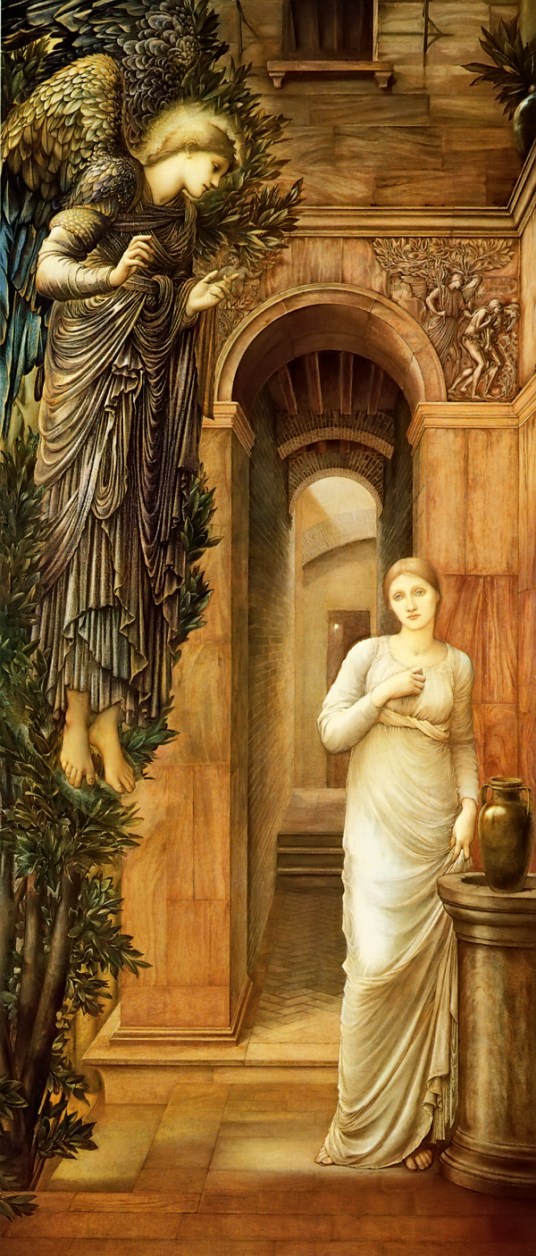
BURNE-Jones,_Edward_The_Annunciation_1876-79
by Edward Burne-Jones

Mary said, “Behold, I am the handmaid of the Lord.
May it be done to me according to your word.”

The Annunciation by Henry Ossawa Tanner 1896
by Henry Ossawa Tanner

Music: Ave Maria – Franz Schubert

Heart-Burn?

Sunday, March 24, 2019

Click here for readings

Today, in Mercy, we have powerful readings – they get really serious about repentance!

Ex3_2 bush

In our first reading, Moses has been on a kind of decades-long sabbatical on his father-in-law’s homestead. After the young glory days of Egypt, and the ensuing drama that exiled him, Moses had settled into being a humble shepherd in Midian. He probably wasn’t expecting a fiery, direct telegram from God.

But God never gives up on his plan for us. So God, divinely expert at getting our attention, conflagrates a bush right in front of Moses.  Supposedly, it was not that unusual for this type of bush to spontaneously combust in the desert heat. What was unusual was for it not to be consumed by the fire.

God then delivers a message of overwhelming fidelity to Moses:

Thus shall you say to the Israelites:
The LORD, the God of your fathers,
the God of Abraham, the God of Isaac, the God of Jacob,
has sent me to you.
This is my name forever;
thus am I to be remembered through all generations.

Because of God’s mercy and fidelity, the Israelites – and Moses – are getting another chance to live in covenant with God.

In our Gospel, Jesus tells his followers not to ignore such chances. He reminds his listeners that life is fragile and transitory. If we haven’t acted on God’s invitation to grace, we might lose the opportunity.

If we look back over our lives, we might realize that there have been burning bushes all over the place – times and events where life offered us a choice between grace and sin, smallness of heart, selfishness. When we chose grace, the bush kept burning and was not consumed. It lit our way to deeper covenant with God.

These final weeks of Lent offer us countless encouragements to look for God’s Fire in our hearts and to go deeper toward the Light. Let’s not ignore them.

Music: Fire of God – Craig Musseau

Saint Joseph, Silent Strength

Tuesday, March 19, 2019

Click here for readings

Today, in Mercy, we celebrate the Solemnity of St. Joseph, husband of the Blessed Virgin Mary.

St Joseph
St. Theresa of Avila wrote, “I took for my patron the glorious St. Joseph and recommended myself earnestly to him. It is now very many years since I began asking St. Joseph for something on his feast, and I always received it. If the petition was in any way amiss, he rectified it for my greater good.”

The very way the Church defines the Feast tells us a great deal about Joseph. Men are seldom described by their relationship to a woman.  It is more often the other way around. Consider our lingering custom of wives assuming their husband’s surnames, for example.

But Joseph is known because of his connection to Mary. He is a steady force in the background of her life and the life of Jesus. Joseph is the kind, generous and faithful one who nurtures and protects them.

And he is the silent one. Not a single word was ever recorded from him. What we know of Joseph issues from his actions. For example, before he knew that Mary had conceived through the Holy Spirit:

Joseph her husband, since he was a righteous man,
yet unwilling to expose her to shame,
decided to divorce her quietly.

This virtue of righteousness sums up the character of Joseph as we find him in scripture. Righteousness is complementary to justice.

Walter Brueggemann in his book, Journey to the Common Good, says this about the relationship between justice and righteousness:

“Justice in the Old Testament concerns distribution in order to make sure that all members of the community have access to resources and goods for the sake of a viable life of dignity…. Righteousness concerns active intervention in social affairs, taking an initiative to intervene effectively in order to rehabilitate society, to respond to social grievance, and to correct every humanity-diminishing activity.”

Joseph exercised such righteousness not only in responding to Mary’s unexpected pregnancy. He took the risk of becoming a refugee family in order to save Jesus’s infant life. After the finding in the Temple, he stepped into the background in order to allow young Jesus to assume his teaching vocation. No doubt, during the silent years which then surround Joseph, he continued to live an active life doing good for his family and community, and quietly fostering the ministry of Jesus.

Despite the scarcity of recorded knowledge about Joseph, there is an ample devotional treasury describing him. It is captured in outline form in the Litany to St. Joseph, a prayer I learned to love because it was one of my father’s favorites. I sometimes say just a few lines, slowly, to let the holiness of Joseph call me deeper into my own spiritual life.
(Music is below the Litany.)

Lord, have mercy.
Christ, have mercy.
Lord, have mercy.
Christ, hear us.
Christ, graciously hear us. 

God, the Father of Heaven, have mercy on us. 
God the Son, Redeemer of the world, have mercy on us. 
God the Holy Spirit, have mercy on us. 
Holy Trinity, One God, have mercy on us. 

Holy Mary, pray for us (after each line)
Saint Joseph,
Renowned offspring of David,
Light of Patriarchs,
Spouse of the Mother of God,
Chaste guardian of the Virgin,
Foster-father of the Son of God,
Diligent protector of Christ,
Head of the Holy Family,
Joseph most just,
Joseph most chaste,
Joseph most prudent,
Joseph most strong,
Joseph most obedient,
Joseph most faithful,
Mirror of patience,
Lover of poverty,
Model of artisans,
Glory of home life,
Guardian of virgins,
Pillar of families,
Solace of the wretched, Hope of the sick,
Patron of the dying,
Protector of Holy Church, 

Lamb of God, who take away the sins of the world,
Spare us, O Lord. 
Lamb of God, who take away the sins of the world,
Graciously hear us, O Lord. 
Lamb of God, who take away the sins of the world,
Have mercy on us. 

V. He made him the lord of His house:
R. And ruler of all His substance. 

Let us pray.
O God, who in Your unspeakable providence chose blessed Joseph to be the spouse of Your own most holy Mother: grant, we ask, that we may deserve to have him for our intercessor in heaven, whom we reverence as our defender on earth. Amen.

Music: I Am a Carpenter – Cher & Gene Klosner 

Great and Glorious St. Patrick

Sunday, March 17, 2019

Click here for readings


St. PAddyToday, in Mercy, our readings are about types of citizenship.

  • In Deuteronomy , Abraham is given a land for himself and his descendants.
  • In Philippians, Paul tells us the “our citizenship is in heaven”.
  • In Luke, the transfigured Jesus shows us that heavenly reality.

These readings confirm that, in God, we are not a people bound by borders, ethnicities, religious cult, or any other human categorization.

Every human being belongs to God and is called to live in the fullness of that Creation.  This is our Divine citizenship.

Think about that in contrast to talk of border walls, ethnic and religious bans, white supremacy, anti-semitism, islamophobia and all the other multiple ways we try to isolate people from this Divine citizenship which makes us brothers and sisters in God.

Friends, on this blessed St. Patrick’s Day, when so many of us rejoice in our Hibernian heritage, let us pray for a world where every human being is respected and celebrated for the particular gifts she/he brings to Creation.

Music: Two Irish hymns today. What can I say? We Irish are noted for our loquaciousness. 😀☘️💚🇨🇮 (Keep scrolling. 2nd hymn way down.)

Hymn to Our Lady of Knock sung by Frank Patterson, “Ireland’s Golden Tenor”
(Lyrics below)

There were people of all ages gathered ’round the gable wall
poor and humble men and women, little children that you called
we are gathered here before you, and our hearts are just the same
filled with joy at such a vision, as we praise Your Name
Golden Rose, Queen of Ireland, all my cares and troubles cease
as we kneel with love before you, Lady of Knock, my Queen of Peace

Though your message was unspoken, still the truth in silence lies
as we gaze upon your vision, and the truth I try to find
here I stand with John the teacher, and with Joseph at your side
and I see the Lamb of God, on the Altar glorified
Golden Rose, Queen of Ireland, all my cares and troubles cease
as we kneel with love before you, Lady of Knock, my Queen of Peace

And the Lamb will conquer and the woman clothed in the sun
will shine Her light on everyone
and the lamb will conquer and the woman clothed in the sun,
will shine Her light on everyone

Hymn: Be Thou My Vision – Gaelic version by Maire Brennan

(English below)

Be Thou my Vision, O Lord of my heart
Naught be all else to me, save that Thou art
Thou my best Thought, by day or by night
Waking or sleeping, Thy presence my light
Be Thou my Wisdom, and Thou my true Word
I ever with Thee and Thou with me, Lord
Thou my great Father, I Thy true Child
Thou in me dwelling, and I with Thee one
Riches I heed not, nor man’s empty praise
Thou mine Inheritance, now and always
Thou and Thou only, first in my heart
High King of Heaven, my Treasure Thou art
High King of Heaven, my victory won
May I reach Heaven’s joys, O bright Heav’n’s Sun
Heart of my own heart, whate’er befall
Still be my Vision, O Ruler of all

God, please …

Thursday, March 14, 2019

Click here for readings

Today, in Mercy, our readings talk about prayer – a particular kind: the prayer of supplication. 

As children, many of us learned this acronym for the types of prayer: ACTS
Ollie_pray

Adoration – Contrition – Thanksgiving – Supplication

The mnemonic has been helpful to me as an adult too. It reminds me to communicate with God only many levels, not just to ask for something. I know how I feel about someone who never talks to me unless they need something. I don’t want to be that way with God.

In our first reading, Esther prays a prayer of supplication for the deliverance of her people from death. Her prayer is not a simple, passing, “Please”. The passage tells us:

She lay prostrate upon the ground,
together with her handmaids,
from morning until evening, (praying)

In our Gospel, Jesus describes the prayer of supplication :

Ask and it will be given to you;
seek and you will find;
knock and the door will be opened to you.

My prayers of supplication haven’t always seemed to get the results Esther got or that Jesus describes. Ever feel that way … that your prayer really hasn’t been answered?

Faith assures us that all our needs are met … even before we present them to God. God is acting in our lives whether or not we speak with God about it.

Our prayer, as it becomes deeper and truer, allows us to enter God’s action with faith, hope, love and courage. This is the perfect prayer of supplication – it allows us to float, content, in the water of God’s will always flowing around our lives.

ask-Receive

David Foster Wallace created a parable you may have heard:

Two young fish are swimming along, and they happen to meet an older fish swimming the other way, who nods at them and says, “Morning, boys. How’s the water?” And the two young fish swim on for a bit, and then eventually one of them looks over at the other and says, “What is water?”

Foster explains, “The point of the fish story is merely that the most obvious, important realities are often the ones that are hardest to see and talk about.”

Our reality is that we exist in the “water” of God’s life and presence. May our “asking” of God lead us to understand that our life in God is already the answer.

Music: Prayer Is the Soul’s Sincere Desire – James Montgomery (1771–1854)

Montgomery wrote the lyrics at the request of Edward Bickersteth, who wanted them for his book Treatise on Prayer. Montgomery called this “the most attractive hymn I ever wrote.”

( I have included all the Lyrics below. Quite beautiful, I think.)

Prayer is the soul’s sincere desire,
Unuttered or expressed;
The motion of a hidden fire
That trembles in the breast.

Prayer is the burden of a sigh,
The falling of a tear
The upward glancing of an eye,
When none but God is near.

Prayer is the simplest form of speech
That infant lips can try;
Prayer, the sublimest strains
That reach the Majesty on high.

Prayer is the Christian’s vital breath,
The Christian’s native air,
His watchword at the gates of death;
He enters Heav’n with prayer.

Prayer is the contrite sinner’s voice,
Returning from his ways,
While angels in their songs rejoice
And cry, “Behold, he prays!”

The saints in prayer appear as one
In word, in deed, and mind,
While with the Father and the Son
Sweet fellowship they find.

Nor prayer is made on earth alone;
The Holy Spirit pleads,
And Jesus, on th’eternal throne,
For sinners intercedes.

O Thou by whom we come to God,
The life, the truth, the way,
The path of prayer Thyself hast trod:
Lord, teach us how to pray.

Time with the Beloved

Tuesday, March 12, 2019

Click here for readings.

Today, in Mercy,  Jesus teaches his disciples how to pray. His prayer is simple and direct, like talking to your Dad over a morning cup of coffee.

What about us? How do we pray?

Our first learned prayers are a lot like Jesus’s simple Our Father. We praise God, giving thanks, and asking for what we need.

Abba Father

Then we grow up and get sophisticated. We may begin to “say” or read prayers rather than use our own words. While such a practice can deepen our understanding of prayer, it places a layer between us and our conversation with God.

Sometimes others lead our prayer in the community of faith. This too can enrich us as we are inspired by a shared faith. But it is a little like trying to have a private conversation in an elevator.

Just as Jesus often went off in solitude to pray, this kind of prayer is our most intimate time with God – a time when God allows us to know God and ourselves in a deeper way. This sacred time alone with God may be spent in words, song, or the silence that speaks beyond words.

It is a time to be with the Beloved as we would our dearest, most faithful companion. We rest in the field of our experiences, letting them flow over God’s heart in tenderness. We listen with the ear of absolute trust to the secrets God tells us in the quiet.

Music: In His Presence – Sandi Patty

What Return Can I Make?

Tuesday, March 5, 2019

Click here for Readings

Today, in Mercy, our readings challenge us to consider what we might offer to God in return for all the good we have received.

Ps50_praise

When I was young, and on a stressful occasion still, I have been known to bargain with God.  It goes something like this:
“Dear God, please, if You will only do X, I promise to do Y.”

The process reminds me of a game my Uncle Joe played with me when I was a toddler. He would give me some pennies to buy candy from him that he had just purchased at the corner store. He intended to teach me simple math. But I also learned what is was like to have resources, to possess buying power.

The glitch in the process was this: none of the resources really belonged to me. Everything belonged to Uncle Joe who allowed me to use his resources to learn and grow.

When we think about what we can offer God, it’s sort of a similar model. We have nothing that doesn’t first and already belong to God. We can give God nothing to “buy” God’s love and grace. God gives these freely and without restriction.

All that we really have to offer God is our love, demonstrated by our charitable actions. That’s what Sirach is talking about today.

In our Gospel, Peter – ever a guileless and simple soul – wants to make sure Jesus knows how much Peter has given up for God. Jesus affirms Peter’s offering, but says that God’s generosity exceeds it a hundredfold.

We live in loving relationship with an infinitely generous God. Our only currency in this relationship is the return of love, praise and thanksgiving.

When I regress to my bargaining stance with God, I think God smiles at me the way Jesus probably smiled at Peter. The smile says, “I am already giving you everything you need. Let yourself rest in Me.”

Music: To God Be the Glory ~ Andrae Crouch

Turn To Me

Monday, March 4, 2019

Click here for readings

Today, in Mercy, our readings are steeped with the scent of Lent, coming this week.

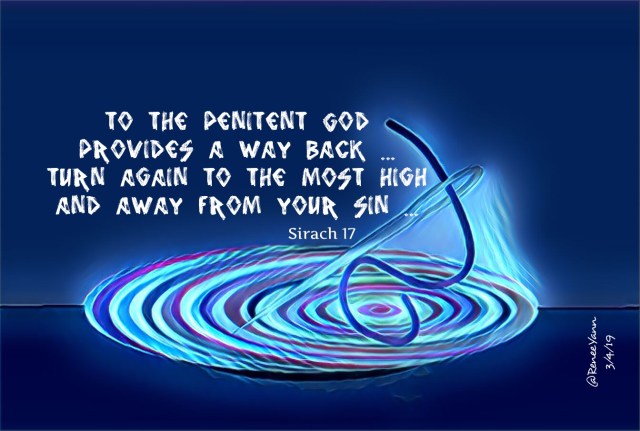
Sirach 17 turn

Sirach appeals to us to be penitent, to turn around and look at the Lord with new eyes. Mark describes the entrance to God’s Kingdom as smaller than a needle’s eye!

The word “penitent” comes from a Latin root paenitere which carries a sense of being filled with regret at what is missing or lacking in our lives.

In Mark, Jesus meets a good young man longing for something more in his life.

Jesus, looking at him, loved him and said to him,

“You are lacking in one thing.
Go, sell what you have, and give to the poor
and you will have treasure in heaven; then come, follow me.”

These readings set us up perfectly for the coming Lenten season. It is a good day to think about what is lacking in our spiritual life, what it will take for us to follow Jesus more wholeheartedly.

Let us turn our hearts to look at Jesus who loves us as much as he loved that young man. Let us ask Jesus to accompany us on the coming journey, giving us the courage to change whatever in us needs change in order to pass through the needle’s eye.

Music: Turn Around – The Vogues

Being Ourselves with God

Sunday, March 3, 2019

Click here for readings.

Today, in Mercy, our readings invite us to spiritual honesty with its accompanying transparency.

husksJPG
In a fabulous metaphor, Sirach tells us that under stress, the measure of our honesty will be evident:

When the sieve is shaken,
the husks appear.

Don’t we try to hide our weaknesses, fears, worries, and doubts? Sometimes we even hide them from ourselves! And God! But under stress, these “husks” rise to the surface and affect our behavior and interactions. Sometimes we create a life-long attitude that attempts to conceal these negativities but causes people – even ourselves – to wonder why we’re so mean, aloof, distracted or angry all the time.

Luke likens this concealment to a “plank”in our inner eye, a blindness which will not let us see ourselves as we are before God – beautiful, beloved and whole. We myopically see instead all our own and other’s annoying fragmentations.

Corinthians tells us that this kind of negative thinking is death-dealing; that it is a product of living only by law and not by spirit. Paul says:

The sting of death is sin,
and the power of sin is the law.
But thanks be to God who gives us the victory
through our Lord Jesus Christ

Lk6_43 fruit

These readings help us to deepen our understanding that only when we open our lives to God will we fully be open to ourselves. Then, as our Psalm explains:

The just one shall flourish like the palm tree,
like a cedar of Lebanon shall they grow.
They that are planted in the house of the LORD
shall flourish in the courts of our God.

They shall bear fruit even in old age;
vigorous and sturdy shall they be,
Declaring how just is the LORD,
my rock, in whom there is no wrong.

Music: O God, You search Me and You Know Me By Bernadette Farrell