Today, in God’s Lavish Mercy, we may be used to celebrating the Feast of the Epiphany. But those who generate the Church calendar have reserved that celebration for this coming Sunday.
We are blessed instead with dynamic readings, triumphant in tone, calling us to celebrate our life in Christ:
Beloved: Who indeed is the victor over the world but the one who believes that Jesus is the Son of God? …. I write these things to you so that you may know that you have eternal life, you who believe in the name of the Son of God.
1 John 5: 5;13
In a way, John calls us to a personal epiphany — the realization of the indescribable gift of grace we have received through Baptism. He enjoins us to live audaciously within the power of that realization.
In our short but powerful Gospel, we see Jesus burst into that audacious living:
It happened in those days that Jesus came from Nazareth of Galilee and was baptized in the Jordan by John. On coming up out of the water he saw the heavens being torn open and the Spirit, like a dove, descending upon him. And a voice came from the heavens, “You are my beloved Son; with you I am well pleased.”
Matthew 1:9-11
In the power of Jesus rising through the Baptismal waters, may we too live each new day in cascade of faith, hope and love.
Poetry: Variation on a Theme by Rilke from Breathing the Water by Denise Levertov
A certain day became a presence to me;
there it was, confronting me--a sky, air, light:
a being. And before it started to descend
from the height of noon, it leaned over
and struck my shoulder as if with
the flat of a sword, granting me
honor and a task, The day's blow
rang out, metallic--or it was I, a bell awakened,
and what I heard was my whole self
saying and singing what it knew: I can.
Today, in God’s Lavish Mercy, we celebrate the Memorial of Saint John Neumann.
John Neumann was born in Bohemia on March 20, 1811. Since he had a great desire to dedicate himself to the American missions, he came to the United States as a cleric and was ordained in New York in 1836 by Bishop Dubois.
In 1840, John Neumann entered the Congregation of the Most Holy Redeemer (Redemptorists). He labored in Ohio, Pennsylvania and Maryland. In 1852, he was consecrated bishop of Philadelphia. There he worked hard for the establishment of parish schools and for the erection of many parishes for the numerous immigrants. Bishop Neumann died on January 5, 1860; he was beatified in 1963. (catholicculture.org)
In our first reading today, John tells us bluntly:
Whoever does not love remains in death.
1 John 3:14
This kind of statement is what one might both love and hate about John. We love it because it’s clear, unequivocal – tells us exactly what we need to do.
And we hate it because it’s clear and unequivocal – there’s no evading it, no back door. We must love – everybody- or we are as good as dead. Wow!
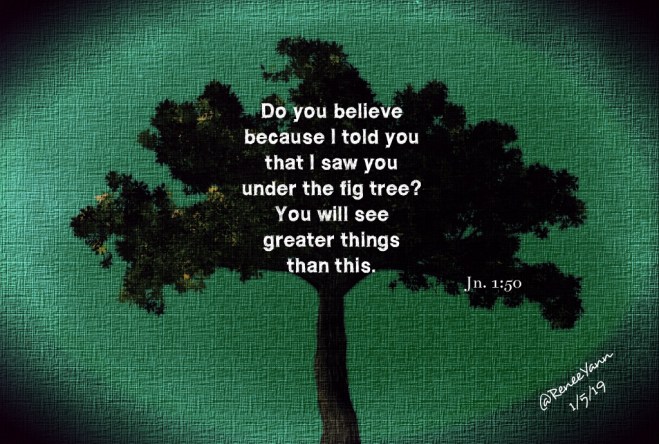
Was this the kind of either-or that Nathaniel struggled with under the fig tree? He sat there pondering some deep challenge or decision and Jesus saw him – and understood – from afar.
The miracle of that moment caused Nathaniel to believe. But Jesus says something like this to Nathaniel:
Hold up, you ain’t seen nothin’ yet! Your little wrestling under the fig tree was all about your own small world and vision. I invite you now to see the world with God’s eyes.
We all spend worrying time under the shadow our own little fig trees – most of the time worrying about ourselves – who hurt us, doesn’t like us, gets in our way, misunderstands or annoys us.
Today’s Gospel invites us to stop licking our wounds. It beckons us out of the shadows of our self-absorption to see what God might see today – the beauty, the needs, the challenges and possibilities of the world around us. We are invited to become lovers and healers like Jesus.
As John has said, we are invited to leave any shadow of death and to live in love:
The way we came to know love was that he laid down his life for us; so we ought to lay down our lives for our brothers. If someone who has worldly means sees a brother in need and refuses him compassion, how can the love of God remain in him? Children, let us love not in word or speech but in deed and truth.
1 John 3:16-18
Poem: In the following poem, Malcolm Guite compares the spiritual transformations of Jacob and Nathaniel.
Jesus called Nathaniel “a true Israelite” and tells him: “… you will see the sky opened and the angels of God ascending and descending on the Son of Man.” This is a clear reference to the story of Jacob’s Ladder from Genesis, where in a dream God transforms Jacob’s life to become the Patriarch of Israel.
Jacob left Beersheba and set out for Harran. When he reached a certain place, he stopped for the night because the sun had set. Taking one of the stones there, he put it under his head and lay down to sleep. He had a dream in which he saw a stairway resting on the earth, with its top reaching to heaven, and the angels of God were ascending and descending on it. There above it stood the Lord, and he said: “I am the Lord, the God of your father Abraham and the God of Isaac. I will give you and your descendants the land on which you are lying. Your descendants will be like the dust of the earth, and you will spread out to the west and to the east, to the north and to the south. All peoples on earth will be blessed through you and your offspring.
Genesis 28:10-15
Nathaniel’s Awakening – Malcolm Guite
A fugitive and exile, Jacob slept,
A man of clay, his head upon a stone
And even in his sleep his spirit wept
He lay down lonely and would wake alone.
But in the night he dreamt the Heavens parted
And glimpsed, in glory, as from Heaven’s core,
A ladder set for all the broken-hearted
And earth herself becoming Heaven’s door.
And when the nameless Angel named him Israel
He kept this gift, whose depth he never knew;
The promise of an end to all our exile,
For now a child of Israel finds it true,
And sees the One who heals the deep heart’s aching
As Jacob’s dream becomes Nathanael’s waking.
Music: Maybe Nathaniel sang a song like this in his heart as he came out from under his fig tree.
Today, in God’s Lavish Mercy, we celebrate the Feast of St. Elizabeth Anne Seton, the first American born saint.
Elizabeth Seton was born on August 28, 1774, of a wealthy and distinguished Episcopalian family. She was baptized in the Episcopal faith and was a faithful adherent of the Episcopal Church until her conversion to Catholicism.
She established her first Catholic school in Baltimore in 1808; in 1809, she established a religious community in Emmitsburg, Maryland. After seeing the expansion of her small community of teaching sisters to New York and as far as St. Loius, she died on January 4, 1821, and was declared a saint by Pope Paul VI on September 14, 1975. She is the first native born American to be canonized a saint.
(from CatholicCulture.org)
In our Gospel, we find the first disciples encountering Jesus. They are curious about him because the Baptist has just described him as “the Lamb of God”.
The two disciples heard what he said and followed Jesus. Jesus turned and saw them following him and said to them, “What are you looking for?” They said to him, “Rabbi” (which translated means Teacher), “where are you staying?” He said to them, “Come, and you will see.” So they went and saw where he was staying, and they stayed with him that day. It was about four in the afternoon. Andrew, the brother of Simon Peter, was one of the two who heard John and followed Jesus.
John 1: 37-40
We can picture Andrew and his unnamed buddy trailing behind Jesus, watching him, listening to him. Finally they hazard a question, “Rabbi, where do you live?”
It’s kind of a loaded question. What it might really mean are things like these:
Where did you come from all of sudden?
How could you possibly be the Messiah if you’re walking around looking just like us?
Do you go back to heaven at night or are you really one of us?
Can we just hang out and find out more about you?
Their faith is tentative, hopeful and maybe just a little bit suspicious. Does your faith ever feel like that?
When we pray, are we convinced that God hears us? When we suffer, do we believe God abides with us? When we choose, act or respond, do we trust that God cares about our actions? Do we believe, in these and all circumstances, that the power of God is present in our lives?
To have that kind of faith, we have to “learn” Christ, to become as close and comfortable with him as with an intimate friend. In our Gospel, Jesus tells us how to do that: “Come and see.”
In other words:
Spend time with me. Talk with me about ordinary things. Watch sunsets and sunrises with me. Tell me your secrets. Let me tell you mine. Laugh with me. Be silent with me. Trust that you are never separate from me.
If we do these things, even slowly and steadily as the first disciples, we will eventually say with Andrew, “l have found the Messiah” – and he is living right within my life!
Poetry: the calling of the disciples – Lucille Clifton
some Jesus
has come on me

i throw down my nets
into the water he walks

i loose the fish
he feeds to cities

and everyone calls me
an old name

as i follow out
laughing like God’s fool
behind this Jesus
Today, in God’s Lavish Mercy, we pray with John’s soul-stirring words:
Beloved, we are God’s children …
When I pray these words I think of my mother. As a little child, I already bore a clear physical likeness to her. But as I grew into a young woman, and later an older woman, people remarked that we looked like twins. There were even occasions when we were confused with each other.
This visible resemblance gave me great pride. My mother was strong, courageous, funny, wise, and fiercely loving. I loved to hear the phrase, “Oh my, you are the image of your mother!” I wanted to be like her – made of the same stuff as she was.
In our reading today, John tells us that we are made of the very stuff of God – the essence of the Sacred. He suggests that when people look at us they should see God’s features written all over us.
See what love the Creator has bestowed on us that we may be called the children of God. Yet so we are.
1 John 2:30
John says that we should see this Divine familial likeness in one another – that we are each imprinted with our Creator’s image.
The reason the world does not know us is that it did not know him. Beloved, we are God’s children now; what we shall be has not yet been revealed.
1 John 2:31
If we believe John’s words, what tenderness we would bear toward ourselves and others! How could we ever belittle, hate or kill one another? How could we ever do these things to ourselves?
In our Gospel, the great prophet John the Baptist sees the imminent transformation of the world coming toward him in the person of Jesus Christ. May we see this too as, by our sincere prayer and study of the scriptures, the Light of Christmas waxes in our hearts throughout 2023. In that Loving Light, we recognize one another clearly as beloved children of God.
John the Baptist saw Jesus coming toward him and said, “Behold, the Lamb of God, who takes away the sin of the world. ….. John testified further, saying, “I saw the Spirit come down like a dove from the sky and remain upon him. I did not know him, but the one who sent me to baptize with water told me, ‘On whomever you see the Spirit come down and remain, he is the one who will baptize with the Holy Spirit.’ Now I have seen and testified that he is the Son of God.”
John 1:29-34
Poetry:I Am the Light – Malcolm Guite
I see your world in light that shines behind me,
Lit by a sun whose rays I cannot see,
The smallest gleam of light still seems to find me
Or find the child who’s hiding deep inside me.
I see your light reflected in the water,
Or kindled suddenly in someone’s eyes,
It shimmers through the living leaves of summer,
Or spills from silver veins in leaden skies,
It gathers in the candles at our vespers
It concentrates in tiny drops of dew
At times it sings for joy, at times it whispers,
But all the time it calls me back to you.
I follow you upstream through this dark night
My savior, source, and spring, my life and light.
Music: How Can Anyone Ever Tell You – Shaina Knoll
Often, when I think of Christ on the Cross, I can hear God the Mother singing this song to Jesus, reaching from heaven to console Him in His pain.
This morning, we might ask God to sing this song over our wounded world which has so obscured God’s likeness – perhaps to sing it over us if we are in particular pain.
In our heart’s deep forgiveness, we might sing this song over anyone who has hurt us – the meanness coming from their failure to recognize their own beauty – the fact that they and we are the very image of our loving God.
Today, in God’s Lavish Mercy, we continue to relish John’s eloquent first letter in which he heartily instructs us in the life of Christian love and fidelity.
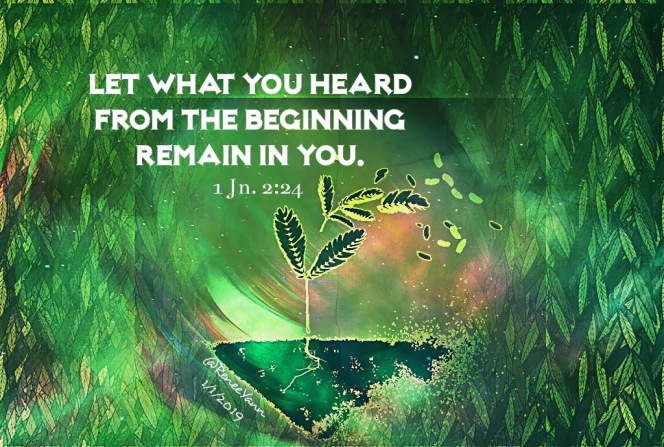
Let what you heard from the beginning remain in you. If what you heard from the beginning remains in you, then you will remain in the Son and in the Father. And this is the promise that he made us: eternal life.
1 John 2:24-26
John has written this letter out of concern about false teachings that are cropping up in the early Church. Misguided “prophets” are placing distorted interpretations on the pure, original message of the Gospel.
Human beings have never stopped doing that, have we? Down through the centuries, how many heresies and misinterpretations have tried to weave their confusion into the Gospel’s central, inviolable thread? How many charlatans, purposefully or ignorantly, have confused people with their bogus religious interpretations.
Has it happened to our own faith? Have we lost the crisp, clear power of our foundational belief? Have we been hijacked into a “faith” or religious practice that ultimately contradicts the Gospel?
It can happen easily in a society where truth is manipulated for purposes of politics, power, and economics. How can we work to avoid it?
John tells us to hold fast to the core teaching of the Gospel.
As for you, the anointing that you received from him remains in you, so that you do not need anyone to teach you. But his anointing teaches you about everything and is true and not false; just as it taught you, remain in him.
1 John 2: 27
This is the faith that many of us learned as children from devout parents and teachers. It is a faith that continues to evolve through scriptural prayer and meditation, through openness to theological wisdom, through the holy dialogue of the beloved community.
It is a living faith, stretched and tested by our daily choices for true Christian love for all people, especially the poor, sick and marginalized.
Ultimately, it is a faith rooted in the Cross and transformed by the Resurrection.
Over these next few weeks, let us listen carefully to John as he guides us to the depth of this faith.
Poetry: A Thanksgiving – St. John Henry Newman
The faith-journey of John Henry Newman has always inspired me. Born in 1801, he was an English theologian, academic, intellectual, philosopher, polymath, historian, writer, scholar and poet, first as an Anglican priest and later as a Catholic priest and cardinal. He was an important and controversial figure in the religious history of England in the 19th century. St. John Henry Newman was canonized as a saint in the Catholic Church in 2019.
As a young nun, when I thought faith was largely an intellectual pursuit, I was caught up in his Apologia Pro Vita Sua (Latin: A defense of one’s own life). The essay is a defense of his religious opinions, published in 1864 in response to Charles Kingsley of the Church of England after Newman quit his position as the Anglican vicar of St. Mary’s, Oxford.
Newman also wrote poetry. “A Thanksgiving” traces the unfolding gift and struggle of Newman’s faith journey.
Lord, in this dust Thy sovereign voice
      First quicken’d love divine;
I am all Thine, Thy care and choice,
      My very praise is Thine.

I praise Thee, while Thy providence
      In childhood frail I trace,
For blessings given, ere dawning sense
      Could seek or scan Thy grace;

Blessings in boyhood’s marvelling hour,
      Bright dreams, and fancyings strange;
Blessings, when reason’s awful power
      Gave thought a bolder range;

Blessings of friends, which to my door
      Unask’d, unhoped, have come;
And, choicer still, a countless store
      Of eager smiles at home.

Yet, Lord, in memory’s fondest place
      I shrine those seasons sad,
When, looking up, I saw Thy face
      In kind austereness clad.

I would not miss one sigh or tear,
      Heart-pang, or throbbing brow;
Sweet was the chastisement severe,
      And sweet its memory now.

Yes! let the fragrant scars abide,
      Love-tokens in Thy stead,
Faint shadows of the spear-pierced side
      And thorn-encompass’d head.

And such Thy tender force be still,
      When self would swerve or stray,
Shaping to truth the froward will
      Along Thy narrow way.

Deny me wealth; far, far remove
      The lure of power or name;
Hope thrives in straits, in weakness love,
      And faith in this world’s shame.
Music: some gentle meditation music for your prayer with John:
Solemnity of the Blessed Virgin Mary, the Mother of God
Theotokos, a mosaic mural from the Gelati Monastery, Georgia, (1125-1130 AD)
Today, in God’s Lavish Mercy, we celebrate Mary, Mother of Jesus.
We might begin prayer today by asking a question posed by distinguished theologian, Elizabeth Johnson, CSJ:
What would be a theologically sound, spiritually empowering and ethically challenging theology of Mary, mother of Jesus the Christ, for the 21st century? This question has no simple answer, for the first-century Jewish woman Miriam of Nazareth, also held in faith to be Theotokos, the God-bearer, is arguably the most celebrated woman in the Christian tradition. One could almost drown surveying the ways different eras have honored her in painting, sculpture, icons, architecture, music and poetry; venerated her with titles, liturgies, prayers and feasts; and taught about her in spiritual writings, theology and official doctrine.
In my own prayer today, though, I am not reaching for a deeper theological understanding of Mary. I simply want to talk with her as a faithful woman, my Mother, my older Sister, my Friend. I want to seek her guidance and her inspiration. I want to thank her for her continual willingness to bear Christ into the world, and into my life.
How significant it is that the Church begins the year inviting us all to Mary’s Light! Our first reading blesses us in a way that Mary might bless us, especially as we begin this New Year of grace:
The LORD bless you and keep you! The LORD let his face shine upon you, and be gracious to you! The LORD look upon you kindly and give you peace!
Numbers 6: 24-26
Mary was all about giving us the LORD, not giving us herself. We see Mary best when we see her holding Christ toward us – the “God-bearer” or “Theotokos”.
Theotokos Vladimirskaya icon, Vologda, Vladimirskaya Church, mid-end 16 century
“Theotokos”, a title used especially in Eastern Christianity, originated in the 3rd century Syriac tradition. It affirms Mary as the Mother of Jesus, Who was both human and divine in nature.
Our reading from Galatians assures us that we too, by our Baptism, are the daughters and sons of God – thus becoming Mary’s own. She is our Mother too by the power of this sacrament.
When the fullness of time had come, God sent his Son, born of a woman, born under the law, to ransom those under the law, so that we might receive adoption as sons
Galatians 4:4
Our Gospel reveals the spirituality of Mary who, after all the heavenly wonders faded, “pondered” all the mysterious workings of God deep in her heart. This Mary is my revered sister, guiding me as I meet the unfolding of God in my own life.
And Mary kept all these things, reflecting on them in her heart. Then the shepherds returned, glorifying and praising God for all they had heard and seen, just as it had been told to them.
Luke 2: 19-20
Today, let us pray with Mary, our Mother, our Sister, Bearer of God. Let us learn to be “ponderers” and “bearers” of God in her pattern. Let us pray for the whole Church, the whole world – all of whom dear Mary tenderly loves.
Music: Two selections today.
A Peaceful Hymn to the Theotokos – Nuns of the Carmazani Monastery in Romania
Today, in God’s Lavish Mercy, we stand on the far western shore of the Year of Our Lord, 2022.
It is well near evening. Our memories are silhouetted against the deep purple sky as they sail beyond the shimmering horizon. In 2022, we have lived, laughed, lost and loved in ways never to be repeated, yet never to be forgotten. The great turning of time goes relentlessly on, but we have written our story in its indelible trail. It’s an awesome realization.
John, when writing the first reading, seems to have felt some of tonight’s emotions:
Children, it is the last hour; and just as you heard that the evil one is among us,
But you have the anointing that comes from the Holy One, and you all have knowledge.
Slightly later on in the epistle, John finishes the thought:
Let what you heard from the beginning remain in you. If what you heard from the beginning remains in you, then you will remain in the Son and in the Father. And this is the promise that he made us: eternal life.
With fireworks and reveling, popular culture will invite us to the brash celebration of our presence within this point in history. But, at the altar of our hearts, we recognize this long evening of reminiscence as a time of quiet thanksgiving and petition. It is a time of awe and trust. It is an evening when we balance “time” against the promise of “eternity”.
Like flint struck against the almighty soul of God, we have been given life. We are God’s fire at this moment in time’s long unwinding. Tonight, we turn our spirits to those beside us, behind us, before us and we pray in thanksgiving and hope for them.
Together, we sink into the Dark Infinity of our Creator who sustains all life beyond our worries, fears and limitations. With innumerable universes, God balances us in the Palm of Mercy. As the midnight shadows fall, God closes the fingertips of grace and protection over us.
In the split moment between two years, we too become infinite – fire in God’s darkness, spark redeemed beyond time.
In 2023, we will forget this transcendent moment. The bright light of daily living will blind us to that piece of divinity shining in our souls. But tonight, let us remember. As midnight passes by, may our spirits kneel within us to the Awesome Mystery who holds us, as one, eternally within Itself.
A truly blessed New Year to you and your beloveds, my friends.
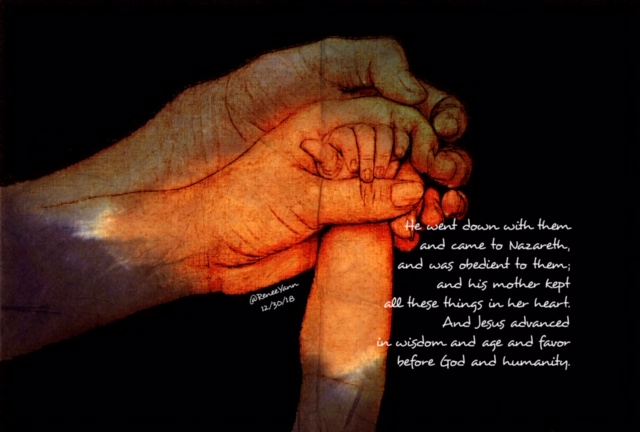
Today, in God’s Lavish Mercy, our prayer is turned to the Holy Family, that unique configuration of love which nurtured the developing life of Jesus. Can you imagine how tenderly the Creator shaped this Triad, this nesting place of love for God’s own Word? Our passage from Sirach gives us an idea of the honor given to the concept of “family” down through the ages leading to Christ:
God sets a father in honor over his children; a mother’s authority he confirms over her sons. Whoever honors his father atones for sins, and preserves himself from them. When he prays, he is heard; he stores up riches who reveres his mother. Whoever honors his father is gladdened by children, and, when he prays, is heard. Whoever reveres his father will live a long life; he who obeys his father brings comfort to his mother.
Sirach 3: 2-6
The Flight into Egypt – Rembrandt
Matthew’s Gospel today describes a fierce devotion in Joseph and Mary to protect the precious life of Jesus. It is a natural instinct, fed by God, and made holy by its selflessness. We do not have to look far to see such devotion today … we see it wherever refugees struggle to foster their own and their beloveds’ lives. Today’s feast calls us to consider our efforts, by prayer or activism, to create a world where all may be reverenced and may live in safety.
We also look to the Holy Family so that we might be strengthened in the virtues that will help us build our own families: sacrificial love, reverence, courage, unfailing support, committed presence, shared faith, gentle honesty, unconditional acceptance.
“Family” is the primordial place where we learn who we are. The lessons it teaches us about ourselves – for better or worse — remain with us forever.
Not everyone is blessed by their family. Family can ground us in confidence or undermine us with self-doubt. It can free us from fear or cripple us with reservation. It can release either possibility or perpetual hesitation within us.
Some families are so dysfunctional that we spend the rest of our lives trying to recover from them. But some, like the Holy Family, allow God’s dream to be nurtured in us and to spread to new families, both of blood and spirit.
The challenge today is to thank God for whatever type of family bore us. Lessons can be learned from both lights and shadows. Let us spend time this morning looking at our own families with love, gratitude, forgiveness, understanding. Where there are wounds to be healed, let us face them. Where there are belated thanks to be offered, let us give them. Where there are negligence and oversights to confess, let us use them as bridges to a new devotion.
For some, it may seem too late to heal or bless our family. Time may have swallowed some of our possibilities. But it is never too late to deepen relationships through prayer, both for and to our ancestors.
May this feast strengthen us for the families who need us today.
Music: God Bless My Family ~ Anne Hampton Calloway (Lyrics below)
GOD BLESS MY FAMILY Words and music – By Ann Hampton Callaway
It’s Christmas time Outside the snow is falling Like a million stars Like a million dreams All dressed up in white I’m writing Christmas cards A joy that’s tinged with sadness As I think of friends Some are here and some are gone But our love goes on and on Like the snow tonight
CHORUS And oh, what a familyMy life has given me From the corners of the earth To the reaches of the sky We touch eternally And though my heart aches ev’ry day This Christmas I will find a way To let each face I’ve ever loved Shine out in me God bless my family
As years go by The carols we sang as children Gather memories What was just a song Now feels like a pray’r Welcoming us home To fathers, mothers Sisters, brothers ev’rywhere Some we’ve lost and some we’ve found As love circles us around In the songs we share
CHORUS
So fly, angels of my heart We’ll never be apart Tonight I say a pray’r For loved ones ev’rywhere
CHORUS/CODA
You’re a part of my family That life has given me From the corners of the earth To the reaches of the sky We touch eternally And though my heart aches ev’ryday This Christmas I will find a way To let each face I’ve ever loved Shine out in me God bless my family You’ll always live in me God bless my family
Today, in God’s Lavish Mercy, as I begin to create today’s reflection, Pope Francis has asked the world to pray for Pope Emeritus Benedict XVI who is mortally ill. Perhaps by the time you red this, God will already have taken Benedict home. If so, may he rest in peace.
Today’s readings fit so well for this moment for Benedict and for the Church. Our first reading offers us John’s perfect honesty and simplicity:
Whoever says, “I know him,” but does not keep his commandments is a liar, and the truth is not in him. But whoever keeps his word, the love of God is truly perfected in him. This is the way we may know that we are in union with him: whoever claims to abide in him ought to walk just as he walked.
1 John 2:5-6
Yes, it’s that simple and that hard!
It is so fitting that as we pray Pope Benedict home to heaven, we meet Simeon in our Gospel. He speaks with the holy confidence of a long and well-lived life. His lifelong dream was that he might not die before seeing the Messiah. That dream now fulfilled, Simeon intones one of the most beautiful prayers in Scripture:
Lord, now let your servant go in peace; your word has been fulfilled: my own eyes have seen the salvation which you prepared in the sight of every people, a light to reveal you to the nations and the glory of your people Israel.
Luke 2: 29-32
If we live by the Light, we too will see the Messiah within our own life’s experiences. We too will come to our final days confident and blessed by that enduring recognition.
For as John also assures us:
Whoever says they are in the light, yet hates their brother or sister is still in the darkness. But whoever loves their brother and sister remains in the light …
1 John 2:9-10
Let’s pray today for those all who are dying, that they may know this kind of peace, especially for Pope Emeritus Benedict XVI.
Let us pray for ourselves, that when our time comes, we too may experience this confidence.
Poetry: Nunc Dimittis – Joseph Brodsky (from Joseph Brodsky, A Part of Speech by George L. Kline (NY: Noonday, 1996) The poem is long but exceptionally beautiful. I hope you can take the time to enjoy it.
‘Nunc Dimittis’
When Mary first came to present the Christ Childto God in His temple, she found—of those fewwho fasted and prayed there, departing not from it—devout Simeon and the prophetess Anna.The holy man took the Babe up in his arms.The three of them, lost in the grayness of dawn,now stood like a small shifting frame that surroundedthe Child in the palpable dark of the temple.The temple enclosed them in forests of stone.Its lofty vaults stooped as though trying to cloakthe prophetess Anna, and Simeon, and Mary—to hide them from men and to hide them from Heaven.And only a chance ray of light struck the hairof that sleeping Infant, who stirred but as yetwas conscious of nothing and blew drowsy bubbles;old Simeon's arms held him like a stout cradle.It had been revealed to this upright old manthat he would not die until his eyes had seenthe Son of the Lord. And it thus came to pass. Andhe said: ‘Now, O Lord, lettest thou thy poor servant,according to thy holy word, leave in peace,for mine eyes have witnessed thine offspring: he isthy continuation and also the source ofthy Light for idolatrous tribes, and the gloryof Israel as well.' The old Simeon paused.The silence, regaining the temple's clear spaceoozed from all its corners and almost engulfed them,and only his echoing words grazed the rafters,to spin for a moment, with faint rustling sounds,high over their heads in the tall temple's vaults,akin to a bird that can soar, yet that cannotreturn to the earth, even if it should want to.A strangeness engulfed them. The silence now seemedas strange as the words of old Simeon's speech.And Mary, confused and bewildered, said nothing—so strange had his words been. He added, while turningdirectly to Mary: ‘Behold, in this Child,now close to thy breast, is concealed the great fallof many, the great elevation of others,a subject of strife and a source of dissension,and that very steel which will torture his fleshshall pierce through thine own soul as well. And that woundwill show to thee, Mary, as in a new visionwhat lies hidden, deep in the hearts of all people.’He ended and moved toward the temple's great door.Old Anna, bent down with the weight of her years,and Mary, now stooping gazed after him, silent.He moved and grew smaller, in size and in meaning,to these two frail women who stood in the gloom.As though driven on by the force of their looks,he strode through the cold empty space of the templeand moved toward the whitening blur of the doorway.The stride of his old legs was steady and firm.When Anna's voice sounded behind him, he slowedhis step for a moment. But she was not callingto him; she had started to bless God and praise Him.The door came still closer. The wind stirred his robeand fanned at his forehead; the roar of the street,exploding in life by the door of the temple,beat stubbornly into old Simeon's hearing.He went forth to die. It was not the loud dinof streets that he faced when he flung the door wide,but rather the deaf-and-dumb fields of death's kingdom.He strode through a space that was no longer solid.The rustle of time ebbed away in his ears.And Simeon's soul held the form of the Child—its feathery crown now enveloped in glory—aloft, like a torch, pressing back the black shadows,to light up the path that leads into death's realm,where never before until this present hourhad any man managed to lighten his pathway.The old man's torch glowed and the pathway grew wider.
Music: Nyne Otpushchayeshi ~Sergei Rachmaninoff (translated Nunc Dimittis, Now Let Your Servant Go). This was sung at Rachmaninoff’s funeral, at his prior request.
Today, in God’s Lavish Mercy, we are lifted to Light by John’s sacred words in our first reading:
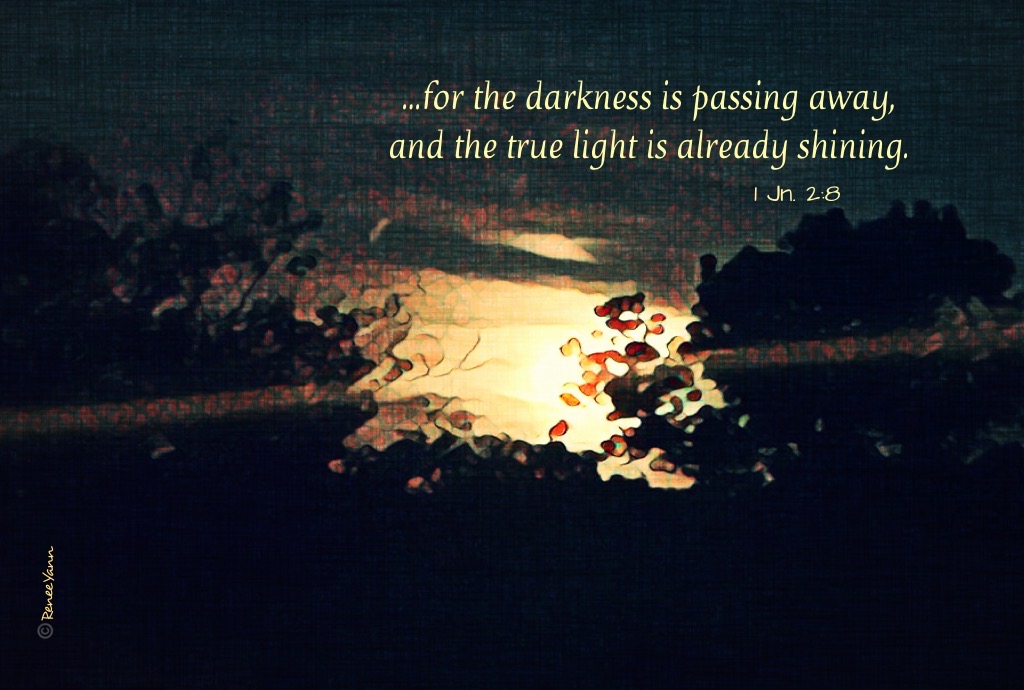
Beloved: This is the message that we have heard from Jesus Christ and proclaim to you: God is light, and in God there is no darkness at all.
1 John 1:5
Simply hearing it, we long to abide in that whole and healing Light.
But then we read our Gospel, among the saddest accounts in all of Scripture – the slaughter of the Holy Innocents. Their needless deaths come at the hands of a power-crazed and fearful man. So hungry for his own aggrandizement, he tries to assure it by killing a generation of children.
It sounds impossible, doesn’t it, that anyone could be so hardened by evil? It sounds impossible that good people would execute this order of a mad man! It sounds impossible that human beings could be so blind to the sanctity of another’s life!
When Herod realized that he had been deceived by the magi,
he became furious.
He ordered the massacre of all the boys in Bethlehem and its vicinity
two years old and under,
in accordance with the time he had ascertained from the magi.
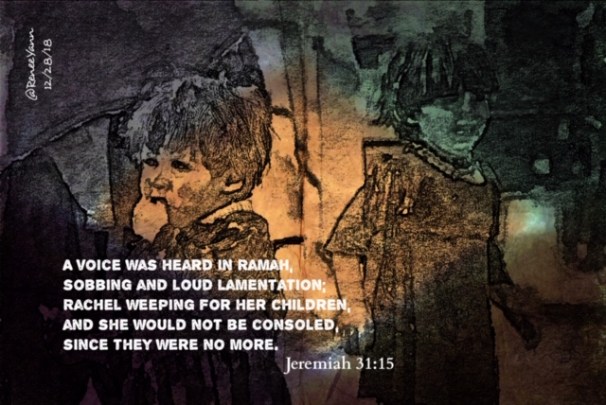
Then was fulfilled what had been said through Jeremiah the prophet:
A voice was heard in Ramah,
    sobbing and loud lamentation;
Rachel weeping for her children,
    and she would not be consoled,
    since they were no more.
Dear friends, we must confront our own blindness. We must look into the eyes of our 21st century children – the border children, the children of Ukraine, Russia, Sudan, Haiti, … the children of war, violence, drugs and poverty. We must hear the last cries of the children we fail to protect by adequate gun laws – the children of Columbine, Uvalde, Sandy Hook and on and on….
We must hear the cry of God, their Mother, and choose legislators and leaders who will honor life; who will shape global policies and relationships recognizing the common life we share in God – who will make true pro-life choices regarding gun control, arms sales, and an economy of endless war.
Our attitudes, our advocacy and our votes will either condemn or exonerate us when that Great Light ultimately reveals our hearts. When a society’s children become the victims of its indefensible corruption, we must say “Enough!”
Poetry: Holy Innocents – Christina Rossetti
Sleep, little Baby, sleep;
The holy Angels love thee,
And guard thy bed, and keep
A blessed watch above thee.
No spirit can come near
Nor evil beast to harm thee:
Sleep, Sweet, devoid of fear
Where nothing need alarm thee.

The Love which doth not sleep,
The eternal Arms surround thee:
The Shepherd of the sheep
In perfect love hath found thee.
Sleep through the holy night,
Christ-kept from snare and sorrow,
Until thou wake to light
And love and warmth to-morrow.
Music: A Coventry Carol – sung by Anúna
The “Coventry Carol” is an English Christmas carol dating from the 16th century. The carol was traditionally performed in Coventry in England as part of a mystery play called The Pageant of the Shearmen and Tailors. The play depicts the Christmas story from chapter two in the Gospel of Matthew: the carol itself refers to the Massacre of the Innocents, in which Herod ordered all male infants under the age of two in Bethlehem to be killed, and takes the form of a lullaby sung by mothers of the doomed children. (Lyrics below)
Lullay, thou little tiny child Sleep well, lully, lullay And smile in dreaming, little one Sleep well, lully, lullay Oh sisters two, what may we do To preserve on this day This poor youngling for whom we sing Sleep well, lully, lullay Farewell, lully, lullay Herod the king in his raging Set forth upon this day By his decree, no life spare thee All children young to slay All children young to slay Then woe is me, poor child, for thee And ever mourn and say For thy parting, neither say nor sing Farewell, lully, lullay Farewell, lully, lullay And when the stars fill darkened skies In their far venture, stay And smile as dreaming, little one Farewell, lully, lullay Dream now, lully, lullay








 Lavish Mercy