The End Times

Thirty-third Sunday in Ordinary Time
November 13, 2022

Today’s Readings:

https://bible.usccb.org/bible/readings/111322.cfm

Today, in God’s Lavish Mercy, our readings carry the full flavor of the “end times” warnings, those repeated annually as we move closer to Advent (which is only two weeks away!) When I was a kid, these readings scared me. And now, even as an elder, I’m not particularly in love with them!

But, nevertheless, you gotta’ love Malachi! What a powerful poet! His message of impending judgement and necessary repentance definitely hits the mark.

Lo, the day is coming, blazing like an oven,
 when all the proud and all evildoers will be stubble…

Malachi 3:19

Wow! Really? Depending on where we stand in our moral life, our reaction to this announcement might range from:

Good! Go get ‘em, God!” 

to

Oh, dear God, I hope it’s not me!!!”.


Nobody wants to be “stubble” when the final fires blaze. So how can we avoid that? Paul resets us on the right track, from both “cheer” and “fear” to commitment. He instructs his readers to do their job, living and honest simple lives. He says something like this:

Listen! You must imitate your teachers in Christ.
Live with integrity, justice and generous mercy.
Navigate the world with these as your compass.
Then you will welcome the end times.


Lk21_19 perseverance

In Luke’s Gospel, Jesus offers an equally dire prediction of the end times. When we read the list of disasters and betrayals Jesus describes, we must admit that every one of them occurs somewhere in our world everyday. In essence, we already live in the “end times”, trying to welcome and foster Divine Grace in our piece of the universe.


Photo by Stas Knop on Pexels.com

Today’s readings are an alarm clock. They call us to recognize the geopolitical world we live in as the emerging Realm of God, and to do our part to bring that realm to full realization.

It is likely impossible to communicate God’s vision for the world in the language of politics.  Scripture offers us the transcendent gift of the eloquent prophets Malachi and Jesus describing not only their own times but ours as well.


Walter Brueggemann says this:

The prophet’s task is to imagine the world as though Yahweh, the God of Israel and the creator of heaven and earth, were a real character and a lively agent in the life of the world.  I believe that such a claim, then and now, has to be articulated poetically in order not to be co-opted by political absolutism or theological orthodoxy.

Our readings today give us this poetic vision and challenge. Read them with great longing to hear God’s voice for our times. The world so sorely needs the answer that will blossom by the perseverance of our lives.


Poetry: A Song on the End of the WorldCzeslaw Milosz

Czeslaw Milosz ranks among the most respected figures in 20th-century Polish literature, as well as one of the most respected contemporary poets in the world: he was awarded the Nobel Prize for Literature in 1980. 

On the day the world ends
A bee circles a clover,
A fisherman mends a glimmering net.
Happy porpoises jump in the sea,
By the rainspout young sparrows are playing
And the snake is gold-skinned as it should always be.

On the day the world ends
Women walk through the fields under their umbrellas,
A drunkard grows sleepy at the edge of a lawn,
Vegetable peddlers shout in the street
And a yellow-sailed boat comes nearer the island,
The voice of a violin lasts in the air
And leads into a starry night.

And those who expected lightning and thunder
Are disappointed.
And those who expected signs and archangels’ trumps
Do not believe it is happening now.
As long as the sun and the moon are above,
As long as the bumblebee visits a rose,
As long as rosy infants are born
No one believes it is happening now.

Only a white-haired old man, who would be a prophet
Yet is not a prophet, for he’s much too busy,
Repeats while he binds his tomatoes:
There will be no other end of the world,
There will be no other end of the world.

Warsaw, 1944


Music:  Let Justice Roll – video of the Salvation Army

Choosing Goodness

Monday of the Thirty-second Week in Ordinary Time
November 7, 2022

Today’s Readings:

https://bible.usccb.org/bible/readings/110722.cfm

Today, in God’s Lavish Mercy, our readings raise and answer some powerful questions. How does faith inspire moral responsibility? What is the relationship between moral commitment and leadership? How do we measure a person’s “communal righteousness”?

Paul asks these questions with respect to bishops and presbyters, and the standards are stringent – extending even to the leader’s family.

… appoint presbyters in every town, as I directed you,
on condition that a man be blameless,
married only once, with believing children
who are not accused of licentiousness or rebelliousness

In our Gospel, Jesus is direct and practical about how morally good a leader needs to be:

Jesus said to his disciples,
“Things that cause sin will inevitably occur,
but woe to the one through whom they occur.
It would be better for him if a millstone were put around his neck
and he be thrown into the sea
than for him to cause one of these little ones to sin.

Choosing leaders, trusting them, moving forward with them to a chosen future is something we do not only in our faith communities, but also in the civic arena. Even though we try mightily to separate religion and politics, these will inevitably touch because they so significantly affect the human person.

I find it interesting that these readings permeate my thoughts and prayers as many of us in the United States prepare to vote tomorrow. How might my faith direct me to choose those candidates who lead toward inclusivity, peace, mutual charity, and care for the vulnerable?

What I need as I ponder these questions is exactly what the disciples requested of Jesus. In our Gospel, Jesus instructs the disciples on sin, repentance and forgiveness — all of which we encounter within the struggling community of faith. Hearing him, the  disciples immediately realize what it is they most need to engage the challenges before them:

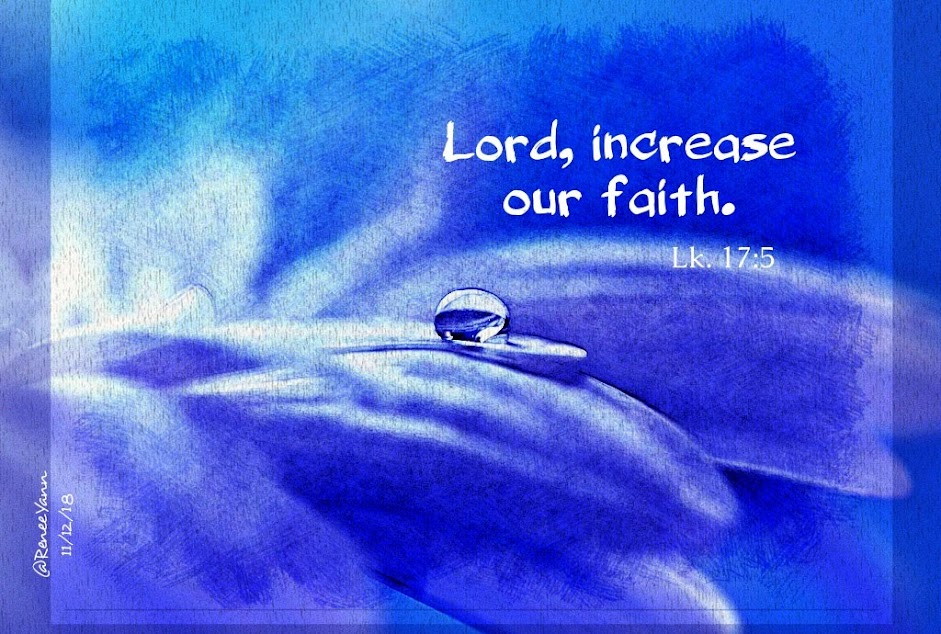
Lord, increase our faith!

Let us join their prayer today for unity and love in our faith and civic communities.


Thought: By voting, we help answer Pope France’s prayer:

I beg the Lord to grant us more politicians 
who are genuinely disturbed
by the state of society,
the people, the lives of the poor!

Joy of the Gospel (205)

 Renee Yann, RSM

Carry Us Home, Lord!

Thursday of the Thirty-first Week in Ordinary Time
November 3, 2022

Today’s Readings:

https://bible.usccb.org/bible/readings/110322.cfm

Lk15_5 lost lamb

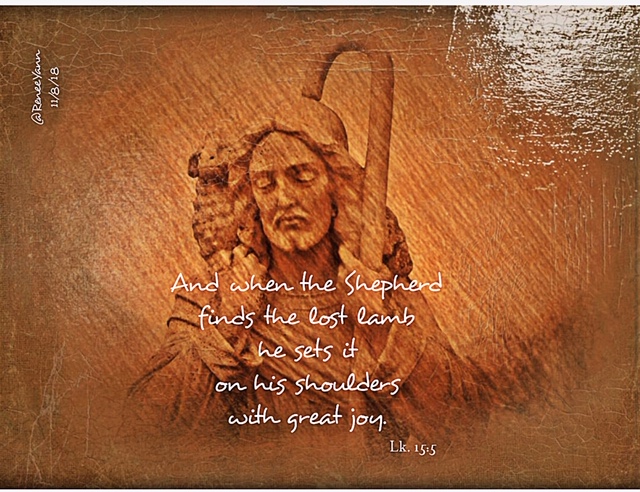
Today, in God’s Lavish Mercy, we meet the Shepherd bringing the lost lamb home.  Haven’t we all, at sometime in our lives, been carried on those sacred shoulders?

Whether by our own prayers, or the prayers of those who love us, have we not been rescued from sorrow, foolishness, isolation or fear?

This beautiful Gospel assures us of the one thing we most deeply need – we are cherished, irrevocably, by God.

Today, if we need to ride those shoulders, let us trust ourselves to them in prayer. 

If, by grace, we are already home, let us pray for those feeling most lost or abandoned – those most beset by a hostile world. May our merciful action help lift them to peace and the sweet scent of God so close beside them.


Poetry: The Good Shepherd – Brian Yapko

I enjoyed this poem which imagines Jesus still as a youngster experiencing a night as a shepherd. Mary and Joseph think it might not be the right vocation for him after his traumatic overnight!

My count of sheep was off as twilight fell
And father’s friend, Ben Ezra’s lamb was gone!
I had to find her! Searching past the well
I climbed the rocks exhausted but pressed on.
Delay could mean her life! She’d failed to heed
My shepherd’s call and so risked being killed!
Some wild beast might capture her and feed.
I could not let her unstained blood be spilled!

Great danger filled that dark and craggy hill.
My fear was deep! And then my torch went dim!
Oh, why did I avoid my father’s will
To one day be a carpenter like him?
Because my father’s friend was gravely ill.
I loved his sheep, so father made a plan
For me to herd them just one year until
I’m old enough to be declared a man.

I found the frightened lamb inside a cave
Cornered by a wolf of knife-sharp claw.
The fiercest wolf I’ve seen! How could I save
This little sheep? I thrust my staff to draw
Away the beast. He snarled, bit my wrist
And mauled my side. In agony, I heard
The wolf’s attack, too wounded to resist.
But then, thank God, a miracle occurred!

I closed my eyes and with a trembling voice
Said “Help me, father!” And the fierce wolf froze!
He yelped, then fled as if he had no choice!
I clutched the lamb and wept till the sun rose.
Still shaking I then rose up on my feet.
I kissed the lamb and said don’t be afraid
For now you’re safe. She cried a grateful bleat.
She knew I’d saved her and the price I paid.

My parents say I may no longer herd
And must devote my life to nails and wood;
But angels fill my dreams and leave me stirred
To try to be a shepherd—one who’s good—
Who shields his sheep from wickedness and strife.
I love them all, the good ones and the lost;
I’ll fear no evil that might take my life,
For I think their salvation’s worth the cost.


Music: I Will Carry You – Sean Clive

I will carry you when you are weak.
I will carry you when you can’t speak.
I will carry you when you can’t pray.
I will carry you each night and day.

I will carry you when times are hard.
I will carry you both near & far.
I’ll be there with you whenever you fall.
I will carry you through it all.

My arms are wider than the sky,
softer than a little child,
stronger than the raging,
calming like a gentle breeze.
Trust in me to hold on tight because 

I will carry you when you can’t stand.
I’ll be there for you to hold your hand.
And I will show you that you’re never alone.
I will carry you and bring you back home.

Not pain, not fear, not death, no nothing at all
can separate you from my love.
My arms and hands will hold you close.
Just reach out and take them in your own.
Trust in me to hold on tight.
I will carry you.

Released from Hate

Monday of the Thirty-first Week in Ordinary Time
October 31, 2022

Today’s Readings:

https://bible.usccb.org/bible/readings/103122.cfm

Today, in God’s Lavish Mercy, what a beautiful prayer Paul spreads over his listeners. It is a prayer that calls all believers to live in love, peace, and reverence for one another:

Brothers and sisters:
If there is any encouragement in Christ,
any solace in love,
any participation in the Spirit,
any compassion and mercy,
complete my joy by being of the same mind, with the same love,
united in heart, thinking one thing.

Philippians 2:1-2

Reading this passage, I was immediately struck by the awareness of how much opposite messaging we receive in today’s world.

In the arenas of entertainment, politics, civic life, and – sad to say – even religion, we often hear a message contradictory to Paul’s. We hear civic and supposedly “religious” leaders tell their followers to attack, shun, fight, and even “hang” the other. Night after night on our TVs, we watch fictional characters act out the hate and crime that has become normalized in our culture. Our video games, music and movies are drowning in blood, hate and anger.

Sometimes, I am just astounded that we entertain ourselves with murder, war, rape and other outrages against human beings!

With the vicious attack on Paul Pelosi this week, as in so many other horrendous incidents of unbridled hate, we see a perpetrator sickened and abetted by the violent rhetoric our society has allowed. And perhaps even worse than the crime itself, we see political leaders not only minimizing the atrocity, but mocking the victim!


If St. Paul were here, what would he say?

  • where is the encouragement in Christ?
  • where is the solace in love?
  • where is the participation in the Spirit?
  • where is the compassion and mercy?

As a matter of fact, if St. Paul were here, I think he would wail in sadness!


In Luke’s Gospel, Jesus tells us what a society should look like when it respects God and God’s Creation. It should be impelled by the deepest respect and tenderness toward the self and the other:

When you hold a lunch or a dinner,
do not invite your friends or your brothers or sisters
or your relatives or your wealthy neighbors,
in case they may invite you back and you have repayment.
Rather, when you hold a banquet,
invite the poor, the crippled, the lame, the blind; 
blessed indeed will you be because of their inability to repay you.
For you will be repaid at the resurrection of the righteous.

Luke 14:12-14

Bottom line is this: a lot of people just don’t buy Paul’s or Jesus’s message. A lot of people would rather live for themselves to the expense of others.

But we’re not just “a lot of people”. We are Christ’s, and we must examine our speech, attitudes, choices and behaviors for anything that contradicts his message of love, mercy, inclusion, and mutual reverence.

The contradictions are subtle. Discovering and uprooting them takes honest and humble prayer. It requires a good look at how we entertain ourselves, how we confront those we disagree with, who we criticize and how we do it.


Several years ago, I was shocked when someone close to me announced, “I hate Obama!” I asked her why and she said, “I just do. I don’t need a reason!”

Where does all the hate in our culture come from? And, oh, how much more does it tell us about the haters than the ones hated! And of course, the essential question, “What can we do about it?”

Jesus made it simple. He told us to look around the “table” of our attitudes, behaviors and choices.

Who is welcome? Who is shunned? Who is embraced as a human being? Who is objectified and dispensed with as unimportant.

As in all solutions, we can begin with ourselves. Ridding ourselves of these contradictions requires that we listen to ourselves to see if, how, and why we ever use the word “hate”. Only then might we cleanse our hearts of its subtle poisons.


Prose: Two thoughts today

The enemy is fear.
We think it is hate,
but it is really fear.

Mahatma Gandhi

Who would I be,
and what power would be expressed in my life,
if I were not dominated by fear?

Paula D’Arcy

Music: At My Table – JJ Heller – a kinda fun video to watch!

Called by Name

Thirty-first Sunday in Ordinary Time
October 30, 2022

Today’s Readings:

https://bible.usccb.org/bible/readings/103022.cfm

Today, in God’s Lavish Mercy, we have three wonderful readings to enrich our prayer.

In our passage from Wisdom, we can picture the pray-er sitting down with God to express admiration, thanks and love.

Before the LORD the whole universe is as a grain from a balance
 or a drop of morning dew come down upon the earth.
 But you have mercy on all, because you can do all things;
 and you overlook people’s sins that they may repent.
 For you love all things that are
 and loathe nothing that you have made;
 for what you hated, you would not have fashioned.

In his letter to the Thessalonians, Paul prays a beautiful blessing over the community – a blessing which, by grace, transcends through time to us:

We always pray for you,
that our God may make you worthy of his calling
and powerfully bring to fulfillment every good purpose
and every effort of faith,
that the name of our Lord Jesus may be glorified in you,
and you in him,
in accord with the grace of our God and Lord Jesus Christ. 

In Luke’s Gospel, Jesus meets a height-challenged scribe who is intensely interested in seeing the rumored Messiah:

Zaccheus ran ahead and climbed a sycamore tree in order to see Jesus,
who was about to pass that way.
When he reached the place, Jesus looked up and said,
“Zacchaeus, come down quickly,
for today I must stay at your house.” 

Notice that Jesus doesn’t just wave or look at Zacchaeus with a wry smile at his perch. Jesus incorporates Zacchaeus into the embrace of salvation.As Wisdom says, Jesus “loves all things that are..” And as Paul says, “powerfully brings to fulfillment every good purpose
and every effort of faith…”


I think there are times in every life when we need to stretch to find God. We may need to climb faith’s tree and dangle over the confusions of life in the hope of grasping grace. Friends, all of us, no matter how tall we might be, have been Zaccheaus! Am I right? When we are, let”s listen for the One Who calls our name!


Poetry: Zacchaeus – George Macdonald (10 December 1824 – 18 September 1905) was a Scottish author, poet and Christian minister. He was a pioneering figure in the field of modern fantasy literature and the mentor of fellow writer Lewis Carroll. 

To whom the heavy burden clings,
It yet may serve him like a staff;
One day the cross will break in wings,
The sinner laugh a holy laugh.

The dwarfed Zacchaeus climbed a tree,
His humble stature set him high;
The Lord the little man did see
Who sought the great man passing by.

Up to the tree he came, and stopped:
“To-day,” he said, “with thee I bide.”
spirit-shaken fruit he dropped,
Ripe for the Master, at his side.

Sure never host with gladder look
A welcome guest home with him bore!
Then rose the Satan of rebuke
And loudly spake beside the door:

“This is no place for holy feet;
Sinners should house and eat alone!
This man sits in the stranger‘s seat
And grinds the faces of his own!”

Outspoke the man, in Truth‘s own might:
“Lord, half my goods I give the poor;
If one I’ve taken more than right
With four I make atonement sure!”

Salvation here is entered in;
This man indeed is Abraham’s son!”
Said he who came the lost to win-
And saved the lost whom he had won.


Music: He Called Me by My Name – Fr. Christopher Cuelho, OFM

An Honest, Humble Spirit

Thirtieth Sunday in Ordinary Time
October 23, 2022

Today, in God’s Lavish Mercy, in our readings:

  • Sirach assures us that the prayer of the humble reaches the ear of God
  • Paul readies himself for death
  • Jesus gives us one of his most memorable parables. 

The thread running through all of these? Humility- that beautiful virtue which allows us to be who we truly are before God and humanity.

Jesus addressed this parable
to those who were convinced of their own righteousness
and despised everyone else. 
“Two people went up to the temple area to pray;
one was a Pharisee and the other was a tax collector. 
The Pharisee took up his position and spoke this prayer to himself,
‘O God, I thank you that I am not like the rest of humanity —
greedy, dishonest, adulterous — or even like this tax collector. 


Oh my goodness friends, how many times – at meetings or dinners — have we been with “the Pharisees”, such as Jesus describes? They are so unsure and unaware of their true value in God, that they begin to create an illusion of their greatness to protect their fear.

We know the statements (or attitudes) by heart. Sometimes, they’re harmless, and our listeners see through them right away.

fish

But there are other statements, such as the Pharisee’s, that are not harmless. By falsely aggrandizing the self, these statements and attitudes degrade and dehumanize the other. But perhaps most importantly, they delude the speaker himself so that his ability to see his true worth in God is blocked by his false pride.

Paul, sensing the death’s approach, has a much more honest and humble self-evaluation:

I have competed well; I have finished the race;
I have kept the faith.
From now on the crown of righteousness awaits me,
which the Lord, the just judge,
will award to me on that day, and not only to me,
but to all who have longed for his appearance.


It’s really sad to miss the whole point of one’s true greatness: that we are beloved and redeemed by God – just like every Creature! That we are called, in that belovedness , to serve God in our sisters and brothers. Knowing this inalienable truth is the source of all humility, courage, joy, and perseverance in faith. It is the whole reason we were created. What a tragedy to, like the Pharisee, never realize how divinely great we really are!


Let us pray with Paul and the humble tax collector today. “O God, be merciful to me a sinner – a redeemed, grateful, and joyful sinner.”

Let us use for our poetry today’s beautiful Psalm 34.

I will bless the LORD at all times;
whose praise shall be ever in my mouth.
Let my soul glory in the LORD;
the lowly will hear me and be glad.

The LORD confronts the evildoers,
to destroy remembrance of them from the earth.
When the just cry out, the LORD hears them,
and from all their distress they are rescued.

The LORD is close to the brokenhearted;
and those who are crushed in spirit God saves.
The LORD redeems the lives of these servants;
no one incurs guilt who takes refuge in our God.


Music: Miserere Mei – Gregorio Allegri 

Share this:

Mary, Vessel of Grace

Memorial of Our Lady of the Rosary
October 7, 2022

Today’s Readings:

https://bible.usccb.org/bible/readings/100722.cfm

Today, in God’s Lavish Mercy, we encounter readings that are probably not among anyone’s favorites. In the epistle, Paul is trying to demonstrate to the Galatians how blessed they are to have inherited the promise given to Abraham. 

In the Gospel, there is a lot of talk about evil spirits, divided kingdoms, and good old Beelzebub. It’s not really a day when you’ll say, “Gosh, those readings inspired me!”

Is it worth sticking with the daily readings in such a case?  I think so.

Ps111_grateful heart

There is always a string lying among these sacred words that we can tie to our own hearts. For me today, that string is wrapped around the Responsorial Psalm:

I will give thanks to the Lord with all my heart.

Just as the Galatians have inherited God’s promise, so have we. Just as the Kingdom of God has come upon Jesus’ followers, it has come upon us. God’s fidelity remains with us through all the “demons” that might annoy or threaten us. God’s graciousness has already redeemed us for an eternal life beyond their reach.

So let’s have intentionally grateful hearts today. Everything – yes, everything – in our lives is a gift, if we but have the grace to unwrap it with humility, openness and gratitude.

On this day when we pray in a special way to Our Lady of the Rosary, we can take the opportunity, while fingering our beads, to relive her life with her. We talk with her about the major mysteries of our own lives which have invited us to birth Christ into our own times and experiences.

Poetry: Theotokos – Malcolm Guite

You bore for me the One who came to bless
And bear for all and make the broken whole.
You heard His call and in your open ‘yes’
You spoke aloud for every living soul.
Oh gracious Lady, child of your own child,
Whose mother-love still calls the child in me,
Call me again, for I am lost, and  wild
Waves suround me now. On this dark sea
Shine as a star and call me to the shore.
Open the door that all my sins would close
And hold me in your garden. Let me share
The prayer that folds the petals of the Rose.
Enfold me too in Love’s last mystery
And bring me to the One you bore for me.

Music: Give Thanks ~Don Moen

Lessons in Love and Light

Monday of the Twenty-fifth Week in Ordinary Time
September 19, 2022

Today’s Readings

https://bible.usccb.org/bible/readings/091922.cfm

Today, in God’s Lavish Mercy, our readings encourage us to live lives of Charity and Light.

Today’s first reading opens two weeks of inspiration from the Wisdom Literature of the Hebrew Scriptures. These books include Job, Proverbs, Ecclesiastes, Song of Solomon, and parts of Psalms.

Wisdom literature differs from other books in the Old Testament in that the authors were sages rather than prophets or priests. Priests and prophets typically dealt with religious and moral concerns whereas sages generally focused on the practical aspects of how to live and the intellectual challenges that arise when contemplating the human experience. 

from: compellingtruth.org

Our passage from Proverbs offers a good dose of that sage advice with these basics of mutual charity:

  • Refuse no one the good on which they have a claim
  • Plot no evil against your neighbor,
  • Quarrel not with someone without cause,
  • Envy not lawless persons
  • Choose not their ways …

If we all followed that list, the world would be in pretty good shape. And, in Luke’s Gospel, Jesus says that once we get that shaped-up, we can take it up a notch — into the Light:

No one who lights a lamp conceals it with a vessel
or sets it under a bed;
rather, you place it on a lampstand
so that those who enter may see the light.

Matthew’s version adds this line:

Let your light shine before others,
that they may see your good deeds 
and glorify God in heaven.

So how do I let Charity kindle God’s Light in me? The list from Proverbs can get me started, but what might my own “Charity Challenges” look like?

Poetry: Charity — The Greatest of All Three – Robert Morris

The soul serene, impenetrably just, 
Is first in CHARITY; we love to muse 
On such a model; knit in strictest bonds 
Of amity with spirits like disposed; 
Aiming at truth for her own sake, this one 
Passes beyond the golden line of Faith, 
Passes beyond the precious line of Hope, 
And sets foot unmoved on CHARITY . 
“A soul so softly radiant and so white, 
The track it leaves seems less of fire than light.”


Music: Lampstand – Ben Bigelow

(Spoiler alert: Those who are still able may want to dance by the end of this video!🤩 I just did a very good finger-snapping routine)

Prodigal: Another Word for “Lavish”

Twenty-fourth Sunday in Ordinary Time
September 11, 2022

Today’s Readings:

https://bible.usccb.org/bible/readings/091122.cfm

Today, in God’s Lavish Mercy, Exodis tells a story of Moses’ intervention to save the people from God’s wrath. It is a story of God’s relenting … a theme which repeats itself endlessly in the Hebrew Scriptures.

This is the way we sometimes characterize the astonishment of Grace – God’s overwhelming passion to love and forgive us over and over. We just can’t imagine such mercy, such infinite generative love!

And so we imagine instead that Moses made God do it! Yeah, I don’t think so. 😉


We imagine that God cannot tolerate our sinful pursuits because we cannot tolerate them in ourselves or in others. But God is mercy, forgiveness, reconciliation, wholeness, love. God can’t help loving us!

Of course, we shouldn’t be stupid and take advantage of the divine largesse… not because it would hurt God, but because it so damages us and limits our capacity for wholeness. But nevertheless, whether we’re stupid or not, God will always welcome us home.

Today’s readings are example of a word we’ve used few times in Lavish Mercy 

splancha

– that “gut love” that so describes God’s prodigal passion for us. We find the word again today in the heart-wrenching parable of the Prodigal Son.

prodigal son

You know the story. Near the end, as the devastated son returns seeking mercy…

While he was still a long way off,
his father caught sight of him,
and was filled with compassion — with splancha – esplanchnisthē
Luke 15:20

Our God is a Love that is filled, overflowing – with no room for retribution or condemnation.

Indeed, our God, like the Prodigal Father, is soft-hearted, an easy mark, a pushover for our sincere repentance, trust, and hope. Our God would bleed for us — just as Jesus did!


This short but powerful scene from George Balanchine’s ballet, Prodigal Son, may inspire our prayer today. The father is steadfast, a monolith of strength and love. The son is broken, naked in his desperation. Let their magnetic reunion take you to God’s heart. Let God wrap you too in the mantle of Love for any hurt or emptiness that is within you.

George Balanchine “Prodigal Son” – Final Scene (Son- Barishnikov)

Claude Debussy also wrote a beautiful piece on this parable. If you have a contemplative space sometime this week, you may want to listen to Debussy’s moving opera (with my all-time fav Ms. Jessye Norman.)

Click here for full opera

If you have only a little time, do try this – short, and oh so beautiful!

Music: Debussy The Prodigal Son – Prelude

Life Guidance

Wednesday of the Twenty-Third Week in Ordinary Time
September 7, 2022

Today’s Readings:

https://bible.usccb.org/bible/readings/090722.cfm

Today, in God’s Lavish Mercy, Paul gives a little “life guidance” to the neophyte Christian community in Corinth. One might get the picture of him sitting, grandfather-like, in a lounge chair by the Korinthos Bay, thinking his instructions out loud.

You know, if you’re a virgin, that’s good.
– on the other hand -if you’re not, well that can work too.
And if you’re not married, great.
But – on the other had – if you are married,
hmm, you’re gonna suffer,
but you can still find a way.

Renee’s Translation of the passage below 🙂

In regard to virgins, I have no commandment from the Lord,
but I give my opinion as one who by the Lord’s mercy is trustworthy.
So this is what I think best because of the present distress:
that it is a good thing for a person to remain as he is.
Are you bound to a wife?  Do not seek a separation.
Are you free of a wife?  Then do not look for a wife.
If you marry, however, you do not sin,
nor does an unmarried woman sin if she marries;
but such people will experience affliction in their earthly life,
and I would like to spare you that.

1 Corinthians :25-28

I can picture myself sitting in that crowd, turning to a companion to say, “WHAT the heck is he talking about!?”. And hopefully that companion would be tuned in enough to say, “He’s talking about life and how hard it is to truly appreciate what life is all about before it’s too late.”

I think that is the key and precious tidbit in this reading:

Life in Christ is the inverse of worldly definitions.
It is a heartbeat humming under appearances,
between the layers of our experience,
which renders them infinitely more grace-filled
than we might perceive.

I tell you the time is running out.
From now on, let those having wives act as not having them,
those weeping as not weeping, 
those rejoicing as not rejoicing,
those buying as not owning,
those using the world as not using it fully.
For the world in its present form is passing away.

1 Corinthians 7: 29-21

We need deeper vision, a blessed listening to perceive this Sacred Heartbeat.

We need a peaceful courage and holy insight to enter it, to sing with it. Paul, in this reading and Jesus, in our Gospel, invite us to step into the spiritual counterpoint of God’s song.

Counterpoint is a compositional technique in which two or more melodic lines complement one another but act independently. The term comes from the Latin punctus contra punctum, which means “point against point.” Composers use counterpoint to create beautiful, complementary polyphonic music.

Paul’s lesson isn’t about being a virgin or not, being married or not. It’s about finding that sweet spot in your life, between the layers, where you can best hear God breathing within you and open your life, in counterpoint, to that Eternal Song.

Jesus says we will have found that sweet spot when we understand and live the “inverse richness” – the “counterpoint” of the Beatitudes which are offered in a perhaps less familiar form today by Luke:

Blessed are you who are poor,
for the Kingdom of God is yours.
Blessed are you who are now hungry,
for you will be satisfied.
Blessed are you who are now weeping,
for you will laugh.
Blessed are you when people hate you,
and when they exclude and insult you,
and denounce your name as evil
on account of the Son of Man.
Rejoice and leap for joy on that day!
Behold, your reward will be great in heaven.  

Poetry: The Layers – Stanley Kunitz

I have walked through many lives, some of them my own,
and I am not who I was,
though some principle of being
abides, from which I struggle
not to stray.
When I look behind,
as I am compelled to look
before I can gather strength
to proceed on my journey,
I see the milestones dwindling
toward the horizon
and the slow fires trailing
from the abandoned camp-sites,
over which scavenger angels
wheel on heavy wings.
Oh, I have made myself a tribe
out of my true affections,
and my tribe is scattered!
How shall the heart be reconciled
to its feast of losses?
In a rising wind
the manic dust of my friends,
those who fell along the way,
bitterly stings my face.
Yet I turn, I turn,
exulting somewhat,
with my will intact to go
wherever I need to go,
and every stone on the road
precious to me.
In my darkest night,
when the moon was covered
and I roamed through wreckage,
a nimbus-clouded voice
directed me:
“Live in the layers,
not on the litter.”
Though I lack the art
to decipher it,
no doubt the next chapter
in my book of transformations
is already written.
I am not done with my changes.

Music: Inside This River – Gary Schmidt ( more great counterpoint)