Monday of the Eighteenth Week in Ordinary Time

Monday, August 2, 2021

Today, in God’s Lavish Mercy, we pray with Psalm 81, and today’s verses sound a little harsh. The Lord seems a bit fed up with Israel’s hungers:

My people heard not my voice,
    and Israel obeyed me not;
So I gave them up to the hardness of their hearts;
    they walked according to their own counsels.

Psalm 81:12-13

Translated to 21st century jargon that verse might sound like this:

I love them and all, but come on!
    They don’t follow my advice;
so the heck with their stubbornness.
    Let them stew in their own juices!

Renee’s unofficial imaginings 🙂

But see, here’s the thing. God is never like that with us. God is, instead, everlastingly patient with us. God stays with us until we – hopefully – respond to Grace.

And don’t we sometimes really test God’s patience! Moses was great at it — pushing and pushing for God to make things easier for him. 

I cannot carry all this people by myself,
for they are too heavy for me.
If this is the way you will deal with me,
then please do me the favor of killing me at once,
so that I need no longer face this distress.

Numbers 11:14-15

Picture Moses standing in front of God, hands on hips yelling, “I’ve had it! Why not just kill me now?!?!”

The verse actually makes me chuckle because I also picture God, smothering a smile at Moses’s tantrum, and thinking, “Maybe some quail will settle this guy down for the long haul.”


Today’s psalm and reading from Numbers remind us that each of our lives is an unfolding journey in relationship with God. It is a journey that requires us to listen and respond over and over again. At each response we move ever deeper into the heart of God, letting go of those things which impede us from our destination.

If only my people would hear me,
    and Israel walk in my ways,
Quickly would I humble their enemies;
    against their foes I would turn my hand.

Psalm 81: 14-15

God is our help
and is ALWAYS present with us.
If we can listen to our deep lives,
we will know that
and our spirits will sing.

Poetry: Moses by Alan Kanfer

Whatever residue of pride adhere
To eyes, to bones, to hair will shed like sand
When we discover the The Name is near
And fire is Light, and we are asked to stand.
That night my hair was like a fell of sheep,
My bones like water, I was weak and dumb:
My perfume reeked like camp whores that we keep.
I stood, receiving “I am that I am.”
How small the distance is between the root
And flower: the Name is near as our consent,
As our denial. Coming up the hill on foot
Long after, knowing we must be content
With shadow of The Name, I shed my will
But not my love: the final miracle.


Music: Frangeti – George Winston

Wednesday of the Seventeenth Week in Ordinary Time

July 28, 2021

Today, in God’s Lavish Mercy, we pray with Psalm 99, one of the six “enthronement psalms” which celebrate God as King.

The psalm is filled with awestruck sentiment such as one might feel before a king:

From the pillar of cloud God spoke to them;
    they heard the decrees and the law God gave them.
Extol the LORD, our God,
    and worship at the holy mountain;
    for holy is the LORD, our God.

Psalm 99:6-9

The images evoked are similar to those of our first reading with Moses’ face shining from his meetings with God:

As Moses came down from Mount Sinai
with the two tablets of the commandments in his hands,
he did not know that the skin of his face had become radiant
while he conversed with the LORD.

Exodus 34:29

The neat thing about all this glory is that a very tender human image nestles in the wording:

… worship at God’s footstool;
   for God is holy!

Psalm 99:5

Imagine the Beloved’s footstool – some precious place in the universe that invites you to God’s side. For someone it may be beside the ocean. For another it may be a quiet glen. It may be at your window listening to the sparrow’s morning song.

Wherever it is in the glorious universe, we are welcomed to rest with God at the peaceful footstool. We are free to speak as easily with God as Moses did in the little Sinai tent. And no doubt, we will receive a certain radiance, perhaps not so visible as Moses’. But we will be changed by such prayer.


Poetry: Here is Thy Footstool – Rabindranath Tagore 

HERE IS THY footstool and there rest thy feet 
where live the poorest, and lowliest, and lost.
When I try to bow to thee, 
my obeisance cannot reach down to the depth 
where thy feet rest among the poorest, and lowliest, and lost.
Pride can never approach to where thou walkest 
in the clothes of the humble among the poorest, and lowliest, and lost.
My heart can never find its way 
to where thou keepest company with the companionless 
among the poorest, the lowliest, and the lost.


Music: Resting Place – Daphne Rademaker

Tuesday of the Seventeenth Week in Ordinary Time

Tuesday, July 27, 2021

Today, in God’s Lavish Mercy, we pray with Psalm 103 whose verses this morning remind us of God’s munificence.

Munificent – it’s a wonderful word whose Latin roots literally mean gift-making, abundant generosity.

Merciful and gracious is the LORD,
    slow to anger and abounding in kindness.

Psalm 103:8

Praying this morning, I realize that I can’t even begin to number the gifts God has given me.


But like Moses in today’s first reading, I want to visit God in the sacred tent of prayer – learning, thanking and awakening to the Mercy in my life.

… and, like Moses, to invite God into every moment, to ask God to keep company with me on my journey:

Moses at once bowed down to the ground in worship.
Then he said, “If I find favor with you, O LORD,
do come along in our company.


Poetry: Bearing the Light – Denise Levertov

Rain-diamonds, this winter morning, embellish the tangle
of unpruned pear-tree twigs;
each solitaire, placed, it appears,
with considered judgement,
bears the light beneath the rifted clouds —
the indivisible shared out in endless abundance.


Music: In the Garden – written by C. Austin Miles in 1912. Miles wrote nearly 400 hymns, this one the most famous.

And who doesn’t love Anne Murray’s mellow voice!

Memorial of Saints Joachim and Anne, Parents of the Blessed Virgin Mary

Monday, July 26, 2021

Today, in God’s Lavish Mercy, we pray with Psalm 106 which, like its companion piece Psalm 105, is about the praise that comes from remembering.

The difference between the two psalms is this:

In Psalm 105, Israel has remembered God’s goodness, thus a celebratory tone

In Psalm 106, the psalmist recounts Israel’s forgetfulness of God’s goodness, thus a repentant tone.

In Psalm 106, a companion piece to Psalm 105, the same inventory is recited, but this time the focus is on the recurring recalcitrance of infidelity on the part of Israel. That is, it is a confession of sin, and it ends in petition: 

Save us, O LORD our God, and gather us from among the nations that we may give thanks to your holy name and glory in your praise. (v.47)

Walter Brueggemann

The message for us? Here is what I take from this psalm:

1 – Never forget or overlook God’s presence and action in my life. 

But they soon forgot all God had done;
they had no patience for God’s plan.

Psalm 106:13

We have to give ourselves the time to search our circumstances for God’s presence and invitation to Grace. 

This practice has always helped me – pausing occasionally during the day, before or after my many tasks and encounters, simply to raise this question: Where is God in this moment?


2 – Structure my life in such a way that it calls me back to grateful remembering.

For their sake God remembered stayed fast to the covenant
and relented in abundant mercy,
Winning for them compassion
from all that held them captive.

Psalm 106: 45-46

Our lives are complex. We have a lot of responsibilities, needs, desires, obstacles, hopes, and frustrations. In trying to deal with life’s complexities, we might begin to think that it all depends on us. We might get tangled in our own machinations. We might forget that it is God who breathed us into life and holds us in it through all our experiences. 

Brief morning and evening prayers of gratitude, hope, reflection, repentance, and thanksgiving – these can keep us aware and focused. Slowly we may build to an hourly remembering of God’s companionship and action in our lives. Ultimately, with patience and practice, the awareness becomes constant and sustaining.


There are two wonderful books that have helped me with the prayer of awareness for those who might be interested.

  1. Seven Sacred Pauses: Living Mindfully Through the Hours of the Day by Macrina Wiederkehr
  1. Music of Silence: A Sacred Journey through the Hours of the Day by Brother David Steindl-Rast

Poetry: I live my life in widening circles – Rainer Maria Rilke

I live my life in widening circles
that reach out across the world.
I may not complete this last one
but I give myself to it.
I circle around God, around the primordial tower.
I’ve been circling for thousands of years
and I still don’t know: am I a falcon,
a storm, or a great song?

Thought and Music: The Great Song – Brother David

Saturday of the Sixteenth Week in Ordinary Time

Saturday, July 24, 2021

Today, in God’s Lavish Mercy, we pray with Psalm 50 which enjoins us – from sunrise to sunset – to offer God a sacrifice of praise.


A sacrifice of praise!
It’s a phrase and concept
that pops up in scripture several times.
And it intrigues me.
What might that repeated phrase mean
for my life with God?

In our first reading, the Israelites took detailed steps to offer sacrifice to the Lord. Their efforts are summarized in this verse: 

We will do everything that the LORD has told us. 

But what is the difference between a “sacrifice of praise” and the ritualized blood sacrifice described in Exodus? 


I think of a “sacrifice of praise” as that moment in our spiritual lives when our focus shifts 

  • from “what we do to honor God” to “how God lives in us”
  • from practiced ritual to the awe of Sacred Presence
  • from my efforts to God’s fidelity
  • in other words…..
  • from me to God

At that moment, the “sacrifice” is of our natural self-absorption and self-involvement in order to free God’s presence and action through us.

It is a moment of recognition like that of John the Baptist who, busy as he had been establishing his ministry, on seeing Jesus said, “He must increase and I must decrease.


Our psalm tells us that God is faithfully responsive to such total awareness and commitment:

Offer to God praise as your sacrifice
     and fulfill your vows to the Most High;
Then call upon me in time of distress;
    I will rescue you, and you shall glorify me.


Our psalm moves me to this prayer:

My intention, hope, and prayer, dear God, is

  • to praise You with my life
  • to act for You in all things
  • to be Mercy in the world as You would be

May these become a sacrifice of praise to You.


Poetry: St. John’s Eve –  Malcolm Guite

Midsummer night, and bonfires on the hill
Burn for the man who makes way for the Light:
‘He must increase and I diminish still,
Until his sun illuminates my night.’
So John the Baptist pioneers our path,
Unfolds the essence of the life of prayer,
Unlatches the last doorway into faith,And makes one inner space an everywhere.
Least of the new and greatest of the old,
Orpheus on the threshold with his lyre,
He sets himself aside, and cries “Behold
The One who stands amongst you comes with fire!”
So keep his fires burning through this night,
Beacons and gateways for the child of light.

Music: Praise You – Brooklyn Tabernacle Choir

Lord I come to you today,

With a simple prayer to pray.

In everything I do,

Let my life O Lord praise you.

Praise you, praise you, praise you

Let my life, praise you

Praise you, praise you, praise you

Let my life, O lord praise you

Lord you formed me out of clay,

And for your glory I was made.

Use this vessel as you choose.

Let my life O Lord praise you

Friday of the Sixteenth Week in Ordinary Time

Friday, June 23, 2021

Today, in God’s Lavish Mercy, we pray with Psalm 19, a testament to God’s Word as living and real in our lives. This psalm foreshadows the beautiful words from John’s Gospel.

Our first reading recounts God’s presentation of the Ten Commandments on Sinai. This code was the basic framework for the community’s response to God’s gift of relationship. God was saying, “Here’s what I need from you to make this thing work.”

Psalm 19 shows us that even though this “Law” was “carved in stone”, it was lived in the hearts of the faithful. It was dynamic, required nuance and interpretation, needed human engagement to fully come to life.

In other words, the “Law” had to live, come off the stone, and into hearts.


When this happens, we grow in the essence of “law”, which is love, reverence, mutuality, and generosity. We experience God’s Word as gift and delight. We long to learn more perfectly what, in our choices and actions, can bring us closer to God.

Then the law becomes, as Psalm 19 tells us:

  • perfect, refreshing the soul
  • trustworthy, giving wisdom to the simple
  • right, rejoicing the heart
  • clear, enlightening the eye.
  • pure, enduring forever;
  • true,
  • just
  • more precious than gold
  • sweeter also than syrup
  • or honey from the comb.

We all know people who claim to live by a static, lifeless but recite-able law. They can readily quote some out-of-context scripture to judge, reprimand, or condemn. It’s sad because the Word has died in them.

The Law of Love grows in the rich soil of today’s Gospel. It meets life with an honest, open, and loving spirit to find the unique adventure of grace God wants for each of us.

Pope Francis, when speaking of the Law, said this:

Our God is the God of nearness, a God who is near, who walks with his people. That image in the desert, in Exodus: the cloud and the pillar of fire to protect the people: He walks with his people. He is not a God who leaves the written prescriptions and says, “Go ahead.” He makes the prescriptions, writes them with his own hands on the stone, gives them to Moses, hands them to Moses, but does not leave the prescriptions and leaves: He walks, He is close. “Which nation has such a close God?” It’s the nearness. Ours is a God of nearness.


Poetry: What is the Root? – Hafiz

What
Is the
Root of all these
Words?

One thing: love.
But a love so deep and sweet
It needed to express itself
With scents, sounds, colors
That never before
Existed.

Music: Your Word is Life to Me – Travis Cottrell

I am a stranger in this place

This world is not my home

I want more than it can give

I am a desert needing rain

I’m thirsty for Your voice

The very reason that I live

You are the Word, my one desire

And all consuming Holy fire

The very breath that I am longing for

My heart is desperate for Your ways

Refine me in Your holy blaze

If that is what it takes to know You more

You are the Truth that sets me free

Your word is life to me

Only the power of Your Word

Can melt away these chains

That have held me far too long

So light the fire and let it burn

These shackles and restraints

And I will sing this freedom song

You are the Word, my one desire

And all consuming Holy fire

The very breath that I am longing for

My heart is desperate for Your ways

Refine me in Your holy blaze

If that is what it takes to know You more

You are the Truth that sets me free

Your word is life to me

Lamp unto my feet, light unto my path

Shine, shine on

Lamp unto my feet, light unto my path

Shine, shine on

Lamp unto my feet, light unto my path

Shine, shine on

Lamp unto my feet, light unto my path

Shine, shine on

You are the Word, my one desire

And all consuming Holy fire

The very breath that I am longing for

My heart is desperate for Your ways

Refine me in Your holy blaze

If that is what it takes to know You more

You are the Truth that sets me free

Your word is life to me

Feast of Saint Mary Magdalen

Thursday, July 22, 2021

Today, in God’s Lavish Mercy, we pray with Psalm 63, a prayer of both longing and fulfillment.

O God, you are my God whom I seek;
for you my flesh pines and my soul thirsts
like the earth, parched, lifeless and without water.

Thus have I gazed toward you in the sanctuary
to see your power and your glory,
For your kindness is a greater good than life;
my lips shall glorify you.

Psalm 63: 2-4

And isn’t our spiritual life exactly like that?
We feel our lives caressed by God,
and yet we long for greater oneness
with Infinite Love.

Mary Magdalen is the embodiment of that longing and embrace. And so the Church applies to her the powerful intimacy of our first reading:

The Bride says:
On my bed at night I sought him
whom my heart loves–
I sought him but I did not find him.
I will rise then and go about the city;
in the streets and crossings I will seek
Him whom my heart loves.
I sought him but I did not find him.
The watchmen came upon me,
as they made their rounds of the city:
Have you seen him whom my heart loves?
I had hardly left them
when I found him whom my heart loves.

Song of Songs 3:1-4

Within each one of us is a sacred mystic who longs for and seeks God’s embrace. Perhaps that mystic hibernates like a little bear hidden under all the distractions of our lives. But if we give ourselves to silence and holy waiting, the sleeping hermit will awake! 😴 

We might pray with beautiful Mary Magdalen today to let that seeker in us reach for God Who is also waiting.


Poem: Song of the Soul That Is Glad to Know God by Faith – St. John of the Cross

English version by Antonio T. de Nicolas
Original Language Spanish

Well I know the fountain that runs and flows,
though it is night!


This eternal fountain is hidden deep.
Well I know where it has its spring,
Though it is night!

In this life’s dark night,
Faith has taught where this cold fountain lies,
Though it is night!

Its origin I cannot know, it has none,
And I know all origins come from it,
Though it is night!

And I know there can be nothing more fair,
The heavens and earth drink there,
Though it is night!

And I know it has no bed,
And I know no one can cross its depths,
Though it is night!

Its clarity is never clouded,
And I know all light shines from it,
Though it is night!

I know her streams swell so abundantly,
They water people, heaven and even hell,
Though it is night!

The current born of this fountain
I know to be wide and mighty,
Though it is night!

And from these two another stream flows,
And I know neither comes before,
Though it is night!

I know Three in only one water live,
And each the other feeds,
Though it is night!

This eternal fountain is hiding from sight
Within this living bread to give us life,
Though it is night!

He calls all creatures to this light,
And of this water they drink, though in the dark,
Though it is night!

This living fountain I desire,
I see it here within this living bread,
Though it is night!


Music: I Found My Beloved – John Michael Talbot

So I found my beloved in the mountains
On the lonely and far distant isles
O’er resounding waters
I heard the whispering of love’s breezes
To heal my broken heart
Oh tranquil evening, silent music
And the sounding solitude of the rising dawn
It is there that I hear You
There that I taste of You
In love’s banquet to fill my heart
Chorus:
And I found Your footprints
In the sands by the sea
And like Your maiden
I ran along the way to a secret chamber
And there you gave to me
There you taught me, O so well
And I drank of your sweet spiced wine
The wine of God
And there I gave to You
Keeping nothing for myself
And I promised You forever
To be your bride
(Repeat Chorus)
So I have abandoned
All I ever sought to be
And in dying
My spirit has been released

Wednesday of the Sixteenth Week in Ordinary Time

Wednesday, July 21, 2021

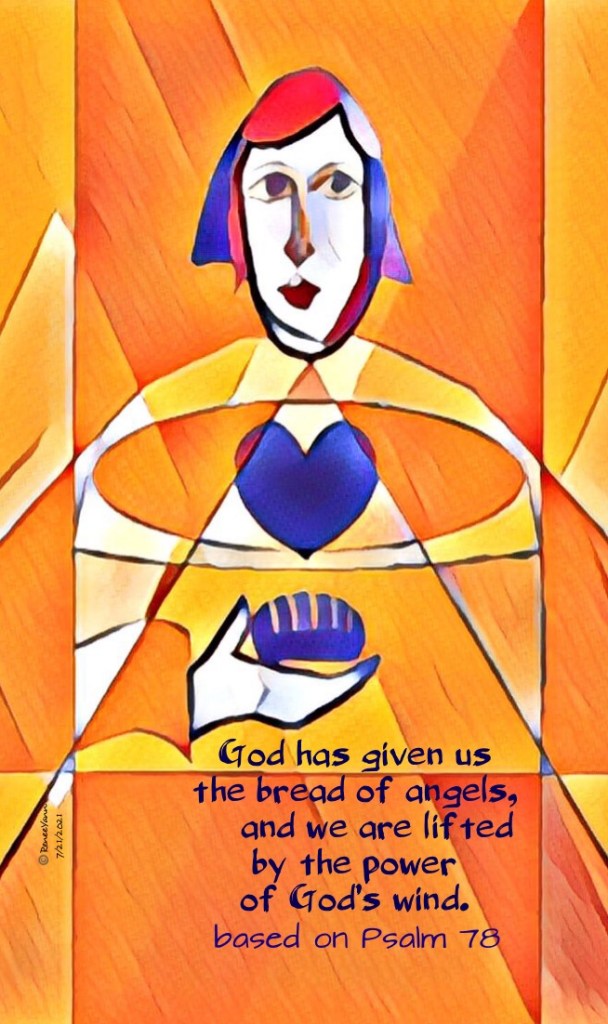
Today, in God’s Lavish Mercy, we pray with Psalm 78 which calls on the community to remember God’s constant gifts to us. Those gifts are symbolized in bread, manna from Heaven.


Thinking about the symbol of bread, this wonderful poem by Mary Oliver captured my prayer today. I leave it with you without additional comment to find your own place within it.


As I prayed with the poem, I began drawing a mandala … but it turned into an icon! (Who knew!😀) Each segment holds a memory or awareness of a particular gift God has given me.

Icons, like poems, allow the receiver a certain amount of interpretation. For example, is the figure here God, an Angel, me – or someone else? It’s up to you … enjoy the sacred play.


I hope this poem will offer you a doorway to your prayer as well.

Eat bread and understand comfort.
Drink water, and understand delight.
Visit the garden where the scarlet trumpets
are opening their bodies for the hummingbirds
who are drinking the sweetness, who are
thrillingly gluttonous.

For one thing leads to another.
Soon you will notice how stones shine underfoot.
Eventually tides will be the only calendar you believe in.

And you will hear the air itself, like a beloved, whisper
Oh let me, for a while longer, enter the two
Beautiful bodies of your lungs…

The witchery of living
is my whole conversation
with you, my darlings.
All I can tell you is what I know.

Look, and look again.
This world is not just a little thrill for your eyes.

It’s more than bones.
It’s more than the delicate wrist with its personal pulse.
It’s more than the beating of a single heart.
It’s praising.
It’s giving until the giving feels like receiving.
You have a life–just imagine that!
You have this day, and maybe another, and maybe
still another…

We do one thing or another; we stay the same, or we
change.
Congratulations, if
you have changed.

Let me ask you this.
Do you also think that beauty exists for some
fabulous reason?
And, if you have not been enchanted by this adventure–
your life–
what would do for you?

What I loved in the beginning, I think, was mostly myself.
Never mind that I had to, since somebody had to.
That was many years ago.
Since then I have gone out from my confinements,
though with difficulty.
I mean the ones that thought to rule my heart.
I cast them out; I put them on the mush pile.
They will be nourishment somehow (everything is nourishment
somehow or another).

And I have become the child of the clouds, and of hope.
I have become the friend of the enemy, whoever that is.
I have become older and, cherishing what I have learned,
I have become younger.

And what do I risk to tell you this, which is all I know?
Love yourself. Then forget it. Then, love the world.


Music: Break Thou the Bread of Life by Mary A. Lathbury (1877), and sung beautifully here by Acapeldridge

Sixteenth Sunday in Ordinary Time

Sunday, June 18, 2021

Today, in God’s Lavish Mercy, we pray with Psalm 23, the familiar hymn of confidence, gratitude, and hope.

You, Lord, are my shepherd; 
I shall not be in want.
You make me lie down in green pastures 
and lead me beside still waters.
You revive my soul 
and guide me along right pathways for your name’s sake.

Though I walk through the valley of the shadow of death,
I shall fear no evil;
for you are with me;
your rod and your staff, they comfort me.

You spread a table before me
in the presence of those who trouble me;
you have anointed my head with oil,
and my cup is running over.

Surely goodness and mercy shall follow me 
all the days of my life,
and I will dwell in the house of the Lord forever.

Praying this psalm, we are enfolded into the arms of a loving God.

This beautiful image, which is beloved to us even in our highly urbanized society, certainly held even greater meaning to the early Christians. They understood, from experience, the utter self-donation of a shepherd to his flock. The shepherd needs the sheep in order to live, just as they need the shepherd. Their lives were critically interdependent.

In a sense, the shepherd became one with the sheep. From sunrise to sunset, and even through the night, he led them to food, water, and rest. He protected them as they slept, by laying his own body across the sheep gate.


In our own time, a more familiar image might be that of a horse-whisperer, someone who through natural sensitivity and studious training, is able to understand and communicate with animals. Rather than “breaking” a horse, as seen in old westerns, the horse-whisperer leads them to trust by listening and responding to them through body-language.


As we pray with the image of the Good Shepherd today, we might imagine Jesus as our “Soul-Whisperer”. Jesus stands beside us in the vast, open loneliness of life, which sometimes tries to “break” us. But we are never alone. He is listening. As he opens our life before us, let us trust and follow him. He has made our welfare his own by becoming one of us.


Poetry: I Am the Door of the Sheepfold – Malcolm Guite

Not one that’s gently hinged or deftly hung,
Not like the ones you planed at Joseph’s place,
Not like the well-oiled openings that swung
So easily for Pilate’s practiced pace,

Not like the ones that closed in Mary’s face
From house to house in brimming Bethlehem,
Not like the one that no man may assail,
The dreadful curtain, The forbidding veil
That waits your breaking in Jerusalem.

Not one you made but one you have become:
Load-bearing, balancing, a weighted beam
To bridge the gap, to bring us within reach
Of your high pasture. Calling us by name,
You lay your body down across the breach,
Yourself the door that opens into home.

Music: The Lonely Shepherd – Leo Rojas

Memorial of Saint Bonaventure

Thursday, July 15, 2021

Today, in God’s Lavish Mercy, we pray with Psalm 105 which depicts a “Remembering God” who calls us to respond as a “Remembering People”.

“Forever” is a word whose true meaning can be found only in an Eternal God. In Exodus, and in our Psalm 105, we see God inviting us to that fullness.

Our first reading recounts the Abrahamic covenant renewed with Moses. God, flaming out of a bush, tells Moses that God sticks by agreements.

God spoke further to Moses,
“Thus shall you say to the children of Israel:
The LORD, the God of your fathers,
the God of Abraham, the God of Isaac, the God of Jacob,
has sent me to you.
    “This is my name forever;
        this my title for all generations.

Exodus 3:15

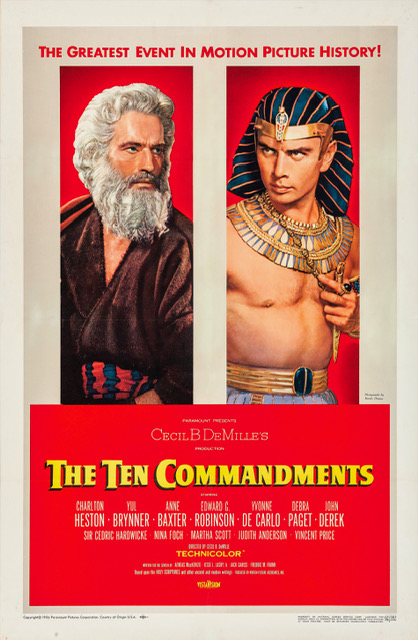
(I don’t know about you, but I’ve flashbacking all week to to Cecil B. DeMille’s 1956 classic, The Ten Commandments.)


Our psalm reinforces the Exodus commitment:

God remembers forever the covenant 
    made binding for a thousand generations
    entered into with Abraham
    and by the oath to Isaac.

Psalm 105: 8-9

Our brief but beautiful Gospel shows us what God’s promise looks like in the tender person of Jesus:

Jesus said:
“Come to me, all you who labor and are burdened,
and I will give you rest.
Take my yoke upon you and learn from me,
for I am meek and humble of heart;
and you will find rest for yourselves.
For my yoke is easy, and my burden light.”

Matthew 11: 28-30

Throughout the ages,
God’s reiterated fidelity
calls us to obedience – that “heart-listening”
which hears the invitation to Love.

Poetry: Everything That Was Broken – Mary Oliver

Everything that was broken has
forgotten its brokenness. I live
now in a sky-house, through every
window the sun. Also your presence.
Our touching, our stories. Earthy
and holy both. How can this be, but
it is. Every day has something in
it whose name is Forever.

Music; Forever – Edelis