Alleluia: Innocence!

Thursday of the Sixteenth Week in Ordinary Time
July 21, 2022

Today’s Readings:

https://bible.usccb.org/bible/readings/072122.cfm
Today, in God’s Lavish Mercy, Jeremiah images Israel as a bride, the sacred betrothed of God:

I remember the devotion of your youth,
how you loved me as a bride,
Following me in the desert,
in a land unsown.
Sacred to the LORD was Israel,
the first fruits of his harvest;
Should any presume to partake of them,
evil would befall them, says the LORD.

Jeremiah 2: 1-3

These passionate verses portray a heartbroken and angry God lamenting Israel’s ingratitude and unfaithfulness.

Be amazed at this, O heavens,
and shudder with sheer horror, says the LORD.
Two evils have my people done:
they have forsaken me, the source of living waters;
They have dug themselves cisterns,
broken cisterns, that hold no water.

Jeremiah 2:12-13

This reading from Jeremiah is about a loss of innocence, and the spiritual fragmentation it can bring. Our Alleluia Verse, on the other hand, leads to a Gospel that proclaims the restoration of an “eternal innocence” rooted in “knowledge of the mysteries of the Kingdom of heaven”.

Alleluia, alleluia.
Blessed are you, God,
Creator of heaven and earth;
you have revealed to little ones
the mysteries of the Kingdom.

There is a human innocence that comes from not knowing any better, a kind of blind trust that hasn’t yet been “burned”.

But don’t confuse “innocence” with naïveté.

The Gospel innocence Jesus describes isn’t blind and it isn’t naive. It does know better. It recognizes and chooses the cost of a faithful life. That recognition and choice yield a profound spiritual freedom that is the ultimate innocence.

Blessed are your eyes, because they see,
and your ears, because they hear.
Amen, I say to you, many prophets and righteous people
longed to see what you see but did not see it,
and to hear what you hear but did not hear it.

Matthew 13: 16-17

Poetry: The Divine Image – William Blake

from The Project Gutenberg
To Mercy, Pity, Peace, and Love,
All pray in their distress,
And to these virtues of delight 
Return their thankfulness.

For Mercy, Pity, Peace, and Love, 
Is God our Father dear
And Mercy, Pity, Peace, and Love, 
Is man, his child and care.

For Mercy has a human heart ; 
Pity, a human face ;
And Love, the human form divine ;
And Peace, the human dress.

Then every man, of every clime,
That prays in his distress, 
Prays to the human form divine :
Love, Mercy, Pity, Peace.

And all must love the human form, 
In heathen, Turk, or Jew,
Where Mercy, Love, and Pity dwell, 
There God is dwelling too.

Music: U2 – A Song for Someone from Songs of Innocence

When you listen to this highly poetic song, could God be your “someone”?

Alleluia: Seedlings

Wednesday of the Sixteenth Week in Ordinary Time
July 20, 2022

Today’s Readings:

https://bible.usccb.org/bible/readings/072022.cfm

Alleluia, alleluia.
The seed is the word of God,
Christ is the sower;
all who come to him will live for ever.

Before I formed you in the womb, I knew you.

Today, in God’s Lavish Mercy, our first reading recounts Jeremiah’s call. Oh, and it has a sovereign ring to it, doesn’t it! You can almost hear trumpets accompanying the words:

The word of the LORD came to me thus:
Before I formed you in the womb I knew you,
before you were born I dedicated you,
a prophet to the nations I appointed you.

Jeremiah 1: 2-3

Long before Jeremiah knew, the Word had been instilled in him. At the appointed time, God called for that Word to bear fruit.


At our creation, God breathed the Divine Word into our hearts too. Jesus says it was like a farmer planting seed. And our humble, patient Creator waits to see if we turn out to be rich soil.

A sower went out to sow.
… some seed fell on the path,
and birds came and ate it up.

Some fell on rocky ground, 
…. the sun rose it was scorched,

Some seed fell among thorns
which choked it.

But some seed fell on rich soil, 
and produced fruit,
a hundred or sixty or thirtyfold.
Whoever has ears ought to hear.
(from Matthew 13: 1-9)

When Jeremiah heard about the Word in his heart, he didn’t immediately have “ears to hear”. At first, he resisted:

“Ah, Lord GOD!” I said,
“I know not how to speak;
I am too young.”

Jeremiah

Every day, God continues to call forth the fruitful Word from us. Sometimes we resist. Our lives can be a little rocky, thorny, or we might just be off the path a bit.

We also might make excuses to ignore the call of grace:

  • too young
  • too old
  • too tired
  • too busy
  • too afraid
  • too weak

We might just too … too… too ourselves into spiritual quicksand!


Our beautiful psalm tells what to say instead of our “too”s:

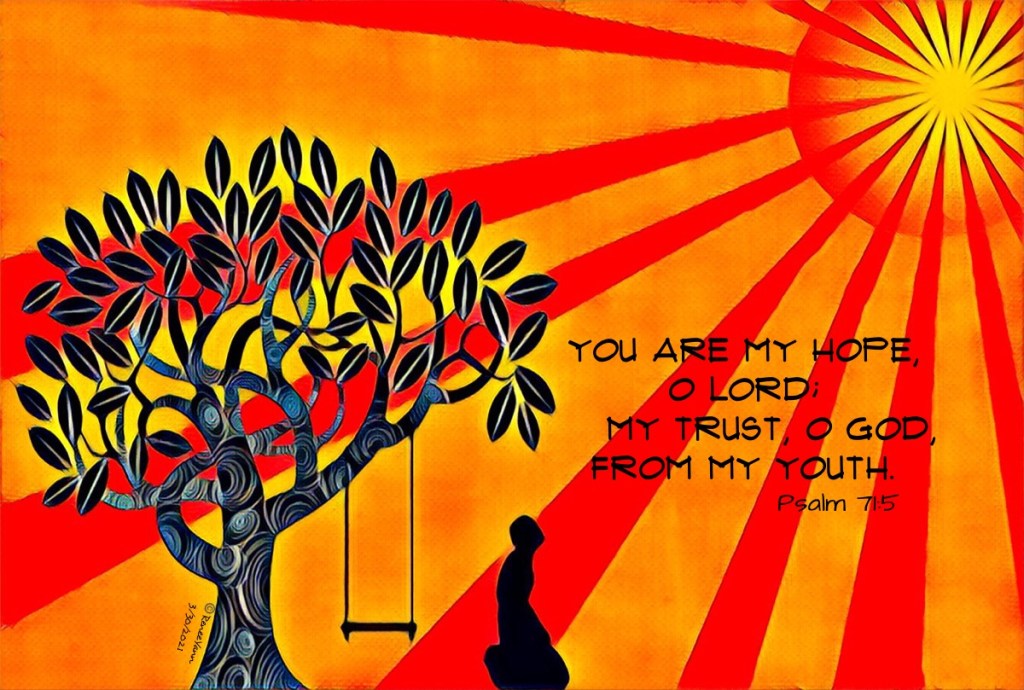
For you are my hope, O Lord;
my trust, O God, from my youth.
On you I depend from birth;
from my mother’s womb you are my strength.

My mouth shall declare your justice,
day by day your salvation.
O God, you have taught me from my youth,
and till the present I proclaim your wondrous deeds.

Psalm 71: 5-6; 15,17

Poetry: Two poems today – one from Wendell Berry and one from me. His is way better. 🙂

The Wild Geese – Wendell Berry

Horseback on Sunday morning,
harvest over, we taste persimmon
and wild grape, sharp sweet
of summer's end.  In time's maze
over the fall fields, we name names
that went west from here, names
that rest on graves.  We open
a persimmon seed to find the tree
that stands in promise,
pale, in the seed's marrow.

Geese appear high over us,
pass, and the sky closes.  Abandon,
as in love or sleep, holds
them to their way, clear,
in the ancient faith: what we need
is here.  And we pray, not
for new earth or heaven, but to be
quiet in heart, and in eye
clear.  What we need is here.

If You Are Mother – Renee Yann, RSM

If you are Mother, God
don’t let us hurt ourselves;
keep freedom in us
as freedom,
not as willfulness,
so that we grow
even if we must grow down
like a dark, hidden root.

Remember,
if life dies in us,
You change.  We are not
isolated seedlings
you left somewhere
in lonely hope one spring.
You are the ground, and the
growth, and the growth’s nourishment.
When we green, it is You
who thrive.

Music: Listen and blossom, dears❤️

Alleluia: Wonderful Signs

Tuesday of the Sixteenth Week in Ordinary Time
July 19, 2022

Today’s Readings 

https://bible.usccb.org/bible/readings/071922.cfm

Today, in God’s Lavish Mercy, our Alleluia Verse reiterates that the love of God is a mutual exchange. God loves us first. But God blossoms in us to the degree that we respond to God’s Word.

Alleluia, alleluia.
If you love me
you will keep my Word,
and my Father will love you
and we will come to you.


Our first reading demonstrates, with beautiful images, the longing of Micah’s community for this kind of relationship:

Shepherd your people with your staff,
the flock of your inheritance,
That dwells apart in a woodland,
in the midst of Carmel.
Let them feed in Bashan and Gilead,
as in the days of old;
As in the days when you came from the land of Egypt,
show us wonderful signs.

Micah 7:14-15

Show us wonderful signs! 

Micah 7:15

It’s a prayer that we can all say at times in our lives. We long to see where and how God is present in our sometimes chaotic world. We want God to wave a sacred wand over our pain, confusion, loss, anger, loneliness and a thousand other burdens. Perhaps we want God to say, “Look! It’s only Me hiding in the corners of your life!”

Our Alleluia Verse says that if we live in God’s Word those signs of Presence will become apparent to us. 

They are there – woven through our everyday experiences. It is our alignment to the Word, nurtured by prayer and good works, that will reveal them to us.


Prose: Thich Nhat Hanh, from “The Sun My Heart”

There is no phenomenon in the universe 
that does not intimately concern us, 
from a pebble resting at the bottom of the ocean, 
to the movement of a galaxy millions of light years away.

Music: Diamonds in Rain – Michael Hoppè

Hoppè dedicated this piece of music to the poet Edward Thomas who, like all good poets, could see diamonds hidden in the rain – signs of wonder and grace. One of ET’s poems in below for your enjoyment.

Out in the dark over the snow
The fallow fawns invisible go
With the fallow doe;
And the winds blow
Fast as the stars are slow.

Stealthily the dark haunts round
And, when the lamp goes, without sound
At a swifter bound
Than the swiftest hound,
Arrives, and all else is drowned;

And star and I and wind and deer,
Are in the dark together,—near,
Yet far,—and fear
Drums on my ear
In that sage company drear.

How weak and little is the light,
All the universe of sight,
Love and delight,
Before the might,
If you love it not, of night.

Alleluia: Righteousness

Memorial of Saint Benedict, Abbot
July 11, 2022

Today’s Readings

https://bible.usccb.org/bible/readings/071122.cfm

Today, in God’s Lavish Mercy, our Alleluia Verse repeats one of the treasured yet challenging Beatitudes:

Alleluia, alleluia.
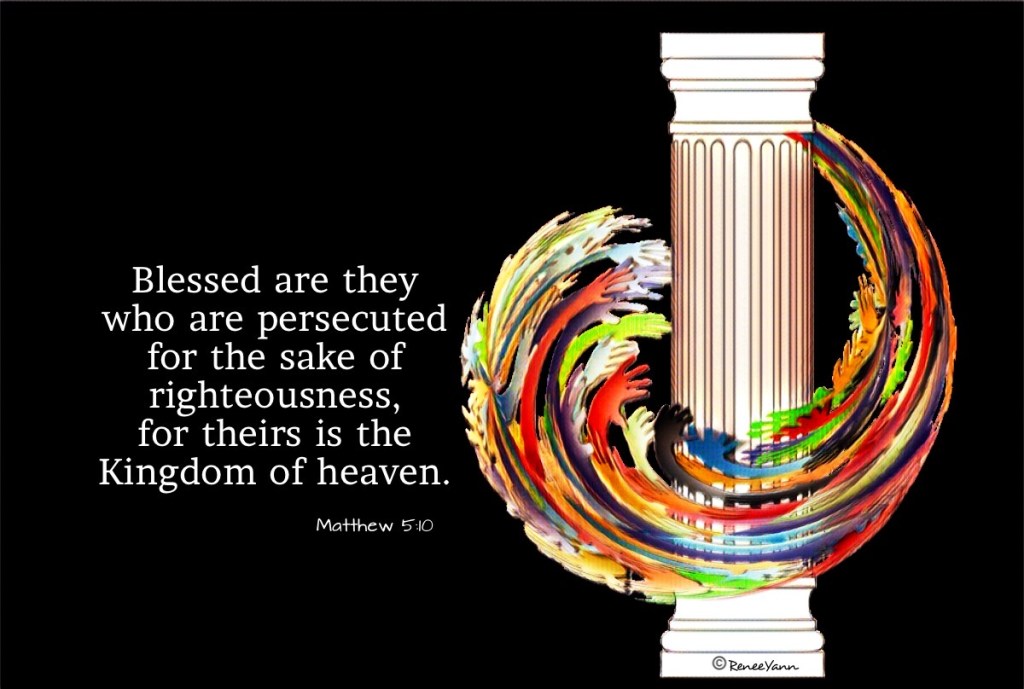
Blessed are they who are persecuted
for the sake of righteousness,
for theirs is the Kingdom of heaven.


Sometimes, the word “righteous” can fall harshly on the mind. Over the years, it has acquired a tinge of Bible-banging fundamentalism. Even in secular culture, a “self-righteous” person is repellent.

But the “righteousness” which is our heritage from both the Hebrew and Christian scriptures is a caring and dynamic discernment born of Wisdom and Mercy. It is a virtue the disciple seeks in imitation of the Beloved.


From Walter Brueggemann’s Theology of the Old Testament:

Israel’s characteristic grammar in speaking of Yahweh, governed by active verbs, regularly insisted that Yahweh is a major player in Israel’s life and in the life of the world. Yahweh’s characteristic presentation in Israel’s rhetoric is that Yahweh acts powerfully, decisively, and transformatively. Yahweh is morally serious and demanding, so that Yahweh is endlessly attentive to distinctions of good and evil, justice and injustice. Indeed, it is palpable power and moral seriousness that distinguish Yahweh from all rival gods, who have no power to act decisively and no capacity for moral distinctions.


In our first reading, we meet this righteous God who is fed up with the people’s dissembling.

When you come in to visit me,
who asks these things of you?
Trample my courts no more!
Bring no more worthless offerings;
your incense is loathsome to me.

Isaiah 1: 12-13

Instead, Isaiah’s God states clearly what makes one righteous:

Put away your misdeeds from before my eyes;
cease doing evil; learn to do good.
Make justice your aim: redress the wronged,
hear the orphan’s plea, defend the widow.

Isaiah 1: 16-17

Jesus tells us that it’s not easy to be such a person. You’re going to suffer for your acts of justice and mercy because we live in a world that honors vengeance and oppression instead. You’re going to be insulted, mocked and ostracized for your righteousness – for your desire to “right-balance” life for all human beings.

Brueggemann tells us that, nevertheless, this is our call:

The purpose of human life, a life of vocation, fellowship, and witness is to attest the truth of God’s solidarity with is, that is in justice, righteousness, compassion, steadfast love, and faithfulness.

Poetry: A Psalm of Life – Henry Wadsworth Longfellow

Anyone with a little interest in English poetry, must have had this poem etched into memory; hence no guesses about Longfellow’s best poem. Such is its evocative eloquence, such is its superior effect on every person regardless of class, religion and nationality that it transcends the boundaries of a mere song, and in the right sense, transforms into a psalm – a path to be followed for glorified and righteous life. Recited at Senate meetings, public gatherings and even at churches, this poem is sometimes speculated to have inspired Longfellow after he had come across a board in a German graveyard. Certainly his greatest, ‘Psalm of Life’ seems to have varied ideas where each quatrain is a guideline in itself. (from classical poets.org)

A Psalm of Life – (1839)
What the Heart of the Young Man Said to the Psalmist

Tell me not, in mournful numbers,
Life is but an empty dream!
For the soul is dead that slumbers,
And things are not what they seem.

Life is real! Life is earnest!
And the grave is not its goal;
Dust thou art, to dust returnest,
Was not spoken of the soul.

Not enjoyment, and not sorrow,
Is our destined end or way;
But to act, that each to-morrow
Find us farther than to-day.

Art is long, and Time is fleeting,
And our hearts, though stout and brave,
Still, like muffled drums, are beating
Funeral marches to the grave.

In the world’s broad field of battle,
In the bivouac of Life,
Be not like dumb, driven cattle!
Be a hero in the strife!

Trust no Future, howe’er pleasant!
Let the dead Past bury its dead!
Act,—act in the living Present!
Heart within, and God o’erhead!

Lives of great men all remind us
We can make our lives sublime,
And, departing, leave behind us
Footprints on the sands of time;

Footprints, that perhaps another,
Sailing o’er life’s solemn main,
A forlorn and shipwrecked brother,
Seeing, shall take heart again.

Let us, then, be up and doing,
With a heart for any fate;
Still achieving, still pursuing,
Learn to labor and to wait.


Music: I just had to offer a beautiful song from the Righteous Brothers on this “righteous” day. 🙂

I believe for every drop of rain that falls
A flower grows
I believe that somewhere in the darkest night
A candle glows
I believe for everyone who goes astray
Someone will come
To show the way
I believe, I believe

I believe above a storm the smallest prayer
Can still be heard
I believe that someone in the great somewhere
Hears every word

Every time I hear a new born baby cry
Or touch a leaf or see the sky
Then I know why, I believe

Alleluia: Heaven’s at Hand

Wednesday of the Fourteenth Week in Ordinary Time
July 6, 2022

Today’s Readings 

https://bible.usccb.org/bible/readings/070622.cfm

Today, in God’s Lavish Mercy, our first reading and Responsorial Psalm encourage us to seek God. 

Sow for yourselves justice,
reap the fruit of piety;
break up for yourselves a new field,
for it is time to seek the LORD …

And our Gospel proclaims that we have already found God through Jesus Christ.

Jesus sent out these Twelve
after instructing them thus,
…. “As you go, make this proclamation:
‘The Kingdom of heaven is at hand.’”


The word “seek” is one we don’t use frequently, except to describe games that hide things from us – “Seek and Find”, “Hide and Seek”. In these games, someone is trying to fool us or outwit us.

But God is not trying to hide from us. Our scriptures are about a whole different kind of seeking. We might think of it like this:

Have you ever opened a kitchen drawer looking for a particular utensil but been unable to find it? You might exclaim aloud, “Where’s that darn corkscrew???!!!”, just as your sister leans in and picks it out of the drawer for you.

It was right there in front of you all the time. You just couldn’t see it — couldn’t put your hand on it.

Jesus tells us it is like that with the Kingdom of Heaven. We may be seeking it with all our effort while all the while it is right at hand. We sometimes fail to see the “touchable grace” in our lives because we throw a camouflage of unawareness or ingratitude over it.

Alleluia, alleluia.
The Kingdom of God is at hand:
repent and believe in the Gospel.


The poet Mary Oliver offers the antidote to that kind of blindness:

Instructions for living a life.
Pay attention.
Be astonished.
Tell about it.

Mary Oliver

Today, let’s pay attention to the wonder of our lives. Let’s seek God’s face in our ordinary circumstances. God is not hiding – we just have to look with the insightful eyes of faith, love, and hope.


Poetry: Rumi

Your task is not 
to seek for love, 
but merely 
to seek and find 
all the barriers 
within yourself 
that you have built 
against it. 

Music: Seek God’s Face – Jules Riding

Alleluia: Hear; Know; Follow

Saturday of the Thirteenth Week in Ordinary Time
July 2, 2022

Today’s Readings

https://bible.usccb.org/bible/readings/070222.cfm

Today, in God’s Lavish Mercy, our Alleluia Verse paints the dynamic picture of Christ’s relationship with those who follow him. With due respect to the ancient “shepherd” image, the verse might speak to us better like this:

Alleluia, alleluia.
My beloved hear my voice, says the Lord;
I know them, and they follow me.


In our readings today, we see the cycle of grace and resistance worked out in the lives of the ancients. Our passage from Amos talks about the full restoration of Israel to a place in God’s favor. Our Gospel shows that those with closed hearts cannot receive the lavish mercy of God given to us in the gift of Jesus.

What about us? Can we open ourselves to that powerful grace? Can we respond in reciprocity to this Divine invitation:

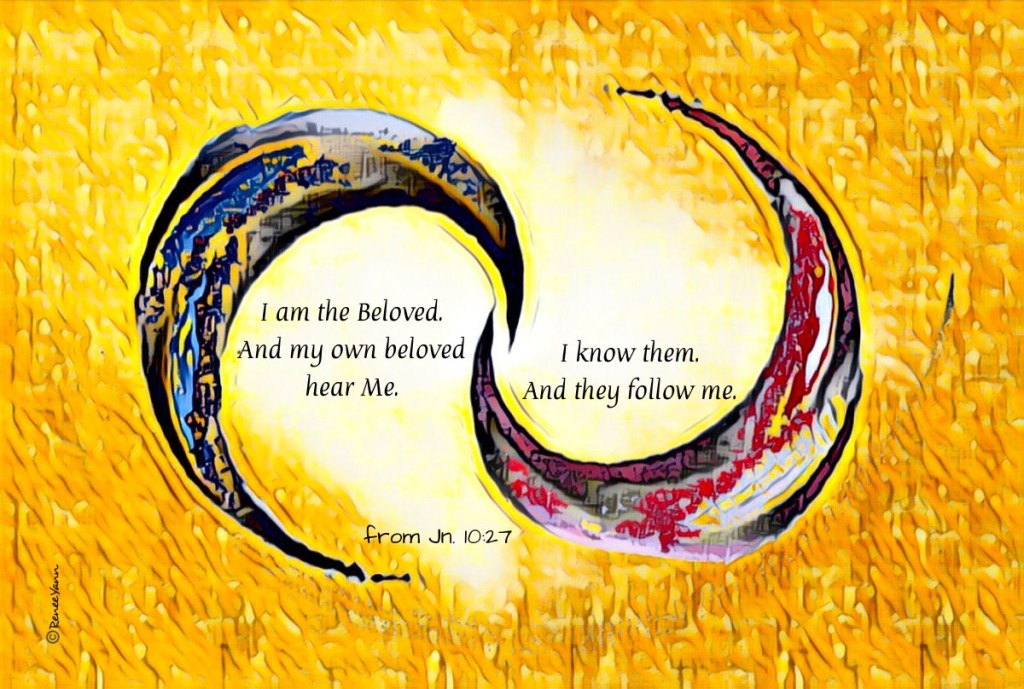
I am the Beloved. 
And my own beloved hear Me.
I know them.
And they follow me.


Poetry: TO LIVE WITH THE SPIRIT – Jessica Powers

To live with the Spirit of God is to be a listener.
It is to keep the vigil of mystery,
earthless and still.
One leans to catch the stirring of the Spirit,
strange as the wind’s will.

The soul that walks where the wind of the Spirit blows
turns like a wandering weather-vane toward love.
It may lament like Job or Jeremiah,
echo the wounded hart, the mateless dove.
It may rejoice in spaciousness of meadow
that emulates the freedom of the sky.

Always it walks in waylessness, unknowing;
it has cast down forever from its hand
the compass of the whither and the why.

To live with the Spirit of God is to be a lover.
It is becoming love, and like to Him
toward Whom we strain with metaphors of creatures:
fire-sweep and water-rush and the wind’s whim.
The soul is all activity, all silence;
and though it surges Godward to its goal,
it holds, as moving earth holds sleeping noonday,
the peace that is the listening of the soul.


Music: Path of Joy – Daniel Kobialka

Alleluia: Come to Me

Friday of the Thirteenth Week in Ordinary Time
July 1, 2022

Today’s Readings: 

https://bible.usccb.org/bible/readings/070122.cfm

Today, in God’s Lavish Mercy, our readings revolve around a theme of taxes, measures, weights, scales – those instruments that may be misused to unduly burden others.

We will diminish the containers for measuring,
add to the weights,
and fix our scales for cheating!

Amos 8:5

Our Gospel illustrates the mental instruments we use to measure, and sometimes condemn others – judgement, prejudice, stereotyping.

The Pharisees said to Jesus’s disciples,
“Why does your teacher eat with tax collectors and sinners?”

Matthew 9:11

There are all kinds of ways we can lay heavy burdens on ourselves and others. Our Alleluia Verse invites us to freedom from such burdens:

Alleluia, alleluia.
Come to me, all you who labor and are burdened,
and I will give you rest, says the Lord.

Does this mean that God will remove such burdens from our lives? No. We know better than that don’t we. 🙂

Trusting our lives to God does not change our burdens. It changes us. 

That change – that unburdening grace – allows us spiritual freedom even in the midst of challenges and trials.

Our hope, confidence, freedom and peace rests in God. Nothing can shake that foundation.


Poetry: Edwina Gateley – Let Your God Love You

Be silent.
Be still.
Alone.
Empty
Before your God.
Say nothing.
Ask nothing.
Be silent.
Be still.
Let your God look upon you.
That is all.
God knows.
God understands.
God loves you
With an enormous love,
And only wants
To look upon you
With that love.
Quiet.
Still.
Be.

Let your God—
Love you.


Music: Come to Me – Gregory Norbet

Lyrics

Come to me, all who labor and are heavy burdened
And I shall give you rest
Take up my yoke and learn from me
For I am meek and humble of heart
And you'll find rest for your souls
Yes, my yoke is easy and my burden is light.

You, God, are my shepherd, I shall never be in need
Fresh and green are the meadows where you give me rest

Come to me, all who labor and are heavy burdened
And I shall give you rest
Take up my yoke and learn from me
For I am meek and humble of heart
And you'll find rest for your souls
Yes, my yoke is easy and my burden is light

Pursue me, o God, with your fathomless love
In your tent let me dwell all the days of my life

Come to me, all who labor and are heavy burdened
And I shall give you rest
Take up my yoke and learn from me
For I am meek and humble of heart
And you'll find rest for your souls
Yes, my yoke is easy and my burden is light

Alleluia: Saints for the Ages

Solemnity of Saints Peter and Paul
Wednesday, June 29, 2022

Today’s Readings:

https://bible.usccb.org/bible/readings/062922-day.cfm

Alleluia, alleluia.
You are Peter and upon this rock I will build my Church,
and the gates of the netherworld shall not prevail against it.


I, Paul, am already being poured out like a libation,
and the time of my departure is at hand.
I have competed well; I have finished the race;
I have kept the faith.


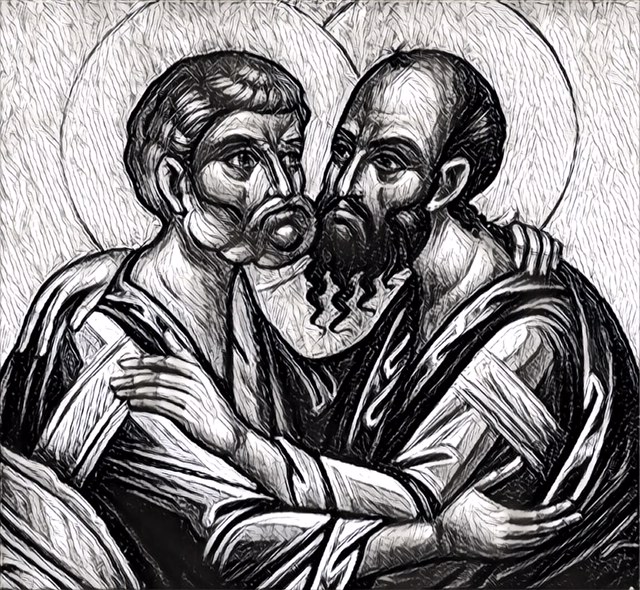
Today, in God’s Lavish Mercy, we celebrate the great Apostles Peter and Paul. The stories of these men embody all the hills and valleys of a Christian life, albeit to majestic scale: call, conversion of heart, ministry, miracles, sacrifice, suffering, failure and glory.

Every human being passes through these hills and valleys. Why do some emerge as saints for the ages and others not? 

Today’s readings would suggest this answer: they believed, and submitted their hearts to God’s unimaginable grace and power. Through that faith, they ultimately were led to the heights of holiness and carried the rest of us believers with them.

Paul says, 

“The Lord stood by me and gave me strength,
so that through me the proclamation of the Word
might be completed.”

When Jesus asks Peter what he believes, Peter says,

“You are the Christ, the Son of the living God.”

Ordinary men responding with a clear and extraordinary faith. May their lives and legacies bless and teach us.


Poetry: Two wonderful sonnets from Malcolm Guite

If you love Malcolm Guite’s poetry as much as I do, you might enjoy his blog found at this link:


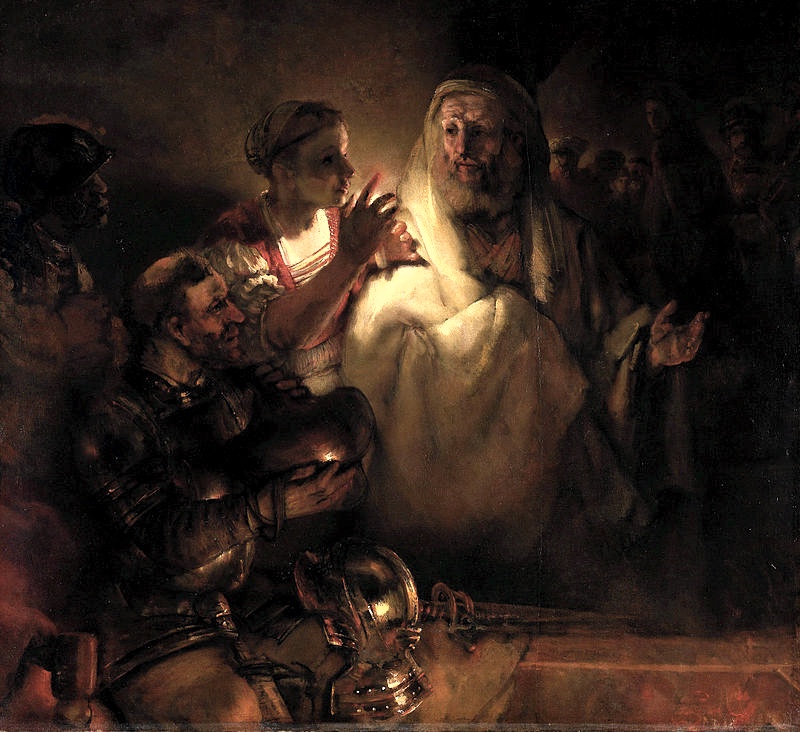
Peter Denies Christ – Rembrandt

St. Peter

Impulsive master of misunderstanding
You comfort me with all your big mistakes;
Jumping the ship before you make the landing,
Placing the bet before you know the stakes.
I love the way you step out without knowing,
The way you sometimes speak before you think,
The way your broken faith is always growing,
The way he holds you even when you sink.
Born to a world that always tried to shame you,
Your shaky ego vulnerable to shame,
I love the way that Jesus chose to name you,
Before you knew how to deserve that name.
And in the end your Saviour let you prove
That each denial is undone by love.

Apostle

Caravaggio’s Conversion of Saul
An enemy whom God has made a friend,
A righteous man discounting righteousness,
Last to believe and first for God to send,
He found the fountain in the wilderness.
Thrown to the ground and raised at the same moment,
A prisoner who set his captors free,
A naked man with love his only garment,
A blinded man who helped the world to see,
A Jew who had been perfect in the law,
Blesses the flesh of every other race
And helps them see what the apostles saw;
The glory of the lord in Jesus’ face.
Strong in his weakness, joyful in his pains,
And bound by love, he freed us from our chains.

Music: Nunc scio vere (Now I am sure…) – Introit from today’s liturgy

Alleluia: Speak, Lord!

Thirteenth Sunday in Ordinary Time
June 26, 2022

Today’s Readings

https://bible.usccb.org/bible/readings/062622.cfm

Today, in God’s Lavish Mercy, our Alleluia Verse suggests an amazing consideration- that the Almighty God responds to our human invitation!

Alleluia, alleluia.
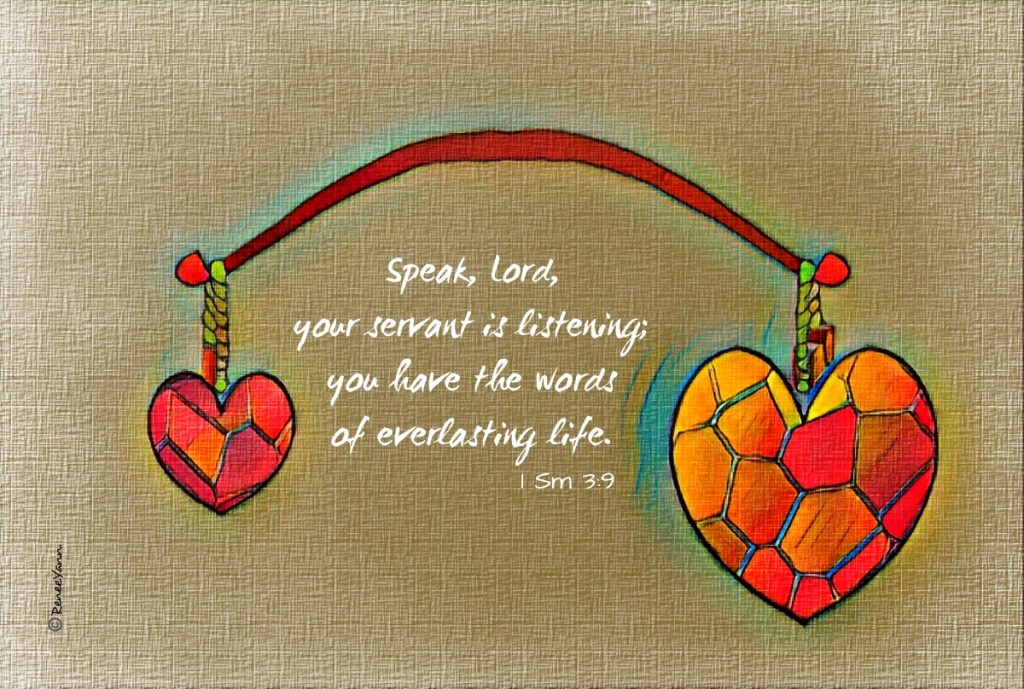
Speak, Lord, your servant is listening;
you have the words of everlasting life.

1 Sm 3:9; Jn 6:68


This humble, hopeful prayer encapsulates themes from each of today’s readings which all use the symbol of a yoke to illustrate their message.

Elisha, and the listeners to both Paul and Jesus understand what a yoke does. It ties the beast of burden to its task. It also ties the one who holds the reins and plow handle.

Although the symbols of ploughing and yoke may be less familiar to us, our readings instruct us that to truly hear God’s voice in our lives we must have a deep freedom from anything that burdens our spirits. How do we do that while living normal human lives with responsibilities, worries and frustrations?

Our verse today might offer us an answer. It all depends on how we perceive our daily lives. 

Speak, Lord, your servant is listening;
you have the words of everlasting life.

Do we see our life only for itself with all the burdens it might put on us? Or do we see it as the sacred unfolding of an infinitely deeper life – everlasting life?

  • Elisha’s life was so much more than the field he had to plow that day!
  • The Galatians lives were so much more than the “biting” arguments that plagued them that day!
  • Jesus’s invitation to follow him is to so much more than the surface concerns of our lives.

Our life in Christ is a call to live in the deep stream of grace – to live “everlasting life” even within the limits of time’s circumstances.

Doing so changes us. It breaks the yoke that constricts our vision, our hope, our capacity for mercy. It allows us to invite God to speak and to hear God’s voice in our ordinary day. It strengthens us to live with extraordinary love and “everlasting “ grace.

Poetry: from T.S.Eliot’s Ash Wednesday 

I have taken a few lines from this long poem of Eliot’s. He wrote it in his later years. He expresses his continuing struggle with living a deep faith. After the excerpt, there is a link to the entire poem. I find Eliot not to be an easy poet, but oh is he ever worth the effort!

If the lost word is lost, if the spent word is spent

If the unheard, unspoken

Word is unspoken, unheard;

Still is the unspoken word, the Word unheard,

The Word without a word, the Word within

The world and for the world;

And the light shone in darkness and

Against the Word the unstilled world still whirled

About the centre of the silent Word.

O my people, what have I done unto thee.

Where shall the word be found, where will the word

Resound? Not here, there is not enough silence

Not on the sea or on the islands, not

On the mainland, in the desert or the rain land,

For those who walk in darkness

Both in the day time and in the night time

The right time and the right place are not here

No place of grace for those who avoid the face

No time to rejoice for those who walk among noise and deny

the voice

Will the veiled sister pray for

Those who walk in darkness, who chose thee and oppose thee,

Those who are torn on the horn between season and season,

time and time, between

Hour and hour, word and word, power and power, those who wait

In darkness? Will the veiled sister pray

For children at the gate

Who will not go away and cannot pray:

Pray for those who chose and oppose

O my people, what have I done unto thee.

Will the veiled sister between the slender

Yew trees pray for those who offend her

And are terrified and cannot surrender

And affirm before the world and deny between the rocks

In the last desert before the last blue rocks

The desert in the garden the garden in the desert

Of drouth, spitting from the mouth the withered apple-seed.

O my people.

http://famouspoetsandpoems.com/poets/t__s__eliot/poems/15133


Music – I Can Hear Your Voice – Jean Watson, Michael W. Smith

Alleluia: God’s Heart for Us

Solemnity of Most Sacred Heart of Jesus
June 24, 2022

Today’s Readings:

https://bible.usccb.org/bible/readings/062422.cfm

Alleluia, alleluia.
Take my yoke upon you, says the Lord,
and learn from me, for I am meek and humble of heart.

Today, in God’s Lavish Mercy, we offer our loving adoration to the Sacred Heart of Jesus Who teaches us the boundless humility of God.

Although not today’s reading, this passage from Philippians captures for me the perfect description of God’s humility in Jesus:

Though Jesus was in the form of God,
he did not count equality with God
a thing to be grasped,
but emptied himself, taking the form of a servant,
being born in human likeness.
And being found in human form
he humbled himself
and became obedient unto death,
even death on a cross.
Therefore God has highly exalted him
and bestowed on him the name
which is above every name,
that at the name of Jesus every knee should bend,
in heaven and on earth and under the earth,
and every tongue confess that Jesus Christ is Lord,
to the glory of God the Creator.

Philippians 2: 6-11

In order to meet our invisible God in prayer, we must imagine God in the ways that most speak to our spirits. For St. Margaret Mary Alacoque that image came in the form of the Sacred Heart, an image which combines both the sacred infinity and the full human heart of Jesus.

Margaret Mary Alacoque (1647 – 1690) was a French Roman Catholic Visitation nun and mystic, who promoted devotion to the Sacred Heart of Jesus in its modern form.

We must never be discouraged or give way to anxiety. . . but ever have recourse to the adorable Heart of Jesus.

Margaret Mary Alacoque

As we pray on this holy feast, may we lean closer and more confidently into the loving heart of Jesus. God loves us enough to do for us what is described in our passage from Philippians. May we fully trust that love and give our own hearts to it.


Poetry: from Rumi in The Masnavi, an extensive poem written in Persian. The Masnavi is one of the most influential works of Sufism, commonly called “the Quran in Persian”. It has been viewed by many commentators as the greatest mystical poem in world literature. The Masnavi is a series of six books of poetry that together amount to around 25,000 verses or 50,000 lines. It is a spiritual text that teaches Sufis how to reach their goal of being truly in love with God.

Open the Window

There’s a street where the Beautiful One
is known to take a stroll.

When a certain radiance is noticed
through the latticed windows
of that neighborhood,

people whisper, The Beloved
must be near.

Listen: open a window to God
and breathe. Delight yourself
with what comes through that opening.

The work of love is to create
a window in the heart,

for the breast is illumined
by the beauty of the Beloved.

Gaze incessantly on that Face!
Listen, this is in your power, my friend!

Find a way to your innermost secret.
Let no other perception distract you.

You, yourself, possess the elixir,
so rub it into your skin,

and by this alchemy
your inner enemies will become friends.

And as you are made beautiful,
the Beautiful One will become your own,
the intimate of your once lonely spirit.


Music: This Ancient Love – Carolyn McDade