Today, in Mercy, we pray with John’s soul-stirring words:
Beloved, we are God’s children …
When I pray these words I think of my mother. As a little child, I already bore a clear physical likeness to her. But as I grew into a young woman, and later an older woman, people remarked that we looked like twins. There were even occasions when we were confused with each other.
This visible resemblance gave me great pride. My mother was strong, courageous, funny, wise, and fiercely loving. I wanted to be like her – made of the same stuff as she was.
In our reading today, John tells us that we are made of the very stuff of God – the essence of the Sacred. He suggests that when people look at us they should see God’s features written all over us.
He says that we should see this Divine familial likeness in one another – that we are each imprinted with our Creator’s image.
If we believe John’s words, what tenderness we would bear toward ourselves and others! How could we ever belittle, hate or kill one another? How could we ever do these things to ourselves?
Music: How Can Anyone Ever Tell You – Shaina Knoll
Often, when I think of Christ on the Cross, I can hear God the Mother singing this song to Jesus, reaching from heaven to console Him in His pain.
This morning, we might ask God to sing this song over our wounded world which has so obscured God’s likeness – perhaps to sing it over us if we are in particular pain.
In our heart’s deep forgiveness, we might sing this song over anyone who has hurt us – the meanness coming from their failure to recognize their own beauty.
(PS: Speaking about my mother has inclined me to offer a second post today … a reflection I wrote 10 years ago.I thought some of you might enjoy reading it. You will receive it in a separate mailing.)
Today, in Mercy, we continue to relish John’s eloquent first letter in which he heartily instructs us in the life of Christian love.
John has written this letter out of concern about false teachings that are cropping up in the early Church. Misguided “teachers” are placing distorted interpretations on the pure, original message of the Gospel.
Human beings have never stopped doing that, have we? Down through the centuries, how many heresies and misinterpretations have woven their way into the Gospel’s central, inviolable thread?
Has it happened to our faith? Have we lost the crisp, clear power of our original belief?
John tells us to hold fast to the core teaching of the Gospel. This is the faith that many of us learned as children from devout parents and teachers. It is a faith that continues to evolve through scriptural prayer and meditation, through openness to theological wisdom, through the holy dialogue of the beloved community.
It is a living faith, stretched and tested by our daily choices for true Christian love for all people, especially the poor, sick and marginalized.
Ultimately, it is a faith rooted in the Cross and transformed by the Resurrection.
Over these next few weeks, let us listen carefully to John as he guides us to the depth of that faith.
Music: some gentle meditation music for your prayer with John:
Today, in Mercy,our first reading offers us John’s perfect honesty and simplicity:
Whoever says, “I know him,” but does not keep his commandments
is a liar, and the truth is not in him.
But whoever keeps his word,
the love of God is truly perfected in him. This is the way we may know that we are in union with him:
whoever claims to abide in him ought to walk just as he walked.
Yes, it’s that simple and that hard!
Then, in our Gospel, we meet Simeon who speaks with the holy confidence of a long and well-lived life. His lifelong dream was that he might not die before seeing the Messiah. That dream now fulfilled, Simeon intones one of the most beautiful prayers in Scripture:
Lord, now let your servant go in peace;
your word has been fulfilled:
my own eyes have seen the salvation
which you prepared in the sight of every people,
a light to reveal you to the nations
and the glory of your people Israel.
If we live in the Light, we too will see the Messiah within our life’s experiences. We too will come to our final days confident and blessed by that enduring recognition.
For as John also assures us:
Whoever says he is in the light,
yet hates his brother or sister is still in the darkness. But whoever loves his brother and sister remains in the light …
Let’s pray today for those who are dying, that they may know this kind of peace.
Let us pray for ourselves, that when our time comes, we too may experience this confidence.
Music:Nyne Otpushchayeshi ~Sergei Rachmaninoff (translated Nunc Dimittis, Now Let Your Servant Go). This was sung at Rachmaninoff’s funeral, at his prior request.(For musicians among you, point of interest: Nunc dimittis (Nyne otpushchayeshi), has gained notoriety for its ending in which the low basses must negotiate a descending scale that ends with a low B-flat (the third B-flat below middle C).
Church Slavonic text Ныне отпущаеши раба Твоего,
Владыко, по глаголу Твоему, с миром;
яко видеста очи мои спасение Твое,
еже еси уготовал, пред лицем всех людей,
свет во откровение языков
и славу людей Твоих Израиля
English translation Now let Your servant depart in peace,
Lord, by Your word;
My eyes have seen Your salvation,
Which You have prepared,
In view of all the people,
A light revealed to all tongues
and to the glory of Your people, Israel
Representation of St. Stephen from The Demidoff Altarpiece by Carlo Crivelli, an Italian Renaissance painter of the late fifteenth century. This many-panelled altarpiece or polyptic painted by Crivelli in 1476, sat on the high altar of the church of San Domenico in Ascoli Piceno, east central Italy. It is now in the National Gallery in London, England.
Today, in Mercy, we celebrate the Feast of St. Stephen, first martyr for the Christian faith.
The commemoration and readings are a drastic turn from singing angels and worshiping shepherds.The Liturgy moves quickly from welcoming a cooing baby to weeping at the death of innocence. Why?
One thought might be to keep us practical and focused on what life in Christ truly means.
Stephen, like Jesus, “was filled with grace and power, … working great wonders and signs among the people.” He, as Jesus would, met vicious resistance to his message of love and reconciliation. He, as Jesus would, died a martyr’s death while forgiving his enemies.
The Church turns us to the stark truth for anyone who lets Christ truly be born in their hearts. WE will suffer as Jesus did – as Stephen did. The grace and power of Christ in our life will be met with resistance, or at least indifference.
We may not shed blood but, in Christ, we will die to self. When we act for justice for the poor and mercy for the suffering, we will be politically frustrated and persecuted. When we forgive rather than hate, we will be mocked. Powerful people, like the yet unconverted Saul in today’s second reading, may catalyze our suffering by their determined hard-heartedness.
Our Gospel confirms the painful truth:
“You will be hated by all because of my name,
but whoever endures to the end will be saved.”
Tomorrow, the liturgy picks up the poetic readings from John’s letters. These are delights to the soul.
But for today, it is a hard look, with Stephen, at what Christmas ultimately invites us to.
Music: Gabriel’s Oboe from the movie “The Mission”, played by Henrik Chaim Goldschmidt, principal oboist of The Royal Danish Orchestra in Copenhagen, Denmark.
We can imagine the manger in any way we choose: perhaps a small rest in a cold, wooden barn, or a hard pallet for a soft newborn. I choose this year to imagine it as warm comfort and a circle of love.
Advent has been an unusual journey for me this year. Just two days after it began, I had my right knee replaced. It might not seem like a big deal. Thousands of people have it done every day. But it’s a big deal when it’s your knee.
I knew what to expect from my surgery and healing process. What I didn’t expect is that the time, coincidental with Advent, would take me to a new place in the heart of Jesus.
You see, what I had planned on was my surgeon’s expertise and my own determination. Like Mary and Joseph, I had set out wholeheartedly, knowing where I had to go and why.
But I had taken an inadequate measure of my vulnerability.
I had not considered my need for a compassionate stable owner; for the warm, living breath of other beings, for the wonder of shepherds, or the songs of angels to lift me up to my hopes for wholeness. Still these came to me in the most wonderful ways!
After an unexpected complication, I was welcomed at our nursing facility for a slightly longer stay than planned. It was my stable on a night that turned out chillier and longer than expected.
My sisters, family and friends – both near and far – breathed their comforting prayers over me, day after day. I saw that holy vapor rising even when I struggled through the first nights with pain or uncertainty. One even brought her prayers crocheted into a shawl under whose warmth I sought my healing.
People did all the things for me that I forgot I would be unable to do, all the time assuring me how well I was doing. Nurses, physicians and amazingly compassionate aides lifted me up – literally and figuratively – with hope and encouragement.
We may not think to find a shepherd’s smile or an angel’s song in such ordinary things as a cup of tea, a Payday candy bar, a soothing towelette, a warm pot pie, a vase of flowers, or a pan of kugel.
We may forget to recognize the heavenly host in a phone call, a card, a peek in the door to see what small service is needed.
But this is how God comes to us. This is the real Advent. It isn’t on a calendar.
Good people gave me many gifts through my Advent journey, the greatest of which was this: a crystal recognition of how much we need one another – even in the simplest of ways. No gesture of companionship or compassion is too small to foster the promise of healing and hope.
Nothing is truly born in isolation from love.
Our human fragility can be an uncomfortable companion, or it can be that just and relentless teacher whom we appreciate only after graduation.
I come to this Christmas Eve with a grateful desire to be more aware of the journeys of those beside me; to reach out my hand with prayer, compassion and help – to be a manger for the birth of everyday miracles. This was the enduring gift of this blessed Advent.
As we close this holy season, we each may want to consider the “manger” within us. Warm? Circled in light? Open to Angel songs? What welcome will “Christ in Every Person” find in me? How has God brought me to the moment of Christmas?
“We are celebrating the feast of the Eternal Birth which God the Father has borne and never ceases to bear in all eternity…. But if it takes not place in me, what avails it? Everything lies in this, that it should take place in me.” ~ Meister Eckhart
Music:Emanuel ~ Tim Manion (Lyrics below)
Baby born in a stall,
Long ago now and hard to recall
Cold wind, darkness and sin
Your welcoming from us all.
How can it be true
A world grown so cold now,
How can it be new
Sorrow’s end; God send,
Born now for me and you.
Emanuel, Emanuel,
What are we that you have loved us so well?
A song on high,
A Savior’s night,
Angel host rejoice thy glory to tell.
Lord, lead us to know,
You lay like a beggar so humble and low.
No place for your head, and straw for your bed
The glory of God to show.
Babe on mother’s knee,
Child so soon to be nailed to a tree,
All praise ‘til the end of our days.
O Lord, you have set us free.
Today, in Mercy, our Gospel places us with Jesus, as he descends the mountain after the Transfiguration.
He speaks about two great prophets – Elijah and John the Baptist:
Elijah – the fiery reformer who “turned back hearts” to the day of the Lord
John – who cried out in the desert, “Prepare the way of the Lord!”
These prophets open the door to our final approach to Christmas – our last few days to heed their advice and ready our hearts for the awesome, yet humble, coming of Christ.
Is there anything in my heart that needs to be turned back to God — any energy, dedication or insight that has shifted from God’s Way to my own selfish way?
Is there anything I must prepare so that my life is ready to receive Christ?
These are the questions Elijah and John offer us today..
Music: Prepare the Way, O Zion – Fernando Ortega (Lyrics below)
Prepare the way O Zion
Your Christ is drawing near
Let every hill and valley
A level way appear
Greet One who comes in glory
Foretold in sacred story
Chorus:
O blest is Christ that came
In God’s most holy name
Christ brings God’s rule O Zion
He comes from heaven above
His rule is peace and freedom
And justice truth and love
Lift high your praise resounding
For grace and joy abounding
Fling wide your gates, O Zion
Your Savior’s rule embrace
And tidings of salvation
Proclaim in every place
All lands will bow rejoicing
Their adoration voicing
Today, in Mercy, we celebrate the feast of St. John of the Cross, a great mystic of the 16th century, one of the 36 Doctors of the Church, and an influential Spanish writer.
John, with Teresa of Ávila, founded the Discalced Carmelites. His poetry and prose recount the journey of the soul as it grows more deeply into God.
Much of his poetic writing can surprise, perhaps even shock, with its passionate tone. But John’s love for God is so profound that he uses the symbols of deepest human intimacy to convey his passion.These are the most beautiful images he has to express his total gift of self to the Divine.
Through the darkness of profound personal suffering, John found Light by nurturing this extraordinary spiritual intimacy with God.
John is a perfect inspiration for the Advent journey as we move through darkness to the Light of Christmas.
Many of us will have favorite passages from this prolific and passionate writer.Mine is this:
“In the evening of our lives,
we will judged on love.
Learn, therefore, to love God
as God wishes to be loved.”
Music: John Michael Talbot tries to capture the mysticism of John’s writings.
Today, in Mercy, we begin our journey through Advent.We will be accompanied by the great prophets of the Hebrew Scriptures.We will walk with the saints and sinners of the Gospel. We will be comforted by God’s promises.
We will be in the company of all the Church here on earth and in heaven, as we wait once again for the astounding miracle of Christ’s birth.
Every year we make the journey – some of us for scores of times, some of us just beginning.And every year, we open and stretch our hearts to hope that God will once again transform the world with Grace.
Jeremiah, in today’s first reading, shared such a hope:
The days are coming, says the LORD, when I will fulfill the promise I made to the house of Israel and Judah.
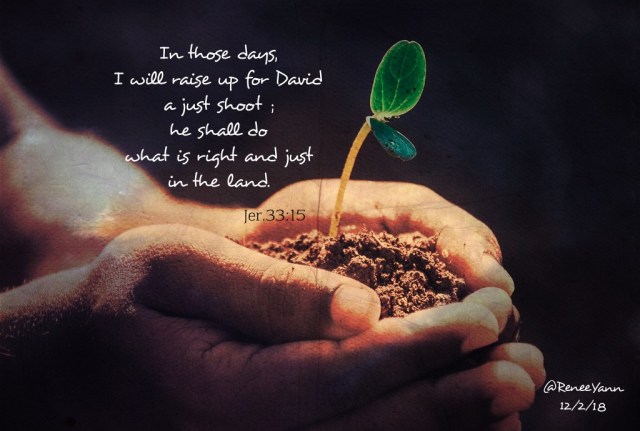
In those days, in that time, I will raise up for David a just shoot ; he shall do what is right and just in the land.
In those days Judah shall be safe and Jerusalem shall dwell secure; this is what they shall call her: “The LORD our justice.”
Change but a few “geographies” in the passage, and we are speaking of our own time. May we who have been blessed with the promise of Christ once again claim it during this Advent.May we engage the grace being offered so that our world – and our own hearts – grow in justice, security and peace.
Music:: Comfort Ye My People from Handel’s Messiah – The English Concert, directed by Trevor Pinnock. Soloist: Kurt Streit
Today, in Mercy, we are struck with Revelation’s images of the end time!
a crowned Christ wielding a sharp sickle
angels commanding the final harvest of the earth
and perhaps the most powerful
the earth’s vintage thrown into the great winepress of God’s fury!
This author could write! We can almost imagine the scene, filmed with all the pyro-technics of today’s computer age.
But besides the amazing imagery, what does the passage say to our hearts?
In Biblical symbolism, the winepress almost always stands for judgment. The passage reminds us that we all will be judged.The divine winepress will compress the sinful gaps that plague our human existence.In the end time, there will be no “other” — no judgmental spaces separating us from one another.We will all be one, like wine mingled.
We will be judged on how we lived that oneness in this life, on where we have stood in the gap between the:
rich and poor
well and sick
citizen and refugee
abled and disabled
powerful and vulnerable
Do we live in ignorance or indifference to those who suffer on the other side of the human scale? Have we been impervious to the imbalances of justice and charity in this world?
And how do we respond? The passage suggests that we do some weeding of our spiritual gardens before the harvest of our souls. The intention of this fiery writer is to tell us that we still have a little time.
Music:The Day Is Surely Drawing Near – written by the prolific 16th century Lutheran hymnist Bartholomaüs Ringwaldt. This piece is a majestic instrumental rendering, but if you would like to see the words, they are below.
1 The day is surely drawing near
When Jesus, God’s anointed,
In all His power shall appear
As judge whom God appointed. Then fright shall banish idle mirth,
And flames on flames shall ravage earth
As Scripture long has warned us.
2 The final trumpet then shall sound
And all the earth be shaken,
And all who rest beneath the ground
Shall from their sleep awaken.
But all who live will in that hour,
By God’s almighty, boundless pow’r,
Be changed at His commanding.
3 The books are opened then to all,
A record truly telling
What each has done, both great and small,
When he on earth was dwelling,
And ev’ry heart be clearly seen,
And all be known as they have been
In thoughts and words and actions.
4 Then woe to those who scorned the Lord
And sought but carnal pleasures,
Who here despised His precious Word
And loved their earthly treasures!
With shame and trembling they will stand
And at the judge’s stern command
To Satan be delivered.
5 My Savior paid the debt I owe
And for my sin was smitten;
Within the Book of Life I know
My name has now been written.
I will not doubt, for I am free,
And Satan cannot threaten me;
There is no condemnation!
6 May Christ our intercessor be
And through His blood and merit
Read from His book that we are free
With all who life inherit.
Then we shall see Him face to face,
With all His saints in that blest place
Which He has purchased for us.
7 O Jesus Christ, do not delay,
But hasten our salvation;
We often tremble on our way
In fear and tribulation.
O hear and grant our fervent plea;
Come, mighty judge, and make us free
From death and ev’ry evil.
Revelation, a very complex book of the Bible, uses symbols, prophecies and allegorical references to make its point. There are huge bodies of scholarship written in the attempt to interpret these passages. Our Gospel has Jesus describing what it will be like in heaven – when our human perceptions will be erased and we will finally be absorbed into God’s understanding.
These are BIG thoughts and my mind, at least, needs some more manageable inspirations for my morning prayer. 😉 So here’s how I prayed with these readings today.
What both passages share are continual references to time – past, present and future. They reference then-time, now-time, and to-be-time. These passages, and others in Scripture like them, talk about time like this:
“in the days before”
“in the days after”
“in the day of”
So what is this day, November 24th, for me? How is God revealing Love to me in this, my time?
Today is still among “the days after” Thanksgiving. The lingering familial and community blessings of Thursday continue to bless my prayer.
However, it is also among “the days before” the next big events of my life. So my prayer includes a petition for new and continued blessings.
And, most importantly, today is “a day of”. I ask God to help me see and receive the graces of this present moment – not to miss them because I am looking only back or forward. Let me look God square in the eye on this day, which is the only place that I can really find the God Who is always Now.
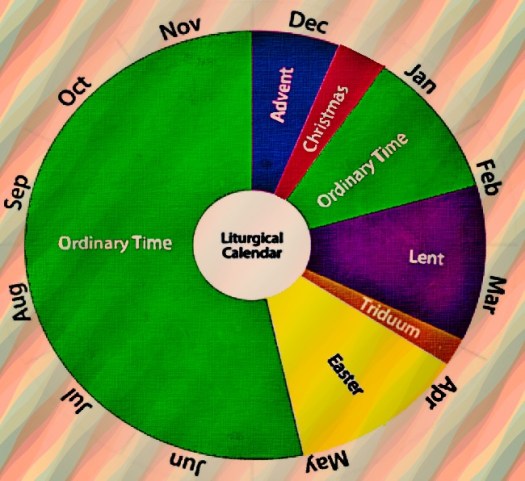
The entire liturgical year is built on this understanding of time.
Advent and Lent are “the days before”, the days of preparation, anticipation, imagining, creating, hoping.
The feasts like Christmas, Easter and Pentecost are “the days of”, days of celebrating, loving, being with.
The various Octaves are “the days after”, days of remembering, thanking, appreciating, understanding, mourning, forgiving and savoring
Where are you today in the times of your life? It may be in a very different place from what is printed on the calendar. The events of our lives create their own personal liturgies. No matter where that happens to be, let us meet God there with full and open hearts.







 Lavish Mercy