
Fifth Sunday of Lent
March 22, 2026
I will keep my covenant with you … to be your God and the God of your descendants after you.
Genesis 17:7
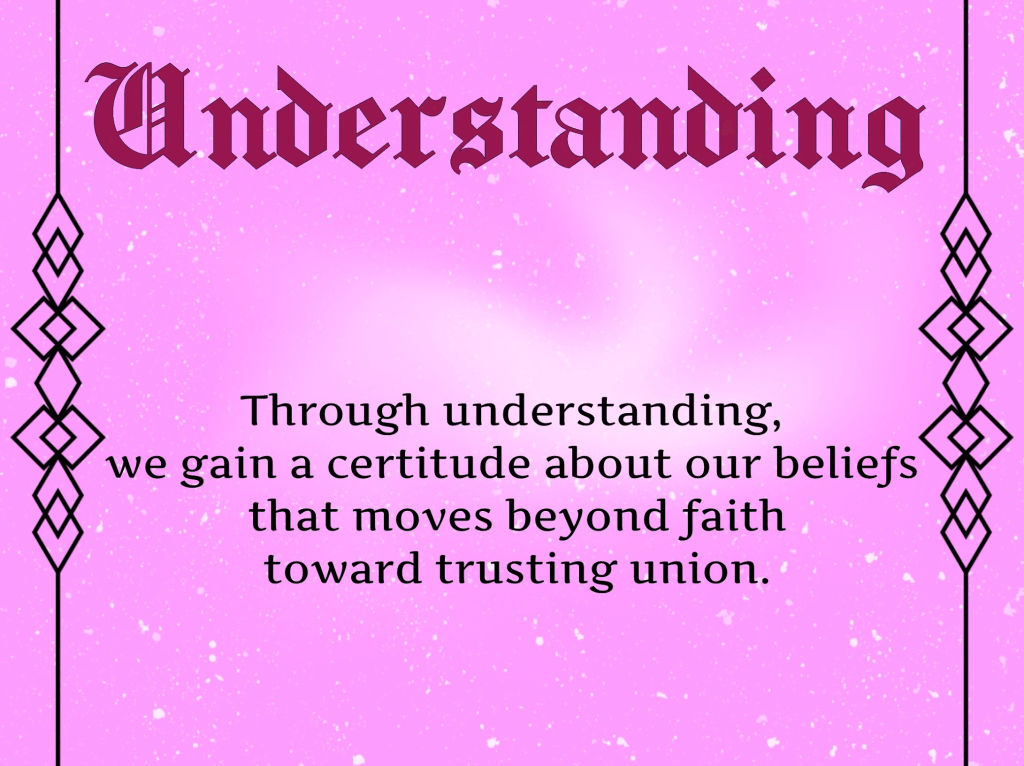
Understanding is a Gift of the Holy Spirit which allows us
to grasp, at least in a limited way,
the essence of the truths of our faith.
Through understanding, we gain a trust in God
that moves beyond circumstances,
enabling us to find meaning and peace in our lives.
The fifth week of Lent is filled with high drama. Impossible things happen at the hand of God: Lazarus comes back from the dead; both innocent Suzanna and the adulterous woman are saved; three men pass unharmed through Nebuchadnezzar’s fire; and Jesus proclaims he is the Son of God. It is a week when the truth of God’s power confronts the security of human conventions. From what symbolic graves is God asking me to rise?
(This story is a repeat for those of you who are familiar with the blog. But I choose to include it again because I love it so much. These two individuals were very precious to me and taught me so much. I hope I have been able to share some of that learning with you, my readers.)
The golden morning had broken bright and warm through the hospital windows. With its breaking, the attending physician and chaplain had received a page. Dorothy had taken an unexpected turn. She was struggling both to live and to die.
As they attended and comforted her, Dorothy managed to whisper,” … wait for Henry.” Henry, her husband of fifty-eight years, had arrived promptly at 7:00 a.m. daily for all the weeks of Dorothy’s hospitalization. Glancing at her watch, the chaplain saw that it was just 6:50 AM.
When, after ten prolonged minutes, Henry appeared at the door, he carried a small bouquet of yellow roses from their beloved garden. Quickly comprehending the changed situation, he laid the roses aside and hurried to hold Dorothy for the last few minutes of her life. In the loving, covenanted presence Dorothy had waited for, she finally embraced a peaceful death.
It had not been easy for Dorothy to die nor, from then on, had it been easy for Henry to live. Still, through many bereavement visits, the chaplain watched their long, honest love arise to heal Henry. Through prayer and the benediction of memories, Henry understood that their love, like the roses still blooming in their garden, was both fragile and perpetual.
In this week’s readings, God again calls us to such a love.
As God brought Lazarus, Suzanna and Shadrack out of darkness and death, so God promises to bring us. “I will keep my covenant with you,” God says. “Whoever keeps my word will never die.”
Accompanying Jesus, as he nears Jerusalem, let us trust and cherish these promises in our own darknesses and bereavements.
Music: Surrexit Dominus
Latin Lyrics & English Translation:
Latin:
Surrexit Dominus vere,
Alleluia, alleluia.
Victimae paschali laudes,
Immolent Christiani.
Mors et vita duello,
Conflixere mirando:
Dux vitae mortuus,
Regnat vivus.
Surrexit Christus spes mea,
Praecedet vos in Galilaeam.
Credamus cum Maria,
Et gaudeamus cum Ecclesia.
English:
The Lord is truly risen,
Alleluia, alleluia.
To the Paschal Victim, let Christians offer praise.
Death and life contended
In wondrous conflict:
The Prince of Life, once slain,
Now lives and reigns.
Christ, my hope, has risen,
He goes before you into Galilee.
Let us believe with Mary,
And rejoice with the Church.
Suggested Scripture: John 11:1-45
For your reflection:
- What feelings or reactions do I have after reading this reflection?
- Do my feelings or reactions remind me of any passage or event in scripture, especially in the life of Christ?
- What actions might I take today because of my response to these readings?





 Lavish Mercy