Athanasius in Spring

Memorial of Saint Athanasius, Bishop and Doctor of the Church
May 2, 2023

Today’s Readings:

https://bible.usccb.org/bible/readings/050223.cfm
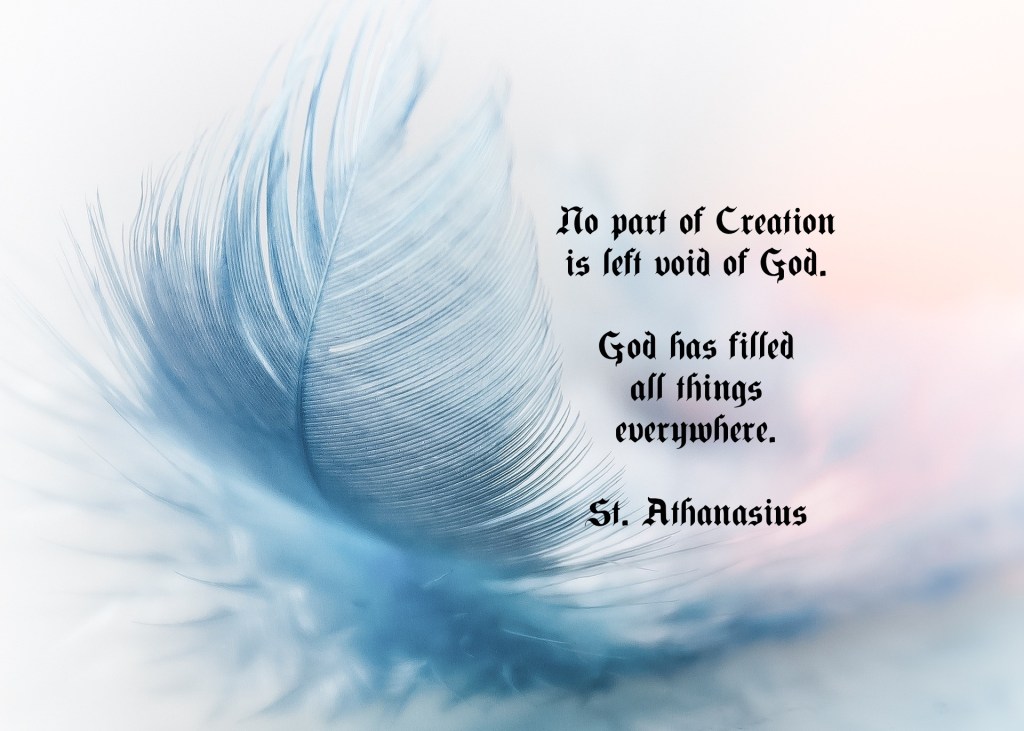
Today, in God’s Lavish Mercy, we celebrate the feast of St. Athanasius, and since our readings repeat themes we have prayed with for a few days, I thought we might focus our prayer today on Athanasius.

Living in 4th century Egypt, Athanasius was a Church Father – one of the ancient and influential Christian theologians and writers who established the intellectual and doctrinal foundations of Christianity. (For insight into the often uncelebrated Church Mothers, see this excellent article: https://www.ncronline.org/news/opinion/simply-spirit/honor-mothers-early-christianity-during-womens-history-month )


During his lifetime, the Church struggled with the heresy of Arianism which questioned whether Jesus was really God. Athanasius was named a Doctor of the Church for his steadfast defense of the doctrine of the divinity of Christ. Some of Athanasius’s writings are suggestive of the theology of our great modern theologians, and so necessary for our spirituality today.

The Self-revealing of the Word
is in every dimension –
above, in creation;
below, in the Incarnation;
in the depth, in Hades;
in the breadth, throughout the world.
All things have been filled
with the knowledge of God.

St. Athanasius

Pierre Teilhard de Chardin, the revered Jesuit theologian of the early 20th century, writes in a tone suggestive of Athanasius:

If we live at a distance from God, the universe remains neutral or hostile to us. But if believe in God, immediately all around us the elements, even the irksome, organize themselves into a friendly whole, ordered to the ultimate success of life.

Pierre de Chardin, SJ in Christianity and Evolution

More recently, beloved Pope Francis teaches with the same sacred appreciation of the “mystical” depths of Creation:

The universe unfolds in God, who fills it completely. Hence, there is a mystical meaning to be found in a leaf, in a mountain trail, in a dewdrop, in a poor person’s face. The ideal is not only to pass from the exterior to the interior to discover the action of God in the soul, but also to discover God in all things.

Pope Francis in Laudato Sí, 84)

As we pray in these early days of May, still drenched in the glory of Easter, may we hear God speaking to us in the infinitely new and ever-evolving power and beauty of all Creation.

The occurrence of chance in the world in its own finite way reflects the infinite creativity of the living God, endless source of fresh possibilities. The indwelling Creator Spirit grounds not only life’s regularities but also the novel occurrences that open up the status quo, igniting what is unexpected, interruptive, genuinely uncontrolled, and unimaginably possible. As boundless love at work in the universe, the Spirit embraces the chanciness of random mutations, being the source not only of order but also of the unexpected breaks in order that ensure freshness. Divine creativity is much more closely allied to the outbreak of novelty than our older order-oriented theology ever imagined

Elizabeth Johnson, CSJ – Distinguished Professor of Theology at Fordham University in her book, Ask the Beasts: Darwin and the God of Love

Poetry: Spring – Mary Oliver

Somewhere
a black bear
has just risen from sleep
and is staring
down the mountain.
All night
in the brisk and shallow restlessness
of early spring
I think of her,
her four black fists
flicking the gravel,
her tongue
like a red fire
touching the grass,
the cold water.
There is only one question:
how to love this world.
I think of her
rising
like a black and leafy ledge
to sharpen her claws against
the silence
of the trees.
Whatever else
my life is
with its poems
and its music
and its glass cities,
it is also this dazzling darkness
coming
down the mountain,
breathing and tasting;
all day I think of her -—
her white teeth,
her wordlessness,
her perfect love.

Music: Spring from The Four Seasons – Antonio Vivaldi

Memorial of Saint Athanasius, Bishop and Doctor of the Church

May 2, 2022

For some info on Athanasius,
click the button below.

Today, in God’s Lavish Mercy, Acts introduces us to Stephen, so filled with the Holy Spirit that “his face was like the face of an angel”.

Acts6_8 Stephen

Stephen is among the first group of Christians designated as deacons “to serve at table” – in other words, to do the administrative tasks that kept the community whole.

However, Stephen’s gifts went well beyond these services. Acts describes him like this:

Stephen, filled with grace and power,
was working great wonders and signs among the people.


For today’s reflection, though, our focus will be John 6 which is the beginning of a week-long journey into the discourse on the Bread of Life (Jn 6:22-71). These passages, going from today until Friday, are like a “faith boot camp” for Jesus’s followers. They contain the core message of who Jesus is and how we are brought into communion with him.


John’s Gospel does not include an account of the Last Supper and institution of the Eucharist. The Bread of Life Discourse is where Jesus proclaims those teachings in John. It is a more detailed instruction and, as we pray with it over the course of the week, we may trace our own past and current awakening in faith.

painting
Limbourg Brothers, Très Riches Heures du duc de Berry, Jesus Feeding the 5,000 Source Wikimedia Commons

Today’s verses offer very basic training. Jesus has just fed 5000 people in the miracle of the loaves and fishes. The crowds, not having a global view of the miracle like we do, are confused. They know they got plenty to eat, but did everybody? They heard many people ate, but they saw only their nearby neighbors. What really happened out on the green field?

Finding Jesus the next day, they are ready for another meal. They’re more interested in matzoh than miracles. Their basic hunger for physical sustenance consumes them. Jesus begins the task of opening their hearts to their deeper hungers and his desire to meet them:

Jesus said,
“You are looking for me
not because you saw signs
but because you ate the loaves and were filled.
Do not work for food that perishes
but for the food that endures for eternal life.”

John 6: 26-27
Jn6_27 food

Praying with today’s Gospel, we might ask ourselves some basic questions about our own faith.

  • When we go looking for God, as these hungry people did, what is it that we are looking for?
  • Do we talk to God only when we need something the way these folks needed another loaf or fish?
  • Jesus is inviting us to Eucharist, to Communion with him. To what degree have we opened our hearts to that invitation by our reflective prayer and acts of mercy?

Jesus’s basic message to his flock today is this:

Don’t be satisfied by a tasty roll, a fat fish,
(or a fancy car, a good job, a comfortable life.)
God made you for much more than these things.
Come to Me and feed your deepest hunger.

Maybe, as we pray, we can ask the question posed at end of today’s Gospel and listen intently to Jesus’s answer:

So they said to him,
“What can we do to accomplish the works of God?”
Jesus answered and said to them,
“This is the work of God, that you believe in the one he sent.”


Poetry: Bread of Life by Malcolm Guite

6: 35 Jesus said to them, ‘I am the bread of life. 
Whoever comes to me will never be hungry, 
and whoever believes in me will never be thirsty.
Where to get bread? An ever-pressing question
That trembles on the lips of anxious mothers,
Bread for their families, bread for all these others;
A whole world on the margin of exhaustion.
And where that hunger has been satisfied
Where to get bread? The question still returns
In our abundance something starves and yearns
We crave fulfillment, crave and are denied.
And then comes One who speaks into our needs
Who opens out the secret hopes we cherish
Whose presence calls our hidden hearts to flourish
Whose words unfold in us like living seeds
Come to me, broken, hungry, incomplete,
I Am the Bread of Life, break Me and eat.

Music: Hungry – Kathryn Scott