Heaven in My Window

Tuesday of the Thirtieth Week in Ordinary Time
October 25, 2022

Today’s Readings:

https://bible.usccb.org/bible/readings/102522.cfm

Edited in Prisma app with Trophy

Today, in God’s Lavish Mercy, Jesus begins a lesson to the disciples by asking a question many of us ask ourselves:

What is the Kingdom of God like?

As he so often does, Jesus uses nature to help his listeners understand the otherwise incomprehensible Love he has come to reveal.

Jesus said, “What is the Kingdom of God like?
To what can I compare it?
It is like a mustard seed that a man took and planted in the garden.
When it was fully grown, it became a large bush
and the birds of the sky dwelt in its branches.”


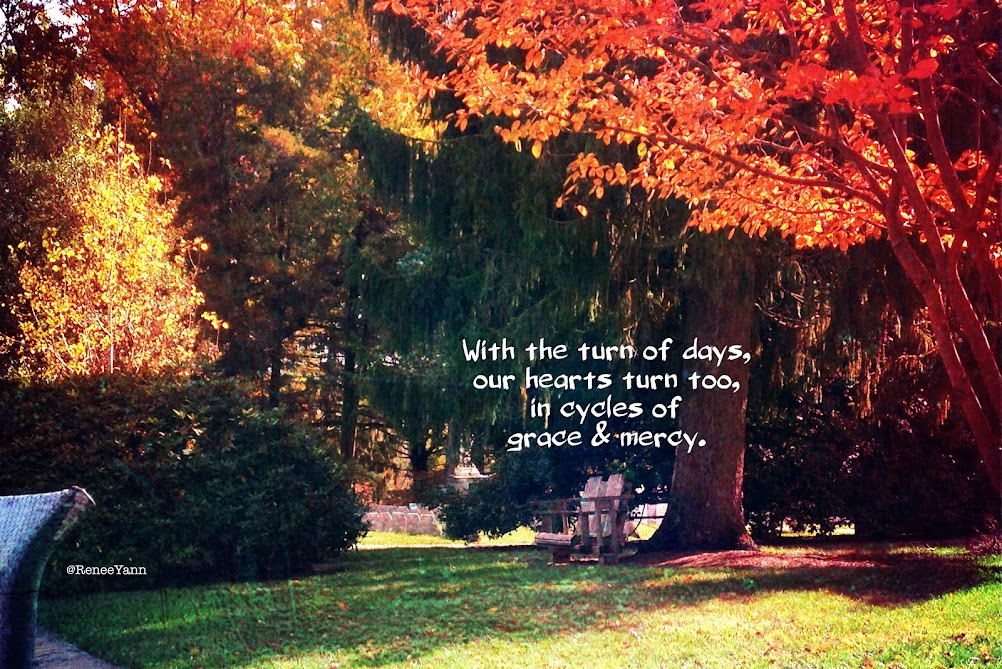
In the northern hemisphere, nature slowly rolls toward winter. The gentle downward path through autumn is lined with glory bursting from the trees and splashed against October’s brilliant blue skies. I think if Jesus were preaching in my front yard today, he might say something like this:

Look at that maple tree! Look at that chestnut! Just as their colors explode in beauty, so God’s love washes over you every moment of your lives. That love is the Kingdom of Heaven — and it is right here within you waiting to be recognized. Let the trees teach you! Let the skies teach you!


Each one of you, dear readers, may be experiencing your own season – either in nature or in your spirit. in Australia, it is spring! Jacarandas and wildflowers blossom across the land as koala and kangaroo joeys begin to venture out of their mothers’ pouches for the first time. In Peru, October spring is a “shoulder season”, slowly moving from its beautiful dry days toward the wet winter.

At the same time, no matter where we live, our hearts may experience their own seasons as our inner world rotates through our life experiences. Still, no matter the season, each displays something of the abiding mystery of God’s love and presence.


Jesus recognized these inner seasons too. Sometimes, like the baker in his lesson, we have to work a little to find the hints of grace around us. She had to take the latent yeast and mix it with the unleavened flour. She had to reach for the graces available to her.

To what shall I compare the Kingdom of God?
It is like yeast that a woman took
and mixed in with three measures of wheat flour
until the whole batch of dough was leavened.

Through our prayer and silent hopeful presence to God, we ready ourselves for the “yeast” of sacred grace. We open our unleavened lives to the wonder of the Kingdom of Heaven already living within us

Perhaps today, we might take a little walk outside — or a stroll through our heart — to appreciate the season we are in, to let it open our spirits to the power of God’s life around and within us. As Mary Oliver describes her contemplative experience:

FOOLISHNESS? NO, IT’S NOT – from A Thousand Mornings by Mary Oliver (2021, Penguin)

Sometimes I spend all day trying to count leaves on a single tree. To do this I have to climb branch by branch and write down the numbers in a little book. So I suppose, from their point of view it’s reasonable that my friends say: what foolishness! She’s got her head in the clouds again!

But it’s not. Of course I have to give up, but by then I am half crazy with the wonder of it – the abundance of the leaves, the quietness of the branches, the hopelessness of my effort. And I am in that delicious and important place, roaring with laughter, full of earth-praise.


Poetry: Autumn Fires – Robert Louis Stevenson

In the other gardens
   And all up in the vale,
From the autumn bonfires
   See the smoke trail!

Pleasant summer over, 
   And all the summer flowers,
The red fire blazes,
   The grey smoke towers.

Sing a song of seasons!
   Something bright in all!
Flowers in the summer,
   Fires in the fall! 


Music: Flowers in October – Tim Janis

Power in Fragility

Memorial of Saints John de Brébeuf and Isaac Jogues, Priests, and Companions, Martyrs
October 19, 2022

Today’s Readings:

https://bible.usccb.org/bible/readings/101922.cfm

Today, in God’s Lavish Mercy,  Paul proclaims his mission to the Gentiles, announcing that through the Gospel, salvation is offered to all people. He says that, by grace, he became a minister of this Gospel – called to preach “the inscrutable riches of Christ”.

Lk12_48 much given

And Paul certainly did an extraordinary job. He had been given much by God, and he gave it back wholeheartedly.

In the Gospel, Jesus talks about that same kind of investment. In answer to Peter’s confusion about the call to be ready for God, Jesus tells the story of wily steward.

This servant had been given much: trust, responsibility, power and probably higher pay. But when the master is away, the trusted servant fails him, acting cruelly and greedily in his own interest.

Jesus ends the story with a pronouncement that has always shaken me a little: 

For unto whomever much is given,
much will be required. 

I know I’ve been given a stunning abundance by God: faith, family, friends and a thousand other graces.  But my will and ability to give back sometimes feels as fragile as a decaying leaf. Ever feel like that?

It turns out that even Paul, great Apostle to the Gentiles, felt that way too. He says so in his letter to the Corinthians. Paul asks God to remove his fragility.

But He said to me,
“My grace is sufficient for you, 
for my power is made perfect in weakness.” 

Let’s pray today to be good stewards of the amazing riches God has given us – in Creation, Faith, Grace and Community. Let us invite God’s power to perfect our weakness, all for the sake of God’s glory.

Even a lacy leaf can be beautiful when it is filled with Light.


Poetry: To Autumn – John Keats

Season of mists and mellow fruitfulness,
  Close bosom-friend of the maturing sun;
Conspiring with him how to load and bless
  With fruit the vines that round the thatch-eves run;
To bend with apples the moss'd cottage-trees,
  And fill all fruit with ripeness to the core;
    To swell the gourd, and plump the hazel shells
  With a sweet kernel; to set budding more,
And still more, later flowers for the bees,
Until they think warm days will never cease,
    For summer has o'er-brimm'd their clammy cells.
Who hath not seen thee oft amid thy store?
  Sometimes whoever seeks abroad may find
Thee sitting careless on a granary floor,
  Thy hair soft-lifted by the winnowing wind;
Or on a half-reap'd furrow sound asleep,
  Drowsed with the fume of poppies, while thy hook
    Spares the next swath and all its twined flowers:
And sometimes like a gleaner thou dost keep 
  Steady thy laden head across a brook;
  Or by a cider-press, with patient look,
    Thou watchest the last oozings, hours by hours.
Where are the songs of Spring? Ay, where are they?
  Think not of them, thou hast thy music too,--
While barred clouds bloom the soft-dying day,
  And touch the stubble-plains with rosy hue;
Then in a wailful choir the small gnats mourn
  Among the river sallows, borne aloft
    Or sinking as the light wind lives or dies;
And full-grown lambs loud bleat from hilly bourn;
  Hedge-crickets sing; and now with treble soft
  The redbreast whistles from a garden-croft,
    And gathering swallows twitter in the skies.

Music: My Grace is Sufficient for You – Keith and Amy Amano 

Autumn Equinox

Wednesday of the Twenty-fifth Week in Ordinary Time

September 22, 2021

Today, in God’s Lavish Mercy, as we mark the Autumn Equinox, we pray with a verse from our Responsorial Psalm:

Bless the Lord, all you chosen ones,
and may all of you praise God’s majesty.
Celebrate days of gladness, 
give God praise.

Tobit 13: 7-8
"EQUINOX"
- the beautiful heft of the word!
Four malleable vowels and
two steely consonants,
softened slightly by a third.
On the fulcrum of a middle "i",
"equ" pushes for balance
against the pressure of "nox",
whose mass bears 
winter's weighted threat.

However we may read the word “equinox”, it spells “change“. Trees put away their lithesome summer greens, like sleeveless tops folded on September’s shelf. Slowly, they wrap themselves within autumn’s deep gold and umber sweaters, trimmed in warm magenta.

We too return to the enterprise of warmth, of fueling fires, of lighting lamps. What nature gave, and we heedlessly received in bright July, is spent. Some chilled memory of solstice motivates us to prepare.


Our hearts too, in synch or out with seasons, cycle through such changes. This inner rhythm of need and abundance is the music through which the Holy Spirit shapes our understanding of God. As in all graceful dances, there must be a yielding. There must be abandon to the mystery into which each passing step dissolves.

God hums the infinite song in our souls, if we will listen. It is deeper than any single note of joy or sorrow. It is the fluid under-beat of Love which recreates and sustains us in every shifting moment of our lives. We belong to it as the waves belong to the Sea, as the leaves belong to the Seasons.


In Philadelphia, it is a glorious day – a perfect vestibule to a season of amazing beauty.  Nature prepares to shed the showy accretions of summer in a multi-colored ritual of leave-taking. It is time to return to the essentials – back to the branch, back to the buried root, back to the bare, sturdy reality that will anchor us in the coming winter.

On each of the coming days, some new layer of green will ignite in a blaze of scarlet or gold then turn out its light for a long winter’s sleep. Nature knows when things are finished.  It knows when it has had enough.  It knows its need for a season of emptying, for a clearing of the clutter, for the deep hibernation of its spirit.


But we humans often ignore the need for an “autumning” of our spirits.  We try to live every moment in the high energy of summer – producing, moving, anticipating, and stuffing our lives with abundance.  

But simplicity, solitude and clarity are necessary for our spirit to renew itself.  Autumn is the perfect time to prayerfully examine the harvest of our lives – reaping the essentials and sifting out the superfluous. In the quiet shade of a crimson maple tree, we may discover what we truly love, deeply believe and really need to be fully happy.

Take time on these crystal days to ask yourself what is really essential in your life.  Nurture those things with attention and care.  Don’t take them for granted.  After the flare of the summer has passed, these are the things that will sustain you: a strong faith, a faithful love and a loving compassion. Tend them in this season of harvest.

Music: Autumn from The Four Seasons by Antonio Vivaldi

Psalm 51: Spring Cleaning

Fifth Sunday of Lent 

March 21, 2021

Today, in God’s Lavish Mercy, we pray with Psalm 51, a psalm to inspire our spring soul-cleaning.

A clean heart create for me, O God,
    and a steadfast spirit renew within me.

Psalm 51:12

Happy Spring to all of you in the northern hemisphere! Blessings of new life and hope!

And for my southern friends already in your Autumn Season, blessings of change and release!


Psalm 51 can speak to our hearts in whatever season we find ourselves.

After our long winters, external or internal, we may call upon God for a fresh budding of our hearts:

Give me back the joy of your salvation,
    and a willing spirit sustain in me.

Psalm 51: 14-15

When bright summer wanes and vibrant trees speak of leave-taking, we may pray to remain in warmth and light:

Cast me not out from your presence,
    and your Holy Spirit take not from me.

Psalm 51: 13

Across our hemispheres, we all share the longings of Lent to be cleared of all that blocks us from Grace in our lives – to have the hidden corners of our small selfishness swept, polished and ready for Loving Mercy:

Have mercy on me, O God, in your goodness;
    in the greatness of your compassion wipe out my offense.
Thoroughly wash me from my guilt
    and of my sin cleanse me.

Psalm 51: 3-4
The Heart Cave

       I must remember
To go down to the heart cave
& sweep it clean; make it warm
with a fire on the hearth,
& candles in their niches,
the pictures on the walls
       glowing with a quiet light.

       I must remember
To go down to the heart cave
       & make the bed
with the quilt from home,
strew
       the rushes on the floor
                                  hang
lavender and sage
                      from the corners.

           I must go down
To the heart cave & be there
           when you come.

- by Geoffrey Brown

Today, as we might take a walk under the nearly budding trees, or over their first fallen leaves, let’s ask God to walk with us:

Lord, you  open my lips;
and my mouth to proclaim your praise.
For you do not desire sacrifice or I would give it;
a burnt offering you would not accept.
What you want of me, O God, is a contrite spirit;
a contrite, humbled heart, O God, you will not scorn.

Psalm 51: 17-19

I open my heart, O God, to your Heart.
Teach me Love.

Poetry: A Spring Poem – Luci Shaw

all the field praises Him/all
dandelions are His glory/gold
and silver/all trilliums unfold
white flames above their trinities
of leaves all wild strawberries
and massed wood violets reflects His skies’ 
clean blue and white
all brambles/all oxeyes
all stalks and stems lift to His light
all young windflower bells
tremble on hair
springs for His air’s
carillon touch/last year’s yarrow (raising
brittle star skeletons) tells
age is not past praising
all small low unknown
unnamed weeds show His impossible greens 
all grasses sing
tone on clear tone
all mosses spread a spring-
soft velvet for His feet
and by all means all leaves/buds/all flowers cup
jewels of fire and ice
holding up
to His kind morning heat
a silver sacrifice
now
make of our hearts a field 
to raise Your praise.

Music: I Come to the Garden Alone – C. Austin Miles

“In the Garden” ( – sometimes rendered by its first line “I Come to the Garden Alone”) is a gospel song written by American songwriter C. Austin Miles (1868–1946), a former pharmacist who served as editor and manager at Hall-Mack publishers for 37 years. According to Miles’ great-granddaughter, the song was written “in a cold, dreary and leaky basement in Pitman, New Jersey that didn’t even have a window in it let alone a view of a garden.” The song was first published in 1912 and popularized during the Billy Sunday evangelistic campaigns of the early twentieth century.
(Source: Wikipedia)