Spirit Set Free

Today, in God’s Lavish Mercy, we have two highly dramatic passages in which a lot of people are annoying one another! If there were an Oscar category for “Best Biblical Drama”, these stories would definitely be nominees!

In our ongoing “David Saga”, the troubled king flees Jerusalem because his own son Absalom is plotting to overthrow him. David, at this point in time, is humbled and not a little wearied by the theatrics of his life. His sins continue to haunt him and wreak a recompense. 

Shimei curses David by Julius Schnorr von Karolsfeld

In today’s passage, we meet Shimei who has his own little miniseries going on in the Bible. Shimei is part of Saul’s family and holds David responsible for Saul’s demise. When meeting David in this passage, Shimei dangerously, and we might say stupidly, sets on him, throwing dirt and stones at the King. David prevents the troops from responding to the wildly outraged man. David even suggests that God may be trying to teach David something in the attack.

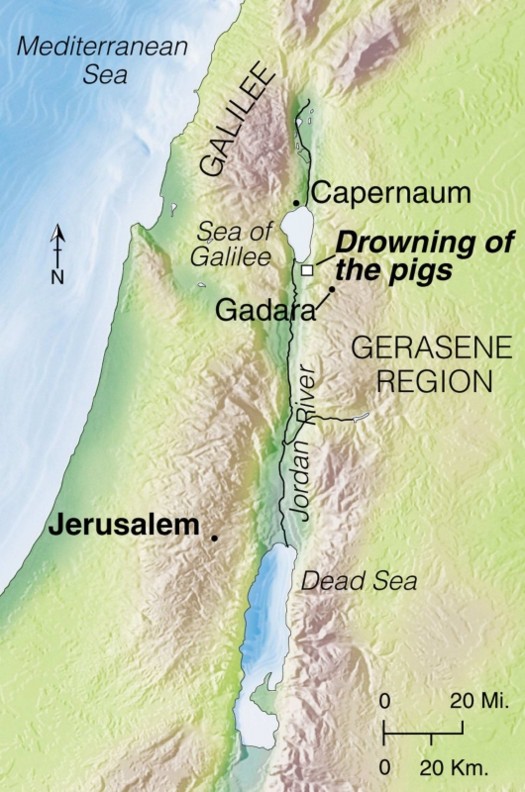
The Demoniac at Gadara

In our Gospel, we meet another wildly outraged man. This one is tormented by his inner demons, causing him also to put himself in dangerous situations. Jesus names this man’s tormentor and casts it out, giving the man control of himself again.


Have you ever been so offended, humiliated or injured that you felt outrage for yourself or another? Such fury chains us, making rationality and reconciliation close to impossible. Sometimes, it renders us impotent to name and address the deep source of our indignation.

Instead, we lash out with stones of anger or passive aggression – throwing the dirt of condemnation rather than seeking inner balance and healing.


Most of us have encountered large or small “dementors” in our life.
(Thanks for the term AND the image, Harry Potter)

But when I think of those who have endured unbelievable degrees of torment, I am amazed at their stories of faith and resolution: Anne Frank, Victor Frankel, Nelson Mandela, Harriet Tubman …. Jesus Christ. How did they come through it whole and blessed?

Maybe the possessed man in Mark’s Gospel was just lucky that day to run into Jesus. Or maybe he sought out Christ, trying to find stability in the midst of his derangement.

When we face our own imbalances can we stay still long enough to ask, as David did, “What is God teaching me in this. How can this lead me closer to God?” If we could, might we not be surprised to see our demons named, cast into the greater sea of God’s eternal wisdom, peace and love?


Poetry: Matthew VIII, 28 Fr. – Richard Wilbur
This poem, spoken by the residents of Gadara or Gerasa, imagines that they are more interested in their commerce than in miracles. They’re pretty disturbed about their pigs too
Rabbi, we Gadarenes
Are not ascetics; we are fond of wealth and possessions.
Love, as You call it, we obviate by means
Of the planned release of aggressions.
We have deep faith in properity.
Soon, it is hoped, we will reach our full potential.
In the light of our gross product, the practice of charity
Is palpably non-essential.
It is true that we go insane;
That for no good reason we are
possessed by devils;
That we suffer, despite the amenities
which obtain
At all but the lowest levels.
We shall not, however, resign
Our trust in the high-heaped table and the full trough.
If You cannot cure us without destroying our swine,
We had rather You shoved off.


Music: Set My Spirit Free – Maranatha Singers

To Save A Life …

Day of Prayer for the Legal Protection of Unborn Children

January 22, 2020

Click here for readings

Today, in Mercy, our first reading is stuff worthy of an action movie! Even today, in my seventh decade, I remember the first time I heard it as a spellbound child. Could young, virtually unarmed David really conquer a GIANT!

Goliath

Wrapped in the story, of course, is the spiritual nugget we are meant to take to our own heart:

…thus the whole land shall learn that Israel has a God.
All this multitude, too,
shall learn that it is not by sword or spear that the LORD saves.
                    For the battle is the LORD’s
       and he shall deliver you into our hands.


We have battles of every description all around us: military, political, economic, cultural, moral, and personal. Today’s Day of Prayer highlights one of those battles – the right to life for unborn children.

On January 22, 1973, the Supreme Court issued a 7–2 decision in favor of Roe that held that women in the United States have a fundamental right to choose whether or not to have abortions without excessive government restriction, and struck down Texas’s abortion ban as unconstitutional. (Wikipedia)

Since that fateful day, many people of faith, and certainly the Catholic Church, have fought this decision. It has been a contentious and divisive battle which has divided people into pro and anti-abortion factions.

From my perspective, one unfortunate dimension of the situation is an insufficient effort by Catholic bishops to provide wholistic definition, research, teaching, and support to Catholics on the moral imperative for the right to life in all its aspects.

Mk3_4_life

Episcopal support for right to life often degenerates into a single-issue approach which fails to instruct on other life issues such as war, death penalty, poverty, adequate health care, civil and women’s rights, and environmental justice.

At the same time, morality statements around these issues often fail to address legitimate concerns around birth control, maternity care, newborn nutritional programs, and other issues parents struggle with.

Probably what most infuriates me is the political hijacking of this single issue by those whose own moral and policy choices mock a comprehensive culture of life.

Benedictine Sister Joan Chittister said this in a 2004 interview:

“I do not believe that just because you are opposed to abortion, that that makes you pro-life. In fact, I think in many cases, your morality is deeply lacking if all you want is a child born but not a child fed, a child educated, a child housed. And why would I think that you don’t? Because you don’t want any tax money to go there. That’s not pro-life. That’s pro-birth. We need a much broader conversation on what the morality of pro-life is.”

Personally, I am deeply opposed to abortion. And I am just as deeply opposed to an inconsistent morality and a policy-making which isolates this issue to the point of stagnating ignorance and indifference on other critical life issues.

A phrase in today’s Gospel struck me as I prayed on these things. Perhaps it will strike you as well:

Jesus said to the Pharisees,
“Is it lawful to do good on the sabbath
rather than to do evil,

to save life rather than to destroy it?

Jesus acknowledges that finding moral perfection requires a balancing of goods, some of which are weightier than others. The Sabbath laws were designed to foster the spiritual life. But if their observance consigns this crippled man to hopelessness, have the laws met their goal?

If indeed a life is saved from abortion, society must continue to save that life by fostering a culture which supports it for ALL of its life..

Music: Hymn of Life – St. Teresa of Calcutta