Little Things Mean a Lot

Memorial of Saint Ignatius of Loyola, Priest
Monday of the Seventeenth Week in Ordinary Time
July 31, 2023

Today’s Readings:

https://bible.usccb.org/bible/readings/073123.cfm
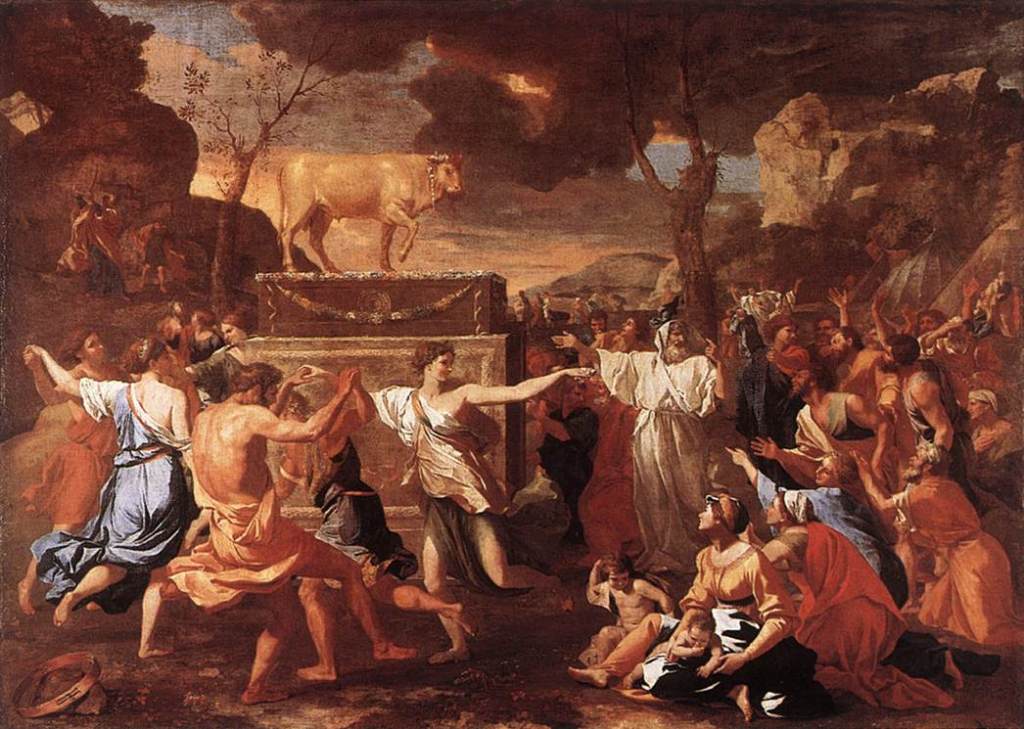

The Adoration of the Golden Calf – Nicholas Poussin

Today, in God’s Lavish Mercy, Aaron, brother of Moses, gets an “F” as a substitute teacher. While Moses is on the mountain negotiating with God for Israel’s future, Aaron caves to the people’s demands and assists them in creating an idol – the infamous “golden calf”.

As Walter Brueggemann says, “All it takes is a little gold to make a god”:

All you need in order to make a god is a measure of the substance that is most valuable in the community, in this case gold…and a mold that can shape the gold. The mold readily available to Aaron is a calf, well, better a “bull” – a symbol and embodiment of virility and fertility, the strength, power, and capacity to generate new life! All you need to make a god is a little gold and a pattern of vitality and fertility that bespeaks self-sufficiency,

Walter Brueggemann – from a Sunday sermon delivered in 2020

Moses was on the mountain for forty days. In his absence, and with God’s silence, the people became frightened. They felt powerless. In that powerlessness, they had a choice: to believe that God would be true to God’s word, or to construct an alternate god of their own design, one that made them feel powerful again. They made the wrong choice.


Praying with this passage today, we might ask ourselves what we do when circumstances render us powerless. What do we do when God seems silent and the supports we have trusted disappear or fail? What do we do when there seems to be no answer to our prayers?

And what is the substance, as Bruegemann notes, most valued in my various communities – the substance most likely to be turned to an idol: reputation, status, resources, influence, political power, physical strength or appearance?

Do we make the mistake of thinking things like this: My power rests in my money, or my looks, or my family name, or my business success, or my intelligence, or my intimidating reputation?

When it comes to the fundamental needs of our lives, none of these things can empower us. Every one of them can fail or disappear. Our only true power lies in God’s unfailing love for us and will for our good. That power is always with us but can be accessed only through faith.


Our Gospel tells us that all one needs is a little faith to ground oneself in the power of God’s love and fidelity..

Jesus proposed a parable to the crowds.
“The Kingdom of heaven is like a mustard seed
that a person took and sowed in a field.
It is the smallest of all the seeds,
yet when full-grown it is the largest of plants.
It becomes a large bush,
and the birds of the sky come and dwell in its branches.”

Matthew 13:31-32

I saw a great graphic on Facebook the other day. It pictured an open hand reaching out with a small speck on the index finger. The caption read:

I have a mustard seed,
and I’m not afraid to use it.


In the absence of a malleable, obeisant god, Israel mistakes their wealth for their god. They mold it into a figure that appears to restore their control over their lives. But they end up with only a clump of unresponsive metal.

God is not a divine butler waiting at the doorway for our next command. The ever-presnt Holy One is sometimes thickly veiled within the circumstances of our lives. It takes faith to stay in relationship with our often silent, but nonetheless abiding God.

Our Gospel tells us that if we have even the smallest seed of that faith, it will root in us and sustain us. And even the smallest measure of “holy yeast” will ferment to the point that others will find in us the inspiration to believe.


Poetry: The Golden Calf by John Newton, (1725 – 1807) who was an English evangelical Anglican cleric and slavery abolitionist. He had previously been a captain of slave ships and an investor in the slave trade. He served as a sailor in the Royal Navy (after forced recruitment) and was himself enslaved for a time in West Africa. He is noted for being author of the hymns Amazing Grace and Glorious Things of Thee Are Spoken.

When Israel heard the fiery law,
From Sinai's top proclaimed;
Their hearts seemed full of holy awe,
Their stubborn spirits tamed.
Yet, as forgetting all they knew,
Ere forty days were past;
With blazing Sinai still in view,
A molten calf they cast.
Yea, Aaron, God's anointed priest,
Who on the mount had been
He durst prepare the idol-beast,
And lead them on to sin.
Lord, what is man! and what are we,
To recompense thee thus!
In their offence our own we see,
Their story points at us.
From Sinai we have heard thee speak,
And from mount Calv'ry too;
And yet to idols oft we seek,
While thou art in our view.
Some golden calf, or golden dream,
Some fancied creature-good,
Presumes to share the heart with him,
Who bought the whole with blood.
Lord, save us from our golden calves,
Our sin with grief we own;
We would no more be thine by halves,
But live to thee alone.

Music: Amazing Grace


Lent: Discerning the Golden Calves

March 31, 2022
Thursday of the Fourth Week of Lent

Today, in God’s Lavish Mercy, we are challenged to assess our true and deepest values.

Our first reading describes a moment when God and Moses are having a nice chat. Suddenly, God makes Moses aware of the fact that his people have gone haywire:

The LORD said to Moses,
“Go down at once to your people
whom you brought out of the land of Egypt,
for they have become depraved.
They have soon turned aside from the way I pointed out to them,
making for themselves a molten calf and worshiping it,
sacrificing to it and crying out,
‘This is your God, O Israel,
who brought you out of the land of Egypt!’

Exodus 32: 7-8

It might seem crazy to us that people would worship a metal statue. But let’s take a look at what that golden calf represents. The idol is a symbol of the Israelite community’s “economy”, what they really deem most important, what they really worship when they think God isn’t looking. When they look upon the idol’s golden reflection, they see themselves mirrored back the way they want to be – rich, powerful, and dominant.

In our society, those desires may not reside in a golden calf – but maybe in a shiny car, a flashy gemstone, a corner office, an elite club membership, an ivy league degree, etc. Does this mean that such things are necessarily wrong! Not really. It means that when these things become our gods, captivating our attention and worship, then we have really lost our soul.

When we begin to believe that such idols make us who we are,
we disconnect from God Who actually makes us who we are.

Further, we disconnect from the human community
which is meant to mirror God’s face to us.

As our Psalm reminds us:
Our fathers made a calf in Horeb
            and adored a molten image;
They exchanged their glory
            for the image of a grass-eating bullock.
They forgot the God who had saved them,
            who had done great deeds in Egypt,
Wondrous deeds in the land of Ham,
            terrible things at the Red Sea.

Psalm 106:19-22

In our Gospel today, Jesus confronts a group of Pharisees and others who have their own sort of “golden calf”. They have turned their religion into a tool to gain power and dominate others. They are no longer open to God and to the message Jesus offers them. They see their fellow humans as “things” to be used for their own advancement:

But you have never heard his voice nor seen his form,
and you do not have his word remaining in you,
because you do not believe in the one whom he has sent.
You search the Scriptures,
because you think you have eternal life through them;
even they testify on my behalf.
But you do not want to come to me to have life.

John 5:37-40

There are serious warnings in our readings today. Perhaps some of them might speak to us personally. And for certain, they speak to us as a society. May we hear God’s voice in whatever way we need to.


Poetry: The Golden Calf – by John Newton

When Israel heard the fiery law,
From Sinai's top proclaimed;
Their hearts seemed full of holy awe,
Their stubborn spirits tamed. 

Yet, as forgetting all they knew,
Ere forty days were past;
With blazing Sinai still in view,
A molten calf they cast. 

Yea, Aaron, God's anointed priest,
Who on the mount had been
He durst prepare the idol-beast,
And lead them on to sin. 

Lord, what is man! and what are we,
To recompense thee thus!
In their offence our own we see,
Their story points at us. 

From Sinai we have heard thee speak,
And from mount Calv'ry too;
And yet to idols oft we seek,
While thou art in our view. 

Some golden calf, or golden dream,
Some fancied creature-good,
Presumes to share the heart with him,
Who bought the whole with blood. 

Lord, save us from our golden calves,
Our sin with grief we own;
We would no more be thine by halves,
But live to thee alone.

Music: Song of the Golden Calf from the opera Faust by Gounod.

The aria is delivered by Mephistopheles who is associated with the Faust legend of an ambitious scholar, based on the historical Johann Georg Faust. In the legend, Faust makes a deal with the Devil at the price of his soul, Mephistopheles acting as the Devil’s agent.

The calf of gold is still standing!
One adulates his power,
From one end of the world to the other end!
To celebrate the infamous idol,
Kings and the people mixed together,
To the somber sound of golden coins,
They dance a wild round
Around his pedestal
Around his pedestal
And Satan leads the dance, etc, etc.

The calf of gold is the victor over the gods!
In its derisory (absurd) glory,
The abject monster insults heaven!
It contemplates, oh weird frenzy!
At his feet the human race,
Hurling itself about, iron in hand,
In blood and in the mire,
Where gleams the burning metal,
And Satan leads the dance,etc.

He Must Increase

Saturday after Epiphany

January 11, 2020

Click here for readings

Today, in Mercy, John talks a lot about sin. But I think he’s talking about more than the itemized laundry list of mistakes we sometimes reckon as sin.

Catholic-Sin300

It all seemed so simple when we were in grade school, didn’t it?
Well, dealing with sinfulness in the world
is a lot more than milk bottles!


John is describing the drenching atmosphere of darkness that falls over a soul turned in on its own gratification. Pope Francis’s quote referenced yesterday captures this atmosphere:

“Jesus, at the Last Supper, does not ask the Father to remove the disciples from the world, but to protect them from the spirit of the world, which is the opposite.” The Holy Father emphasized, that it is, “even worse than committing a sin. It is an atmosphere that renders you unconscious, leads you to a point that you do not know how to recognize good from evil”.

John likens this atmosphere to idol worship:

Children, be on your guard against idols.

Most of us are beyond worshipping golden calves, but we may still be allowing ourselves to be distracted from the centrality of God in our lives.

calf

What are some potential idols that could desensitize our souls to the ravages of evil? Greed, lust, and narcissism rise to the top of the list. Caught in the grasp of these idols, human beings become oblivious to astounding evils such as war, slavery, economic oppression, sexual exploitation, corporate dishonesty, technological dehumanization, and all the other rampant abuses befuddled human beings foist on one another. 

When you see the effects of such evils reported on the evening news, do you sometimes ask yourselves, “How could a person do such things to another human being?” 

What we are seeing is evidence of souls who have died to God’s Presence within their hearts. They are indifferent to the effect of their choices on anyone but themselves.

Jesus came to open our eyes and to free us from the bonds of such sin. As the Presence of God grows in us, so does our awareness of all that is dissonant with that Presence.


We pray with John the Baptist today that we may grow in God and diminish in any selfishness that blinds us to the difference between good and evil in our lives.

Pope Francis tweeted today:

In worship, we learn to reject what should not be worshiped: the god of money, the god of consumerism, the god of pleasure, the god of success, the god of self.


Music:  I Must Decrease – Andrew and Saskia Smith ( Words below.)

God has a sovereign plan for our lives.
We won’t find it within ourselves.
But in seeking His will, His cross,
“Lose your life for My sake,” Jesus says.
Allowing ourselves to be poured out in service for Him,
first we decrease, He must increase.

I must decrease, He must increase.

The whole earth is His footstool. Who am I?
Shall the thing formed say to its Maker,
“Why hast thou made me thus?”
I must decrease, He must increase.

God has a sovereign plan for our lives.
We won’t find it within ourselves.
But in seeking His will, His cross,
“Lose your life for My sake,” Jesus says.
Allowing ourselves to be poured out in service for Him,
first we decrease, He must increase.

Lord, I exist to worship You.

The whole earth is Your footstool.
I am thine, Lord. I exist to worship You.
The whole earth is Your footstool.
I am thine, Lord. I exist to worship You.

Lord, I exist to worship You.
Oh yes, Lord, I exist to worship You.

Idols!

Memorial of Saint Martha

July 29, 2019

Click here for readings

Today, in Mercy, our readings offer us a central question for our faith and spirituality: What do we really worship?

Ex32_19 calf

As we continue the Exodus story, Moses has been on the mountain receiving the Law from God. Meanwhile, back at the ranch, delegated leader Aaron is blowing his assignment. The Israelites tire of waiting for Moses. They want another god to lead them onward. Aaron comes up with idea of fashioning such a idol from all their molten jewelry.

When Moses descends the mountain with the newly-minted tablets in hand, he burns in anger at the scene, smashing the holy stones at his feet. More than a flared temper, this act symbolizes a fractured relationship with God.

The story suggests this for our prayer: we are in ever-deepening relationship with God through our own covenants – our creation, our baptism, our further professions of faith and commitment, our sacramental encounters. These are all living relationships, inviting us to new and deeper life in God.

Still, there may be times in our lives when our hearts lose focus on these covenants 

  • when we try to move somewhere without God’s companionship
  • when we substitute old baubles for moral or spiritual truth
  • when we return to weakening comforts rather than grow into a challenging grace
  • when we just get really mixed up about what is most important in our lives

The calf-worshippers had a big fail in this regard. Exodus tells the story of a merciful God trying to deal with their disloyalty and refashion them as God’s chosen people.

Our Gospel shows us Martha, also a little off target in terms of her spiritual priorities. While she is no where near idol worship, she still allows needless distractions to keep her from fully enjoying relationship with God.

Martha

Gentle, merciful Jesus turns her eyes toward him and she understands. Maybe that beautiful grace is what we want to pray for today.

Music:  You Alone – Sarah Hart