He loved his own in the world and he loved them to the end. The devil had already induced Judas, son of Simon the Iscariot, to hand him over. So, during supper, fully aware that the Father had put everything into his power and that he had come from God and was returning to God, he rose from supper and took off his outer garments. He took a towel and tied it around his waist. Then he poured water into a basin and began to wash the disciples’ feet and dry them with the towel around his waist.
John 13: 1-4
Be there. Feel the astonished silence in the room as Jesus kneels before each of his disciples to wash their feet. Enter their hearts as they begin to realize he is giving them one of the final gifts of his amazing love. Imagine Jesus’ own heart as he washes the feet of each dear friend, knowing the time has come to be parted from them.
Today, in God’s Lavish Mercy:
We let Jesus lean over us and pour the cleansing water of his love over us. We listen to the water, to his hands, to the silence – to hear the call to imitate his humble love in our lives.
Poetry: Morning of Fog – Jessica Powers (Sr. Miriam of the Holy Spirit, OCD)
Between this city of death with its gray face
and the city of life where my thoughts stir wild and free
a day stands. It is a road I trace
too eagerly. For morning can give me nothing but a dull
cold sense of having died. The towers lift
like dreams. Down through the streets the beautiful
gray fogs of sorrow drift. This is a city of phantoms. I am lost
in a place where nothing that beats with life should roam.
Only a spirit chilled into a ghost
could call these streets its home.
I shall go exiled to the fall of night,
until I can return
to the city I love where the streets are washed with light
and the windows burn.
Music: Wash Me, Lord – Harvest
I thought I was so clever Thought I was so wise Surely You could never see Inside this darkness I thought that I had fooled You Now I see I was the fool Thinking that I could hide this darkness In my heart
So wash me, Lord In Your presence Wash me, make me clean There’s a stain in my heart That only You can see Wash me, make me clean
I brought You sacrifices My silver and my gold In my selfishness I tried to buy Your pleasure But Your holiness requires The offering You desire Is that I bring to You A brokеn, humble heart
So break mе, Lord In Your presence Break me, set me free There’s a stain in my heart That only You can see So wash me, Lord In Your presence Wash me, make me clean There’s a stain in my heart That only You can see Wash me, make me clean
Today, in God’s Lavish Mercy, the greatest act of love unfolds around a simple table, in the last rich hues of a Jerusalem sunset. No doubt the Twelve whom we are used to seeing in the paintings, and the many other who had sustained Christ’s journey by their service, sensed that this was an extraordinary Seder.
As you place yourself in the scene, you may wish to be one of the Apostles, or you may be the one who baked bread that would become His Body. You may be the one who decanted the precious wine to be His Blood.
Wherever you are in that ancient, yet living story – and wherever you are tonight, let the ancient awe fill your heart as you hear these astounding words:
Brothers and sisters: I received from the Lord what I also handed on to you, that the Lord Jesus, on the night he was handed over, took bread, and, after he had given thanks, broke it and said, “This is my body that is for you. Do this in remembrance of me.” In the same way also the cup, after supper, saying, “This cup is the new covenant in my blood. Do this, as often as you drink it, in remembrance of me.” For as often as you eat this bread and drink the cup, you proclaim the death of the Lord until he comes.
1 Corinthians 11: 23-26
After the supper, to help us comprehend his incomprehensible Gift, Jesus shows us what Eucharist looks like in everyday practice. It looks like the selfless service of a tender foot washing, the humble bending of our hearts to tend another’s need.
So, during supper, fully aware that the Father had put everything into his power and that he had come from God and was returning to God, he rose from supper and took off his outer garments. He took a towel and tied it around his waist. Then he poured water into a basin and began to wash the disciples’ feet and dry them with the towel around his waist.
….
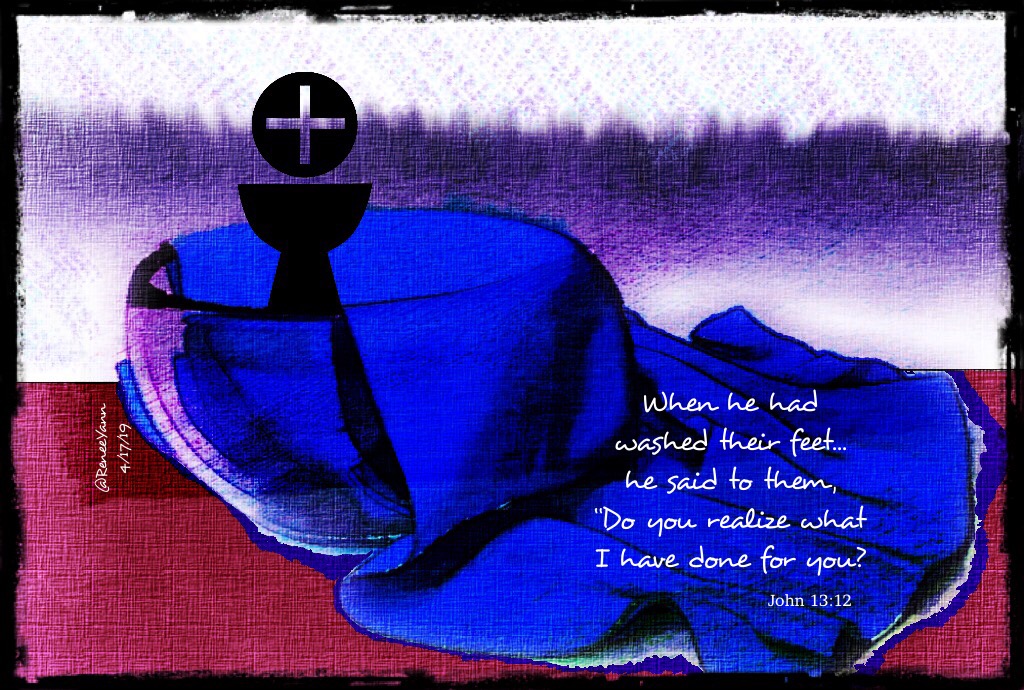
So when he had washed their feet and put his garments back on and reclined at table again, he said to them, “Do you realize what I have done for you? You call me ‘teacher’ and ‘master,’ and rightly so, for indeed I am. If I, therefore, the master and teacher, have washed your feet, you ought to wash one another’s feet. I have given you a model to follow, so that as I have done for you, you should also do.”
Dearest Jesus, teach us the deep, deep lessons of these readings. Let them live in us in sacramental vigor poured over the world in Mercy.
As you walk now from the Upper Room toward the Agony of Gethsemane, let us walk beside you in trusting love.
Poetry: Loves – Scott Cairns is the author of eight books of poetry, including The Theology of Doubt (1985), The Translation of Babel (1990), Philokalia (2002), Idiot Psalms (2014), and Slow Pilgrim: The Collected Poems (2015). Spirituality plays an integral role in Cairns’ writing; in an interview, he said, “I’ve come to think of beauty as how God woos us to himself. One doesn’t so much create it or illuminate it as partake of it. Thereafter, one participates, collaborates, in its endless development.”
One of the more dramatic poems is “Loves.” In the voice of Mary Magdalen it offers a strong critique of the separation of flesh and spirit: “All loves are bodily, require / that the lips part, and press their trace / of secrecy upon the one / beloved . . .
Loves
Of Love’s discrete occasions, we
observe sufficient catalogue,
a likely-sounding lexicon

pronounced so as to implicate
a wealth of difference, where reclines
instead a common element,

itself quite like those elements
partaken at the table served
by Jesus on the night he was

betrayed—like those in that the bread
was breakable, the wine was red
and wet, and met the tongue with bright,

intoxicating sweetness, quite
like ... wine. None of what I write arrives
to compromise that sacrament,

the mystery of spirit graved
in what is commonplace and plain—
the broken, brittle crust, the cup.

Quite otherwise, I choose instead
to bear again the news that each,
each was still itself, substantial

in the simplest sense. By now, you
will have learned of Magdalen, a name
recalled for having won a touch

of favor from the one we call
the son of man, and what you’ve heard
is true enough. I met him first

as, mute, he scribbled in the dust
to shame some village hypocrites
toward leaving me unbloodied,

if ill-disposed to taking up
again a prior circumstance.
I met him in the house of one

who was a Pharisee and not
prepared to suffer quietly
my handling of the master’s feet.

Much later, in the garden when,
having died and risen, he spoke
as to a maid and asked me why

I wept. When, at any meeting
with the Christ, was I not weeping?
For what? I only speculate

—brief inability to speak,
a weak and giddy troubling near
the throat, a wash of gratitude.

And early on, I think, some slight
abiding sense of shame, a sop
I have inferred more recently

to do without. Lush poverty!
I think that this is what I’m called
to say, this mild exhortation

that one should still abide all love’s
embarrassments, and so resist
the new temptation—dangerous,

inexpedient mask—of shame.
And, well, perhaps one other thing:
I have received some little bit

about the glib divisions which
so lately have occurred to you
as right, as necessary, fit

That the body is something less
than honorable, say, in its
... appetites? That the spirit is

something pure, and—if all goes well—
potentially unencumbered
by the body’s bawdy tastes.

This disposition, then, has led
to a banal and pious lack
of charity, and, worse, has led

more than a few to attempt some
soul-preserving severance—harsh
mortifications, manglings, all

manner of ritual excision
lately undertaken to prevent
the body’s claim upon the heart,

or mind, or (blasphemy!) spirit—
whatever name you fix upon
the supposéd bodiless.

I fear that you presume—dissecting
the person unto something less
complex. I think that you forget

you are not Greek. I think that you
forget the very issue which
induced the Christ to take on flesh.

All loves are bodily, require
that the lips part, and press their trace
of secrecy upon the one

beloved—the one, or many, endless
array whose aspects turn to face
the one who calls, the one whose choice

it was one day to lift my own
bruised body from the dust, where, it seems
to me, I must have met my death,

thereafter, this subsequent life
and late disinclination toward
simple reductions in the name

of Jesus, whose image I work
daily to retain. I have kissed
his feet. I have looked long

into the trouble of his face,
and met, in that intersection,
the sacred place—where body

and spirit both abide, both yield,
in mutual obsession. Yes,
if you’ll recall your Hebrew word.

just long enough to glimpse in its
dense figure power to produce
you’ll see as well the damage Greek

has wrought upon your tongue, stolen
from your sense of what is holy,
wholly good, fully animal—
the body which he now prepares.
Music: Tenebrae Music for Holy Thursday – Giovanni Pierluigi da Palestrina (1525-94)
This musical meditation is based on the Lamentations in the Book of Jeremiah. The word “tenebrae” means “shadows”.
Today, in God’s Lavish Mercy, as supper time falls slowly from east to west over the Earth, so will Christians worldwide seek communion with Christ and the believing community.
A great surge of intentional communion will join us in an irrepressible wave of faith. The evening skies will echo with the precious words that, despite whatever distances, gather us into one people in Christ:
Jesus took bread, and, after he had given thanks, broke it and said, “This is my body that is for you. Do this in remembrance of me.” In the same way also the cup, after supper, saying, “This cup is the new covenant in my blood. Do this, as often as you drink it, in remembrance of me.
Our Gospel reminds us that there are two equally significant dimensions to a full understanding of Eucharist:
the Body and Blood we share in Eucharist
the sacrificial service we live daily among the People of God who are the living Body of Christ for us.
In these times of worldly suffering and war, that second dimension sustains us.
Eucharist is offered when we wash the feet of our sisters and brothers:
by those who tend and comfort the sick, poor, war ravaged, and desolate.
by the suffering themselves who endure in faith and hope
by those who serve other’s needs for sustenance and safety
by those who pray for the healing, courage and restoration of all Creation
by each one of us as we turn from self toward the good of the Whole
As Jesus leans to wash the feet of his disciples, so may we lean in service over our suffering world. Jesus asks us:
Do you realize what I, your Lord and Master, have done for you?
We do not realize fully, Lord, what You have done for us.
But we are daily learning a new depth of understanding.
The realization rises like a slow dawn over the shadows of our selfishness. It is a sunrise which continues throughout our lives. Please help us to rise with You no matter how the darkness weighs on us.
Like the fragile bread and fluid wine which hide your Omnipotent Presence, may we become holy nourishment and joy for one another – a true and living memorial to your infinite act of love for us.
Prose Prayer: excerpts from Mass on the World – Pierre Teilhard De Chardin, SJ
Receive, O Lord, this all-embracing host which your whole creation, moved by your magnetism, offers you at this dawn of a new day.
This bread, our toil, is of itself, I know, but an immense fragmentation; this wine, our pain, is no more, I know, than a draught that dissolves. Yet in the very depths of this formless mass you have implanted — and this I am sure of, for I sense it — a desire, irresistible, hallowing, which makes us cry out, believer and unbeliever alike: ‘Lord, make us one.’
You have come down, Lord, into this day which is now beginning. But alas, how infinitely different in degree is your presence for one and another of us in the events which are now preparing and which all of us together will experience! In the very same circumstances which are soon to surround me and my fellow-men you may be present in small measure, in great measure, more and more or not at all. Therefore, Lord, that no poison may harm me this day, no death destroy me, no wine befuddle me, that in every creature I may discover and sense you, I beg you: give me faith.
Music: Pange Lingua – Chant of the Mystics Written by St. Thomas Aquinas in the 13th century English lyrics below
Sing, my tongue, the Saviour’s glory, Of His Flesh, the mystery sing; Of the Blood, all price exceeding, Shed by our Immortal King, Destined, for the world’s redemption, From a noble Womb to spring.
Of a pure and spotless Virgin Born for us on earth below, He, as Man, with man conversing, Stayed, the seeds of truth to sow; Then He closed in solemn order Wondrously His Life of woe.
On the night of that Last Supper, Seated with His chosen band, He, the Paschal Victim eating, First fulfils the Law’s command; Then as Food to all his brethren Gives Himself with His own Hand.
Word-made-Flesh, the bread of nature By His Word to Flesh He turns; Wine into His Blood He changes: What though sense no change discerns. Only be the heart in earnest, Faith her lesson quickly learns.
Down in adoration falling, Lo, the sacred Host we hail, Lo, o’er ancient forms departing Newer rites of grace prevail: Faith for all defects supplying, When the feeble senses fail.
To the Everlasting Father And the Son who comes on high With the Holy Ghost proceeding Forth from each eternally, Be salvation, honor, blessing, Might and endless majesty. Amen.
Today, in God’s Lavish Mercy, we pray with Psalm 116 which Walter Bruggemann calls an example of “the performance of thanks”.
How shall I make a return to the LORD for all the good he has done for me? The cup of salvation I will take up, and I will call upon the name of the LORD.
Psalm 116: 12-13
There is a tone of solemn ritual woven through the psalm, just as there is throughout the Holy Thursday liturgies.
The time of waiting and wondering is over. Jesus chooses the Passover meal to formalize his understanding that the time has come to offer his life in an ultimate sacrifice of praise.
Before the feast of Passover, Jesus knew that his hour had come to pass from this world to the Father. He loved his own in the world and he loved them to the end.
John 13:1
The Last Supper by the nun Plautilla Nelli (1524–1588) of Florence Inscribed: Suor Plautilla · Orate Pro Pictora (Pray for the Paintress)
It is likely that, during his Last Supper, Jesus would have prayed, and possibly sung, Psalm 116 as part of the ancient Hallel, six thanksgiving prayers included in the Passover rites.
On our behalf, Jesus is about to enflesh in his own life the redemptive promise awaited through the ages. He is about to enact the Great Deliverance — far greater than that achieved in the Passover. By the power of his Paschal sacrifice, we are redeemed from death itself:
Return, my soul, to your rest; the LORD has been very good to you. For my soul has been freed from death, my eyes from tears, my feet from stumbling. I shall walk before the LORD in the land of the living
Psalm 116: 7-9
For me, Holy Thursday is the most solemnly beautiful and meaningful day of the Liturgical Year. There is so much to be found in the readings, especially as we peel back single phrases to hear their living power and love. There is so much to be learned at the side of Jesus as we pray with Him.
May we place ourselves beside Jesus at the holy table of his life. Feel him lay the gathering tensions down as he gathers his beloveds in the truth of this moment. It is time for him to give everything over in love. This is the moment of Holy Acquiescence, this is the moment of Eucharist.
With Jesus, let us pray for the loosening of any bonds which prevent us from giving our lives lovingly into God’s Will for us, from allowing Eucharist to be offered through our lives.
Dear to the eyes of the LORD is the death of his faithful ones. I am your servant, the child of your handmaid; you have loosed my bonds. To you will I offer sacrifice of thanksgiving, and I will call upon the name of the LORD. My vows to the LORD I will pay in the presence of all his people.
Psalm 116: 15-18
Prose: from Mass on the World, by Pierre Teilhard de Chardin
Since once again Lord I have neither bread nor wine nor altar,
I will raise myself beyond these symbols
up to the pure majesty of the real itself.
I, your priest, will make the whole earth my altar,
and on it I will offer you
all the labors and the sufferings of the world.
I will place on my paten Lord God
all the harvest to be won from your renewal.
Into my chalice, I shall pour all the sap
which is to be pressed out this day
from the earth’s fruits and from its sufferings.
All the things in the world
to which this day will bring increase;
all those that will diminish;
all those, too, that will die:
all of them, Lord, I try to gather into my arms
so as to hold them out to you in offering.
This is the material of my sacrifice,
the only material you desire.
The restless multitude, confused or orderly,
the immensity of which terrifies us,
this ocean of humanity,
the slow, monotonous wave-flows which trouble the hearts of even those whose faith is most firm.
My paten and my chalice are
the depths of a soul laid widely open
to all the forces which in a moment will rise up
from every corner of the earth
and converge upon the Spirit.
Grant me the remembrance and the mystic presence
of all those whom the light is now awakening to the new day.
Receive, O Lord, this all-embracing Host
which your whole creation, moved by your magnetism,
offers you at this dawn of a new day.Sanctus, Sanctus, Sanctus
Dominus Deus Sabaoth.
Pleni sunt cæli et terra gloria tua.
Hosanna in excelsis.
Music: Sanctus – Jessie Norman
(Get someplace where you can turn the sound up for this and let it blow you away. There are some exquisite soft notes, beginning and end, that you don’t want to miss. Wait for them.)
Today, in Mercy, we celebrate the gift of the Eucharist, infinitely profound in meaning and effect.
The scripture passages for this evening’s liturgy are filled with symbols to help us pray with this profundity:
the Lamb
its exonerating blood on the lintel
the blessing-cup of Psalm 116
the bread
the wine
the towel, basin and water
There is an action connected to each of these symbols which actualizes its meaning:
sacrifice – the Lamb
sign– its exonerating blood on the lintel
lifting– the blessing-cup of Psalm 116
breaking – the bread
pouring– the wine
washing – the towel, basin and water
With his final command in today’s Gospel, Jesus tells us how important action is for those who want to follow him:
I have given you a model to follow, so that as I have done for you,
you should also do.
As we look at our own lives on this Holy Thursday, what symbol and action speak to our hearts?
Is there a sacrifice we are called to make for the sake of goodness in the world?
Are there signsof our faith that we need to make evident?
Do we lift up our praise to God in all aspects of our life?
What needs to be broken and poured for Christ to be fully alive in us?
How are we called to be servant like Him?
On Holy Thursday, Jesus makes it clear that sacrament and service are inextricably tied to each other. As his followers, it is not enough to venerate the symbols. They must be memorialized in our loving actions for one another.
Dear Friends, on this beautiful feast of Christic Love,
let us pray wholeheartedly for one another.
I promise you that in a special way today.
Music: two offerings today
Pange Lingua- traditional Holy Thursday hymn written by St. Thomas Aquinas
Song for Holy Thursday – English rendering of the Pange Lingua




 Lavish Mercy