From this David’s descendants God, according to the promise, has brought to Israel a savior, Jesus. John heralded his coming by proclaiming a baptism of repentance to all the people of Israel; and as John was completing his course, he would say, ‘What do you suppose that I am? I am not he. Behold, one is coming after me; I am not worthy to unfasten the sandals of his feet.’ Acts 13:23-25
John the Baptist was a striking figure written across the pages of scripture. His astonishing lifestyle, his passionate preaching, and his resolute moral witness established him as a giant in human history.
Surely he could have personally profited from his extraordinary gifts and ability to inspire discipleship in his listeners. But instead, this was the Baptist’s message:
Listen people, you ain’t seen nothing yet!
Behold, One is coming after me; I am not worthy to unfasten the sandals of his feet.
Today, in God’s Lavish Mercy:
We ask to be humble, selfless heralds for Christ in our world. May the Gospel impel us to live in such a way that our very being announces God’s Lavish Mercy for the world.
Poetry: John the Baptist – Philip C. Kolin
Out of the wilderness came this prophet of fire and repentance, his voice a flame igniting souls out of darkness to witness the Messiah. Wherever he went bonfires reddened the night air.
He wore a tunic of camel hair, and a rope cincture binding unruly flesh from appetite; he lived on locusts and burr- nested cones. When he entered the Jordan
it flowed east, away from the sin-crusted west. Each wave was engraved with grace as he plunged sinners heavy with the world’s woes under only to lift them up toward the light. But not the Pharisees. Stones would rise sooner.
When he announced Christ passing by, the birds of the air carried each honeyed syllable to every open heart and sin-ridden soul.
Music: Ut queant laxis – Latin Hymn to John the Baptist
1. Ut queant laxis resonáre fibris Mira gestórum fámuli tuórum, Solve pollúti lábii reátum, Sancte Joánnes. 2. Núntius celso véniens Olýmpo Te patri magnum fore nascitúrum, Nomen, et vitae sériem geréndae Ordinae promit. 3. Ille promíssi dúbius supérni, Pérdidit promptae módulos loquélae: Sed reformásti genitus perémptae Organa vocis. 4. Ventris obstrúso récubans cubíli Sénseras Regem thálamo manéntem: Hinc parens nati méritis utérque Abdita pandit. 5. Sit decus Patri, genitaéque Proli et tibi, compare utriúsque virtus, Spíritus semper, Deus unus, omni Témporis aevo. Amen.
O for your spirit, holy John, to chasten Lips sin-polluted, fettered tongues to loosen; So by your children might your deeds of wonder Meetly be chanted.
Lo! a swift herald, from the skies descending, Bears to your father promise of your greatness; How he shall name you, what your future story, Duly revealing.
Scarcely believing message so transcendent, Him for a season power of speech forsaketh, Till, at your wondrous birth, again returneth, Voice to the voiceless.
You, in your mother’s womb all darkly cradled, Knew your great Monarch, biding in His chamber, Whence the two parents, through their offspring’s merits, Mysteries uttered.
Praise to the Father, to the Son begotten, And to the Spirit, equal power possessing, One God whose glory, through the lapse of ages, Ever resounding. Amen.
Today, in God’s Lavish Mercy, we think about John the Baptist. For several days in this middle part of Advent, our Gospel makes reference to John, the Precursor of the Messiah.
John the Baptist by Anton Raphael Mengs
Faithful Jews had an expectation that there would be a Messiah, and that a fiery Precursor would announce him. They identified this forerunner with the prophet Elijah, based on writings like today’s from Sirach:
How awesome are you, Elijah, in your wondrous deeds! Whose glory is equal to yours? You were taken aloft in a whirlwind of fire, in a chariot with fiery horses. You were destined, it is written, in time to come to put an end to wrath before the day of the LORD…
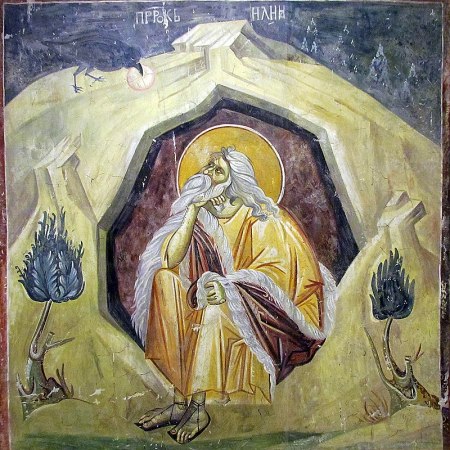
Elijah, a prophet and a miracle worker, Gračanica monastery
In our Gospel, Jesus indicates that John the Baptist is the new Elijah, preparing the way for Jesus’s ministry.
As they were coming down from the mountain, the disciples asked Jesus, “Why do the scribes say that Elijah must come first?” He said in reply, “Elijah will indeed come and restore all things; but I tell you that Elijah has already come, and they did not recognize him but did to him whatever they pleased. So also will the Son of Man suffer at their hands.” Then the disciples understood that he was speaking to them of John the Baptist.
Matthew 17: 9-13
As we pray today with these two greatest prophets, we might examine our own readiness to receive God’s revealing grace in our lives:
What is it in my life that prepares me to receive God in my heart?
What inspires me “prepare the way of the Lord” in the many “worlds” that I touch?
Am I attuned to God’s “announcements”, those quiet inklings that tell me God is trying to make something new in my life?
Jesus says that Elijah “has already come” but has been rejected by the people.
Are there habits and choices in my life that make it hard for God to get through to me?
Maybe God is sending an “Elijah”or “Baptist” my way today. Will I recognize that Precursor? Will I be open to the message?
Poetry: The Cup of Eliyahu – Marge Piercy
Eliyahu is a masculine Hebrew given name and surname of biblical origin. It means “My God is Yahweh” and derives from the prophet Elijah who, according to the Bible, lived during the reign of King Ahab (9th century BC).
In life you had a temper.
Your sarcasm was a whetted knife.
Sometimes you shuddered with fear
but you made yourself act no matter
how few stood with you.
Open the door for Eliyahu
that he may come in.
Now you return to us
in rough times, out of smoke
and dust that swirls blinding us.
You come in vision, you come
in lightning on blackness.
Open the door for Eliyahu
that he may come in.
In every generation you return
speaking what few want to hear
words that burn us, that cut
us loose so we rise and go again
over the sharp rocks upward.
Open the door for Eliyahu
that he may come in.
You come as a wild man,
as a homeless sidewalk orator,
you come as a woman taking the bima,
you come in prayer and song,
you come in a fierce rant.
Open the door for Eliyahu
that she may come in.
Prophecy is not a gift, but
sometimes a curse, Jonah
refusing. It is dangerous
to be right, to be righteous.
To stand against the wall of might.
Open the door for Eliyahu
that he may come in.
There are moments for each
of us when you summon, when
you call the whirlwind, when you
shake us like a rattle: then we
too must become you and rise.
Open the door for Eliyahu
that we may come in.
Music: Days of Elijah – Robin Mark
The commentary in the Worship & Song Leader’s Edition contains a good summary of this hymn’s text: “This is a song of victory and of hope, of God’s triumph forever over death and of Christ’s eternal reign. It also calls believers to stand fast, even in the face of troubles, and to witness to the promised coming of Christ.”
Today, in God’s Lavish Mercy, we honor John the Baptist under the title of his “Passion”. The memorial used to be called “the Beheading of John the Baptist”, a title that more referenced the act of the criminal rather than the perseverance of the martyr.
The Gospel narrative is gripping, as is much of the history of John the Baptist. He was no smoldering wick. Rather, John was on fire with the Truth of the Messiah and he never compromised.
Herod was the one who had John the Baptist arrested and bound in prison on account of Herodias, the wife of his brother Philip, whom he had married. John had said to Herod, “It is not lawful for you to have your brother’s wife.” Herodias harbored a grudge against him and wanted to kill him but was unable to do so.
Mark 6: 17-19
In a commentary on this Gospel, Pope Francis described the central players like this: There are four characters:
King Herod “corrupt and indecisive”
Herodias, the wife of the king’s brother who “knew only how to hate”
Salome, “the vain ballerina”,
the “prophet, decapitated and alone in his cell”.
Pope Francis continued:
John had pointed Jesus out to His first disciples, indicating that He was the Light of the world. He, instead, gave his life little by little, to the point of being extinguished in the darkness of a prison cell. Life has value only when we give it; when it is given in love, in truth; when we give it to others, in daily life, in our families. It should always be given. If someone grasps his or her life in order to keep it, like the king by his corruption, or the woman with her hatred, or the child, the young girl with her vanity that was that of an adolescent, naive, life dies, life ends up withered, it is useless”
Homily of Pope Francis, Santa Marta, 8 February 2019
PopeBenedict XVI also offered some compelling thoughts on the Passion of John the Baptist: “Celebrating the martyrdom of St. John the Baptist also reminds us – Christians in our own times – that we cannot give into compromise when it comes to our love for Christ, for his Word, for his Truth. The Truth is the Truth; there is no compromise. The Christian life requires, as it were, the ‘martyrdom’ of daily fidelity to the Gospel; the courage, that is, to allow Christ to increase in us and to direct our thoughts and actions.”
Francis and Benedict give us plenty to think about as we celebrate this solemn feast. Let us pray for the courage to live our faith wholeheartedly, inspired by the unswerving fidelity of St. John the Baptist.
Poetry: from “Saint John the Baptist” by Thomas Merton
St. John, strong Baptist,
Angel before the face of the Messiah
Desert-dweller, knowing the solitudes that lie
Beyond anxiety and doubt,
Eagle whose flight is higher than our atmosphere
Of hesitation and surmise,
You are the first Cistercian and the greatest Trappist:
Never abandon us, your few but faithful children,
For we remember your amazing life,
Where you laid down for us the form and pattern of
Our love for Christ,
Being so close to Him you were His twin.
Oh buy us, by your intercession, in your mighty heaven,
Not your great name, St. John, or ministry,
But oh, your solitude and death:
And most of all, gain us your great command of graces,
Making our poor hands also fountains full of life and wonder
Spending, in endless rivers, to the universe,
Christ, in secret, and His Father, and His sanctifying Spirit.
Music: Jesu, Joy of Man’s Desiring – J.S. Bach – This beautiful hymn befits John’s great love and devotion to Jesus.
Today, in God’s Lavish Mercy, we celebrate John the Baptist of whom Jesus said, “no man greater has been born of women”.
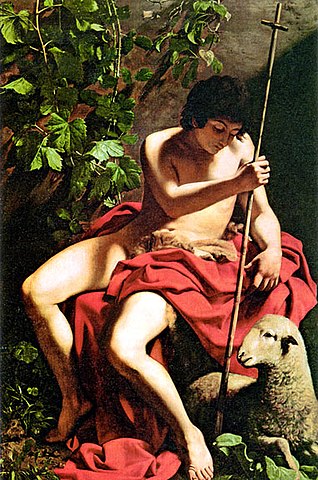
John the Baptist – Caravaggio
Today’s Gospel talks about the surprise conception of John, and all the drama surrounding his birth. Several other Gospel passages tell us about John’s preaching, his challenges to Herod, and his eventual martyrdom at the request of Salome. These are worth a read today, if you have a little time, just to be reacquainted with this extraordinary man.
John the Baptist was the living bridge between the Old Law and the New. He was the doorway from a religion of requirements to a religion of love. That bridge and doorway were built on a baptism of repentance in order to clear one’s heart to receive the Good News.
The magnificent Greek word for repentance is “metanoia” which indicates a turning of one’s mind and heart after realizing a new truth. Metanoia is to have awareness dawn on us, and to feel sorrow for our former blindness or hardness of heart.
May our prayer today help us to receive the grace of metanoia wherever our spirits are hardened or closed – or just plain deadened by routine. May we hear the Baptist calling to us, “Prepare your hearts – EVERYDAY- for the Lord. There is always room for you to be surprised by God.”
Poetry: Song of Zechariah – Irene Zimmerman, OSF
At the circumcision of his son,
relatives and neighbors came
to speak for Zechariah of the tied
tongue. The child, they concurred,
would bear his worthy father’s name.
But during her husband’s silence,
old Elizabeth had found her voice.
“His name will be John,” she said.

Why this strange, unprecedented choice,
the relatives and neighbors wondered.
Armed with writing instrument,
back they went to poor, dumb Zechariah.
But during the long confinement,
as young Mary and Elizabeth
spoke about the missions of their sons,
he had listened and grown wise.
Straightaway, he wrote: “His name is John.”
He caught Elizabeth’s smiling eyes,
felt his old tongue loosen, found his voice,
sang of God’s tender mercy,
sang of the breaking dawn,
sang of the prophet, their son,
who would make straight the way
for the long awaited One.
Music: Ut Queant Laxis ( English translation below)
“Utqueant laxis” or “Hymnus in Ioannem” is a Latin hymn in honor of John the Baptist written in Horatian Sapphics and traditionally attributed to Paulus Diaconus, the eighth-century Lombard historian. It is famous for its part in the history of musical notation, in particular solmization (do-re-mi-fa-so-la-ti-do). The hymn is sung to a Gregorian chant, and introduces the original do-re-mi music.
1. O for your spirit, holy John, to chasten Lips sin-polluted, fettered tongues to loosen; So by your children might your deeds of wonder Meetly be chanted.
2. Lo! a swift herald, from the skies descending, Bears to your father promise of your greatness; How he shall name you, what your future story, Duly revealing.
3. Scarcely believing message so transcendent, Him for a season power of speech forsaketh, Till, at your wondrous birth, again returneth, Voice to the voiceless.
4. You, in your mother’s womb all darkly cradled, Knew your great Monarch, biding in His chamber, Whence the two parents, through their offspring’s merits, Mysteries uttered.
5. Praise to the Father, to the Son begotten, And to the Spirit, equal power possessing, One God whose glory, through the lapse of ages, Ever resounding. Amen.
Today, in God’s Lavish Mercy, our Gospel places us with Jesus, as he descends the mountain after the Transfiguration.
He speaks about two great prophets – Elijah and John the Baptist:
Elijah – the fiery reformer who “turned back hearts” to the day of the Lord
John – who cried out in the desert, “Prepare the way of the Lord!”
In those days, like a fire there appeared the prophet Elijah whose words were as a flaming furnace. Their staff of bread he shattered, in his zeal he reduced them to straits; By the Lord’s word he shut up the heavens and three times brought down fire. How awesome are you, Elijah, in your wondrous deeds!
Sirach 48:1-4
Jesus said, “Elijah will indeed come and restore all things; but I tell you that Elijah has already come, and they did not recognize him but did to him whatever they pleased. So also will the Son of Man suffer at their hands.” Then the disciples understood that he was speaking to them of John the Baptist.
Matthew 17:10-13
These prophets open the door to our final approach to Christmas – our last few days to heed their advice and ready our hearts for the awesome, yet humble, coming of Christ.
Is there anything in my heart that needs to be turned back to God — any energy, dedication or insight that has shifted from God’s Way to my own selfish way?
Is there anything I must prepare so that my life is ready to receive Christ?
These are the questions Elijah and John offer us today…
Poetry: john – Lucille Clifton – (1936 – 2010), a winner of the National Book Award for Poetry, was discovered as a poet by Langston Hughes. Hughes published Clifton’s poetry in his highly influential anthology, The Poetry of the Negro (1970). A prolific and widely respected poet, Lucille Clifton’s work emphasizes endurance and strength through adversity, focusing particularly on African-American experience and family life.
somebody coming in blackness
like a star
and the world be a great bush
on his head
and his eyes be fire
in the city
and his mouth be true as time

he be calling the people brother
even in the prison
even in the jail

i’m just only a baptist preacher
somebody bigger than me coming
in blackness like a star
Music: Prepare the Way, O Zion – Fernando Ortega (Lyrics below)
Prepare the way O Zion Your Christ is drawing near Let every hill and valley A level way appear Greet One who comes in glory Foretold in sacred story
Chorus: O blest is Christ that came In God’s most holy name Christ brings God’s rule O Zion He comes from heaven above His rule is peace and freedom And justice truth and love Lift high your praise resounding For grace and joy abounding
Fling wide your gates, O Zion Your Savior’s rule embrace And tidings of salvation Proclaim in every place All lands will bow rejoicing Their adoration voicing
Alleluia, alleluia. Blessed are they who are persecuted for the sake of righteousness for theirs is the Kingdom of heaven.
( Dear Friends, I have just come home from the funeral of one of our Sisters – a beloved, holy, humble human being – full of love, generosity and joy. I would love to offer today’s reflection based on the power of her Home-Going Ceremony. But I need more time to let that brew in my heart. So, since I am running quite late, I am offering an edited reflection from two years ago for today’s reflection. But, trust me, you will be hearing soon about the miracle of Sister Margery Lowry.)
Today, in God’s Lavish Mercy, Jeremiah and John the Baptist are living out the meaning.of Psalm 69.
Each of these great prophets has been ensnared by the civic evil of their times, personified in Old Testament princes and New Testament Herod and Herodias. The power structure surrounding each prophet stood in direct contradiction to their witness to God’s Word. Those structures, when confronted with a sacred truth, tried to overwhelm the messenger, like quicksand swallows an innocent traveler.
Rescue me out of the mire; may I not sink! may I be rescued from my foes, and from the watery depths. Let not the flood-waters overwhelm me, nor the abyss swallow me up, nor the pit close its mouth over me.
Psalm 69 raises to our prayer the reality that such struggles continue in our time. We live in a wonderful but still sinful world where every person decides, everyday, where he or she will stand in the contest between good and evil.
The decision is sometimes very clear. At other times, the waters are so muddied with lies, propaganda, greed, fear, bias. and unexamined privilege that we feel mired in confusion or resistance.
But I am afflicted and in pain; let your saving help, O God, protect me. I will praise the name of God in song, and I will glorify him with thanksgiving.
Psalm 69 throws us a rescue line in today’s final verse:
See, you lowly ones, and be glad; you who seek God, may your hearts revive! For the LORD hears the poor, and his own who are in bonds God spurns not.
The steady path to truth lies with those who seek God among the humble and poor. The humble are the ones through whom the Lord speaks. They are God’s own. Jeremiah and the Baptist understood this truth and preached it by their lives.
We might examine our lives today in the light of their witness and the message of this challenging psalm.
Poetry: Beginners – Denise Levertov
‘From too much love of living,
Hope and desire set free,
Even the weariest river
Winds somewhere to the sea—‘


But we have only begun
to love the earth.
We have only begun
to imagine the fullness of life.
How could we tire of hope?
—so much is in bud.
How can desire fail?
—we have only begun
to imagine justice and mercy,
only begun to envision
how it might be
to live as siblings with beast and flower,
not as oppressors.
Surely our river
cannot already be hastening
into the sea of nonbeing?
Surely it cannot
drag, in the silt,
all that is innocent?
Not yet, not yet—
there is too much broken
that must be mended,
too much hurt we have done to each other
that cannot yet be forgiven.
We have only begun to know
the power that is in us if we would join
our solitudes in the communion of struggle.
So much is unfolding that must
complete its gesture,
so much is in bud.
Solemnity of the Nativity of Saint John the Baptist June 23, 2022 ( usually 6/24)
Today, in God’s Lavish Mercy, we celebrate the feast of John the Baptist! What a life! What a man!
Alleluia, alleluia. You, child, will be called prophet of the Most High, for you will go before the Lord to prepare his way.
From a little baby leaping in his mother’s womb to the grown man ferociously in love with God, John the Baptist is holy fire in the flesh.
I’ve had a real love for him since my early religious life. Mother Mary Bernard, Mother General in the early 60s, had great devotion to John. She chose June 24th both to receive me and my companions into the community, and to celebrate our First Profession.
I remember Mother talking to us during a retreat leading up to one of these events. She spoke at length about John, emphasizing one particular verse he uttered:
Mother said that coming to understand this verse was what a holy, joyful, and complete life was all about.
Here is a reflection I wrote about John a few years ago.
The Sharp Edge
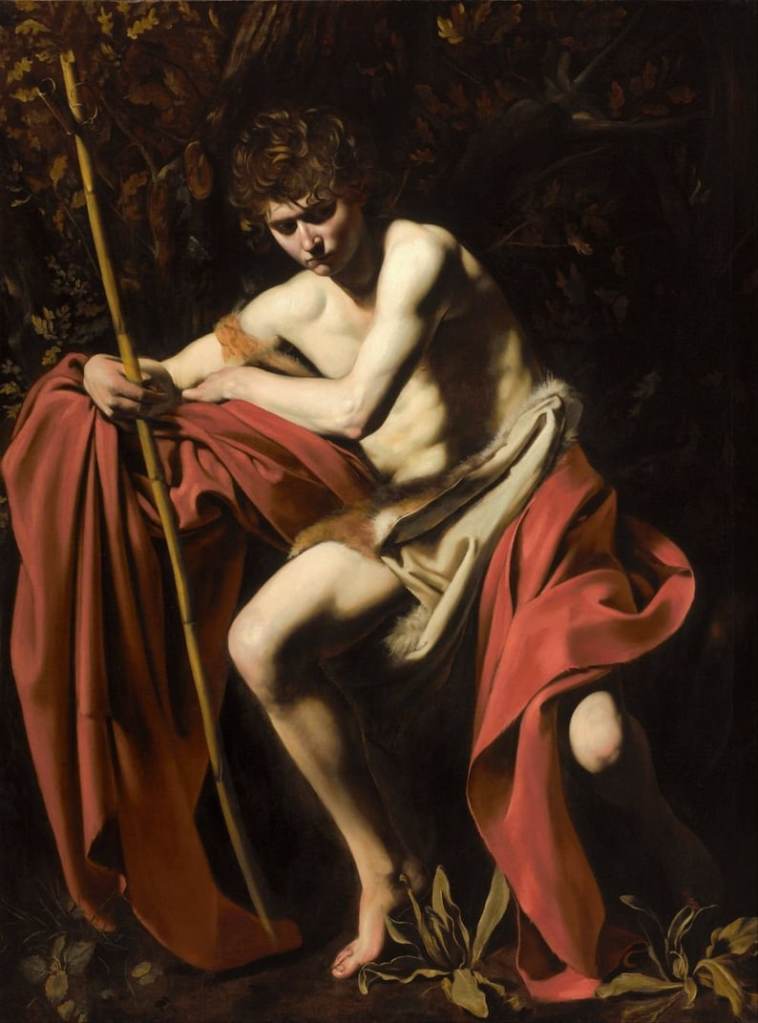
John the Baptist by Caravaggio
In John the Baptist, we celebrate the greatest of the prophets, a man whom history has now sanctified in Scripture, statue, painting, and song.
But what might it have been like to know him in time?
Prophets generally make us uncomfortable. Like John, they shake up their family’s routine, sometimes rendering their parents speechless and their neighbors astounded. They might dress oddly, rant a bit, and follow a strange diet. They hang out in inhospitable places. Prophets are the oddities on the edge of our striving for comfort. Someone like John the Baptist would not be the most popular member of your country club.
And yet John the Baptist’s call is one given, in its own particular measure, to every disciple of Christ:
Go to the sharp edge of your existence. That is where you will find the Divine Presence.
Go by way of the inner desert, continually learning the aridity of all that is not God.
Shed the trappings that separate you from the Holy – be they the adoration of wealth, power, or vanity.
Then speak the Truth you have become.
The poet Mary Oliver put it simply this way:
Instructions for living a life: Pay attention. Be astonished. Tell about it.
Where will we find the prophets today? At the borders of everything. But they will be building bridges, not walls. They will be inviting the rest of us out of the quagmire of our comfort zones to come see Christ rising on the bright distance of our courage. Today’s prophets, like John, will be pointing away from themselves to the place where Christ waits with His counter-cultural Gospel – among those who are poor, weakened by the world, among the marginalized who live at life’s sharp edge where Grace is most accessible because it is all there is.
The wonderful Baptist, robed in his camel hair, eating locusts, shouting and throwing people into the Jordan! The greatest of the prophets calls down the hills of time to us today: “Behold One is coming after me. Prepare your hearts! Do not miss Him!”
Poetry: John the Baptist – Kelly Chripczuk
He didn’t see it, but felt it through the darkness of his mother’s womb, the flame that baptized drawn close enough to singe his foot, which caused him to leap. The wild fire caught and grew, ruining him for a life of conformity. So he moved to the wilderness somewhere near the river’s edge where others were drawn by the smoldering flame. He doused them each with water, warning them one-by-one of the fire to come. Later, when he leapt from this world to the next, leaving his head behind, he was greeted by the fellowship of the flame – Isaiah with his charred black lips, Miriam who danced like a flickering wick, and the others, too many now to name together they glowed like so many embers, lighting the long, dark night.
Visit Kelly’s wonderful website ” The Contemplative Life” at:
Music: BWV30 Cantata for Nativity of St John the Baptist – Karl Richter conducting
First Part
Aria (S, A, T, B)
Joyful be, O ransomed throng, Joyful be in Zion’s dwellings. Thy well-being hath henceforth Found a sure and solid means Thee with bliss and health to shower.
Recit. (B)
We have our rest, The burden of the law Has been removed. Nought shall from this repose distract us, Which our belovéd fathers oft Had sought with yearning and with hope. Come forth, Be joyful all, whoever can, And raise to pay their God due honor A song of praise, And all the heav’nly choir, Yea, sing in glad accord!
Aria (B)
All praise be to God, all praise for his name’s sake, Who faithfully keepeth his promise and vow! His faithful servant hath been born now, Who long had for this been elected, That he the Lord his way prepare.
Recit. (A)
The herald comes and sounds the king’s approach, He calls; so tarry not And get ye up, And with a lively pace Rush to this voice’s call! It shows the way, it shows the light By which we on those blessed pastures At last may surely gaze with wonder.
Aria (A)
Come, ye sorely tempted sinners, Haste and run, O Adam’s children, This your Savior calls and cries! Come forth, ye like sheep that wander, Rise ye up from sin-filled slumber, For now is the hour of grace!
Chorale (S, A, T, B)
There a voice of one is crying In the desert far and wide, Leading mankind to conversion: For the Lord the way prepare, Make for God a level path, All the world should henceforth rise, Every valley shall be lifted, That the mountains may be humbled.
Second Part
Recit. (B)
If thou dost then, my hope, intend That law which thou didst make With our forefathers to maintain And in thy gracious might o’er us to reign, Then will I set with utmost care On this my purpose: Thee, faithful God, at thy command In holiness and godly fear to live.
Aria (B)
I will detest now And all avoid Which thee, my God, doth cause offense.
I will thee not cause sadness, Instead sincerely love thee, For thou to me so gracious art.
Recit. (S)
And even though the fickle heart In human weakness is innate, Yet here and now let this be said: So oft the rosy morning dawns, So long one day the next one lets ensue, So long will I both strong and firm Through thine own Spirit live, My God, entirely for thine honor. And now shall both my heart and voice According to thy covenant With well deservéd praise extol thee.
Aria (S)
Haste, ye hours, come to me, Bring me soon into those pastures!
I would with the holy throng To my God an altar raise, In the tents of Kedar offered,(1) Where I’ll give eternal thanks.
Recit. (T)
Forbear, the loveliest of days Can no more far and distant be, When thou from every toil Of imperfection’s earthly burdens, Which thee, my heart, doth now enthrall, Wilt come to have thy perfect freedom. Thy hope will come at last, When thou with all the ransomed spirits, In that perfected state, From death here of the body wilt be freed, And there thee no more woe will torment.
Aria (S, A, T, B)
Joyful be, O hallowed throng, Joyful be in Zion’s pastures!
Of thy joyful majesty, Of thy full contentment’s bliss Shall all time no end e’er witness.
Today, in Mercy, we celebrate Gaudete Sunday, Advent’s joyful midway pause.
Advent was originally, like Lent, a time of fasting. Midway in the fast, the Church took a break from its rigors and rejoiced prematurely for the coming Christmas.
I remember going, as a grade schooler, with my mother to buy two candy bars on the Saturday before Gaudete (because most stores were closed on Sunday back then!) After Sunday Mass, we would hold a sort of “sweetness ceremony”, delighting in our choices. Mom’s was always a Milky Way. My choice ran with the fads, sticking for a few years on Rollos – remember them?
The Church has its own “sweet ceremony” on Gaudate Sunday. Pink vestments worn for the liturgy indicate joy, as do the uplifting readings.
In our first reading, Zephania tells us that “the Lord will rejoice over us with gladness!”
Shout for joy, O daughter Zion! Sing joyfully, O Israel! Be glad and exult with all your heart, O daughter Jerusalem!
Zephania 3:14
In a reassuring blessing, Paul tells us, “Don’t worry. Be happy!”
Rejoice in the Lord always. I shall say it again: rejoice! Your kindness should be known to all. The Lord is near. Have no anxiety at all, but in everything, by prayer and petition, with thanksgiving, make your requests known to God. Then the peace of God that surpasses all understanding will guard your hearts and minds in Christ Jesus.
Philippians 4: 4-7
Even serious John the Baptist seems to tingle with expectation of the coming Savior. He’s just a little more taciturn in his proclamations.
John answered them all, saying, “I am baptizing you with water, but one mightier than I is coming. I am not worthy to loosen the thongs of his sandals. He will baptize you with the Holy Spirit and fire.
Luke 3: 16-17
In our terribly commercialized holiday world, let’s stop and remember the true cause of our hope and celebration.
What gives your heart real joy as we approach the holy celebration of Christmas?
What is the sacred delight you long for in your heart and soul?
Let’s make a deeper effort this week, which will require so much bustle of us, to settle our hearts on God – remembering that God’s sweet presence with us is what this whole season is about.
Poetry: The Flower by George Herbert
How fresh, oh Lord, how sweet and clean Are thy returns! even as the flowers in spring; To which, besides their own demean, The late-past frosts tributes of pleasure bring. Grief melts away Like snow in May, As if there were no such cold thing.
Who would have thought my shriveled heart Could have recovered greenness? It was gone Quite underground; as flowers depart To see their mother-root, when they have blown, Where they together All the hard weather, Dead to the world, keep house unknown.
These are thy wonders, Lord of power, Killing and quickening, bringing down to hell And up to heaven in an hour; Making a chiming of a passing-bell. We say amiss This or that is: Thy word is all, if we could spell.
Oh that I once past changing were, Fast in thy Paradise, where no flower can wither! Many a spring I shoot up fair, Offering at heaven, growing and groaning thither; Nor doth my flower Want a spring shower, My sins and I joining together.
But while I grow in a straight line, Still upwards bent, as if heaven were mine own, Thy anger comes, and I decline: What frost to that? what pole is not the zone Where all things burn, When thou dost turn, And the least frown of thine is shown?
And now in age I bud again, After so many deaths I live and write; I once more smell the dew and rain, And relish versing. Oh, my only light, It cannot be That I am he On whom thy tempests fell all night.
These are thy wonders, Lord of love, To make us see we are but flowers that glide; Which when we once can find and prove, Thou hast a garden for us where to bide; Who would be more, Swelling through store, Forfeit their Paradise by their pride.
Music: Gaudete in Domino sung by the Schola of St. Meinrad Abbey (Latin and English lyrics below)
Gaudete in Domino semper iterum dico gaudete. Modestia vestra nota sit omnibus hominibus. Dominus prope est. Nihil solliciti sitis sed in omni oratione et obsecratione cum gratiarum actione petitiones vestrae innotescant apud Deum. Et pax Dei quae exsuperat omnem sensum custodiat corda vestra et intellegentias vestras in Christo Iesu [Domino nostro].
Rejoice in the Lord always: and again I say, rejoice. Let your moderation be known unto all men. The Lord is at hand. Be careful for nothing; but in every thing by prayer and supplication with thanksgiving let your requests be made known unto God. And the peace of God, which passeth all understanding, shall keep your hearts and minds through Christ Jesus [our Lord].
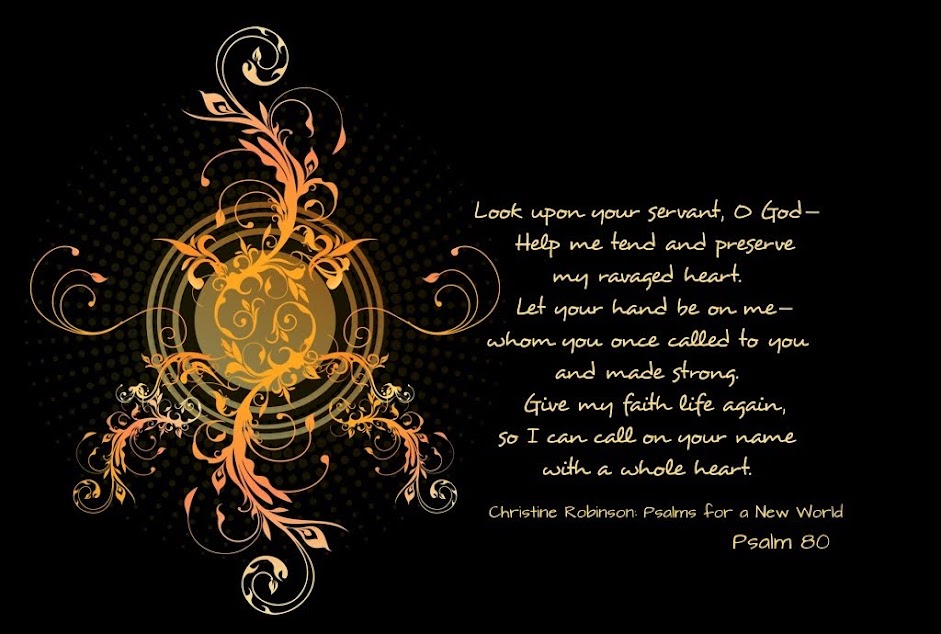
Today, in God’s Lavish Mercy, we pray with Psalm 80 which calls upon God to “rouse” – to wake up, to look toward us from heaven, and to take care of us. Perhaps the psalm calls us to wake too????
O shepherd of Israel, hearken, From your throne upon the cherubim, shine forth. Rouse your power. Once again, O LORD of hosts, look down from heaven, and see; Take care of this vine, and protect what your right hand has planted the we whom you yourself made strong.
Psalm 80: 2-3;15-16
Our Gospel places us with Jesus, as he descends the mountain after the Transfiguration.
He speaks about two great prophets – Elijah and John the Baptist:
Elijah – the fiery reformer who “turned back hearts” to the day of the Lord
John – who cried out in the desert, “Prepare the way of the Lord!”
These prophets open the door to our final approach to Christmas – our last few days to heed their advice and ready our hearts for the awesome, yet humble, coming of Christ.
Is there anything in my heart that needs to be turned back to God — any energy, dedication or insight that has shifted from God’s Way to my own selfish way?
Is there anything I must prepare so that my life is ready to receive Christ?
These are the questions Elijah and John offer us today.. Praying Psalm 80, we might ask that God care for us and show us the way to the Christmas Light.
Poetry: The God We Hardly Knew – Saint Oscar Romero
No one can celebrate a genuine Christmas without being truly poor.
The self-sufficient, the proud, those who, because they have everything, look down on others, those who have no need even of God – for them there will be no Christmas.
Only the poor, the hungry, those who need someone to come on their behalf, will have that someone. That someone is God. Emmanuel. God-with-us. Without poverty of spirit there can be no abundance of God.
Music: Prepare the Way, O Zion – Fernando Ortega (Lyrics below)
Prepare the way O Zion Your Christ is drawing near Let every hill and valley A level way appear Greet One who comes in glory Foretold in sacred story
Chorus: O blest is Christ that came In God’s most holy name Christ brings God’s rule O Zion He comes from heaven above His rule is peace and freedom And justice truth and love Lift high your praise resounding For grace and joy abounding
Fling wide your gates, O Zion Your Savior’s rule embrace And tidings of salvation Proclaim in every place All lands will bow rejoicing Their adoration voicing
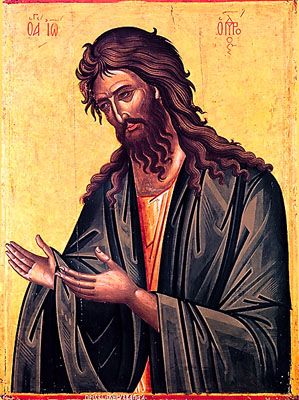
Icon of St. John the Baptist (16th c.) Dionysiou Monastery
Today, in Mercy, we celebrate one of the greatest figures of the Bible, John the Baptist. He prepared the way for the Lord.
Thinking of John’s role in Salvation History, I am reminded of a captivating poem by Geoffrey Brown, author of Road of the Heart Cave:
The Heart Cave
I must remember
To go down to the heart cave & sweep it clean; make it warm with a fire on the hearth, & candles in their niches, the pictures on the walls glowing with a quiet light. I must remember
To go down to the heart cave & make the bed with the quilt from home, strew the rushes on the floor hang lavender and sage from the corners. I must go down To the heart cave & be there when You come.
John the Baptist went down to the heart cave of our human perception of God. He understood, in an inexpressible way, that God was about to do something astounding in human history. God was about to become part of it!
John understood this with unquestioning faith, the way we understand heaven but cannot rationalize it. Understanding it, he knew that the world needed to turn itself toward God – to repent – in radical and ardent expectation.
This was his call and his message – this extraordinary man, dressed in his camel hair vestments, preaching at the desert’s edge.
We might pray with John today to be turned from anything that distracts us from God, to long for God’s presence in our hearts and in our world, to love deeply and make a welcome home for Christ within us.
( On this Feast, 55 years ago, my entrance companions and I professed our vows. I think of all of them with love today. May I humbly ask you, dear readers, to join me in prayer for us as we thank God for the gift of our lives in Mercy.)
Music: “Utqueant laxis” or “Hymnus in Ioannem” is a Latin hymn in honor of John the Baptist written in Horatian Sapphics and traditionally attributed to Paulus Diaconus, the eighth-century Lombard historian. It is famous for its part in the history of musical notation, in particular solmization (do-re-mi-fa-so-la-ti-do). The hymn is sung to a Gregorian chant, and introduces the original do-re-mi music
1. O for your spirit, holy John, to chasten Lips sin-polluted, fettered tongues to loosen; So by your children might your deeds of wonder Meetly be chanted.
2. Lo! a swift herald, from the skies descending, Bears to your father promise of your greatness; How he shall name you, what your future story, Duly revealing.
3. Scarcely believing message so transcendent, Him for a season power of speech forsaketh, Till, at your wondrous birth, again returneth, Voice to the voiceless.
4. You, in your mother’s womb all darkly cradled, Knew your great Monarch, biding in His chamber, Whence the two parents, through their offspring’s merits, Mysteries uttered.
5. Praise to the Father, to the Son begotten, And to the Spirit, equal power possessing, One God whose glory, through the lapse of ages, Ever resounding. Amen.









 Lavish Mercy