
Twelfth Sunday in Ordinary Time
June 25, 2023
Today’s Readings:
https://bible.usccb.org/bible/readings/062523.cfm
Today, in God’s Lavish Mercy, our readings are studies in darkness and light.

Jeremiah – from the Sistine Chapel ceiling painted by Michelangelo c. 1512
Our first reading comes from Jeremiah, sometimes referred to as “the weeping prophet”. Jeremiah was pretty much a sad sack, as today’s selection demonstrates. He wrote for the Jews during the darkness of the Babylonian exile, helping them to mourn their situation which had been brought upon themselves by their unfaithfulness and sin. Jeremiah calls the people to repent and to find a healing grace by trusting God.
Sing to the LORD,
Jeremiah 22:13
praise the LORD,
who has rescued the life of the poor
from the power of the wicked!
Paul, addressing the Romans, uses the same light/dark, sin/redemption theme. He says that all of us display an inclination to darkness by any choice to break relationship with God, neighbor and Creation.

In the Genesis allegory of Adam and Eve, they choose to supersede God’s terms of relationship, eschewing the pure abundance of Creation for the sake of a self-satisfying “apple”.

The magnificent encyclical “Laudato Si” leads us through an enlightened understanding of of this Genesis story:
The creation accounts in the book of Genesis contain, in their own symbolic and narrative language, profound teachings about human existence and its historical reality. They suggest that human life is grounded in three fundamental and closely intertwined relationships: with God, with our neighbor and with the earth itself. According to the Bible, these three vital relationships have been broken, both outwardly and within us. This rupture is sin. The harmony between the Creator, humanity and creation as a whole was disrupted by our presuming to take the place of God and refusing to acknowledge our creaturely limitations. This in turn distorted our mandate to “have dominion” over the earth (cf. Gen 1:28), to “till it and keep it” (Gen 2:15). As a result, the originally harmonious relationship between human beings and nature became conflictual (cf. Gen 3:17-19). It is significant that the harmony which Saint Francis of Assisi experienced with all creatures was seen as a healing of that rupture. Saint Bonaventure held that, through universal reconciliation with every creature, Saint Francis in some way returned to the state of original innocence. This is a far cry from our situation today, where sin is manifest in all its destructive power in wars, the various forms of violence and abuse, the abandonment of the most vulnerable, and attacks on nature.
Laudato Sì, paragraph 66
Our Gospel so beautifully complements this enlightened understanding. Jesus encourages his disciples not to be afraid because the Creator embraces them in love and care. They, as we, need not make parsimonious choices that fracture essential relationships with God, neighbor, self, or Creation. We are already safe and whole in God.
Jesus said to the Twelve:
Matthew 10:26-33
“Fear no one.
Nothing is concealed that will not be revealed,
nor secret that will not be known.
What I say to you in the darkness, speak in the light;
what you hear whispered, proclaim on the housetops…
… Are not two sparrows sold for a small coin?
Yet not one of them falls to the ground without your Father’s knowledge.
Even all the hairs of your head are counted.
So do not be afraid; you are worth more than many sparrows…
Poetry: The Root of the Root of Yourself – Rumi
(Reading this poem, we might imagine that the Trinity is inviting us to recover the pristine goodness of our creation.)
Don’t go away, come near.
Don’t be faithless, be faithful.
Find the antidote in the venom.
Come to the root of the root of yourself.
Molded of clay, yet kneaded
from the substance of certainty,
a guard at the Treasury of Holy Light —
come, return to the root of the root of your Self.
Once you get hold of selflessness,
You’ll be dragged from your ego
and freed from many traps.
Come, return to the root of the root of your Self.
You are born from the children of God’s creation,
but you have fixed your sight too low.
How can you be happy?
Come, return to the root of the root of your Self.
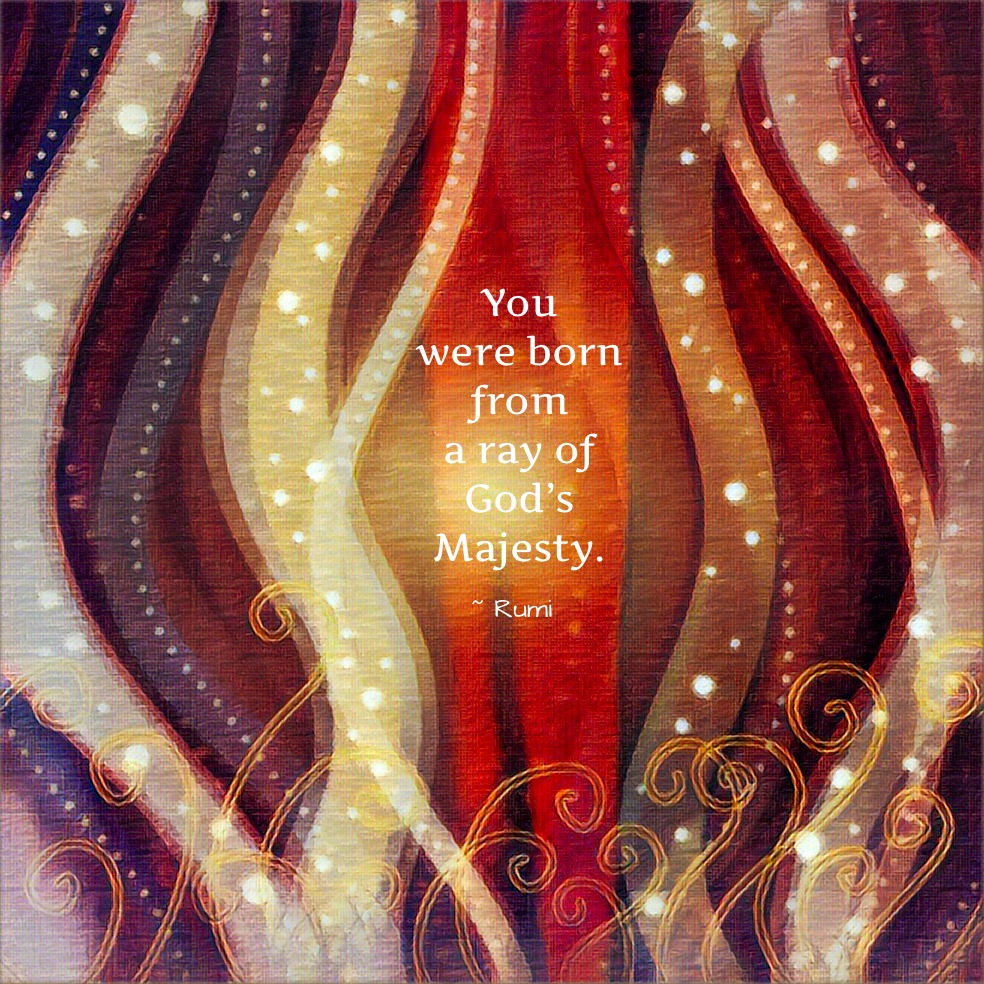
You were born from a ray of God’s majesty
and have the blessings of a good star.
Why suffer at the hands of things that don’t exist?
Come, return to the root of the root of your Self.
You are a ruby embedded in granite.
How long will you pretend it’s not true?
We can see it in your eyes.
Come to the root of the root of your Self.
You came here from the presence of that fine Friend,
a little dazed, but gentle, stealing our hearts
with that look so full of fire; so,
come, return to the root of the root of your Self.
Music: Rainlight – David Lanz

 Lavish Mercy