Choose to Believe

Saturday of the Twenty-fourth Week in Ordinary Time
September 17, 2022

Today’s Readings:

https://bible.usccb.org/bible/readings/091722.cfm

Today, in God’s Lavish Mercy, Paul strongly confronts the doubts of the Corinthian community regarding the Resurrection.

Someone may say, “How are the dead raised? 
With what kind of body will they come back?”
You fool!

1 Corinthians 15:35

Remember that these post-Resurrection Christians had expected an immediate Parousia, or end of time. They thought that with the completion of Christ’s redemptive act, that was it! Time for heaven for all us believers. Yippee!

Well, not so fast!

When Parousia didn’t happen, the people grew a little confounded. They began to awaken to  the hard lesson  that redemption is not time-bound, but continues in the timeless gift of grace given to new generations. It is up to us to work through our own lives to become one with the Pascal Mystery of Christ.

In the miracle of God’s eternity, each of us has the chance to engage the power of Christ’s Passion, Death and Resurrection by the faithful living of our own lives – no matter if we have lived in the first or the twenty-first century. 


God doesn’t do “time” and doesn’t have a calendar.

But still I feel for those struggling Corinthians! It’s hard to believe sometimes, don’t you agree? It’s hard to wade through the sometimes tumultuous unfolding of our lives and history to find God.

When I taught eighth graders many years ago, one intelligent young girl asked me this question:

What if everything you believe is wrong? 
Was the way you live your life worth it?

It was a powerful question and it has stayed with me for half a century. I continue to ask myself versions of the same question especially when I can’t find God in the circumstances of my life or world – when children are sick, or old people suffer, or human beings dreadfully hurt one another – and I have no answers.

Like the early Corinthians, I ask God, “Where are You? I thought your Resurrection healed all this? I thought You had redeemed our suffering world! 


Paul and Jesus, in our readings today, give us images to help us mature in a long and lasting faith that doesn’t answer but receives these questions with trust and hope.

What you sow is not brought to life unless it dies.
And what you sow is not the body that is to be
but a bare kernel of wheat, perhaps, or of some other kind.

So also is the resurrection of the dead.
It is sown corruptible; it is raised incorruptible.
It is sown dishonorable; it is raised glorious.
It is sown weak; it is raised powerful.
It is sown a natural body; it is raised a spiritual body.
If there is a natural body, there is also a spiritual one.

1 Corinthians 15

By faith, the power of Christ’s Resurrection has been sown in us like a seed. Because we are creatures of time, that power needs time to root itself in every aspect of our lives – our choices, actions, our very nature.

Jesus tells us that God is sowing the seeds of the Resurrection in our lives. Our job is simply provide good soil by choosing to believe and act on God’s Word.

“This is the meaning of the parable. 
The seed is the word of God.
Those on the path are the ones who have heard,
but the Devil comes and takes away the word from their hearts
that they may not believe and be saved.
Those on rocky ground are the ones who, when they hear,
receive the word with joy, but they have no root;
they believe only for a time and fall away in time of temptation.
As for the seed that fell among thorns,
they are the ones who have heard, but as they go along,
they are choked by the anxieties and riches and pleasures of life, 
and they fail to produce mature fruit.
But as for the seed that fell on rich soil,
they are the ones who, when they have heard the word,
embrace it with a generous and good heart,
and bear fruit through perseverance.”

Luke 8:5-11

Poetry: Flickering Mind – Denise Levertov

Lord, not you
it is I who am absent.
At first
belief was a joy I kept in secret,
stealing alone
into sacred places:
a quick glance, and away -- and back,
circling.
I have long since uttered your name
but now
I elude your presence.
I stop
to think about you, and my mind
at once
like a minnow darts away,
darts
into the shadows, into gleams that fret
unceasing over
the river's purling and passing.
Not for one second
will my self hold still, but wanders
anywhere,
everywhere it can turn.  Not you,
it is I am absent.
You are the stream, the fish, the light,
the pulsing shadow.
You the unchanging presence, in whom all
moves and changes.
How can I focus my flickering, perceive
at the fountain's heart
the sapphire I know is there?

Music: Out of Time – Liz Story

Live Your Resurrection Power!

Third Sunday of Easter

April 26, 2020

Click here for readings

Today, in Mercy, our Eastertide readings once again pull us into the full power of the Resurrection.

Act2_24

Just listen to Peter who stands and raises his mighty voice over the gathered crowd:

Let this be known to you, and listen to my words.
You who are Israelites, hear these words.
Jesus the Nazarene was a man commended to you by God …
This man … you killed, using lawless men to crucify him.
But God raised him up,
releasing him from the throes of death,

because it was impossible for him to be held by it.

There is no fear in Peter. There is only the courage that comes from certainty in God’s power over death. This is the grace of Resurrection Faith.


Resurrection Faith is a power we intensely need in these times that so test us. 

We may be severely tested like those suffering illness and loss; like those valiantly serving the suffering. Or we, like many, may simply be challenged by our self-isolation and radical disruption of routine.

emmaus nuns
In that, we may be like the disciples walking home to Emmaus. They didn’t die on Calvary. They weren’t even retained as followers of Jesus. They simply drifted away from their Hope. They were going home to a sad but comfortable dinner adequate enough to invite a stranger.

Yet they were heartbroken. The world they had loved and hoped in had been shattered. Everything they believed in appeared to be contradicted by the Cross. Most devastating of all, they were at a loss to imagine a future. 

Aren’t we at least a little bit like them?

Aren’t we dazed that the reality we trusted seems to have disappeared overnight? Aren’t we too trying to figure out what we do now in the vacuum? Aren’t we too so blinded by sadness that we might fail to see God walking right beside us?


In our second reading, Peter gives us the formula to break through such blindness:

    • Invoke God as your Father
    • Remain faithful to your good works
    • Conduct yourselves with reverence during the time of your sojourning,
    • Realize that you are already ransomed from death by the precious blood of Christ

Practicing this kind of Resurrection Faith in troubled times makes us not only unafraid of death but, more importantly, unafraid of life. Because I think that is what really most cripples us – not any fear of dying, but rather our fear of fully living our life in God.

We worry about what we have to lose if we live like that, don’t we?

By jeopardizing everything most precious to us, these pandemic times make clear all that we have to lose. But they also make clear the powers in us impossible to chain: how we love, hope, serve and believe. Neither death nor pandemic has power over these living graces.


Like the Emmaus disciples, our hearts burn within us, too, with an ardent mix of longing, confusion, and stubborn trust. Like them, let us sit down with Jesus at the table of our lives. Let his patient voice speak to our souls and clear our vision. The Resurrection power of God is alive in all things. May we recognize that Power even in these seemingly contradictory times.

cross

Because Christ rose from the dead, it is impossible for any form of death to hold us captive. On this Third Sunday of Easter, our readings invite us to truly believe that. Let’s fully accept the invitation, dear friends. Let’s live like we believe!

Music: Christ Our Hope in Life and Death – The Gettys 

Heads or Tails?

Tuesday, July 3, 2018

Readings: http://www.usccb.org/bible/readings/070318.cfm

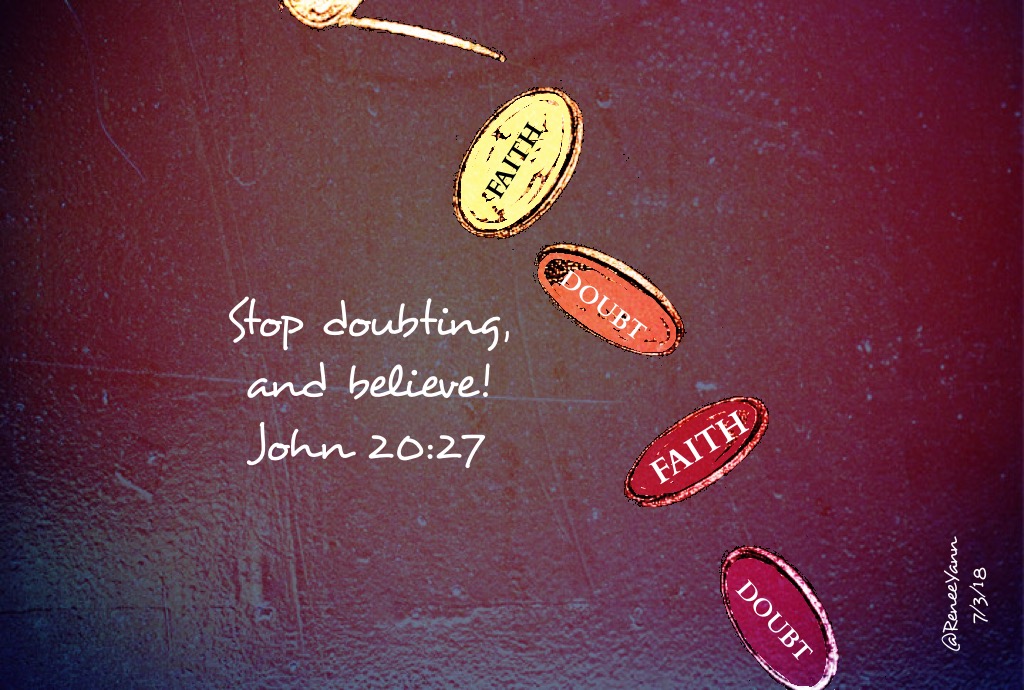
Jn20_27doubt

Has doubt ever dogged you, or at least nipped at the edges of your soul?  All kinds of doubt, I’m talking about! Doubt yourself. Doubt your loved ones. Doubt the Church, the government, the media. You get the idea.

Some doubt is good. It’s more like “discernment”, and it saves us from misplaced trust. A skill that’s honed through a lifetime, it can eventually be exercised prudentially, without skepticism or aloofness.

But another type of doubt can be crippling. Call it the “not enough” type: I am not good enough, smart enough, good-looking enough, experienced enough, – so on and on – to take on a challenge or make a contribution. Ever felt that kind of doubt?

There is third type of doubt which I call “the flip side of faith”. It’s that fine line where we balance between wanting to believe and wanting to know. This type of doubt whispers things like this in our minds: “You don’t really know if there is a God, so how can you believe?” But isn’t that the whole point of faith? If we really knew, for certain, of God’s existence, we wouldn’t have to believe!

What’s the difference between these flip sides of the coin? 

With faith, we give our love and service unreservedly, even though we have not seen. With doubt, we skimp or reserve these until given proof.

So today, we meet “doubting Thomas”. He needed the touch of nail marks and lance wounds before he could believe. And it’s not hard to understand why.

The Resurrection of Jesus was mind-blowing. It changed history for all time to come. It conquered the one unconquerable – DEATH itself. Thomas had not yet seen proof of the Resurrection. The other disciples had. No wonder his coin was spinning between heads and tails!

What about us? Have we seen the Easter Power in our lives? Have we let God win the toss up between our faith and doubt? Today, on this feast of St. Thomas, we might ask his help to let us learn from the wounds of Christ exactly how that Power can assure us.

Music: Blessed Assurance ~ a well-known Christian hymn. The lyrics were written in 1873 by blind hymn writer Fanny Crosby to the music written in 1873 by Phoebe Knapp.

Our Father

Thursday, June 21,2018

Readings: http://www.usccb.org/bible/readings/062118.cfm

Today, in Mercy, our readings are a study in contrasts.  Our first reading from Sirach describes the fiery majesty of the prophet Elijah. Everything about Elijah was thunder and lightning.  He toppled kings and raised the dead, and generally cast a path of fire as he preached. At the end of his life, he passed into heaven in a chariot of flames.

The Gospel presents a Prophet of a gentler stripe – Jesus, who is teaching us how to pray.

Jesus says to pray simply, humbly, to ask for forgiveness, and freedom from temptation. He tells us to forgive others, avoid evil and be content with our daily bread.  No fiery chariots; no tumbling governments.  This gentle man will die in the agony of the cross.

No wonder those who hoped for a Messiah like Elijah were disappointed in Jesus.  No wonder we still struggle to understand the contradiction of the Cross.

However, Walter Brueggemann says this:  The crucifixion is

“the ultimate act of prophetic criticism
in which Jesus announces the end of a world of death…
and takes the death into his own person”.  

Still, the witness of Calvary would remain nothing but a contradiction without the transformative act of the Resurrection.

cross ressur

Through the combined witness of Good Friday and Easter, Jesus not only confronts the old order, he embraces and transforms it.  He takes to himself the same suffering and death that we all must face, but he shows us that it cannot destroy us. He proves that, ultimately, death has no power over those who believe in Him and in the Father Who has sent Him.

Indeed, the Our Father is a most powerful, prophetic prayer. It teaches us how to be in the presence of God even in the midst of our daily life. It shows us how to express our faith in God’s Kingdom even as we live in our earthly one.  It helps us to become a little more like gentle, powerful Jesus.

Music: Aramaic Our Father – in the orgs that Jesus likely used.

The “Scriptures of Our Lives”

Thursday, April 26, 2018

Readings: Acts 13:13-25; Psalm 89; John 13:16-20

Today, in Mercy, our readings continue to extol the blessings of salvation history as it culminates in the Resurrection. In Acts, Paul recounts God’s presence throughout the Jewish Scriptures . In John’s Gospel, Jesus speaks about the fulfillment of these scriptures in Himself. Psalm 89 allows us to offer thanks for God’s presence throughout the “scriptures of our lives.” Are there times in your life when you remember God’s presence most gratefully? Are there times God has carried you through to salvation? Mary sang her thanks so beautifully that I thought our prayer would be blessed by a song about her.

A Blossoming Faith

Sunday, April 15, 2018: Today In Mercy, Jesus opens the minds and hearts of his followers to understand that He is the fulfillment of the Scriptures. Faith is like the evolution of a beautiful flower. The miracle does not happen all at once. There is a patient, silent process which finally yields the blossom. In these stories of the Resurrection appearances, the early Christians are showing us how they matured through trust, prayer and a shared community of faith. It is a model for us and the whole Church. Many of us will attend services this weekend. Is there a mutual nourishment between us and our faith community? If not, how can I help change that?

img_5062


The Final Command

Easter Saturday, April 7, 2018: Today, in Mercy, our Gospel summarizes the post-Resurrection appearances of Jesus to his disciples. With the final one, Jesus seems to say that their faith has been sufficiently assured; it is time for them to spread that faith to the whole world – to every creature! We are given the same command. Does our life proclaim our faith? Does it embrace all Creation in its loving service?

B455BEBE-D6A7-47B1-82FE-F39DD3583AAF