Now, Dismiss Your Servant

December 29, 2022
The Fifth Day in the Octave of Christmas

Today’s Readings:

https://bible.usccb.org/bible/readings/122922.cfm
Today, in God’s Lavish Mercy, as I begin to create today’s reflection, Pope Francis has asked the world to pray for Pope Emeritus Benedict XVI who is mortally ill. Perhaps by the time you red this, God will already have taken Benedict home. If so, may he rest in peace.


Today’s readings fit so well for this moment for Benedict and for the Church. Our first reading offers us John’s perfect honesty and simplicity:

Whoever says, “I know him,” but does not keep his commandments
is a liar, and the truth is not in him.
But whoever keeps his word,
the love of God is truly perfected in him.
This is the way we may know that we are in union with him:
whoever claims to abide in him ought to walk just as he walked.

1 John 2:5-6

Yes, it’s that simple and that hard!


It is so fitting that as we pray Pope Benedict home to heaven, we meet Simeon in our Gospel. He speaks with the holy confidence of a long and well-lived life. His lifelong dream was that he might not die before seeing the Messiah. That dream now fulfilled, Simeon intones one of the most beautiful prayers in Scripture:

Lord, now let your servant go in peace;
your word has been fulfilled:
my own eyes have seen the salvation
which you prepared in the sight of every people,
a light to reveal you to the nations
and the glory of your people Israel.

Luke 2: 29-32

If we live by the Light, we too will see the Messiah within our own life’s experiences. We too will come to our final days confident and blessed by that enduring recognition.

For as John also assures us:

Whoever says they are in the light,
yet hates their brother or sister is still in the darkness.
But whoever loves their brother and sister remains in the light …

1 John 2:9-10

Let’s pray today for those all who are dying, that they may know this kind of peace, especially for Pope Emeritus Benedict XVI.

Let us pray for ourselves, that when our time comes, we too may experience this confidence.


Poetry: Nunc Dimittis – Joseph Brodsky  
(from Joseph Brodsky, A Part of Speech by George L. Kline (NY: Noonday, 1996)
The poem is long but exceptionally beautiful. I hope you can take the time to enjoy it.


‘Nunc Dimittis’

When Mary first came to present the Christ Child
to God in His temple, she found—of those few
who fasted and prayed there, departing not from it—
devout Simeon and the prophetess Anna.

The holy man took the Babe up in his arms.
The three of them, lost in the grayness of dawn,
now stood like a small shifting frame that surrounded
the Child in the palpable dark of the temple.

The temple enclosed them in forests of stone.
Its lofty vaults stooped as though trying to cloak
the prophetess Anna, and Simeon, and Mary—
to hide them from men and to hide them from Heaven.

And only a chance ray of light struck the hair
of that sleeping Infant, who stirred but as yet
was conscious of nothing and blew drowsy bubbles;
old Simeon's arms held him like a stout cradle.

It had been revealed to this upright old man
that he would not die until his eyes had seen
the Son of the Lord. And it thus came to pass. And
he said: ‘Now, O Lord, lettest thou thy poor servant,

according to thy holy word, leave in peace,
for mine eyes have witnessed thine offspring: he is
thy continuation and also the source of
thy Light for idolatrous tribes, and the glory

of Israel as well.' The old Simeon paused.
The silence, regaining the temple's clear space
oozed from all its corners and almost engulfed them,
and only his echoing words grazed the rafters,

to spin for a moment, with faint rustling sounds,
high over their heads in the tall temple's vaults,
akin to a bird that can soar, yet that cannot
return to the earth, even if it should want to.

A strangeness engulfed them. The silence now seemed
as strange as the words of old Simeon's speech.
And Mary, confused and bewildered, said nothing—
so strange had his words been. He added, while turning

directly to Mary: ‘Behold, in this Child,
now close to thy breast, is concealed the great fall
of many, the great elevation of others,
a subject of strife and a source of dissension,

and that very steel which will torture his flesh
shall pierce through thine own soul as well. And that wound
will show to thee, Mary, as in a new vision
what lies hidden, deep in the hearts of all people.’

He ended and moved toward the temple's great door.
Old Anna, bent down with the weight of her years,
and Mary, now stooping gazed after him, silent.
He moved and grew smaller, in size and in meaning,

to these two frail women who stood in the gloom.
As though driven on by the force of their looks,
he strode through the cold empty space of the temple
and moved toward the whitening blur of the doorway.

The stride of his old legs was steady and firm.
When Anna's voice sounded behind him, he slowed
his step for a moment. But she was not calling
to him; she had started to bless God and praise Him.

The door came still closer. The wind stirred his robe
and fanned at his forehead; the roar of the street,
exploding in life by the door of the temple,
beat stubbornly into old Simeon's hearing.

He went forth to die. It was not the loud din
of streets that he faced when he flung the door wide,
but rather the deaf-and-dumb fields of death's kingdom.
He strode through a space that was no longer solid.

The rustle of time ebbed away in his ears.
And Simeon's soul held the form of the Child—
its feathery crown now enveloped in glory—
aloft, like a torch, pressing back the black shadows,

to light up the path that leads into death's realm,
where never before until this present hour
had any man managed to lighten his pathway.
The old man's torch glowed and the pathway grew wider.

Music:  Nyne Otpushchayeshi ~Sergei Rachmaninoff (translated Nunc Dimittis, Now Let Your Servant Go). This was sung at Rachmaninoff’s funeral, at his prior request. 
My eyes have seen …

February 2, 2022
Feast of the Presentation of Our Lord

Today, in God’s Lavish Mercy, we begin with a reading from the prophet Malachi, a hurler of fire and brimstone in the 4th-5th century before Christ. The reading is an interesting choice and begs the question of how it relates to this Feast when a little baby comes to be blessed in the Temple.

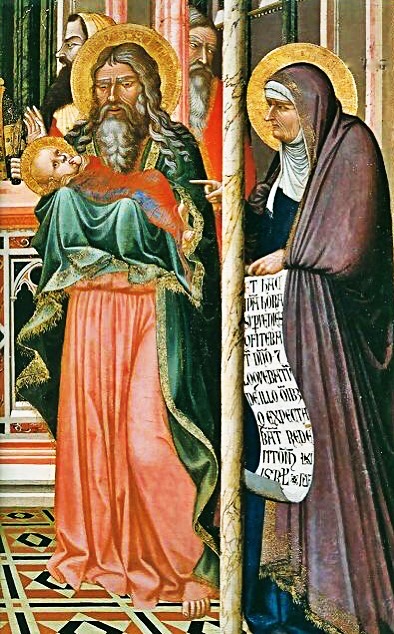
Presentation of Our Lord – Ambrogio Lorenzetti

Ah, perhaps that’s the hinge – the Temple, both actual and symbolic.

Malachi writes at a time when the second Temple has been restored. In other words, God is about giving the people a second chance to behave according to the Covenant. But they’re not doing such a good job — especially those in charge, the priests:

A son honors his father,
and a servant fears his master;
If, then, I am a father,
where is the honor due to me?
And if I am a master,
where is the fear due to me?
So says the LORD of hosts to you, O priests,
who disdain my name.

Malachi 1:6

Through a series of prophetic oracles, Malachi admonishes the people to repent before it is too late because no unrepentant soul will withstand the judgement.

Handel interpreted the Malachi passage below, sung here by the prize winning countertenor, Jakob Orlinski.

Yes, he is coming, says the LORD of hosts.
But who will endure the day of his coming?
And who can stand when he appears?
For he is like the refiner’s fire,
or like the fuller’s lye.


In the passage from Hebrews, Paul presents the perfect priest, Jesus Christ. In taking flesh, Christ’s Body becomes the new Temple of our redemption. We stand before judgement already saved by his Passion, Death, and Resurrection.


In our Gospel, two aged and venerable prophets wait in the Temple for the Promised One. Their extended years of prayer already have proven them faithful. Now, Simeon’s and Anna’s long and complete fidelity is rewarded by seeing their Savior. They know Him because they have already created a place for him in the temple of their hearts. Now, they will meet their judgement in total peace. As Simeon’s prays:

“Now, Master, you may let your servant go
in peace, according to your word,
for my eyes have seen your salvation,
which you prepared in the sight of all the peoples:
a light for revelation to the Gentiles,
and glory for your people Israel.”

Luke 2:29-32

The Nunc Dimittis is a beautiful,

total-hearted prayer!

Don’t we all hope to be able

to offer something like it

when the time comes?

Poetry: A Song for Simeon – T. S. Eliot

Lord, the Roman hyacinths are blooming in bowls and
The winter sun creeps by the snow hills;
The stubborn season has made stand.
My life is light, waiting for the death wind,
Like a feather on the back of my hand.
Dust in sunlight and memory in corners
Wait for the wind that chills towards the dead land.
Grant us thy peace.
I have walked many years in this city,
Kept faith and fast, provided for the poor,
Have taken and given honour and ease.
There went never any rejected from my door.
Who shall remember my house, where shall live my children’s children
When the time of sorrow is come ?
They will take to the goat’s path, and the fox’s home,
Fleeing from the foreign faces and the foreign swords.
Before the time of cords and scourges and lamentation
Grant us thy peace.
Before the stations of the mountain of desolation,
Before the certain hour of maternal sorrow,
Now at this birth season of decease,
Let the Infant, the still unspeaking and unspoken Word,
Grant Israel’s consolation
To one who has eighty years and no to-morrow.
According to thy word,
They shall praise Thee and suffer in every generation
With glory and derision,
Light upon light, mounting the saints’ stair.
Not for me the martyrdom, the ecstasy of thought and prayer,
Not for me the ultimate vision.
Grant me thy peace.
(And a sword shall pierce thy heart,
Thine also).
I am tired with my own life and the lives of those after me,
I am dying in my own death and the deaths of those after me.
Let thy servant depart,
Having seen thy salvation.

Music: Music: Nunc Dimittis – Taizé (Latin and English text below)

Nunc dimittis servum tuum,
Now dismiss your servant
Domine, Domine,
Lord, Lord,
Secundum verbum tuum in pace.
according to your word in peace
Domine.
Lord.

Find Yourself in This Feast

Saturday, February 2, 2019

Click here for readings

Today, in Mercy, we celebrate the feast of the Presentation of Jesus in the Temple.

Presentation
Icon from The Menologion of Basil II, an illuminated manuscript designed as a church calendar or Eastern Orthodox Church service book (menologion) that was compiled c. 1000 AD, for the Byzantine Emperor Basil II

This event is layered with human and Divine dimensions. It is filled with memorable characters and key moments in their lives. One or more of their stories may touch your own experience as you pray today.

The infant Jesus, just forty days old, is presented and dedicated in the Temple, setting in motion his whole life as the fulfillment of Jewish expectation. We may reflect on the power of our own Baptisms. If we were infants when baptized, we may recall who carried us to the font and who stood for our dedication to Christ.

Mary and Joseph came to the Temple that day for the ritual of Purification. They place their young marriage, and their beginning parenthood, into the circle of their Jewish faith. We may reflect on those points of religious dedication in our own lives – marriage, religious profession, ordination, Confirmation, and just how much the sacred nature of these events impacts our daily living.

Anna and Simeon, long-faithful servants of God, rejoice in the fulfillment of their hopes for the Messiah. Those of us richer in years might gratefully reflect on God’s fidelity to us over the course of our lifetime, and what sacred hopes we still might long to have fulfilled.

Simeon, so completed by seeing his Savior, intones the moving prayer Nunc Dimittis – “Now You may dismiss your servant in peace.” We might pray for those who are nearing their life’s close that they may be blessed with peace. We might also pray for ourselves that we will experience peace and joy at the end of our lives.

And finally venerable Anna who, woman to woman, stood beside young Mary as Mary faced Simeon’s painful words:

Behold, this child is destined
for the fall and rise of many in Israel,
and to be a sign that will be contradicted
and you yourself a sword will pierce
so that the thoughts of many hearts may be revealed.

For a beautiful meditation on Anna, click here.

Music: Bach – Cantate BWV 125 – Mit Fried und Freud ich fahr dahin
Johann Sebastian Bach composed the cantata Mit Fried und Freud ich fahr dahin With peace and joy I depart), BWV 125, for use in a Lutheran service. He composed this in 1725 for the feast for the Purification of Mary which is celebrated on 2 February and is also known as Candlemas. The cantata is based on Martin Luther’s 1524 Hymn.

https://www.youtube.com/watch?v=q1f6P_INhWw&app=desktop

Mit Fried und Freud ich fahr dahin
In Gottes Willen,
Getrost ist mir mein Herz und Sinn,
Sanft und stille.
Wie Gott mir verheißen hat:
Der Tod ist mein Schlaf worden.

With peace and joy I go on my way
in God’s will.
My heart and mind are comforted,
peaceful and calm.
As God promised me
death has become my sleep.


Now Go in Peace

Saturday, December 29, 2019

Click here for Readings

Lk2_29 Nunc

Today, in Mercy,  our first reading offers us John’s perfect honesty and simplicity:

Whoever says, “I know him,” but does not keep his commandments
is a liar, and the truth is not in him.
But whoever keeps his word,
the love of God is truly perfected in him.
This is the way we may know that we are in union with him:
whoever claims to abide in him ought to walk just as he walked.

Yes, it’s that simple and that hard!

Then, in our Gospel, we meet Simeon who speaks with the holy confidence of a long and well-lived life. His lifelong dream was that he might not die before seeing the Messiah. That dream now fulfilled, Simeon intones one of the most beautiful prayers in Scripture:

Lord, now let your servant go in peace;
your word has been fulfilled:
my own eyes have seen the salvation
which you prepared in the sight of every people,
a light to reveal you to the nations
and the glory of your people Israel.

If we live in the Light, we too will see the Messiah within our life’s experiences. We too will come to our final days confident and blessed by that enduring recognition.

For as John also assures us:

Whoever says he is in the light,
yet hates his brother or sister is still in the darkness.
But whoever loves his brother and sister remains in the light …

Let’s pray today for those who are dying, that they may know this kind of peace.

Let us pray for ourselves, that when our time comes, we too may experience this confidence.

Music:  Nyne Otpushchayeshi ~Sergei Rachmaninoff (translated Nunc Dimittis, Now Let Your Servant Go). This was sung at Rachmaninoff’s funeral, at his prior request. (For musicians among you, point of interest: Nunc dimittis (Nyne otpushchayeshi), has gained notoriety for its ending in which the low basses must negotiate a descending scale that ends with a low B-flat (the third B-flat below middle C).

Church Slavonic text
Ныне отпущаеши раба Твоего,
Владыко, по глаголу Твоему, с миром;
яко видеста очи мои спасение Твое,
еже еси уготовал,
пред лицем всех людей,
свет во откровение языков
и славу людей Твоих Израиля

English translation
Now let Your servant depart in peace,
Lord, by Your word;
My eyes have seen Your salvation,
Which You have prepared,
In view of all the people,
A light revealed to all tongues
and to the glory of Your people, Israel