
Wednesday of the Fifth Week of Easter
May 10, 2023
Today’s Readings:
https://bible.usccb.org/bible/readings/051023.cfm
Today, in God’s Lavish Mercy, there’s a lot of clipping going on and being talked about.

In Acts, we read about the hubbub around circumcision of the Gentile Christians. Basically, early Christianity was an offshoot of Judaism. All the very earliest Christians were Jews. In many ways, they still thought with Jewish minds not new Christian ones.
The question of circumcision is one of their first wake-ups. Jews considered circumcision a sign of their covenant with God. Greeks on the other hand abhorred the practice. The Apostles were faced with the dilemma:
If our new faith is for all people, how will that change some of our practices?
Which pratices are essential to Christian life, and which are not?
As today’s reading ends, the Apostles are still sequestered on the issue. But the eventual resolution around circumcision proved to be a key factor in the cultural separation of Christianity from Judaism.
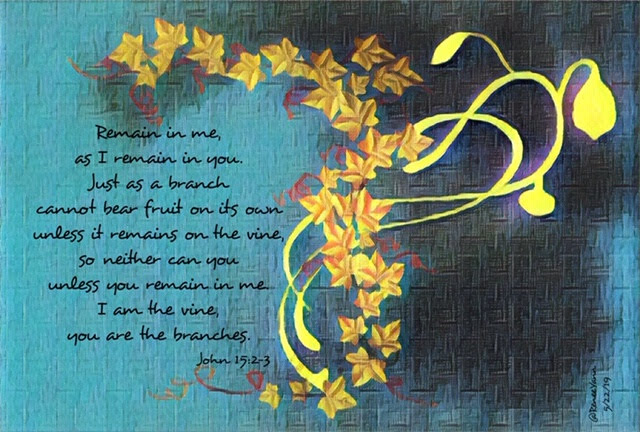
In our Gospel, Jesus talks about another kind of pruning, but the parallels are interesting.
A healthy and vigorous life in Christ is one that is “cultured” by God’s grace. That grace serves to cut away the unholy accretions that sometimes surface in our lives – sin, temptation, spiritual indifference, rampant self-interest, religious ennui……
Jesus said to his disciples:
John 15: 1-3
“I am the true vine, and my Father is the vine grower.
He takes away every branch in me that does not bear fruit,
and everyone that does he prunes so that it bears more fruit.
You are already pruned because of the word that I spoke to you.
God’s Word touches us through scripture, through spiritual teaching, and through our reverent assimilation of our life experiences. We must listen to our lives to hear God’s Word. There is never a moment when God is not speaking to us in love – and often to a completely new understanding of what it means to be in covenant with God.
The Apostles finally come to the decision that one does not become a disciple by physical circumcision but rather by a grafting of one’s heart to God’s own heart. May we, the Church, learn from that openness for our own times. May we become more aware of those assumptions which cut off whole segments of humanity, relegating them to the ecclesiastical sidelines.
I am the vine, you are the branches.
John 15: 5;7-8
Whoever remains in me and I in him will bear much fruit,
because without me you can do nothing…
If you remain in me and my words remain in you,
ask for whatever you want and it will be done for you.
By this is my Father glorified,
that you bear much fruit and become my disciples.”
Poetry: I Am the Vine – Malcolm Guite
How might it feel to be part of the vine?
Not just to see the vineyard from afar
Or even pluck the clusters, press the wine,
But to be grafted in, to feel the stir
Of inward sap that rises from our root,
Himself deep planted in the ground of Love,
To feel a leaf unfold a tender shoot,
As tendrils curled unfurl, as branches give
A little to the swelling of the grape,
In gradual perfection, round and full,
To bear within oneself the joy and hope
Of God’s good vintage, till it’s ripe and whole.
What might it mean to bide and to abide
In such rich love as makes the poor heart glad?
Music: Landscapes of the Heart – Gary Schmidt

 Lavish Mercy