
Today, in God’s Lavish Mercy, we pray with Psalm 146 which tells us just how very much God loves those whom no-one else appears to love.

Hallelujah!
Praise the Lord, O my soul!
I will praise the Lord as long as I live;
I will sing praise to my God while I have my being.
Put not your trust in rulers, nor in any child of earth,
for there is no help in them.
When they breathe their last, they return to earth,
and in that day their thoughts perish.
Happy are they who have the God of Jacob for their help!
For their hope is in the Lord their God,
who made heaven and earth, the seas,
and all that is in them;
who keeps promises for ever;
who gives justice to those who are oppressed,
food to those who hunger
and sets the prisoners free.
The Lord opens the eyes of the blind!
The Lord lifts up those who are bowed down
and loves the righteous.
The Lord cares for the stranger
and sustains the orphan and widow,
but frustrates the way of the wicked.
The Lord shall reign for ever,
your God, O Zion, throughout all generations.
Hallelujah!
In our readings this Sunday, we learn lessons from widows – those whose place in biblical times was uncertain and frightening. Without a husband, a woman experienced diminished standing in the legal, financial and political life of the community.
She was often dependent on charity, and was deemed fortunate to capture a bit of good will from those in better circumstances.
There are several examples of widows being blessed by miracles, because they were among those most in need of them.

In today’s first reading and in the Gospel, we meet two widows displaying amazing charity and character strength. The widow of Zarephath steadfastly prepares for death because she has nothing left to live on. When Elijah asks to share in her last few cornmeal cakes, she does not hesitate to feed him.
In our Gospel, it is significant that, just across the road from the well-stocked treasury, a nearly penniless widow gives her last coins to the poor.
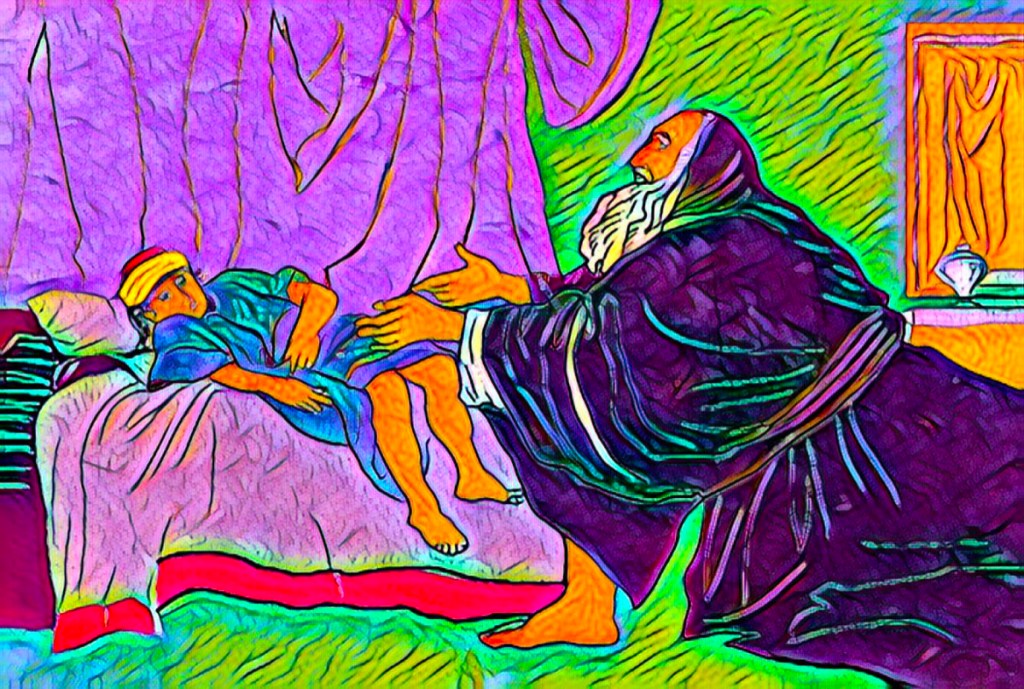
In Elijah’s account, we learn the outcome of the widow’s generosity. She reaps an abundant reward in perpetual flour and oil to sustain her and her son.
We never learn what happens to Jesus’s widow. We are left to imagine that, in some way, her selflessness is rewarded.
It is so hard to give it all to God, especially if we feel we have little left for ourselves. It is hard to give our love when we feel empty-hearted. It is hard to give care when we feel unappreciated. It is hard to assist others when we ourselves are exhausted. It is hard to do good if no one, not even God, seems to notice.
But God does notice. Like Jesus on that long-ago afternoon, God is watching as we empty our coffers in service and care for the poor, sick, troubled and lost.
What we have to give may be small — a single corn cake or two little coins. It is the act of giving it that is large — and will make our hearts large by the choice.
Poetry: The Widow of Zarephath by Sister Lou Ella Hickman, I.W.B.S, a member of the Sisters of the Incarnate Word and Blessed Sacrament of Corpus Christi, Texas. Her most recent collection of poetry is titled “she: robed and wordless“, available through press53
https://www.press53.com/lou-ella-hickman
i was like a small bird
pecking near a gate
when i went in search of twigs—
a bit of wood for a fire
so after one last meal
my son and i could die…
then a man asked for water—
a bit of bread
now i, a small bird,
found more than twigs
because i too, like ravens, fed him
Music with Visuals: The Widow of Zarephath

 Lavish Mercy