
March 4, 2022
Friday after Ash Wednesday
Today, in God’s Lavish Mercy, Isaiah cuts his listeners no slack — and, remember, we too are his listeners.
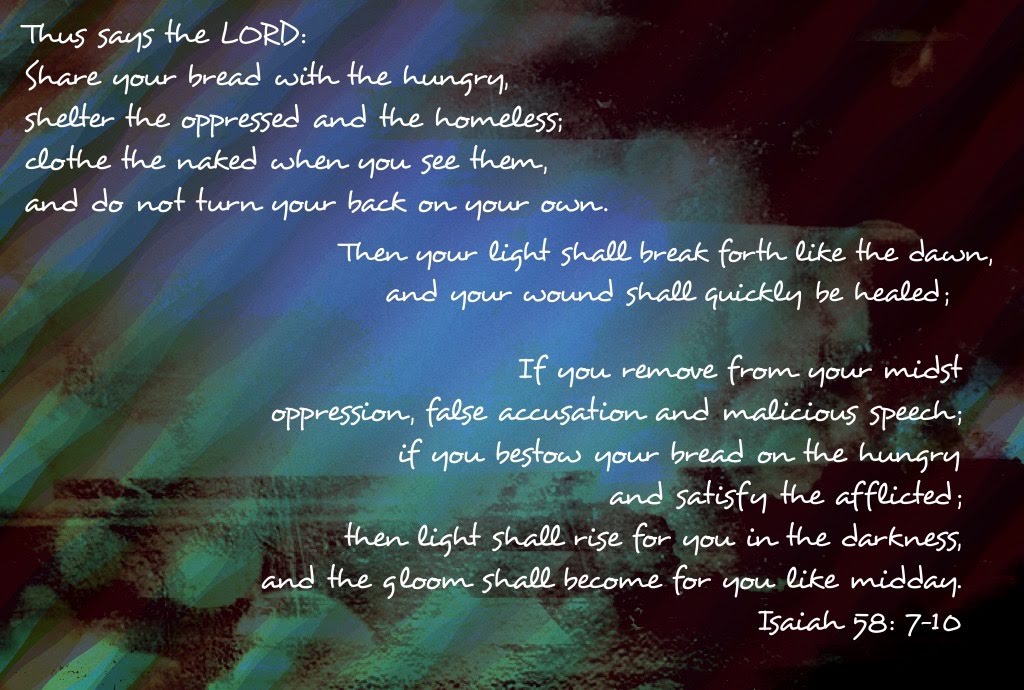
In this powerful passage, the prophet shatters the pretenses of those who make a show of religion. Speaking with God’s voice, Isaiah lambastes those who fast and pray but practice no works of justice and mercy.
Lo, on your fast day you carry out your own pursuits,
and drive all your laborers.
Yes, your fast ends in quarreling and fighting,
striking with wicked claw.
These “fake fasters” are left wondering why God doesn’t answer their prayers. The prophet tells them that God isn’t fooled by their pretenses:
Is this the manner of fasting I wish,
of keeping a day of penance:
That a man bow his head like a reed
and lie in sackcloth and ashes?
Isaiah says that God’s not into sackcloth and ashes. God’s into good works of mercy and justice. These are the actions that change our hearts, opening us to deeper relationship with God.
This, rather, is the fasting that I wish:
releasing those bound unjustly,
untying the thongs of the yoke;
Setting free the oppressed,
breaking every yoke;
Sharing your bread with the hungry,
sheltering the oppressed and the homeless;
Clothing the naked when you see them,
and not turning your back on your own.
Listen, dear friends. It can’t be clearer than that.
In a world full of “prosperity gospels”, false piety and pretend religion – used to justify all kinds of injustice – we may get mixed up sometimes about what pleases God.
Let’s really open our hearts to Isaiah’s message and try to rid our own lives of any pretense about these things.
Let’s confront such hypocrisy when we see it used to subtly oppress rather than to lift up others.
Then your light shall break forth like the dawn,
and your wound shall quickly be healed.
Perhaps we might spend sometime today thinking about that “wound” we need healed. Might there be some harbored prejudice, indifference, fear, or ignorance that distances us from others who are different, vulnerable, or in need?
Isaiah cautions that until that wound is healed,
we will never hear God’s true answer to our prayers.
Poetry: from Gitanjali by Rabindranath Tagore
Then said a rich man, “Speak to us of Giving”.
And he answered:
“You give but little when you give of your possessions.
It is when you give of yourself that you truly give.
For what are your possessions but things you keep and guard
for fear you may need them tomorrow?
And tomorrow, what shall tomorrow bring
to the overprudent dog burying bones in the trackless sand
as he follows the pilgrims to the holy city?And what is fear of need but need itself?
Is not dread of thirst when your well is full, thirst that is unquenchable?There are those who give little of the much which they have
and they give it for recognition and their hidden desire
makes their gifts unwholesome.
And there are those who have little and give it all.
These are the believers in life and the bounty of life,
and their coffer is never empty.There are those who give with joy, and that joy is their reward.
And there are those who give with pain, and that pain is their baptism.
And there are those who give and know not pain in giving,
nor do they seek joy, nor give with mindfulness of virtue;
They give as in yonder valley the myrtle breathes its fragrance into space.
Through the hands of such as these God speaks,
and from behind their eyes He smiles upon the earth.It is well to give when asked,
but it is better to give unasked, through understanding;
And to the open-handed
the search for one who shall receive is joy greater than giving.And is there aught you would withhold?
All you have shall some day be given;
Therefore give now, that the season of giving
may be yours and not your inheritors’.You often say, “I would give, but only to the deserving.”
The trees in your orchard say not so, nor the flocks in your pasture.
They give that they may live, for to withhold is to perish.Surely he who is worthy to receive his days and his nights
is worthy of all else from you.
And he who has deserved to drink from the ocean of life
deserves to fill his cup from your little stream.
And what desert greater shall there be than that which lies
in the courage and the confidence, nay the charity, of receiving?And who are you that men should rend their bosom and unveil their pride,
that you may see their worth naked and their pride unabashed?
See first that you yourself deserve to be a giver,
and an instrument of giving.
For in truth it is life that gives unto life –
while you, who deem yourself a giver, are but a witness.And you receivers – and you are all receivers –
assume no weight of gratitude,
lest you lay a yoke upon yourself and upon him who gives.
Rather rise together with the giver on his gifts as on wings;
For to be overmindful of your debt, is to doubt his generosity
who has the free-hearted earth for mother, and God for father.
Music: Respond – Collin Campbell (Lyrics below)
Oh how long will you cry out
And never truly seek my face
You come to me with heavy hearts
But you ignore what makes mine break
I see your thoughts, I hear your words
And I have watched you as you’ve prayed
I’ve told you my desires
But you don’t follow all the way
Children, I’m crying out
Break the chains
Let the oppressed go free
Empty yourselves to those in need
Be my hands Be my feet
What you do unto them You do unto Me
Every day you lift your voice
And await my swift response
But I see only what’s inside
And it’s (what i see on the inside) an offering I don’t want
Children, I’m crying out
Break the chains
Let the oppressed go free
Empty yourselves to those in need
Be my hands Be my feet
What you do unto them You do unto Me
Then your Salvation will come like the dawn
And my glory will be your shield
When you call on My name I will not turn away
I am Your God And I am here
And your light it will shine from the dark
You will be like a free flowing stream
And when you call on My name I will not turn away
I am your God And I am here




 Lavish Mercy