The Heart to Give My All

Memorial of Saint Aloysius Gonzaga, Religious
Wednesday, June 21, 2023

Today’s Readings:

https://bible.usccb.org/bible/readings/062123.cfm

Today, in God’s Lavish Mercy, Paul and Jesus give us some tips on sound Christian living.

Paul instructs us to live out of our abundance rather than our scarcity.

Brothers and sisters, consider this:
whoever sows sparingly will also reap sparingly,
and whoever sows bountifully will also reap bountifully.
Each must do as already determined, without sadness or compulsion,
for God loves a cheerful giver.
Moreover, God is able to make every grace abundant for you,
so that in all things, always having all you need,
you may have an abundance for every good work.

2 Corinthians 9:6-8

It seems like responding to Paul’s challenge shouldn’t be hard for those of us who actually have an abundance of this world’s goods and benefits. But I think sometimes it is.

It’s pretty easy to assess our generosity when we look at money or physical goods. It’s clear when I give someone in need $5.00 or a warm shirt. What’s not so clear is how generous I am , both locally and globally, with non-material goods like my prayer, respect, time, service, patience, understanding, forgiveness, tolerance, appreciation, encouragement or the many hidden awarenesses that might make someone else’s life more gracefully abundant.


Jesus tells us that if we offer these invisible generosities, we will be divinely enriched:

… your Father who sees what is hidden will repay you.


Jesus also expects us to make that offering. Notice that, when describing good works, Jesus doesn’t say “IF” you do these things. He says “WHEN” you do them:

When you give alms, do not blow a trumpet before you…
when you give alms,
do not let your left hand know what your right is doing,
so that your almsgiving may be secret.
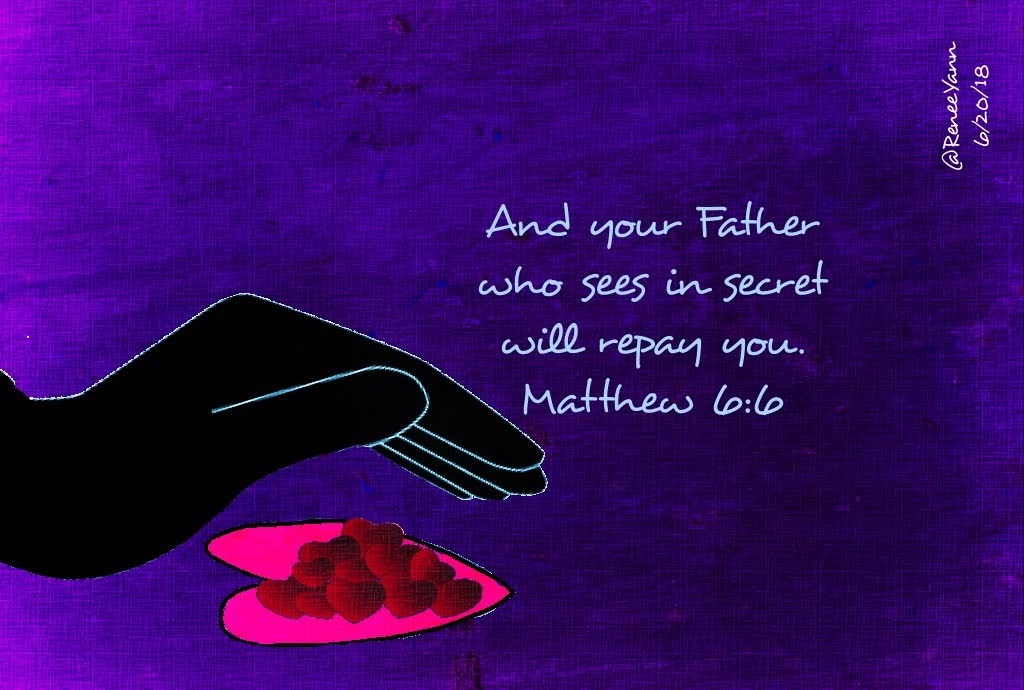
And your Father who sees in secret will repay you.


When you pray, do not be like the hypocrites,
who love to stand and pray on street corners …
when you pray, go to your inner room, close the door,
and pray to your Father in secret.
And your Father who sees in secret will repay you.


When you fast, do not look gloomy like the hypocrites …
when you fast, anoint your head and wash your face,
so that you may not appear to others to be fasting,
except to your Father who is hidden.
And your Father who sees what is hidden will repay you.”


Many of us are embarrassingly blessed in this life. Living gratefully is the first step to easing that embarrassment and turning it into spiritual self-knowledge. That deep gratitude will strengthen us for quiet, joyous generosity and the recognition that all our true abundance belongs to God.


Prose: from Gitanjali 50 – Rabindranath Tagore

I had gone a-begging from door to door in the village path, when thy golden chariot appeared in the distance like a gorgeous dream and I wondered who was this King of all kings!

My hopes rose high and methought my evil days were at an end, and I stood waiting for alms to be given unasked and for wealth scattered on all sides in the dust.

The chariot stopped where I stood. Thy glance fell on me and thou camest down with a smile. I felt that the luck of my life had come at last. Then of a sudden thou didst hold out thy right hand and say “What hast thou to give to me?”

Ah, what a kingly jest was it to open thy palm to a beggar to beg! I was confused and stood undecided, and then from my wallet I slowly took out the least grain of corn and gave it to thee.

But how great my surprise when at the day’s end I emptied my bag on the floor to find a least little grain of gold among the poor heap. I bitterly wept and wished that I had had the heart to give thee to my all.

Music: Soul Food – Dean Evenson

Beyond Expectation…

Tuesday of the Eleventh Week in Ordinary
June 20, 2023

Today’s Readings:

https://bible.usccb.org/bible/readings/062023.cfm

Today, in God’s Lavish Mercy, we receive an in-depth teaching on Christian generosity.

In the early Church, as in the Church today, evangelism and ministry require material support. In Paul’s time, the mother Church in Jerusalem needed funds to support ongoing mission activity.

In our first reading, Paul writes a “fund-raising” letter to the Greek Corinthians. He challenges them to be generous by raising up to them the outstanding example of the Macedonian churches (Philippi, Thessalonica, and Berea). These communities, despite their current hardship, gave beyond expectation to the Church’s need.

Macedonia and Greece had a competitive political relationship. Whether or not Paul was using this contention to stoke a response in Corinthian generosity, we can only guess. However, Paul is very clear about what should motivate the Christian heart to charity:

For you know the gracious act of our Lord Jesus Christ,
that for your sake he became poor although he was rich,
so that by his poverty you might become rich.

2 Corinthians 8:9

While Paul has offered a tutorial on material giving, Jesus inspires us to a much deeper generosity. Jesus asks us to imitate God in our loving benevolence:

Jesus said to his disciples:
“You have heard that it was said,
You shall love your neighbor and hate your enemy.
But I say to you, love your enemies
and pray for those who persecute you,
that you may be children of your heavenly Father,
for he makes his sun rise on the bad and the good,
and causes rain to fall on the just and the unjust.

Matthew 5:43-45

God’s generosity – God’s beautiful Mercy – does not distiguish between who is deserving and who is not. God’s love is universal and irrevocable. Jesus, who is the enfleshment of God’s Love, explains that God’s perfection consists in this Absolute Mercy. He tells us that we should strive to live a life in imitation of this Merciful Perfection.

For if you love those who love you, what recompense will you have?
Do not the tax collectors do the same?
And if you greet your brothers only,
what is unusual about that?
Do not the pagans do the same?
So be perfect, just as your heavenly Father is perfect.”

Matthew 5:46-48

Jesus is telling us that by living in generous mercy, beyond worldly expectation, we become “perfect” or whole in the Wholeness of God. Mercy heals not only those we touch, it heals us.


Poetry: To Live in the Mercy of God – Denise Levertov

To lie back under the tallest
oldest trees. How far the stems
rise, rise
before ribs of shelter
open!

To live in the mercy of God. The complete
sentence too adequate, has no give.
Awe, not comfort. Stone, elbows of
stony wood beneath lenient
moss bed.
And awe suddenly
passing beyond itself. Becomes
a form of comfort.
Becomes the steady
air you glide on, arms
stretched like the wings of flying foxes.
To hear the multiple silence
of trees, the rainy
forest depths of their listening.
To float, upheld,
as salt water
would hold you,
once you dared.
To live in the mercy of God.
To feel vibrate the enraptured
waterfall flinging itself
unabating down and down
to clenched fists of rock.
Swiftness of plunge,
hour after year after century,
O or Ah
uninterrupted, voice
many-stranded.
To breathe
spray. The smoke of it.
Arcs
of steelwhite foam, glissades
of fugitive jade barely perceptible. Such passion—
rage or joy?
Thus, not mild, not temperate,
God’s love for the world. Vast
flood of mercy
flung on resistance.

Music: Mormon Tabernacle Choir – Holy Art Thou »-(adapted from Handel’s Largo “Ombra mai fu” in “Xerxes”. A beautiful instrumental version is under the hymn lyrics below.)

Holy art Thou, Holy art Thou, Lord God Almighty
Glory and Majesty, in Heav′n are Thine
Earth’s lowly bending, swells the full harmony
Blessing and Glory to the Lamb, forevermore
For worthy, worthy art Thou
Worthy art Thou

Let all nations and kindreds and peoples
Give thanks to Thee, forevermore
Give thanks forevermore

Let all nations and kindreds and peoples
Give thanks to Thee, forevermore

The Other Cheek

Monday of the Eleventh Week in Ordinary Time
June 19, 2023

Today’s Readings:

https://bible.usccb.org/bible/readings/061923.cfm


Today, in God’s Lavish Mercy, Matthew hits us right between the eyes with one of the most difficult Gospel passages to defend, to explain, and – most certainly – to practice.

Jesus said to his disciples:
“You have heard that it was said,
An eye for an eye and a tooth for a tooth.
But I say to you, offer no resistance to one who is evil.


“Oh, wow’, we might think. “Did Jesus have any idea what kind of a world I’d be living in someday?!”


Violence is so rampant in our society that some of us have stopped looking at the news because we can’t stand it! Here in the U.S., we are traumatized by statistics around the number and kind of artillery in our neighborhoods and who dies as a result – children, worshippers, movie-goers, picnickers. Are these the “enemy” for whom we have designed our lethal weapons?

We see gunpoint carjackings, drive-by shootings, and unlicensed militia defending their political prejudices. We see children afraid to go to school. Mothers afraid to go shopping. Believers afraid to go to their place of worship. We have even seen an assault on the American government stoked by a nationalistic rhetoric of hostility, hatred, and aberrant machismo.

There are so many guns now on American streets that we may think the best response is to carry our own. The “law” allows that. We may consider ourselves valiant if we “stand our ground”, legally shooting some innocent bystander who happened to wander onto our property or drive into our traffic lane!

So what, in God’s Name, does this Gospel have to say to us who have descended almost beyond recue into the chasm of violence?


Remember, Jesus has just finished talking about the Law. He has assured his followers that he has come to fulfill the Law rather than to abolish it. Jesus honors and recognizes the Law as the framework that has held in place Israel’s centuries-long relationship with God.

But Jesus indicates that following the letter of the Law while not fulfilling its spirit is contradictory to the Reign of God. We can use the “law” as an excuse for our complacency – keeping in place those unexamined tenets that make us comfortable, rich, and more powerful to the detriment of others. This is what the Pharisees and Saducees had done.


In each of the five situations listed in today’s Gospel, Jesus isn’t telling us to lie down like a doormat and let ourselves be walked on. What he’s saying is that with God’s help, there is a better way, a deeper response that we can give to the conflicts in our lives.

Jesus encourages his followers not to meet the other with resistance. So often, resistance is our first defense rather than patience, negotiation, honesty, listening, or forgiveness. Jesus is asking us to stand still for a moment before lashing back – and in that moment move toward a more graced and courageous resolution. He is counseling us to listen, to imagine mutuality, and to work together for an equilibium of justice with mercy.

It must be admitted that sometimes this just doesn’t seem to work. Those with the power to make positive change can block the way, just as they did for Jesus. We can end up looking like “losers” – or even die – like Jesus did. But even though he had the power – the Omnipotence to do so – Jesus did not resist. If we really understand the Paschal Mystery and believe in the Resurrection, we will know why, and we will try to imitate him.


So where do we start? I think it starts with:

  • the level of reverence in our everyday interactions,
  • our attitudes toward “the other” – someone different from me in race, ethnicity, religion, sexuality, nationality, economic status, or opinion.
  • with our efforts toward reasonable gun legislation, educational equity for all children, universally available mental health services, and the eradication of abysmal poverty in our cities.

Can I do something to advance these changes? Not all by myself. But as a community of faith, Christians can bring amazing influence to these issues. Today’s Gospel is telling me to act on that belief.


Poem: Some – Daniel Berrigan, SJ

Some stood up once and sat down.
Some walked a mile and walked away.
Some stood up twice and sat down
I’ve had it, they said.
Some walked two miles and walked away
It’s too much, they cried.
Some stood and stood and stood.
They were taken for dummies
They were taken for fools
They were taken for being taken in.
Some walked and walked and walked.
They walked the earth
They walked the waters
They walked the air.
Why do you stand?
they were asked, and
Why do you walk?
Because of the children, they said, and
Because of the heart, and
Because of the bread.
Because
the cause
is the heart’s beat
and the children born
and the risen bread.

Music: Where Have All the Flowers Gone – written by Pete Seeger, sung by Joan Baez

God Has Always Been in Love with Us!

Eleventh Sunday in Ordinary Time
January 18, 2023

Today’s Readings:

https://bible.usccb.org/bible/readings/061823.cfm


Today, in God’s Lavish Mercy, our beautiful readings this Sunday paint the picture of a God Who is eternally in love with us.

The writer of Exodus twenty-five hundred years ago knew this.

Then the LORD called to Moses and said,
“Thus shall you say to the house of Jacob;
tell the Israelites:
You have seen for yourselves how I treated the Egyptians
and how I bore you up on eagle wings
and brought you here to myself.
Therefore, if you hearken to my voice and keep my covenant,
you shall be my special possession,
dearer to me than all other people
,
though all the earth is mine.

Exodus 19:3-5

Yes, God is eternally in love with us. Paul knew this when he wrote to the Romans about a half-century after Jesus lived on earth.

For Christ, while we were still helpless,
yet died at the appointed time for the ungodly.
Indeed, only with difficulty does one die for a just person,
though perhaps for a good person one might even find courage to die.
But God proves his love for us in that
while we were still sinners Christ died for us
.

Romans 5:6-8

And Matthew knew that God is eternally in love with us when he recorded this memory of his beloved Jesus:

At the sight of the crowds, Jesus’ heart was moved with pity for them
because they were troubled and abandoned,
like sheep without a shepherd.
….
Jesus sent out these twelve after instructing them thus,
“Do not go into pagan territory or enter a Samaritan town.
Go rather to the lost sheep of the house of Israel.
As you go, make this proclamation: ‘The kingdom of heaven is at hand.’
Cure the sick, raise the dead, cleanse lepers, drive out demons.

Matthew 9:36; 10:5-8

If God has loved us this long and this much, isn’t it time for us to really love God back?

In the above situations, and in our own lives, all that God ever asks for is faithfulness – through ups and downs, through ins and outs – God longs for our unwavering relationship.

A deep loving relationship like that requires our complete attention toward the Beloved.

How’re you doing with that?

It’s a question I’ll be asking myself – and God – in my prayer today.


Poetry: from Love’s Fire: Re-Creations of Rumi by Andrew Harvey

It is He who suffers his absence in me 
Who through me cries out to himself.
Love’s most strange, most holy mystery--
We are intimate beyond belief.

Music: The Everlasting Love of God – Matt Boswell and Matt Papa

Mary, Friend and Prophet

Memorial of the Immaculate Heart of Mary
June 17, 2023

Today’s Readings:

https://bible.usccb.org/bible/readings/061723.cfm

Today, in God’s Lavish Mercy, we celebrate Mary, our beautiful human kinswoman who allowed God to take flesh within her. In so doing, Mary taught us how to enflesh God in our own lives. Over a lifetime of prayer with her, we will continually learn her lesson.


Concepts of Mary, and her role in Salvation History, abound in theology and culture.  

madonna-della-seggiola-artwork-photo-1

Madonna della Seggiola ~ Raphael

While many of these images introduce us to a particular understanding of Mary, some can also limit her to deficient descriptions as sweet, passive, and limited in her role as young mother and wife.

immaculate heart

The hope is that Christians today will look beyond any limited definition to find the Prophet who voices a strong, faithful witness to Christ and to his Gospel for the poor and disenfranchised – a Mary whose life offers inspiration for the challenges we face in our own lives.

The Annunciation by Henry Ossawa Tanner 1896

The Annunciation ~ Henry Ossawa Tanner


Dr. Elizabeth Johnson, CSJ is distinguished Professor Emerita at Fordham University. In her ground-breaking book on Mary, Truly Our Sister, she says:

“Remembering Mary as a friend of God and prophet in the communion of saints, a woman who is truly sister to our strivings, allows the power of her life to play in the religious consciousness of the church, encouraging ever-deeper relationship with the living God in whom our spirits rejoice, and allying us with God’s redemptive designs for the hungry, the lowly, and all those who suffer, including in an unforgettable way women with their children in situations of poverty, prejudice, and violence.”


Today, in our prayer, let’s invite ourselves to an ever deeper understanding and relationship with Mary who, with her Immaculate Heart, is nevertheless truly our sister.

windsock visitation

Windsock Visitation ~ Michael O’Neil McGrath, OSFS


Poetry: Women Weaving – from Incarnation by Irene Zimmerman, SSSF

Afterwards, Mary moved from fear
(Will they drag me to the stoning place?)
to pain (Will Joseph doubt my faithfulness?)
to trust (I fear no evil—Thou art with me.)
and back again to fear. “I must go to my cousin,”
she said, and set out in haste for Judea.

As her feet unraveled the warp and woof
of valleys and hills, darkness and days
from Nazareth to Elizabeth,
Mary wove the heart of her Son.

When her newly-womaned cousin came,
Elizabeth, wise old weaver herself
for several months by then, instantly
saw the signs and heavily ran to meet her.

‘Who am I,” she called, “that the mother
of my Lord should come to visit me?”
and helplessly held her sides as laughter
shuttled back and forth inside her.

Then Mary sang the seamless song
she’d woven on the way.


Music:  Behold ( A modern Magnificat) ~ David Kauffmann ( Lyrics Below)

Behold, Behold
The mighty one has done great things for me
Behold, Behold
The mighty one has done great things for me
And Holy is your name

My soul exalts you
Behold my Lord whose mercy lies on me
My soul magnifies the Lord
My spirit rejoices in my savior
He looks at me with kindness
As with holy eyes of blindness
and all will call me blessed
Refrain

My soul exalts you
Behold my Lord whose mercy lies on me
Compassion inhabits those who fear him
He has done great deeds with his arms
Scattered the proud. Rulers are brought down,
and he has lifted the humble
Refrain

My soul exalts you
Behold my Lord whose mercy lies on me
He has filled the hungry with good things
and sent away the selfish empty handed
He has sent his servant, in remembrance of his mercy
and he has kept his promise
Refrain

My soul exalts you
Behold my Lord whose mercy lies on me
Whose mercy lies on me.

Come to Me

Solemnity of the Most Sacred Heart of Jesus
June 16, 2023

Today’s Readings:

https://bible.usccb.org/bible/readings/061623.cfm

Today, in God’s Lavish Mercy, we hear Moses tell the People:

You are a people sacred to the LORD, your God;
he has chosen you from all the nations on the face of the earth
to be a people peculiarly his own.

Deuteronomy 7:6

We modern readers may be a little put off by the use of the word “peculiar” which, since the 16th century, has taken on the connotation of “odd” or “uncommon”. But the original meaning of the word is “to belong exclusively to one person“, as in “Honey, I love you and you belong to me!” Moses is telling Israel that this is the way God loves them.


Below is a song many us will remember. Maybe as teenagers we even did the “Stroll” to its dulcet tones. The love described in this song is but a pale shadow of the love God has for us, and the longing sung about is but a weak imitation of God’s longing for us. Listen to it and let God sing to you – singing around the words and into the meaning behind them.

Thinking of God as we listen to a song like this can make God very human. And, of course, that is exactly who Jesus Christ is. Jesus loves us with a human heart and a divine love. He loves us with a Sacred Heart.


All love is refined and proven in sacrifice. Jesus testified to his infinite love for us in his Passion, Death and Resurrection. In that miracle of redemptive love, God embraces, strengthens and commissions us. We are to love as God loves – to have hearts themselves made sacred by imitation of Christ.

“Come to me, all you who labor and are burdened,
and I will give you rest.
Take my yoke upon you and learn from me,
for I am meek and humble of heart;
and you will find rest for yourselves.
For my yoke is easy, and my burden light.”

Matthew 11:28-30

Prose: In the late 17th, St. Margaret Mary Alacoque shared her vision of Christ’s Sacred Heart. In a book of her writings published after her death we read:

Christ showed me that it was His great desire
to be loved by human beings
and of withdrawing them from the path of ruin
that made Him form the design
of manifesting His Heart to us,
with all the treasures of love, of mercy, of grace,
of sanctification and salvation which it contains,
in order that those who desire
to render Him and procure Him
all the honor and love possible,
might themselves be abundantly enriched
with those divine treasures
of which His heart is the source.

Devotion to the Sacred Heart was fostered by the Jesuits and Franciscans, but it was not until the 1928 encyclical Miserentissimus Redemptor by Pope Pius XI that the Church validated the credibility of St. Margaret Mary’s visions of Jesus Christ in having “promised her that all those who rendered this honor to His Heart would be endowed with an abundance of heavenly graces.”

( see: https://sacredheartfla.org/sunday-mornings/seasonal/feast-days-solemnities/the-solemnity-of-the-most-sacred-heart-of-jesus/


Music: Empty Space – Jose Mari Chan

The Indescribable Gift

Thursday of the Tenth Week in Ordinary
June 15, 2023

Today’s Reading:

https://bible.usccb.org/bible/readings/061523.cfm


Today, in God’s Lavish Mercy, our readings offer us insight into spiritual clarity.

For sure I, like all of you reading this blog, want to know God more deeply.
Moses did.
The people of the Hebrew Scriptures did.
But Paul tells us in our first reading that they didn’t have the advantage – the “indescribable gift” – that we have: Jesus, the Incarnate Word of God.

To this day, whenever Moses is read,
a veil lies over the hearts of the children of Israel,
but whenever a person turns to the Lord the veil is removed.
Now the Lord is the Spirit and where the Spirit of the Lord is,
there is freedom.

2 Corinthians 3:15-17

Paul says that despite this gift, some of us, blinded by “the god of this age” may remain in darkness:

And even though our Gospel is veiled,
it is veiled for those who are perishing,
in whose case the god of this age
has blinded the minds of the unbelievers,

2 Corinthians 4:3-4

Paul compares this blocked vision to a veil covering our eyes and distancing us from the fullness of God.

It’s a great image! Don’t we unconsciously cover our eyes when we don’t want to see what’s really going on? Don’t we cast our own glance downward to obscure our eyes when we are unsure of ourselves or, maybe, telling a white lie?


This morning, when I read about Paul’s “veil”, I remembered a funny but instructive incident from my childhood. I was about seven years old and had been sent to my room for some egregious infraction of household law. Convinced of my innocence and righteousness, I pouted there until Mom called me downstairs for dinner.

Still angry, I didn’t want to go, so I decided not to “face” my family at the dinner table. Probably, deep in my heart, I knew I had been wrong but didn’t yet have the freedom to “face” myself. So, employing a pair of Mom’s old sunglasses and Grandpop’s handkerchief, I appeared at the dinner table like this – “veiled”. (Believe me, it was no fun trying to eat my mashed potatoes that way!)


I am a long, long way from that bratty little girl now. But there are still places in my life where I want to reach for the hanky and the glasses because I’m not ready for God’s overwhelming grace offered to me in every life circumstance. So often, I am still convinced that I see the darkness that I see, rather than the Mystery within it inviting me to Light..

For God who said, “Let light shine out of darkness”,
has shone in our hearts to bring to light
the knowledge of the glory of God
on the face of Jesus Christ.

1 Corinthians 4:6

Back when I was seven years old, it was Uncle Joe who teased me, with a gentle love, out of my peevishness. Maybe God is trying to do that for you, for me, today. What do you think?

(Uncle Joe and me, about 35 years after the described incident.)


Poetry: from Rumi

Your thoughts are a veil 
on the face of the Moon.

That Moon is your heart,
and those thoughts cover your heart.

So let them go,
just let them fall into the water.

Music: Heaven’s Window – Peter Kater – you will hear a gentle call to Agnus Dei, Jesus Lamb of God as the music lifts the veil to heaven. Just relax and let the music lift you too.

Promise Fulfilled

Wednesday of the Tenth Week in Ordinary Time
June 14, 2023

Today’s Readings:

https://bible.usccb.org/bible/readings/061423.cfm


Today, in God’s Lavish Mercy, both Paul and Jesus work to open the minds of their listeners to the wonder and mystery of Jesus Christ and his Gospel.

Paul tells the Corinthians that the old law did not bring life. In other words, it was a set of laws, precriptions, and memories. The old law was only letters. The New Law gives life through the living Spirit of God into Whom we have been baptized.

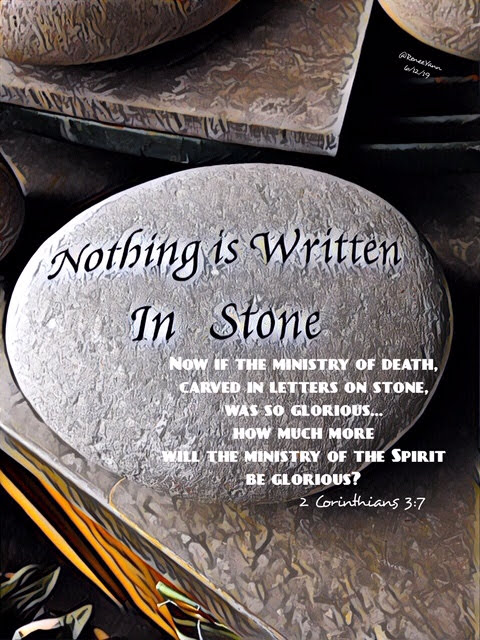
Now if the ministry of death, carved in letters on stone, was so glorious
that the children of Israel could not look intently at the face of Moses
because of its glory that was going to fade,
how much more will the ministry of the Spirit be glorious?
For if the ministry of condemnation was glorious,
the ministry of righteousness will abound much more in glory.

2 corinthians 3:7-9

Jesus talks about the old law too. He assures his listeners that he has not come to abolish it, but to fulfill it.

Do not think that I have come to abolish the law or the prophets.
I have come not to abolish but to fulfill.
Amen, I say to you, until heaven and earth pass away,
not the smallest letter or the smallest part of a letter
will pass from the law,
until all things have taken place.

Matthew 5: 17-18

I’m sure you’ve spent a few Easters opening plastic eggs with the kids in the family. Early on Easter morning, the eggs look so pretty sparkling undisturbed in their tiny baskets. But they can’t stay like that because the real treasure is inside – candy, coins or other little joy-giving gifts.

The Old Law was like those eggs, beautiful and perfect for its time, but existing for the sake of what would follow. With each Gospel teaching and act of his life, Jesus breaks open the Old to fulfill God’s promise and reveal the life-giving New.

Once again, Matthew paints a picture of Jesus as God’s Promise fulfilled. In each of our lives, that fulfillment continues as we grow in our love for and commitment to the Gospel.. May we “break open a few eggs”, and deepen in grateful awareness and understanding.


Poetry: Breakage – Mary Oliver

I go down to the edge of the sea.
How everything shines in the morning light!
The cusp of the whelk,
the broken cupboard of the clam,
the opened, blue mussels,
moon snails, pale pink and barnacle scarred—
and nothing at all whole or shut, but tattered, split,
dropped by the gulls onto the gray rocks and all the moisture gone.
It's like a schoolhouse
of little words,
thousands of words.
First you figure out what each one means by itself,
the jingle, the periwinkle, the scallop
full of moonlight.

Then you begin, slowly, to read the whole story.

Music: Morning Has Broken – Cat Stevens

Jesus, the Eternal “Yes”

Memorial of Saint Anthony of Padua
June 13, 2023

Today’s Readings:

https://bible.usccb.org/bible/readings/061323.cfm


Today, in God’s Lavish Mercy, our readings are about Truth, Spiritual Vigor, Holy Light.

For the Son of God, Jesus Christ, whom we proclaimed to you
was not “yes” and “no,” but only “Yes”.
For however many are the promises of God,
their Yes is in Jesus Christ …

2 Corinthians 1:19-20

A good friend of mine has taught me a lot about “Yes”, the kind of “Yes” I think Paul is describing in this passage. Sometimes, as with all friends, we might need a favor from each other – picking up a quart of milk, typing out a letter, providing transportation to a doctor.

I usually begin such a request with the phrase, “Could you do ^ me a favor…?” Somewhere in between “do” and “me”, my friend always shouts, “YES!!!” even before she hears what the favor is. Her “Yes”, rooted in loving friendship, is complete, unqualified, and inexhaustible.


God’s “Yes” to us, incarnate in the Gift of Jesus Christ, is eternally complete, unqualified, and inexhaustible!

Wow! Just think about that! Believing it can release immense power in our relationship with God! It can drag our Light out from under the bushel basket and into the world which is aching in darkness!


Our Gospel today, which continues Jesus’ Sermon on the Mount, describes what a Christian looks like who is trying to live their own “yes” back to God.

Such a believer is like salt, like light, like an elevated city calling us higher.

  • Salt – which releases and accents the good already inherent in our nature
  • Light – which makes the sacred path discoverable even in life’s shadows
  • City on the hilltop – which not only assures us that the journey can be accomplished, but turns to beckon and encourage us in our climb

Poetry: love is a place – e.e.cummings

love is a place
& through this place of
love move
(with brightness of peace)
all places

yes is a world
& in this world of
yes live
(skillfully curled)
all worlds

Music: Salt and Light – Lauren Daigle

Blessed

Monday of the Tenth Week in Ordinary Time
June 12, 2023

Today’s Readings:

https://bible.usccb.org/bible/readings/monday-tenth-week-ordinary-time


Today, in God’s Lavish Mercy, we resume reading Matthew’s Gospel which will last all the way to the beginning of September. What a gift to spend the summer with Jesus as Matthew came to understand and proclaim him.

So who is the “Jesus of Matthew”? Matthew’s Jesus is the Messiah, the long-awaited fulfillment of God’s promise to Abraham, a promise woven throughout the Hebrew Scriptures. Matthew writes to an audience who believe in Christ but who are nevertheless steeped in the Jewish religion. Matthew is intent on showing Jesus as the fulfillment of all they have believed.

Matthew’s Jesus is very Jewish. He is the Promise realized, the Hope fulfilled, Salvation achieved.


But Matthew’s Jesus is also the Challenger, the Upsetter and the Revolutionary.

In his Gospel sermon today, Jesus asks his believers to invert their worldly thinking and to take on the new mind of God – a God who loves the losers more than the winners! In the Beatitudes, Jesus gives an astounding new meaning to the word ‘blessed”.

In the Sermon on the Mount, Jesus contradicted all human judgments and all nationalistic expectations of the kingdom of God. The kingdom is given to the poor, not the rich; the feeble, not the mighty; to little children humble enough to accept it, not to soldiers who boast that they can obtain it by their own prowess.

John R. W. Stott, The Message of the Sermon on the Mount

I’ve been reading the Beatitudes my whole life, and they still confound me. I can’t honestly say that I want to be poor, mourning, meek, hungry, or thirsty. The only way I have been able to comprehend the Beatitudes is when I have found them in someone else and they have been kind enough to teach me.

I found “Blessed are the poor in spirit” one morning where he lived on a steam vent in downtown Philadelphia. He taught me courage and honesty.

Blessed are those who mourn” was a brokenhearted young wife who taught me how to love by steadfastly caring for her dying husband during his hospice journey.

Blessed are the meek” was a Cuban exile physician who was barred from a U.S. medical license. He taught me by lovingly serving as an orderly in the E.R. where I worked.

Blessed are those who hunger for righteousness” was an old Franciscan sister who was arrested with me in the Nevada desert as we protested nuclear war. Authorities had to handcuff her to her walker so that she could remain standing in the holding cell in the wretched heat.

Blessed are the merciful” is the name of our sisters and nurses at our healthcare facility who teach me by their tireless tenderness toward those who suffer

Blessed are the pure of heart” has sat with me a thousand times to pray and discern God’s Spirit in our hearts

Blessed are the peacemakers” have walked beside me in protests, written letters, made phone calls, witnessed peace in their own lives

Blessed are the persecuted” are my Black, Latino, differently-abled, and LGBTQ friends who have both taught and forgiven me for my prejudices, stereotyping, and ignorance


Learning to really live the Beatitudes is key to the Christian life, and it is an ongoing education until the day we die. As we pray with today’s Gospel, may we receive abundant grace for our learning.


Poetry: The Beatitudes – Malcolm Guite

We bless you, who have spelt your blessings out,
And set this lovely lantern on a hill
Lightening darkness and dispelling doubt
By lifting for a little while the veil.
For longing is the veil of satisfaction
And grief the veil of future happiness
We glimpse beneath the veil of persecution
The coming kingdom’s overflowing bliss
Oh make us pure of heart and help us see
Amongst the shadows and amidst the mourning
The promised Comforter, alive and free,
The kingdom coming and the Son returning,
That even in this pre-dawn dark we might
At once reveal and revel in your light.

Music: The Beatitudes – John Michael Talbot

Blessed are the poor in spirit
Theirs is the kingdom of heaven
Blessed are those who mourn
They shall be comforted

Blessed are the lowly of heart
They shall inherit the earth
Blest are those who hunger for God
Nevermore shall they hunger or thirst

CHORUS:
Blessings upon the disciples of Jesus
Blessings upon al the multitudes
Blessings upon those who climb the mountain
With Jesus the Lord, with Jesus our Lord

Blessed are those who show mercy
They shall inherit the mercy of God
Blessed are the pure of heart
They shall see the face of God

Blest are those who strive for peace
They shall be the children of God
Blest are those who suffer for holiness
Theirs is the kingdom of God