As we wake up today, perhaps surprised that it is already September, this descriptive poem by Helen Hunt Jackson may stir our prayerful appreciation for this glorious month.
In particular, I love the poet’s evocative final verse:
'Tis a thing which I remember;
To name it thrills me yet:
One day of one September
I never can forget.
Many of you, my dear readers, have such a memorable September day tucked in the tabernacle of time. It is, after all, a season of endings and beginnings – many of which can be life-changing, heart-changing.
As we remember , let’s lift up this first day in thanksgiving for all the blessings our Septembers have given us.
Today, in God’s Lavish Mercy, Paul instructs the Thessalonians on how to live a good Christian life. His teaching is strung on the tones of his time, and may fall a bit askew on our ears.
Reading Paul’s words today, I was immediately reminded of a report I read yesterday about Pope Francis’s visit with his Jesuit brothers in Portugal.
The Pope expressed his concern about what he terms “backwardism”, the intent to oppose any change in Church teaching. He said that “backwardism is useless, and it is necessary to understand that there is a correct evolution in the understanding of questions of faith and morals.”
Today’s reading offers us a good example of how we adapt our understanding of scripture according to advances in learning and the sciences.
The image of a man “acquiring” a wife for himself carries an objectification of women intolerable to a developed 21st century mind. Does that mean the teaching is invalid for us?
No. It simply alerts us that we must read all scripture with the understanding of enlightened Church teaching. The essence of this passage from Paul is not the instruction on how one finds a life companion. The essence is the call to holiness which never changes.
This is the will of God, your holiness.
The role of the Pope is to lead the Church in understanding the Word of God for or time. When asked for modern examples of these developing teachings, Francis cited these:
“Today it is a sin to possess atomic bombs; the death penalty is a sin, it cannot can be practiced, and it was not so before,” he said. “As for slavery, some pontiffs before me have tolerated it, but things are different today.”
——————————-
I found inspiration in the Pope’s continued explanation:
Francis went on to point to the writings of the fifth century monk, Vincent of Lérins, who taught that doctrine “may be consolidated by years, expanded by time, exalted by age.”
Change develops from the root upward, growing with these three criteria,” the pope told the Jesuits, noting that Lérins knew that the understanding of the human person is deepened with the passage of time.
The other sciences and their evolution also help the church in this growth in understanding,” Francis said. “The view of church doctrine as a monolith is wrong.”
from NCR: Christopher White, 8/28/2023
———————————-
Unfortunately, not all those charged with leadership and teaching exercise their role with this holy freedom. Fear, ignorance, greediness, and a lust for power can lurk behind even the most exalted title.
As today’s Gospel indicates, it takes great vigilance to remain ready for God. Over centuries for the Church, and over a lifetime for each of us, we must continue to fill our lamps with refreshed and deeper perceptions of God’s ever-unfolding, infinite Wisdom.
————————————
Prose: about St. Augustine
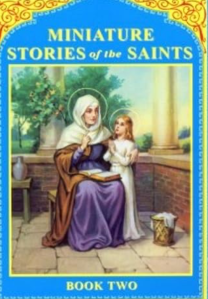
You may have heard this legend, written in the Middle Ages, by Jacobus de Voragine. I remember a book similar to the one below which you too might have seen as a child recounting legends of the saints.
St. Augustine spent 30 years writing his brilliant treatise “De Trinitate”. He never completed it.
Early in the process, as the story goes, Augustine was pondering along the seashore. He saw a young boy industriously running from the ocean back to a small hole dug in the sand. Each time the boy carried a shell full of water to the hole.
When asked, he told Augustine that he was trying to transfer the entire ocean to the hole. When Augustine assured him that that was an impossible task, the child responded, “It would be easier and quicker to draw all the water out of the sea and fit it into this hole than for you to fit the mystery of the Trinity and His Divinity into your little intellect; for the Mystery of the Trinity is greater and larger in comparison with your intelligence than is this vast ocean in comparison with this little hole.”
Today, in God’s Lavish Mercy, our readings speak to us about the power of witness.
We need the witness of one another’s faith to strengthen our own on life’s long journey. Even the strongest spiritual leader is encouraged by the faith and vitality of their traveling companions.
Paul was confirmed by the faithful witness of the Thessalonians to the point that his grateful prayer pours out in today’s letter.
We have been reassured about you, brothers and sisters,
in our every distress and affliction, through your faith.
For we now live, if you stand firm in the Lord.
What thanksgiving, then, can we render to God for you,
for all the joy we feel on your account before our God?
1 Thessalonians 3:7-9
In our Gospel, Jesus tells us that it takes constant vigilance to assure this kind of fidelity in our hearts. There are days when the long journey exhausts us. Sometimes one valley comes so quickly upon another that we stumble a bit in our trust or resolve.
It is at such times that the witness of those beside us is so important. When we are in the valley, we need to lifted by their light. When we are on the hilltop, we need to give that light unselfishly.
That mutuality seems to be working for Paul and the Thessalonians. We can join in Paul’s prayer, remembering when it has gifted us.
———————————————
Poetry: Thank God for Little Things – Helen Steiner Rice
Thank You, God, for little things that often come our way—
The things we take for granted but don’t mention when we pray—
The unexpected courtesy, the thoughtful, kindly deed—
A hand reached out to help us in the time of sudden need—
Oh make us more aware, dear God, of little daily graces
That come to us with “Sweet Surprise” from never-dreamed-of places.
Today, in God’s Lavish Mercy, our readings present us with a stark contrast.
Paul describes a community that has not only “heard” the Word but has allowed it to transform them:
And for this reason we too give thanks to God unceasingly, that, in receiving the word of God from hearing us, you received it not as the word of men, but as it truly is, the word of God, which is now at work in you who believe.
In contrast, Jesus delivers another blast of “woes” to the scribes and Pharisees whose “faith” is a pretense which hides a dead heart:
Woe to you, scribes and Pharisees, you hypocrites. You are like whitewashed tombs, which appear beautiful on the outside, but inside are full of dead men’s bones and every kind of filth. Even so, on the outside you appear righteous, but inside you are filled with hypocrisy and evildoing.
The readings inspire me to ask myself this question:
If I put my faith under a stethoscope, would it have a heartbeat?
I think back over my life and consider how the faith came to me. How did I begin to “hear” in the way that Paul describes?
Many of us began that “hearing” in faithful families, parishes, and schools where we learned stories that we loved and wanted to imitate. We saw faith lived out in the lives of those teachers and we were inspired to become like them.
Others of us came to the faith by a more circuitous route – perhaps, by some blessed experiential conversion that brought us face-to-face with the Holy.
In whatever ways the Word has spoken to us, and continues to speak, the question for us is always this:
Do we hear the Holy with our own hearts?
When a doctor or nurse holds a stethoscope to our chests, both we and they are quiet so that the heartbeat can be heard. So too when we listen for our “faith-beat”. We must settle down and let ourselves rest in God’s Silence. The Spirit will lead us to hear the graces pulsing at the core of our lives.
Sometimes the sound is strong, and we can rest in it with joyful satisfaction. But there are times when the beat is hard to discern because it is buried under life’s pressures and twists. We might find ourselves pressed down and entangled rather than Light-hearted with God.
Finding deep freedom in our spiritual life requires our attention. If we don’t nurture our souls, they will end up like that lonely plant on the windowsill about which we say, “Oh, I’ll water you later”, but later never comes!
Prose: John of the Cross offers two pieces of advice that may help us to free ourselves from those pressures and entanglements that inhibit our spiritual deepening:
Love consists not in feeling great things but in having great detachment and in living life sufferings for the Beloved. The soul that is attached to anything, however much good there may be in it, will not arrive at the liberty of Divine union. For whether it be a strong wire rope or a slender and delicate thread that holds the bird, it matters not, if it really holds it fast; for until the cord be broken, the bird cannot fly.
However softly we speak, God is so close to us that he can hear us; nor do we need wings to go in search of him, but merely to seek solitude and contemplate him within ourselves, without being surprised to find such a good Guest there.
Today, in God’s Lavish Mercy, we honor John the Baptist under the title of his “Passion”. The memorial used to be called “the Beheading of John the Baptist”, a title that more referenced the act of the criminal rather than the perseverance of the martyr.
The Gospel narrative is gripping, as is much of the history of John the Baptist. He was no smoldering wick. Rather, John was on fire with the Truth of the Messiah and he never compromised.
Herod was the one who had John the Baptist arrested and bound in prison on account of Herodias, the wife of his brother Philip, whom he had married. John had said to Herod, “It is not lawful for you to have your brother’s wife.” Herodias harbored a grudge against him and wanted to kill him but was unable to do so.
Mark 6: 17-19
In a commentary on this Gospel, Pope Francis described the central players like this: There are four characters:
King Herod “corrupt and indecisive”
Herodias, the wife of the king’s brother who “knew only how to hate”
Salome, “the vain ballerina”,
the “prophet, decapitated and alone in his cell”.
Pope Francis continued:
John had pointed Jesus out to His first disciples, indicating that He was the Light of the world. He, instead, gave his life little by little, to the point of being extinguished in the darkness of a prison cell. Life has value only when we give it; when it is given in love, in truth; when we give it to others, in daily life, in our families. It should always be given. If someone grasps his or her life in order to keep it, like the king by his corruption, or the woman with her hatred, or the child, the young girl with her vanity that was that of an adolescent, naive, life dies, life ends up withered, it is useless”
Homily of Pope Francis, Santa Marta, 8 February 2019
PopeBenedict XVI also offered some compelling thoughts on the Passion of John the Baptist: “Celebrating the martyrdom of St. John the Baptist also reminds us – Christians in our own times – that we cannot give into compromise when it comes to our love for Christ, for his Word, for his Truth. The Truth is the Truth; there is no compromise. The Christian life requires, as it were, the ‘martyrdom’ of daily fidelity to the Gospel; the courage, that is, to allow Christ to increase in us and to direct our thoughts and actions.”
Francis and Benedict give us plenty to think about as we celebrate this solemn feast. Let us pray for the courage to live our faith wholeheartedly, inspired by the unswerving fidelity of St. John the Baptist.
Poetry: from “Saint John the Baptist” by Thomas Merton
St. John, strong Baptist,
Angel before the face of the Messiah
Desert-dweller, knowing the solitudes that lie
Beyond anxiety and doubt,
Eagle whose flight is higher than our atmosphere
Of hesitation and surmise,
You are the first Cistercian and the greatest Trappist:
Never abandon us, your few but faithful children,
For we remember your amazing life,
Where you laid down for us the form and pattern of
Our love for Christ,
Being so close to Him you were His twin.
Oh buy us, by your intercession, in your mighty heaven,
Not your great name, St. John, or ministry,
But oh, your solitude and death:
And most of all, gain us your great command of graces,
Making our poor hands also fountains full of life and wonder
Spending, in endless rivers, to the universe,
Christ, in secret, and His Father, and His sanctifying Spirit.
Music: Jesu, Joy of Man’s Desiring – J.S. Bach – This beautiful hymn befits John’s great love and devotion to Jesus.
Today, in God’s Lavish Mercy, we make a shift in our first readings. We leave the Hebrew Scriptures for a while to pick up Paul’s letters – from now until almost the end of September.
We begin with the first letter to the Thessalonians. Written about twenty years after the Resurrection, 1 Thessalonians is widely agreed to be the first book of the New Testament to be written, and the earliest extant Christian text.
The lyrical opening greeting in itself is magnificent. With it, Paul confirms these very early Christians as a recognized and deeply appreciated community giving them the encouragement they need to sustain and grow their shared life in Christ.
Paul, Silvanus, and Timothy to the Church of the Thessalonians in God the Father and the Lord Jesus Christ: grace to you and peace.
1 Thessalonians: 1
And then, they are given this beautiful, grateful prayer from Paul naming and blessing their call and subsequent efforts for God:
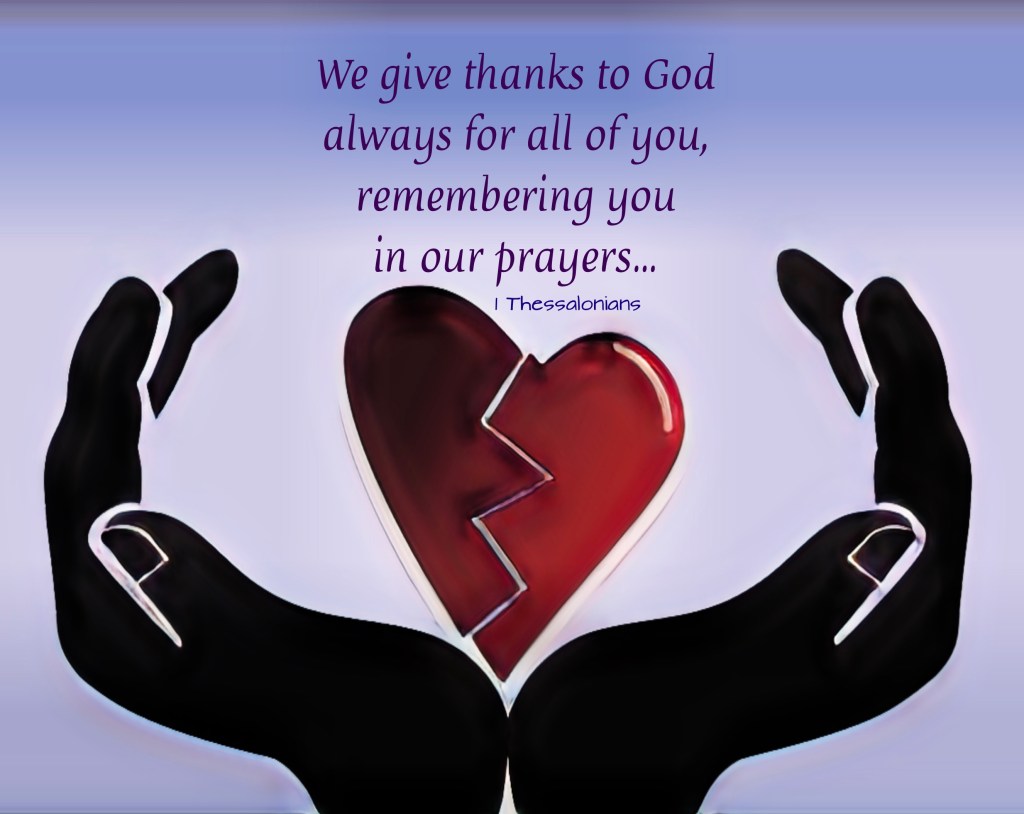
We give thanks to God always for all of you, remembering you in our prayers, unceasingly calling to mind your work of faith and labor of love and endurance in hope of our Lord Jesus Christ, before our God and Father, knowing, brothers and sisters loved by God, how you were chosen.
1 Thessalonians: 2-4
photo by Martin Sanchez from Unsplash
Praying with this passage, I am moved to recall the “encouragers of faith” in my own life. At those few times in my life when the floor seemed to fall out and I felt like I was hanging on by a fingernail, there have always been those dear voices who called to me the way Paul calls to the Thessalonians today:
I am praying for you
You are part of a community who needs you and will sustain you
Know that who you are and what you do is appreciated
By faith, you have endured difficulty before. You can do it again.
You are loved and chosen by God. Be confident in that Power.
This kind of loving support is a key element of Christian community.
In today’s Gospel, Jesus condemns those who completely miss that point. He calls them hypocrites because they bury the heart of community in compliance to their controlling and self-promoting laws.
Jesus said to the crowds and to his disciples: “Woe to you, scribes and Pharisees, you hypocrites. You lock the Kingdom of heaven before others. You do not enter yourselves, nor do you allow entrance to those trying to enter.
Woe to you, scribes and Pharisees, you hypocrites. You traverse sea and land to make one convert, and when that happens you make him a child of Gehenna twice as much as yourselves.
Matthew 23: 13-15
The fundamental charge laid against (the scribes and Pharisees) is hypocrisy—a gap between appearance and reality, between saying and doing, caused by a misplaced hierarchy of values and excessive emphasis on external matters to neglect of the interior.
Daniel J. Harrington – Sacra Pagina: The Gospel of Matthew
Jesus and Paul make it quite clear how we are to love and support one another in the Christian community. As we give thanks for those who have been such a support in our lives, let’s look into our own hearts for the same kind of behaviors. When we love one another in this way, we carry the otherwise invisible love of God to our sisters and brothers when they most need to see it.
Poetry: If I Can Stop One Heart from Breaking – Emily Dickinson
If I can stop one heart from breaking, I shall not live in vain; If I can ease one life the aching, Or cool one pain, Or help one fainting robin Unto his nest again, I shall not live in vain.
Music: You Raise Me Up – written by Rolf Levland and sung by Josh Groban
Today, in God’s Lavish Mercy, our readings revolve around the symbol of keys and the authority attached to them.
Chapter 22 of Isaiah tells the story of Eliakim whose name means “one whom God establishes”. Eliakim takes over as King Hezekiah’s prime minister. Shebna, his predecessor, has kind of wimped out as a fitting leader. Expecting an invasion by the Assyrian armies, Shebna has abandoned hope and instead built himself a nice tomb just in case. So, according to Isaiah, God is unhappy with Shebna and gives the authority and keys to Eliakim:
Thus says the LORD to Shebna, master of the palace: “I will thrust you from your office and pull you down from your station. On that day I will summon my servant Eliakim, son of Hilkiah; I will clothe him with your robe, and gird him with your sash, and give over to him your authority. He shall be a father to the inhabitants of Jerusalem, and to the house of Judah. I will place the key of the House of David on Eliakim’s shoulder; when he opens, no one shall shut, when he shuts, no one shall open.
Isaiah 22:19-22
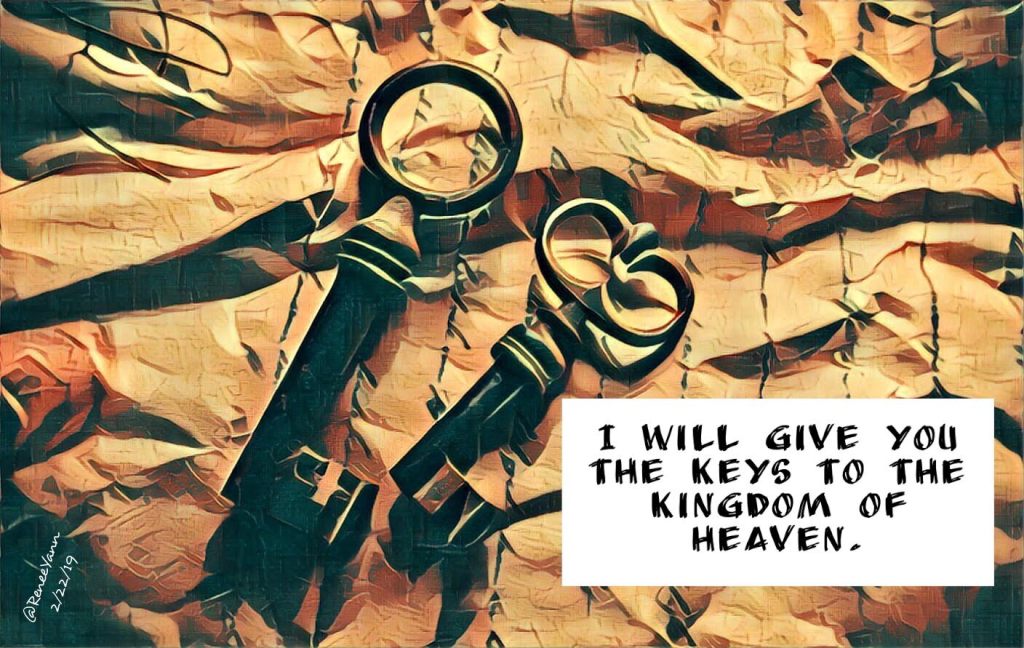
The bestowal of “keys” is the key concept here (not to make a pun.) Keys, both in the passage from Isaiah and from Matthew, symbolize the commissioning of Eliakim and Peter as immediate subordinates to the “king”. They are to act in the king’s place as necessary and appropriate. They have “the keys to the kingdom”.
Our second reading leads us to understand that the symbolic keys given to Peter unlock mysteries far exceeding those described in Isaiah. The entire exchequer of the Faith is placed in Peter’s hands, a treasury for which Christ makes Peter and his successors forever responsible.
Oh, the depth of the riches and wisdom and knowledge of God! How inscrutable are his judgments and how unsearchable his ways! For who has known the mind of the Lord or who has been his counselor? Or who has given the Lord anything that he may be repaid? For from him and through him and for him are all things. To him be glory forever. Amen.
Romans 11:33-36
While the Catholic Church interprets these passages as evidence for the primacy of Peter and the Popes, these scriptures also call all Christ’s disciples to plumb the depths of God’s infinite wisdom as it speaks within their own lives. In the community of learning and living we call “Church”, each of us has a role in illuminating the Gospel for our world.
Our daily prayer with the scriptures and our pursuit of reliable sources of sacred learning will deepen our ability to live the Gospel in our time. Peter did his job in his time. Now it’s our turn and Pope Francis’s turn. Let’s pray for him in a special way today.
Prayer for Pope Francis:
The ancient prayer for the Pope, sung regularly in the Vatican in Latin and found in prayer books and hymnals everywhere, is paraphrased from Psalm 41:3:
May the Lord preserve him, give him a long life,
make him blessed upon the earth,
and not hand him over to the power of his enemies.
O God, Shepherd and Ruler of all the faithful,
look down in your mercy upon your servant, Francis,
whom you have appointed to preside over your Church,
and grant, we beseech you, that both by word and example,
he may edify all those under his charge so that,
with the flock entrusted to him,
he may arrive at length unto life everlasting.
Music: Who Has Known – John Foley, SJ
Oh, the depth of the riches of God And the breadth of the wisdom and knowledge of God For who has known the mind of God To Him be glory forever
A virgin will carry a child and give birth And His name shall be called Emmanuel For who has known the mind of God To Him be glory forever
The people in darkness have seen a great light For a child has been born, His dominion is wide For who has known the mind of God To Him be glory forever
Today, in God’s Lavish Mercy, we continue with the story of Ruth, prototype of the Servant Christ. And we pray our first reading in the light of today’s Gospel in which Jesus teaches his disciples a key lesson in servant leadership:
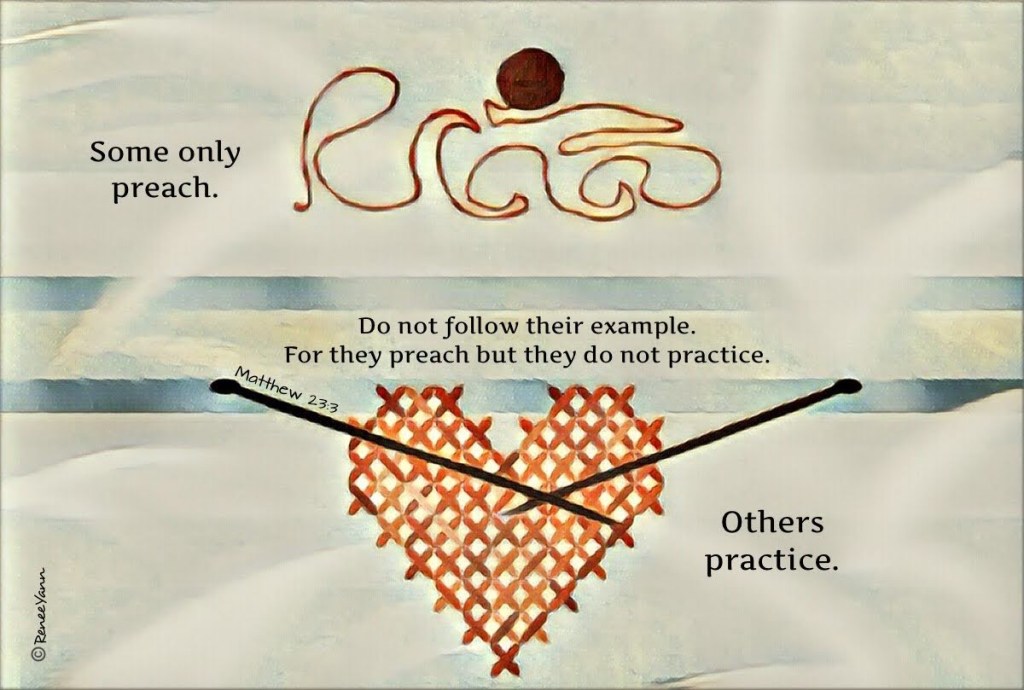
Jesus spoke to the crowds and to his disciples, saying, “The scribes and the Pharisees have taken their seat on the chair of Moses. Therefore, do and observe all things whatsoever they tell you, but do not follow their example. For they preach but they do not practice. They tie up heavy burdens hard to carry and lay them on people’s shoulders, but they will not lift a finger to move them. All their works are performed to be seen. They widen their phylacteries and lengthen their tassels. They love places of honor at banquets, seats of honor in synagogues, greetings in marketplaces, and the salutation ‘Rabbi.’
Matthew 23: 1-7
Jesus is so clear in this teaching. How is it that, even after 2000 years, we still don’t get it!
Stop and think about our culture – how we worship glitz, and bling, and “blow-em-up”! Listen to some of our political rhetoric filled with narcissistic “me-ism” and violent braggadocio. Look at some of the people in leadership positions around the world! They are tangled in their “phylacteries and tassels” and tripping us up with them.
Yes, even in our churches, we sometimes encounter supposed leaders who delight in places of honor and who lay burdens on the faithful rather than lift them.
Our first reading offers us humble Ruth who led and healed by selfless love.
Our Gospel reminds us that the Christian life is one of servant leadership fueled in a God-centered community to which all belong as sisters and brothers.
As for you, do not be called ‘Rabbi.’ You have but one teacher, and you are all brothers. Call no one on earth your father; you have but one Father in heaven. Do not be called ‘Master’; you have but one master, the Christ. The greatest among you must be your servant. Whoever exalts himself will be humbled; but whoever humbles himself will be exalted.
Matthew 23:8-12
History is the story of our struggle to find that balance of leadership and community that will foster the life of all people. It is the great struggle between sin and goodness, between a life lived only for self and a life lived generously with others.
As we deepen our spiritual understanding with today’s readings, we may see ways that we want to act and choose more intentionally around the ministry of leadership – as it is exercised by ourselves and by others.
Prayer: from Jesuit Resources at Xavier University.org
A Leader’s Prayer
Leadership is hard to define. Lord, let us be the ones to define it with justice. Leadership is like a handful of water. Lord, let us be the people to share it with those who thirst. Leadership is not about watching and correcting. Lord, let us remember it is about listening and connecting. Leadership is not about telling people what to do. Lord, let us find out what people want. Leadership is less about the love of power, and more about the power of love.
Lord, as we continue to undertake the role of leader let us be affirmed by the servant leadership we witness in your son Jesus. Let us walk in the path He has set and let those who will, follow.
Let our greatest passion be compassion. Our greatest strength love. Our greatest victory the reward of peace.
In leading let us never fail to follow. In loving let us never fail.
Today, in God’s Lavish Mercy, we read the tender and beloved story of Ruth and Naomi. We have come to love the beautiful exchange between these two women, filled with devotion and selfless love:
But Ruth said to Naomi, “Do not ask me to abandon or forsake you! For wherever you go, I will go, wherever you lodge I will lodge, your people shall be my people, and your God my God. Where you die I will die, and there be buried. May the LORD do thus to me, and more, if even death separates me from you!”
Ruth 1: 16-17
Who doesn’t long to be devoutly loved the way Ruth loved Naomi? Who, especially in elder years or lonely times, isn’t filled with gratitude for the faithful companionship of dear ones? Who isn’t moved at a wedding ceremony when young couples make brave promises like Ruth’s, having no idea what their vow will require down the years?
Reading the story of Ruth from these perspectives can carry us to deep reflection, but it can also leave us with an insubstantial or idealized perception of the infinite Love mirrored in this Scripture.
The Book of Ruth is so much more than an admirable devotion.
In the Book of Ruth, significant theological formation occurs, presenting a beautifully written story placed distinctively between the chaos of the Book of Judges and the epic struggle between the prophet Samuel and the intractable King Saul in the first book of Samuel. Nestled in between this chaotic downward spiral and the recalcitrance of Saul, Ruth exhibits resilience amidst vulnerability, an outsider grafted into the Davidic lineage and its climactic conclusion in Christ. A theology of hope for those found outside the normative structures of patriarchal, religious, and cultural normative spheres.
Bradford Parker: Ruth: A Theology of Resilience Amidst Vulnerability
Various authors suggest a host of underlying theological themes in Ruth:
the community is responsible for those who are hungry;
the experience of despair cannot be ignored;
people young and old are to be cared for; and
the marginalized are to push to the center, and those at the center are to move toward the marginalized. (Katherine Doob Sakenfeld: Ruth, Interpretation)
Another writer sees “Ruth is herself the “mirror of God” by reflecting Yahweh through her actions of devotion throughout the narrative.” (John C. Holbert: Preaching the Old Testament)
Andre LaCocque argues that “Ruth belongs to the extraordinary. She is characterized by hesed (Mercy).” (Ruth: Continental Commentary)
The Book of Ruth, on surface appearance, is a simple yet compelling story. But reading under its words, we will find astounding depth:
a faithful elder who now feels abandoned by God (Naomi),
a vulnerable young woman who chooses to act for mercy and justice (Ruth)
a man who, by aligning himself unselfishly to the Law, allows the continuation of the familial line which will lead through Obed to David and ultimately to Jesus.(Boaz)
Naomi teaches us how to respond from the depths of loss, sadness, diminishment, or fear. Ruth shows us how courage, fidelity, and mercy act in the everyday world. Boaz models faithfulness, responsibility, and justice given without question when needed.
It is not a stretch to say that Ruth is a Christ figure, foreshadowing the Merciful Jesus who accompanies us in our vulnerabilities and who, by loving us, teaches us how to love:
“Teacher, which commandment in the law is the greatest?” He said to him, “You shall love the Lord, your God, with all your heart, with all your soul, and with all your mind. This is the greatest and the first commandment. The second is like it: You shall love your neighbor as yourself. The whole law and the prophets depend on these two commandments.”
Matthew 22:36-40
Poetry: Rather than choose a single poem for you, here is the link to a series of thoughtful, poetic reflections on the characters in the Book of Ruth.
Today, in God’s Lavish Mercy, we pray with Psalm 145, a luxuriant song of praise to a God who overwhelms us with generosity.
I will extol you, my God and king; I will bless your name forever and ever.
Every day I will bless you; I will praise your name forever and ever.
Great is the LORD and worthy of much praise, whose grandeur is beyond understanding.
Psalm 145: 1-3
Citing verses 13-20 which are structured around the word “all”, Walter Brueggemann says:
The image is an overflow of limitless blessing given without reservation to all who are in need and turn to the Creator.
… Which brings us to Nathaniel and how this prayer might have sung in his heart.
I got to be friends with Nathaniel sixty years ago when, at my reception into our community, Mother Bernard decided to give me his name. And after an initial shock, I came to love it.
Nathaniel and I have spent countless hours under his fig tree sharing both our lives. I’ve asked him many times what he was thinking about when Philip came to invite him to meet Jesus. Nathaniel always has a different answer… one amazingly similar to whatever happens to be preoccupying me at the time.😇
a favorite old book that started some of my conversations with Nathaniel
One element remains constant in every circumstance: in his quiet moments, Nathaniel sought God’s Light. As our Gospel shows, that Luminous Word came to him and he responded.
I think that in our “fig tree moments”, we have finally sifted through all that we are capable of in order to find Grace in our lives. Now we wait, in the shade and quiet of prayer, for the True Answer to invite us into Its Mystery.
When that answering Word comes, it shatters our doubts and pretenses like eggshells. And through the shattered shells, the Word releases new life in us. We move deeper into the unbreakable Wholeness and Infinity. Like Nathaniel, even in our ordinary lives, we begin to “see greater things” than we had ever imagined.
Nathanael said to him, “How do you know me?” Jesus answered and said to him, “Before Philip called you, I saw you under the fig tree.” Nathanael answered him, “Rabbi, you are the Son of God; you are the King of Israel.” Jesus answered and said to him, “Do you believe because I told you that I saw you under the fig tree? You will see greater things than this.” And he said to him, “Amen, amen, I say to you, you will see heaven opened and the angels of God ascending and descending on the Son of Man.”
John 1:48-51
After that momentous afternoon when he was drawn from his figgy shade into the Light, Nathaniel’s life became a hymn of praise and thanksgiving.
Let all your works give you thanks, O LORD, and let your faithful ones bless you. Let them discourse of the glory of your Kingdom and speak of your might.
Psalm 145:10-11
Poem-Prayer from Christine Robinson
Psalm 145 – Opening Heart
I exalt you, Holy One, and open my heart to you
by remembering your great love.
Your expansiveness made this beautiful world
in a universe too marvelous to understand.
Your desire created life, and you nurtured
that life with your spirit.
You cherish us all—and your prayer
in us is for our own flourishing.
You are gracious to us
slow to anger and full of kindness
You touch us with your love—speak to us
with your still, small voice, hold us when we fall.
You lift up those who are oppressed
by systems and circumstances.
You open your hand
and satisfy us.
You ask us to call on you—
and even when you seem far away, our
longings call us back to you.
Hear my cry, O God, for some days, it is all I have.
Music: I Will Praise Your Name – Bob Fitts
Lord I will praise your name I will praise your name I will praise your name and extol You
I will praise Your name (I will praise Your name) I will praise Your name I will praise Your name As I behold You
I will magnify, I will glorify I will lift on high Your name, Lord Jesus I will magnify, I will glorify I will lift on high Your name, Lord Jesus
For Your love is never ending And Your mercy ever true I will bless Your name Lord Jesus For my heart belongs to You
I will praise Your name I will praise Your name I will praise Your name and extol you
I will magnify, I will glorify I will lift on high Your name, Lord Jesus For Your love is never ending And Your mercy ever true
I will bless Your name Lord Jesus For my heart belongs to You I will praise Your name I will praise Your name I will praise Your name and extol you I will magnify, I will glorify I will lift on high Your name, Lord Jesus











 Lavish Mercy