Jubilee!

Saturday of the Seventeenth Week in Ordinary Time
Saturday, August 5, 2023

Today’s Readings:

https://bible.usccb.org/bible/readings/080523.cfm


One in a series of 60 paintings by Jacob Lawrence which captures
the journeys of millions of African-Americans
who left the Jim Crow South
in search of better lives elsewhere.


Today, in God’s Lavish Mercy, Leviticus offers us a reading critical to our moral clarity.

This fiftieth year you shall make sacred
by proclaiming liberty in the land for all its inhabitants.
It shall be a jubilee for you,
when every one of you shall return to his own property,
every one to his own family estate.

Leviticus 25:10

Leviticus 25 is the account of Jubilee which, for the Mosaic community, was the quintessential practice of justice.

When the Israelites came to the Promised Land, they came as an emancipated people to share in the abundance to which God had delivered them. There was initial equity in the sharing. But over time, power, influence and wealth were hoarded – endangerments that threaten all communities.

In the proclamation of Jubilee, God directs the people to return to an original justice in which all persons are freed from indebtedness of any kind in order to live in communal harmony.


Consider the hypothetical example of an Israelite family that lost their land twelve years before the Jubilee Year. On the tenth day of the seventh month, the entire community participates in the Day of Atonement and its ritual purging of sin. On this very same day, the trumpet is blown and the Jubilee year is announced; in this year, both sins and debts are forgiven, and the family that had been forced to live and work in another’s household for more than a decade regain possession of their land.

Imagine the joy of this moment! Imagine the dreams and desires! After having served as hired hands for a generation, now to be restored to a position of social and economic strength!

Michael J. Rhodes – Jubilee Formation: Cultivating Desire and Dependence in Leviticus 25

The concept of this type of justice is alien to our capitalist and consumerist orientations. We may have heard the attitude expressed, or we may hold it ourselves, that some people have and some people don’t. And the ones who “have” earned it and deserve it.

“Jubilee” instructs us that this is a false context for fulfilling God’s Will for the wholeness of Creation. In such a false context, reward ensues from avarice, dominance, possessiveness, and aggression, yielding a continually deeper gap between those who have and those who do not, between those who influence and those who cannot, between those who thrive and those who do not.


“Jubilee” resets the game board and in so doing resets attitudes about who owns what and how they must use it to enact the Reign of God.

I recently heard a story which speaks of forgetting to whom things belong. A very proper lady went to a tea shop. She sat at a table for two, ordered a pot of tea, and prepared to eat some cookies which she had in her purse. Because the tea shop was crowded, a man took the other chair and also ordered tea. As it happened, he was a Jamaican black, though that is not essential to the story. The woman was prepared for a leisurely time, so she began to read her paper. As she did so, she took a cookie from the package. As she read, she noticed that the man across also took a cookie from the package. This upset her greatly, but she ignored it and kept reading. After a while she took another cookie. And so did he. This unnerved her and she glared at the man. While she glared, he reached for the fifth and last cookie, smiled and offered her half of it. She was indignant. She paid her money and left in a great hurry, enraged at such a presumptuous man. She hurried to her bus stop just ouside. She opened her purse to get a coin for her bus ticket. And then she saw, much to her distress, that in her purse was her package of cookies unopened. The lady is not different from all of us. Sometimes we possess things so long that do not really belong to us that we come to think they are ours. Sometimes, by the mercy of God, we have occasion to see to whom these things in fact belong.

Walter Brueggemann, “Voices of the Night—Against Justice,” in To Act Justly, Love Tenderly, Walk Humbly: An Agenda for Ministers

The applications are abundant, obvious, and profound for our own lives in the various communites in which we live. But they are not easy applications to confront or practice. They pose the ultimate question to us: where do we place our security? The answer determines how fully we understand “Jubilee”.


You have two meaningful prose passages to consider today so let’s just add a little music for your prayer time.

Gabriel’s Oboe – Ennio Morricone played by Henrik Chaim Goldschmidt

Outside the Lines

Memorial of Saint John Vianney, Priest
Friday of the Seventeenth Week in Ordinary Time
August 4, 2023

Today’s Readings:

https://bible.usccb.org/bible/readings/080423.cfm


Today, in God’s Lavish Mercy, we dip our toes into the Book of Leviticus which is basically a set of instructions on how to live a good life.

Leviticus 23 establishes five holy times of prayer, reflection, and action for the people to grow in friendship with God.

  • the Sabbath (vv. 1–3)
  • the Feast of the Unleavened Bread, or Passover (vv. 4–14)
  • the Feast of Weeks, or Pentecost (vv. 15–23);
  • on the Day of Atonement (vv. 26-32)
  • the Feast of the Tabernacles (vv.33-44)

As Christians, we may be more familiar with Sabbath and Passover because their patterns are embodied in our Sunday and Easter celebrations. In the other less familiar feasts, we might recognize harvest sharing (Weeks), repentance (Atonement), reflection and recommitment (Tabernacles).


The Book of Leviticus is a formation manual for Israel’s spiritual life. Realizing that fact this morning, I thought about my Novitiate and early formation experiences in religious life. Readers who are religious sisters or brothers might share my experience, and those who are lay can probably think of their own comparisons. What were our earliest steps in our journey into God?

I wasn’t completely clueless when I came to the convent at 18 years of age. I did have a vigorous spiritual life and a deep desire to grow in relationship with God. What I needed was spiritual discipline and a quiet reverence in my whole being. And, in those early years, I received abundant amounts of both from multiple sources. It was my “Leviticus Time”.


But our “Leviticus Time” is only a launchpad. If we refuse to leave it, we will never fly. What we must move on to is a personal relationship with God, grounded in loving faith and Gospel commitment. While enhanced by exterior resources, the power of that relationship springs from an interior intimacy with God, as realized so clearly by our saint for today, John Vianney.


Today’s Gospel shows us a group of people unable to take that next step – beyond rules and practices into committed relationship. (“beyond” not “without” rules and practices – more on that in tomorrow’s reflection)

Jesus came to his native place and taught the people in their synagogue.
They were astonished and said,
“Where did this man get such wisdom and mighty deeds?
Is he not the carpenter’s son?
Is not his mother named Mary
and his brothers James, Joseph, Simon, and Judas?
Are not his sisters all with us?
Where did this man get all this?”
And they took offense at him.
But Jesus said to them,
“A prophet is not without honor except in his native place
and in his own house.”
And he did not work many mighty deeds there
because of their lack of faith.

Matthew 13:54-58

This is such a sad Gospel! Here God was right in the midst of these people! They could see him and hear him. He personally invited them to believe. But they refused to see God in Jesus. All they could see was their stagnated prejudgments and inert definitions.

These were probably good people. They more than likely kept all the Leviticus regulations. They colored within the lines, so to speak. Then Jesus came and asked them to step outside the lines. He asked them to believe that the poor are blessed and the persecuted happy. He asked them to cast their nets again into a sea that had denied them all night. He asked them to walk to him across the water. He asked them to sell everything they had and follow. He asked them to fall into the ground and die, as he would.

Only a courageous few set their safe scroll of Leviticus aside to give Jesus a wholehearted “Yes”.

What might we have done — what are we doing — when Jesus invites us outside the lines?


Poetry: Of Being – Denise Levertov

I know this happiness
is provisional:

the looming presences --
great suffering, great fear --

withdraw only
into peripheral vision:
but ineluctable this shimmering
of wind in the blue leaves:
this flood of stillness
widening the lake of sky:
this need to dance,
this need to kneel:
this mystery:

Music: Only You

Something a little different this morning – a picture to contemplate while you listen to a beautiful song. Just click the little white arrowhead in the grey bar below. Let the song take you where it will in your own spiritual landscape.

image by David Mark from Pixabay

Shekhinah – Indwelling Presence

Thursday of the Seventeenth Week in Ordinary Time
August 3, 2023

Today’s Readings:

https://bible.usccb.org/bible/readings/080323.cfm


Today, in God’s Lavish Mercy, our scripture passages focus on how God dwells with us and calls us to ever greater intimacy.

In Exodus, Moses meticulously performs God’s instructions to build a holy dwelling place – the Ark of the Covenant. When Moses’s work is finished, God settles in among the Israelites and begins the new work of leading them to the promised land. It is a “Finished. What’s Next” scenario.

The “next” is this: by manipulating a visible cloud, God signals when it is time to rest and when it is time to move forward on the journey.

Whenever the cloud rose from the Dwelling,
the children of Israel would set out on their journey.
But if the cloud did not lift, they would not go forward;
only when it lifted did they go forward.

Exodus 40:35-36

Verse 33, not included in today’s selection, says this:

Finally, Moses set up the court around the tabernacle and the altar and hung the curtain at the gate of the court.
Thus Moses finished all the work.

Exodus 40:33

The italicized phrase should ring a bell with us. It is reminiscent of this familiar phrase in Genesis:

By the seventh day God had finished the work he had been doing; so on the seventh day he rested from all his work.

Genesis 2:2

And it is predictive of this solemn phrase in John’s Gospel:

When he had received the sour wine, Jesus said, ‘It is finished,’ and he bowed his head and gave up his spirit.

John 19:30

Praying with Exodus today, we might consider how God continually finishes chapters in history and in our lives. With each completion, a new dynamic is initiated which reveals God’s deeper Presence to us. If our hearts are open, God always invites us deeper – that is the journey.


God enacts this ever-renewing revelation in the Scriptures as well as in our lives.

  • In Genesis, God comes to dwell in the Creation.
  • In Exodus, God comes to dwell in Presence.
  • In the Incarnation, God comes to dwell in our flesh.
  • In Pentecost, God comes to dwell in our spirits, giving us the capabilty of opening ourselves to the inexhaustible bounty of God’s Love.

God keeps coming to us anew, not with a new Face, but with a Face that, earlier, we may not have had the depth to recognize.


A word from the Hebrew, first encountered in ancient rabbinic literature, captures the concept of the eternal generative Presence dwelling among us: Shekhinah. The word means “dwelling” or “settling” and denotes the presence of God, as it were, in a particular place.


In today’s Gospel passage, Jesus finishes a significant chapter of his ministry. In five succinct parables, Jesus has painted a picture of our “next” – the Kingdom of Heaven.

  • the mustard seed
  • yeast
  • the hidden treasure
  • the merchant
  • the net

Image by chanwit whanset from Pixabay


Closing today’s lesson, Jesus charges the future teachers of the faith to remember the whole history of God’s indwelling as they guide the people to God’s penultimate revelation. As we move forward to a Parousia we can only imagine, we can be encouraged and consoled by the stories of God’s Presence in the past, and imaged for us in the parables.

“Then every scribe who has been instructed in the Kingdom of heaven
is like the head of a household who brings from his storeroom
both the new and the old.”

Matthew 13:52

Image by chanwit whanset from Pixabay


Before today, we may never have thought of ourselves as God’s “scribes”. But just as God used our first parents, and Moses, and the early disciples, God is using us to write the current and future story of God’s love for all Creation.

The chapter with your name will not be included in the Bible, but it will be written large in the Book of Life. It will be read by those who love you, depend on you, work with you, or need you. Each of our lives, in its own way, is a scipture for our times.


Poetry: Wellfleet Shabbat – Marge Piercy

The hawk eye of the sun slowly shuts.
The breast of the bay is softly feathered
dove grey. The sky is barred like the sand
when the tide trickles out.

The great doors of Shabbat are swinging
open over the ocean, loosing the moon
floating up slow distorted vast, a copper
balloon just sailing free.

The wind slides over the waves, patting
them with its giant hand, and the sea
stretches its muscles in the deep,
purrs and rolls over.

The sweet beeswax candles flicker
and sigh, standing between the phlox
and the roast chicken. The wine shines
its red lantern of joy.

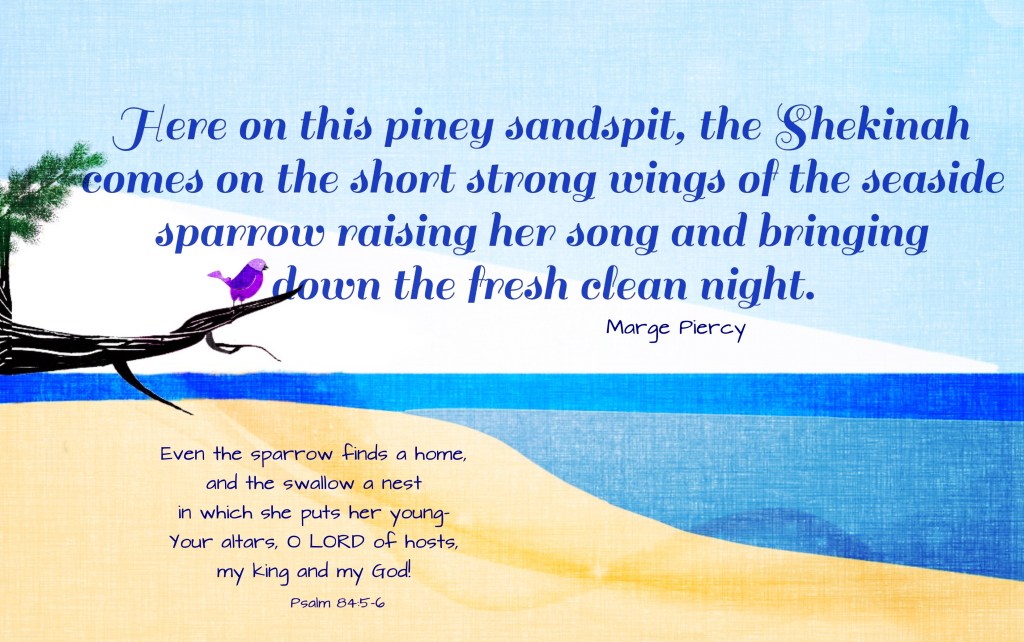
Here on this piney sandspit, the Shekinah
comes on the short strong wings of the seaside
sparrow raising her song and bringing
down the fresh clean night.

Music: Dwelling Place – John Foley, SJ

Shine!

Wednesday of the Seventeenth Week in Ordinary Time
August 2, 2023

Today’s Readings:

https://bible.usccb.org/bible/readings/080223.cfm


Today, in God’s Lavish Mercy, Moses descends the mountain and returns to the people, his face shining with the glory of God.

As Moses came down from Mount Sinai
with the two tablets of the commandments in his hands,
he did not know that the skin of his face had become radiant
while he conversed with the LORD.

Exodus 34:29

Moses’s appearance frightened the Israelites. They weren’t accustomed to being this close to “The God Effect”. Moses had to veil his face until the people became a little more comfortable with his transformed self.


People who are close to God do have a certain “shine”. I know, because I live with a houseful of them! Most of these wonderful women are well into their years, and will moan occasionally about their ever-increasing wrinkles. Like most of us, they don’t see their own beauty, nor the fact that an inimitable loveliness radiates from their fundamental goodness.


Once again in today’s Gospel, as in this past Sunday’s, Jesus encourages his followers to live in that irradiating Presence. Finding that Presence is like finding a treasure or a pearl of great price. The Gospel searcher is filled with abundant “joy” upon the discovery. That joy, no doubt, lit up that finder the way Moses was fired by God’s Glory.


We all want to have that kind of joy. It is the true fulfillment of life. Jesus wants us to have it too as recorded in today’s Alleluia Verse:

I call you my friends, says the Lord,
for I have made known to you all that the Father has told me.

John 15:15

By studying, praying with, and imitating the life of Christ, we too – like the moon emblazoned by the Sun – will come to reflect an Immense Love.


Poetry: As Kingfishers Catch Fire – Gerard Manley Hopkins

As kingfishers catch fire, dragonflies draw flame;
As tumbled over rim in roundy wells
Stones ring; like each tucked string tells, each hung bell's
Bow swung finds tongue to fling out broad its name;
Each mortal thing does one thing and the same:
Deals out that being indoors each one dwells;
Selves — goes itself; myself it speaks and spells,
Crying Whát I dó is me: for that I came.
I say móre: the just man justices;
Keeps grace: thát keeps all his goings graces;
Acts in God's eye what in God's eye he is —
Chríst — for Christ plays in ten thousand places,
Lovely in limbs, and lovely in eyes not his
To the Father through the features of men's faces.

Music: Variations on a Theme From Pachelbel’s Canon in D Major – David Lanz