February blessings to all my readers!


February blessings to all my readers!
Today’s Readings:
https://bible.usccb.org/bible/readings/020124.cfm
Today, in God’s Lavish Mercy, as February’s deep season unrolls, we are just about two weeks away from the beginning of Lent. Our first readings during this time will give a little taste of 1 Kings and then briefly shift to James’s epistle before we pick up the treasured readings of the Lenten Season.

The passage today bears a royal gravity. After preparing his son Solomon for kingship, David solemnly dies.
Keep the mandate of the LORD, your God, following his ways
and observing his statutes, commands, ordinances, and decrees
as they are written in the law of Moses,
that you may succeed in whatever you do,
wherever you turn, and the LORD may fulfill
the promise he made on my behalf….… David rested with his ancestors and was buried in the City of David.
The length of David’s reign over Israel was forty years:
he reigned seven years in Hebron
and thirty-three years in Jerusalem.Solomon was seated on the throne of his father David,
1 Kings 2; 3-4;10-12
with his sovereignty firmly established.
David’s advice to Solomon is basically this: there is work to be done for God and God’s People. And now it’s your responsibility. Keep the course!
In our Gospel, Jesus gives the same sort of mandate to this disciples:
Jesus summoned the Twelve and began to send them out two by two
Mark 6:7-8
and gave them authority over unclean spirits.
He instructed them to take nothing for the journey but a walking stick
–no food, no sack, no money in their belts.
The disciples are ready. It is now their turn to spread the Gospel and to continue the ministry that they have learned at Jesus’s side:
So they went off and preached repentance.
Mark 6:12-13
The Twelve drove out many demons,
and they anointed with oil many who were sick and cured them.
If any of us are wondering what we are supposed to do today for the Reign of God, our answer may be somewhere in these readings as we pray them with an open heart.
Poetry: The Poem of Tecumseh – Tecumseh (1768 –1813) was a Shawnee chief and warrior who promoted resistance to the expansion of the United States onto Native American lands. A persuasive orator, Tecumseh traveled widely, forming a Native American confederacy and promoting intertribal unity. Even though his efforts to unite Native Americans ended with his death in the War of 1812, he became an iconic folk hero in American, Indigenous, and Canadian popular history. (Wikipedia)
Music: Heal the World – Michael Jackson
Today’s Readings:
https://bible.usccb.org/bible/readings/013124.cfm
Today, in God’s Lavish Mercy, David gets himself in trouble once again.
King David said to Joab and the leaders of the army who were with him,
2 Samuel 24: 2;10
“Tour all the tribes in Israel from Dan to Beer-sheba
and register the people, that I may know their number.”
Joab then reported to the king the number of people registered:
in Israel, eight hundred thousand men fit for military service;
in Judah, five hundred thousand.
Afterward, however, David regretted having numbered the people,
and said to the LORD:
“I have sinned grievously in what I have done.
But now, LORD, forgive the guilt of your servant,
for I have been very foolish.”
In the later years of his kingship, David is pretty impressed with himself. The kingdom has grown exponentially. There is peace and prosperity. David wants a census taken so that he can assess his capacity for new expansion.
So why does God get so mad about this census? The Book of Exodus sets out that a person has the right to number only his own belongings. The People belong to God, not to David. David’s pride and self-satisfaction has taken him over.

However, as usual, David repents. This is probably the best lesson we can learn from him. Then, in a greatly allegorized treatment, God gives David a choice of three punishments.
Passages like this can confuse us if we interpret them literally. Does God really interact and punish like this?
It helps to remember the purpose of these writings — not to relay a factual history, but rather to tell a story that helps us grow in relationship with God.
What I believe happened here is that a pestilence did fall upon the country. At the same time, David realized that his heart had grown selfish and graceless. He took the natural event as a sign to turn back to God. And then the writers told the story in a way that the ancient peoples could relate to – with a metaphorical image of a God that forgives but gets even.
In our Gospel, Jesus preaches a clearer and true vision of God – a vision of Complete Mercy, especially toward the vulnerable, weak, and sinful. That pretty much includes all of us.
Jesus releases the power of this Divine Mercy by his words and miracles. But his own family and neighbors reject him. They are more comfortable with a God who behaves like they do – meting out more judgement and punishment (preferably toward others!😉) than mercy and inclusive benediction.
In this Gospel, we begin to see Jesus as One who asks not only for repentance but for conversion – for a new way of being with God and neighbor, the way of Love.
How might we have responded had we been in that neighborhood synagogue? How are we responding today?
Film Excerpt from The Chosen: Jesus is rejected at Nazareth
Music: Today’s Responsorial Psalm 32 – Marty Goetz ( Lyrics below)
Psalm 32 – Marty Goetz
These are periled times we live in, trouble everywhere
Weary hearts will often give in to this world’s despair
But high and over all, our Father knows our every care
And in His Book, if you will look, you’ll find His promise there
(Chorus)
He who trusts in the Lord
Mercy shall surround him
He who trusts in the Lord
Mercy shall surround him
Be glad in the Lord and rejoice
You upright in heart, lift up your voice
For great is His mercy toward all who trust in the Lord
Soon will be the time when we will see the Holy One
Oh how sweet to know that He’ll complete what He’s begun
And blessed is the man who stands forgiven in God’s son
And blessed are they who in that day will hear Him say, “Well done”
(Chorus)
Gracious is He and slow to anger
His loving kindness has no end
With love to embrace both friend and stranger
Reaching out to one and all, who upon His name will call
(Chorus)
Mercy is His reward
For all who trust, for the pure and just
Who put their trust in the Lord
For all who trust for the pure and just who put their trust in the Lord
Today’s Readings:
https://bible.usccb.org/bible/readings/013024.cfm
Today, in God’s Lavish Mercy, we read one of the saddest lines in Scripture.

You have followed the story in these daily passages. Absalom rebels, designing to usurp his father’s throne. A massive battle rises between them. David, as commander-in-chief, remains behind, but gives instructions to his generals to spare Absalom’s life. Joab ignores the command, killing Absalom in a moment of vulnerability.
David is devastated.

I think there is no more wrenching human emotion than regret. When I ministered for nearly a decade as hospice chaplain, and later in the hospital emergency room, I saw so much regret.
People who had waited too long to say “I’m sorry”, “I forgive you”, “Let’s start over”, ” It was my fault too..”, “Thank you for all you did for me”, “I love you”…..
Instead, these people stood at lifeless bedsides saying things like, “I should have”, “I wish…”, “If only…”
Life is complex and sometimes difficult. We get hurt, and we hurt others — sometimes so hurt that we walk away from relationship, or stay but wall ourselves off.
We might think that what is missing in such times is love. But I think it is more likely truth. In times of painful conflict, if we can hear and speak our truth to ourselves and one another, we open the path to healing.
If you want the truth, I’ll tell you the truth.
Listen to the secret sound,
the real sound, which is inside you.
~ Kabir
That healing may demand adjustments, agreements, even a willingness to step apart in mutual respect. But if the changes emerge from shared truth, restoration and wholeness are possible.
David and Absalom never found that path because they were so absorbed in their own self-interests. Theirs was the perfect formula for regret – that fruitless stump that perpetually sticks in the heart.
I remember a trauma surgeon leaving the hospital late one night after an unsuccessful effort to save a young boy who had been shot. The doctor carried the loss so heavily as he walked into the night saying to me, “I’m just going to go home and hug my kids.”
As we pray over David and Absalom today, let us examine our lives for the still healable fractures and act on them. Let us “hug” the life we have. Regret is a useless substitute.
Poetry: The Eyes of My Regret – Angelina Weld Grimké
Angelina Weld Grimké was born in Boston on February 27, 1880. She was the daughter of Archibald Grimké, who had been born a slave in Charleston, South Carolina, and Sarah Stanley Grimké, a white woman and the daughter of an abolitionist. Named after her great-aunt, the abolitionist and suffragist, Angelina Grimké Weld, Grimké grew up in liberal, aristocratic Boston society. She attended the best preparatory schools in Massachusetts, including Cushing Academy and the now defunct Carleton School.
My readers might be interested in Sue Monk Kidd’s excellent historical novel “The Invention of Wings” which tells the story of the poet’s abolitionist great-aunts, the Grimké sisters.
The Eyes of My Regret
Always at dusk, the same tearless experience,
The same dragging of feet up the same well-worn path
To the same well-worn rock;
The same crimson or gold dropping away of the sun
The same tints—rose, saffron, violet, lavender, grey
Meeting, mingling, mixing mistily;
Before me the same blue black cedar rising jaggedly to a point;
Over it, the same slow unlidding of twin stars,
Two eyes, unfathomable, soul-searing,
Watching, watching—watching me;
The same two eyes that draw me forth, against my will dusk after dusk;
The same two eyes that keep me sitting late into the night, chin on knees
Keep me there lonely, rigid, tearless, numbly miserable,
—The eyes of my Regret.
Music: When David Heard – Eric Whitaker (The piece builds. Be patient. Lyrics below)
When David heard that Absalom was slain,
he went up into his chamber over the gate and wept,
and thus he said;
My son, my son,
O Absalom my son,
would God I had died for thee!
When David heard that Absalom was slain,
he went up into his chamber over the gate and wept,
and thus he said;
My son, my son.
Today’s Readings:
https://bible.usccb.org/bible/readings/012924.cfm

Today, in God’s Lavish Mercy, our readings are peppered with angst, curses, demons, and rampaging pigs. Not the perfect way to start your day, right? So after quietly reading all the passages, I asked myself if they had anything to offer me this morning, or should I just play Spider Solitaire on my iPad?
As I considered that question, last night’s evening news flashed before my mind – gun violence, assaults, war, hit-and-run accidents! Suddenly I realized that my world is not that different from the mayhem around David or Jesus. My world just wears different clothes and can create chaos faster because of technological power.
The cause of David’s dire situation is clearly defined by Shimei, the curser:

Shimei Curses David – by Julius Schnorr von Carolsfeld
As David was approaching Bahurim,
2 Samuel 16:5-7
a man named Shimei, the son of Gera
of the same clan as Saul’s family,
was coming out of the place, cursing as he came.
He threw stones at David and at all the king’s officers,
even though all the soldiers, including the royal guard,
were on David’s right and on his left.
Shimei was saying as he cursed:
“Away, away, you murderous and wicked man!
The LORD has requited you for all the bloodshed in the family of Saul,
in whose stead you became king,
and the LORD has given over the kingdom to your son Absalom.
And now you suffer ruin because you are a murderer.”
In other words, David is completely out of alignment with the “self” God created him to be. God’s beautiful hope in David has been nearly swallowed up by most of the seven deadly sins. And good for Shimei, who slings every one of them back in David’s face! What a wake-up call!
In our Gospel, the Evil One has taken up residence in the skewed and troubled soul of a tomb-dweller:
… a man from the tombs who had an unclean spirit met Jesus.
Mark 5:3-4
The man had been dwelling among the tombs,
and no one could restrain him any longer, even with a chain.
In fact, he had frequently been bound with shackles and chains,
but the chains had been pulled apart by him and the shackles smashed,
and no one was strong enough to subdue him.
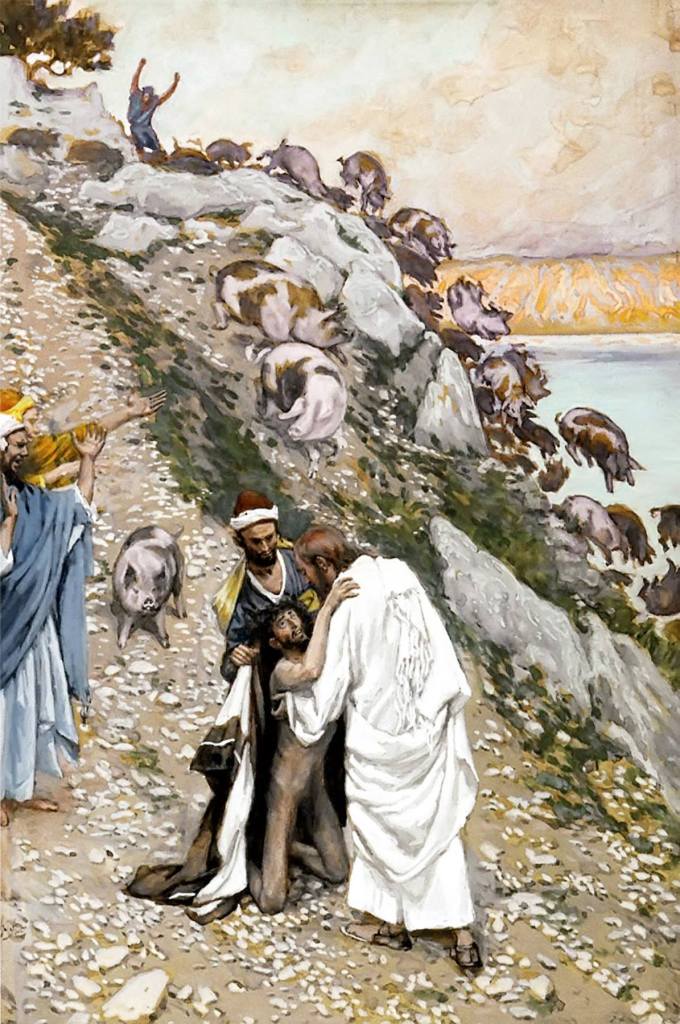
Swine Driven into the Sea by James Tissot
For reasons the Gospel does not reveal, demons rage inside this pathetic man. Jesus confronts them with an intensity even beyond Shimei’s, casting them into the subsequently nose-diving swine:
Catching sight of Jesus from a distance,
Mark 5:6-13
he ran up and prostrated himself before him,
crying out in a loud voice,
“What have you to do with me, Jesus, Son of the Most High God?
I adjure you by God, do not torment me!”
(Jesus had been saying to him, “Unclean spirit, come out of the man!”)
Jesus asked him, “What is your name?”
He replied, “Legion is my name. There are many of us.”
And he pleaded earnestly with Jesus
not to drive them away from that territory.
Now a large herd of swine was feeding there on the hillside.
And they pleaded with him,
“Send us into the swine. Let us enter them.”
And he let them, and the unclean spirits came out and entered the swine.
The herd of about two thousand rushed down a steep bank into the sea,
where they were drowned.
Wow! I mean, really, these two readings are Cecil B. DeMille stuff! Certainly there is a lesson for each of us somewhere in all this drama.
Even though many aspects of today’s readings are harsh, they hold a central message of God’s enduring mercy toward us even in times of desperation and apparent hopelessness. May we hold on to this truth if we ever come to a place of darkness in our lives. And may we offer that Light to those we encounter who are bearing such suffering.
Poetry: Excerpt from “Love Song to the Demon-Possessed Pigs of Gadara” – William Fargason
William Fargason is the author of Love Song to the Demon-Possessed Pigs of Gadara (University of Iowa Press, 2020), winner of the 2019 Iowa Poetry Prize and the 2020 Florida Book Award in Poetry (Gold Medal). In this collection, Fargason inspects the pain of memory alongside the pain of the physical body. Fargason takes language to its limits to demonstrate how grief is given a voice. His speaker confronts illness, grapples with grief, and heals after loss in its most crushing forms. (from Iowa University Press).
The silence just before and just after,
and the black eyes as you leapt— “
no protest, no acceptance either.
You ran almost in unison,
a dance without music,
a curtain call,
and the crowd standing knowing this is what happens
once we find beauty:
we must watch it leave.
Music: Healing Time on Earth – John Denver
Today’s Readings:
https://bible.usccb.org/bible/readings/012824.cfm

Today, in God’s Lavish Mercy, we pray with Psalm 95, once again a call to a holy tenderheartedness – that mix of love, discernment, and generosity that magnetizes us into dynamic relationship with God.
Oh, that today you would hear his voice:
Psalm 95: 7-9
“Harden not your hearts as at Meribah,
as in the day of Massah in the desert,
Where your fathers tempted me;
they tested me though they had seen my works.
Our other Sunday readings, which Psalm 95 anchors, clarify the reason we seek this tenderheartedness. It is so that we might not only hear, but really listen and respond to the Truth of God in our lives.
Those who will not listen to my words
Deuteronomy 18:18
which a prophet speaks in my name,
I myself will make them answer for it.
In our first reading from Deuteronomy, the people were confused. They were passing into a new land with lots of rivaling religions and spiritualities. Moses was nearing the end of his life and leadership over them. They wanted to know who to listen to and how to behave in order to stay in God’s favor.
God promises that God’s voice will come through a prophet like Moses:
I will raise up for them a prophet like you from among their kin,
Deuteronomy 18:19
and will put my words into his mouth;
he shall tell them all that I command him.
In our Gospel, we see Jesus – the fulfillment of the Deuteronomic Promise. The people witnessing his power are amazed. They struggle with whether they can believe in him when he seems just one of them, a Nazarene, Joseph’s son.
But some could believe – readily. Some, like the disciples, discerned quickly the Truth Jesus was. They heard, listened, believed and obeyed the Word.
Our psalm suggests that such readiness, such tenderheartedness comes from the consistent practice of relationship with God through praise, witness, thanksgiving, prayer, worship, humility, and obedience.
To me, it boils down to this:
Come, let us sing joyfully to the LORD;
    let us acclaim the rock of our salvation.
Let us come into God’s presence with thanksgiving;
    let us joyfully sing psalms to the Lord.
R. If today you hear God’s voice, harden not your hearts.
Come, let us bow down in worship;
    let us kneel before the LORD who made us.
For the Lord is our God,
    and we are the people God shepherds, the flock God guides.
Poetry: Rumi
I keep telling my heart,
“Go easy now.
I am submerged in golden treasure.”
It replies,
“Why should I be afraid of love?”
Music: Soften My Heart – by Music Meets Heaven
Today’s Readings:
https://bible.usccb.org/bible/readings/012724.cfm
Today, in God’s Lavish Mercy, our readings say something about Divine Order, about Sacred Balance – and our ability to let go and trust.

Nathan Rebukes David – by James Tissot
In our first reading, the prophet Nathan confronts David regarding his relationship with Bathsheba. The beautiful Bathsheba was the wife of Uriah, an elite soldier in David’s army. From far away one day, David spies her bathing in a pool. Full of covetousness and lust, he engineers a heartless plot to have her as his own.
The story is complex, intriguing, and extremely dramatic. You can read it for yourself in 2 Samuel. But the point I would like to draw out for today is about covetousness. What is that, really, and does it play any part in my life?
“Covet” is an intransitive verb that we learned when we were taught the Ten Commandments. Like all the other sins, my six-year-old self decided I would try hard not to commit it … but I had no idea what it even meant! I was pretty sure I didn’t have to be worried about coveting my neighbor’s wife, but I did like Jimmy Clark’s bike enough to covet it. (But, I didn’t steal it.)
Honestly, I don’t think I’ve ever used the verb “covet” in a sentence before today. So I turned to Meriam-Webster who defines covetousness like this: to desire (what belongs to another) inordinately or culpably
Do we “covet” when we wish we had some of the great things others have? Material things like money, mansions, and limousines? Or immaterial things like talent, beauty, and popularity?
I don’t think so. We may have to deal with the concupiscence of jealousy or envy, but it’s not quite the same as coveting. As Merriam-Webster indicates, coveting implies an inordinance or culpability. In other words, we act on our jealousy or envy in some way, creating an imbalance in our moral life.
When I examine my conscience I remind myself that the world belongs to me, but it also belongs to others — all others. Peace, a decent level of sustenance, the goods of Creation, the right to life — these belong to me but also to others. I may not be aware of “coveting” these things to the detriment of others, but how do my choices and actions in any way limit that right for others?
It could be as simple as this:

When we find ourselves entangled in greed or covetousness, it’s not necessarily that we are bad people. We might be more like the disciples described in today’s Gospel – fearful people, so insecure that we amass material protections around us.
A violent squall came up and waves were breaking over the boat,
Mark 4: 37-40
so that it was already filling up.
Jesus was in the stern, asleep on a cushion.
They woke him and said to him,
“Teacher, do you not care that we are perishing?”
He woke up,
rebuked the wind,
and said to the sea, “Quiet! Be still!”
The wind ceased and there was great calm.
Then he asked them, “Why are you terrified?
Do you not yet have faith?”
Jesus calls us to live a life grounded in faith not material protections. Only faith is invulnerable to life’s storms. Within its eternal securities, we become more deeply aware of our sacred relationship to all creatures and to Creation Itself.
If David had exercised such faith, the taking of Bathsheba and murder of Uriah would have been incomprehensible to him. As we deepen in our faith, what awarenesses will awaken in us?
Quote: Wisdom from Ramana Maharshi (1879 – 1950) who is considered an Indian Hindu sage and “jivanmukta” (liberated being). He is regarded by many as an outstanding enlightened being and, as a charismatic person, attracted many devotees. I particularly value this quote which leads me to consider my oneness with all beings:
Questioner: How are we to treat others?
Ramana Maharshi: There are no others.
Music: Imagine – John Lennon
Today”s Readings:
https://bible.usccb.org/bible/readings/012624.cfm
Today, in God’s Lavish Mercy, we have two beautiful readings to enrich our prayer.

In our first reading, Paul blesses and encourages his young disciple Timothy. Reminding Timothy of his faith heritage, received from his mother and grandmother, Paul inspires Timothy to live a spiritually courageous life:
I remind you to stir into flame
2 Timothy 1: 6-8
the gift of God that you have through the imposition of my hands.
For God did not give us a spirit of cowardice
but rather of power and love and self-control.
So do not be ashamed of your testimony to our Lord,
nor of me, a prisoner for his sake;
but bear your share of hardship for the Gospel
with the strength that comes from God.
Praying with this passage, we can look both back and forward – to those who have encouraged our faith, and to those who depend on us for edification.

… the seed would sprout,
they know not how
Image by Rosy / Bad Homburg / Germany from Pixabay
In our Gospel, Jesus paints a picture for his disciples of what the Kingdom of Heaven is like. This is a realm in which we already live – the eternal universe of the Creator’s love and grace. But our time-bound eyes can’t see that world clearly. It is more real than our physical world, but perceptible only to the awakened spirit.
Jesus tries to explain this “kingdom” to his followers. He says that like the growth of a seed, this world is a sacred mystery whose energy is generated by God, not by us:
This is how it is with the Kingdom of God;
Mark 4: 26-29
it is as if someone were to scatter seed on the land
and would sleep and rise night and day
and the seed would sprout and grow,
they know not how.
Of its own accord the land yields fruit,
first the blade, then the ear, then the full grain in the ear.
And when the grain is ripe, they wield the sickle at once,
for the harvest has come.
Paul and Jesus encouraged their followers to live in joyous alignment with this Divine Order – the “Kingdom of God”, as scripture calls it. In our prayer today, let’s listen to their counsel, for it is meant for us as well.
Poetry: Let This Darkness Be a Bell Tower – Rainer Maria Rilke, Sonnets to Orpheus II, 29
“Quiet friend who has come so far,
feel how your breathing makes more space around you.
Let this darkness be a bell tower
and you the bell. As you ring,
what batters you becomes your strength.
Move back and forth into the change.
What is it like, such intensity of pain?
If the drink is bitter, turn yourself to wine.
In this uncontainable night,
be the mystery at the crossroads of your senses,
the meaning discovered there.
And if the world has ceased to hear you,
say to the silent earth: I flow.
To the rushing water, speak: I am.”
Music: Lamb of God – from the Mass of St. Timothy – Matt Maher
Today’s Readings:
https://bible.usccb.org/bible/readings/012524.cfm

The Conversion of St. Paul – Caravaggio
Today, in God’s Lavish Mercy, we have the thrilling story of the conversion of St. Paul.
“On that journey as I drew near to Damascus,
Acts of the Apostles 22; 6-8
about noon a great light from the sky suddenly shone around me.
I fell to the ground and heard a voice saying to me,
‘Saul, Saul, why are you persecuting me?’
I replied, ‘Who are you, sir?’
And he said to me,
‘I am Jesus the Nazorean whom you are persecuting.’
God was not subtle with Paul! And it’s a good thing because Paul wasn’t subtle. He was the kind of guy who lived on the edge of life, always pushing the limits of his existence. He reminds me of a spiritual “Evel Knievel”.

God had to make a real impression in order to get Paul’s attention and turn his life around. When a lightning bolt knocks you off your horse, you tend to notice!
Our Gospel summarizes Jesus’s choice of his twelve apostles. Again, there was some pretty dramatic divine intervention used to get these men to take heed:
God’s daily call to us may come in softer garments. We all have a few dramatic moments in our lives, when we must grasp our faith to make it through. But for the most part, life may seem hypnotizingly ordinary. Our readings today encourage us to pay attention to grace — to open ourselves to God’s eternal promptings even in their ordinary costumes. Every sunrise offers such an invitation. How blessed we are when we recognize them!

Poetry: The Conversion of St. Paul – Christopher Smart (1722-1771)
Each line in he poem refers to a miracle in the scriptures. The son of Nun was Joshua who opens the poem.
Thro ' him, the chief, begot by Nun,
Controul'd the progress of the sun;
The shadow too, through him, retir'd
The ten degrees it had acquir'd.
The barren could her fruit afford,
The woman had her dead restor'd,
The statesman could himself demean
To seek the river, and be clean.
At his command, ev'n Christ I Am,
The cruse was fill'd, and iron swam;
The floods were dry'd to make a track,
And Jordan's wave was driven back.
All these in ancient days occurr'd,
The great atchievements of the Word,
By Joshua's hand, by Moses' rod,
By virtue of the men of God.
But greater is the mighty deed
To make a profligate recede,
And work a boist'rous madman mild,
To walk with Jesus like a child.
To give a heart of triple steel
The Lord's humanity to feel;
And there, where pity had no place,
To fill the measure of his grace;
To wash internal blackness white,
To call the worse than dead to light;
To make the fruitless soil to hold
Ten thousand times ten thousand fold.
To turn a servant of the times
From modish and ambitious crimes;
To pour down a resistless blaze,
‘Go, persecutor, preach and praise.’
Video: Instead of music today, I’ve included this video analysis of Caravaggio’s painting “The Conversion of St. Paul on the Road to Damascus”. It is one of at least two paintings by Caravaggio on the same subject. The other famous painting, “The Conversion of St. Paul” is seen at the top of this blog post.
I found that the video spoke to both art appreciation and spirituality. I hope you enjoy it.
Today’s Readings:
https://bible.usccb.org/bible/readings/012424.cfm
Today, in God’s Lavish Mercy, Jesus tells us the parable of the sower and the seed.
And he taught them at length in parables,
Mark 4: 2-9
and in the course of his instruction he said to them,
“Hear this! A sower went out to sow.
And as he sowed, some seed fell on the path,
and the birds came and ate it up.
Other seed fell on rocky ground where it had little soil.
It sprang up at once because the soil was not deep.
And when the sun rose, it was scorched and it withered for lack of roots.
Some seed fell among thorns, and the thorns grew up and choked it
and it produced no grain.
And some seed fell on rich soil and produced fruit.
It came up and grew and yielded thirty, sixty, and a hundredfold.”
He added, “Whoever has ears to hear ought to hear.”
How many times have we heard or read this passage over the years? Maybe so many times that we’ve become a little impervious to it. Maybe we can hear something too much.

For example, as a group of us watched the 76ers basketball game last night, the commercials seemed endless. At one point Anne Marie asked me, “Would you ever buy that?”. Although I was staring at the commercial, I had no idea what it was saying. I had tuned it out and was looking right through it!
Here’s the thing: I could hear the commercial, but I wasn’t listening to it.

I think it’s like that with today’s parable and other scripture passages as well.
We’re probably not farmers. If you’re like me, the best you’ve done is to plant an orange seed in a ten-cent flower pot when you were kindergartners! So the parable might not catch our hearts when we hear it for the 100th time unless we have learned to listen as well as hear!
But when we listen to this parable we might realize that, maybe, for us:

As I write this blog, it’s so cold where I live that, unless you had a jackhammer, you couldn’t even plant a seed. We don’t want our hearts to be like that. We want supple hearts, ready for the amazing graces God scatters over our lives daily. Let’s do the work to be ready.
Poetry: The Sower – William Cowper (1731 – 1800) was an English poet and Anglican hymnwriter.
One of the most popular poets of his time, Cowper changed the direction of 18th-century nature poetry by writing of everyday life and scenes of the English countryside. In many ways, he was one of the forerunners of Romantic poetry. Samuel Taylor Coleridge called him “the best modern poet”, whilst William Wordsworth particularly admired his poem “Yardley-Oak”.
Cowper’s religious sentiment and association with John Newton (who wrote the hymn “Amazing Grace”) led to much of the poetry for which he is best remembered, and to the series of Olney Hymns. His poem “Light Shining out of Darkness” gave English the phrase: “God moves in a mysterious way/ His wonders to perform.” (Wikipedia)
Ye child of earth prepare the plough,
Break up your fallow ground;
The sower is gone forth to sow,
And scatter blessings round.
The seed that finds a stony soil
Shoots forth a hasty blade;
But ill repays the sower's toil,
Soon wither'd, scorch'd, and dead.
The thorny ground is sure to balk
All hopes of harvest there;
We find a tall and sickly stalk,
But not the fruitful ear.
The beaten path and highway side,
Receive the trust in vain;
The watchful birds the spoil divide,
And pick up all the grain.
But where the Lord of grace and power
Has bless'd the happy field,
How plenteous is the golden store
The deep-wrought furrows yield!
Father of mercies, we have need
Of thy preparing grace;
Let the same Hand that give me seed
Provide a fruitful place!
Music: Amazing Grace
 Lavish Mercy