Today, in God’s Lavish Mercy Mercy, vigorous, grace-filled David dances with abandon before the Lord. It is a beautiful moment to imagine!
David went to bring up the ark of God from the house of Obed-edom into the City of David amid festivities. As soon as the bearers of the ark of the LORD had advanced six steps, he sacrificed an ox and a fatling. Then David, girt with a linen apron, came dancing before the LORD with abandon, as he and all the house of Israel were bringing up the ark of the LORD with shouts of joy and to the sound of the horn.
2 Samuel 6: 12-15
David dances with unselfconscious joy because he has brought the Presence of God home to the heart of the community. The joy comes from recognizing that God wants to be with the People. This joy, inexpressible in words, takes the form of a dance with the Spirit of God.
Let’s pause today with that dancing image, to consider all the ways God longs to dance with us throughout our lives, and we with God — dances of both:
joy and sorrow, faith and questioning, hope and shadow
… dances in which we must abandon ourselves to the moment’s sacred music and respond to God’s mysterious, leading step.
Whatever the emotion we bring to prayer, what matters is only that we carry it close to God’s heart, listening to our circumstances for the Divine Heartbeat. We may not be the “Fred Astaire” or “Ginger Rodgers” of prayer, but each one of us has a holy dance somewhere in their heart.
I think our children can teach us something about this kind of uninhibited prayer – one filled with trust, hope, joy, and innocence.
Poetry: T. S. Eliot
At the still point of the turning world. Neither flesh nor fleshless; Neither from nor towards; at the still point, there the dance is, But neither arrest nor movement. And do not call it fixity, Where past and future are gathered. Neither movement from nor towards, Neither ascent nor decline. Except for the point, the still point, There would be no dance, ~ T.S. Eliot
A second lovely poem, even though it is not Easter 🙂
Easter Exultet
Shake out your qualms. Shake up your dreams. Deepen your roots. Extend your branches.
Trust deep water and head for the open, even if your vision shipwrecks you.
Quit your addiction to sneer and complain. Open a lookout. Dance on a brink.
Run with your wildfire. You are closer to glory leaping an abyss than upholstering a rut.
Not dawdling. Not doubting. Intrepid all the way Walk toward clarity.
At every crossroad Be prepared to bump into wonder. Only love prevails.
Enroute to disaster insist on canticles. Lift your ineffable out of the mundane.
Nothing perishes; nothing survives; everything transforms! Honeymoon with Big Joy! ~ James Broughton
Today, in God’s Lavish Mercy, our readings place us at watershed moments in the lives of David and Jesus.
All the tribes of Israel came to David in Hebron and said: “Here we are, your bone and your flesh. In days past, when Saul was our king, it was you who led the children of Israel out and brought them back. And the LORD said to you, ‘You shall shepherd my people Israel and shall be commander of Israel.’” When all the elders of Israel came to David in Hebron, King David made an agreement with them there before the LORD, and they anointed him king of Israel.
2 Samuel 5:1-4
In 2 Samuel 5, David fully assumes the kingship through the approbation of the community. The scene marks the culmination of his rise to power and “the beginning of the rest of his life”.
Through our readings in Samuel until now, we have ascended with David to the pinnacle of his life. We are about to begin weeks of moving down “the other side of the mountain”.
Scholars generally see the David narrative in two primary units, the Rise of David (I Sam. 16:1—II Sam. 5:10) and the Succession Narrative (II Sam. 9:1—20:26; I Kings 1:1—2:46). Chapters 5:11—8:18, fall between two larger units. Whereas the first presents David in his ascendancy, the second presents David in his demise and expresses pathos and ambiguity. Our chapters thus come after the raw vitality of the rise of David and before the terrible pathos of the succession narrative. They show the painful process whereby this beloved chieftain is transformed into a hardened monarch, who now has more power than popular affection.
Walter Brueggemann: First and Second Samuel
In our Gospel, Jesus also comes to a sort of “continental divide”. But rather than community approbation, Jesus encounters the condemnation of the scribes who have come from Jerusalem to assess him.
The scribes who had come from Jerusalem said of Jesus, “He is possessed by Beelzebul,” and “By the prince of demons he drives out demons.”
Mark 3: 22
From this moment in his life, Jesus too launches into his “kingship”, one that looks very different from David’s. The ensuing chapters of Samuel will reveal how David struggles and succumbs to the temptations of power and domination. The Gospels, on the other hand, describe Jesus’s “kingdom” as one of humility, mercy, and love for those who are poor and suffering.
Only through faith can we understand the inverse power of God present in the Life, Death and Resurrection of Jesus, and in our own lives. Jesus, the “new David”, is anointed in the Spirit to reveal and incorporate us into the kingdom of God.
Prose: from Immanuel Jakobovits who was the Chief Rabbi of the United Hebrew Congregations of the Commonwealth from 1967 to 1991.
To those without faith there are no answers. To those with faith, there are no questions.
Music: King David, music by Herbert Howells, sung by Sarah Connolly from a poem by Walter de la Mare
King David – Walter de la Mare
King David was a sorrowful man:
    No cause for his sorrow had he;
    And he called for the music of a hundred harps,
    To ease his melancholy.

    They played till they all fell silent:
    Played-and play sweet did they;
    But the sorrow that haunted the heart of King David
    They could not charm away.

    He rose; and in his garden
    Walked by the moon alone,
    A nightingale hidden in a cypress-tree
    Jargoned on and on.

    King David lifted his sad eyes
    Into the dark-boughed tree-
    ''Tell me, thou little bird that singest,
    Who taught my grief to thee?'

    But the bird in no wise heeded
    And the king in the cool of the moon
    Hearkened to the nightingale's sorrowfulness,
    Till all his own was gone.
Today, in God’s Lavish Mercy, each of our readings speaks to us of time.
The concept of time has always fascinated me. I remember being aware of the fascination as a very little girl walking beside my mother and aunt along the Wildwood boardwalk arcade.
Some of you who live locally may remember the spot, an extension of the seaside boardwalk at Oak Avenue. Its main attractions were bumper cars and a booth where little piglets ran along a path, picking a random door that, for a nickel, might earn you a stuffed animal.
On that particular summer day, about 1950, there was a new booth – Miranda, the Fortune Teller. Miranda read Tarot cards, an exercise Mom and Aunt Peg were unfamiliar with. Nevertheless, they decided to try it, and each went separately into the tiny veiled room to learn her future as I stood completely entranced by the piglet race.
Later, as the three of us sauntered side-by-side in the salted air, I heard Aunt Peg ask Mom, “Did she tell you how old you will be when you die?”. My ears leaped to attention! What? My mom could die???? And that lady knew when????
I heard my thirty-three year old mother answer, “She said when I am seventy-two.”
“Oh, God! How soon is that?”, I wondered. My little five-year-old mind tried to calculate the expanse of time but failed. However, the prediction planted itself inextricably in my heart.
Decades later, when Mom did pass away (just before her 72nd year) the memory returned to me. And the nearly forty years in between seemed compressed into an incomprehensible moment that had passed as quickly as that sweet seaside breeze.
How many times do we ask the Universe this unanswerable question, “Where did the time go?” It is a question that has a thousand answers and no answer, much like the question, “Who is God?”.
In our readings today, Jonah, Paul, and John the Baptist want us to think about time in relationship to God.
For Jonah, time is captured in the forty days of grace to seek repentance.
For Paul, time – in the worldly sense – is running out, requiring us to turn our attention to eternity.
For Jesus, it is the time of fulfillment – a fulfillment that can be achieved by living the Gospel.
Praying with today’s readings, we might ask ourselves, “What time is it for me?
Are there places in my life requiring “repentance“, a turning of my heart away from selfishness and toward the mercy of God?
Do I need to widen my perspective with a deeper awareness of eternal rather than worldly values?
Am I making a choice every day to live a life patterned on the Gospel?
Poetry: Endless Time – Rabindranath Tagore
Time is endless in thy hands, my lord.
There is none to count thy minutes.
Days and nights pass and ages bloom and fade like flowers.
Thou knowest how to wait.
Thy centuries follow each other perfecting a small wild flower.
We have no time to lose,
and having no time we must scramble for a chance.
We are too poor to be late.
And thus it is that time goes by
while I give it to every querulous person who claims it,
and thine altar is empty of all offerings to the last.
At the end of the day I hasten in fear lest thy gate be shut; but I find that yet, with you, there is always time.
Music: What’s It All About, Alfie? – written by Burt Bacharach, sung by Dionne Warwick this modern song seems to deal with the timeless questions.
What’s it all about Alfie Is it just for the moment we live
What’s it all about When you sort it out, Alfie Are we meant to take more than we give Or are we meant to be kind?
And if, if only fools are kind, Alfie Then I guess it is wise to be cruel And if life belongs only to the strong, Alfie What will you lend on an old golden rule?
As sure as I believe there’s a heaven above Alfie, I know there’s something much more Something even non-believers can believe in
I believe in love, Alfie Without true love we just exist, Alfie Until you find the love you’ve missed You’re nothing, Alfie
When you walk let your heart lead the way And you’ll find love any day Alfie, Alfie
Today, in God’s Lavish Mercy, our readings center on the themes of grief, honor, and mercy.
In the passage from 2 Samuel, Saul has been killed in battle. The news is brought to David by a scheming Amalekite who (later verses reveal) hopes to profit from his enterprise. He has stripped Saul’s dead body of its kingly insignia, obsequiously depositing it at David’s feet. The messenger expects David’s vengeful rejoicing and a hefty reward.
Instead David, with reverence and honor appropriate to a future king, launches a deep public mourning for Saul and Jonathan. It is a bereavement necessary to both cleanse and heal the community’s heart from all the strife leading up to it.
David seized his garments and rent them, and all the men who were with him did likewise. They mourned and wept and fasted until evening for Saul and his son Jonathan, and for the soldiers of the LORD of the clans of Israel, because they had fallen by the sword.
2 Samuel 1:11-12
David’s lament is profound; it is ”splancha”, sprung from his innards, like the anguish Jesus felt for the suffering persons he encountered, as described in our Gospel.
A callous or indifferent heart cannot comprehend such pathos. Seeing it in Jesus, even his relatives thought him insane!
Jesus came with his disciples into the house. Again the crowd gathered, making it impossible for them even to eat. When his relatives heard of this they set out to seize him, for they said, “He is out of his mind.”
Mark 3: 20-21
Our God is a God of boundless love and impractical mercy. David models a bit of that godliness. Jesus is its complete Incarnation.
Poetry: Talking to Grief – Denise Levertov
Ah, Grief, I should not treat you
like a homeless dog
who comes to the back door
for a crust, for a meatless bone.
I should trust you.
I should coax you
into the house and give you
your own corner,
a worn mat to lie on,
your own water dish.
You think I don't know you've been living
under my porch.
You long for your real place to be readied
before winter comes. You need
your name,
your collar and tag. You need
the right to warn off intruders,
to consider
my house your own
and me your person
and yourself
my own dog.
Music: Lascia Ch’io Pianga (Let Me Weep)- Georg Frideric Handel – a single piece of beautiful music today in two version, an aria and an instrumental interpretation.
Today, in God’s Lavish Mercy, David spares Saul’s life even though Saul is in murderous pursuit of him. (Here is a video for kids featuring the moment. But I thought it was pretty cool. Maybe you will too.)
Is David noble or naïve? Is he magnanimous or stupid? As I pray this morning, I ask myself what it is that God might be saying to me through this passage.
Two things rise up:
Above all else, David is motivated by a deep respect for God’s Will and Presence in his life.
David said to his men, “The LORD forbid that I should do such a thing to my master, the LORD’s anointed, as to lay a hand on him, for he is the LORD’s anointed.”
1 Samuel 24:7
2. David engages Saul directly and respectfully in the hope of reaching a resolution of their issues.
When David finished saying these things to Saul, Saul answered, “Is that your voice, my son David?” And Saul wept aloud.
1 Samuel 24:17
Reverence and honesty rooted in sincere love and respect for one another! What a world we would live in if each of us practiced these things unfailingly!
In our Gospel, Jesus calls his disciples to live in the world in just such a way – to bring healing and wholeness in the Name of Christ, for the sake of Love.
Our Alleluia Verse today captures the essence of Christ’s call to them —- and to us:
God was reconciling the world to himself in Christ, and entrusting to us the message of that reconciliation.
2 Corinthians 5:19
Poetry: Noble Deeds – Henry Wadsworth Longfellow
Whene'er a noble deed is wrought,
Whene'er is spoken a noble thought,
Our hearts in glad surprise,
To higher levels rise.

The tidal wave of deeper souls
    Into our inmost being rolls,
        And lifts us unawares
        Out of all meaner cares.

    Honor to those whose words or deeds
    Thus help us in our daily needs,
        And by their overflow
        Raise us from what is low!
Music:To Fill the World with Love sung by Richard Harris (Lyrics below, but you will no doubt recall them from the fabulous film “Goodbye Mr. Chips”.)
In the morning of my life I shall look to the sunrise. At a moment in my life when the world is new. And the blessing I shall ask is that God will grant me, To be brave and strong and true, And to fill the world with love my whole life through.
And to fill the world with love And to fill the world with love And to fill the world with love my whole life through
In the noontime of my life I shall look to the sunshine, At a moment in my life when the sky is blue. And the blessing I shall ask shall remain unchanging. To be brave and strong and true, And to fill the world with love my whole life through
In the evening of my life I shall look to the sunset, At a moment in my life when the night is due. And the question I shall ask only You can answer. Was I brave and strong and true? Did I fill the world with love my whole life through?
Today, in God’s Lavish Mercy, our readings are about the growing popularity and power of David and Jesus. Accompanying that growth is the fearful jealousy of their peers, requiring both Jesus and David to take precautions.
David Calming Saul’s Fury with the Harp by Silvestro Lega
In our first reading, Saul is plagued by a lethal insecurity. As David’s star rises among the people, a plot to kill him festers in Saul’s heart. Right in the middle of this developing drama, Jonathan attempts to conciliate the relationship between his father and his friend.
Saul was very angry and resentful of the song, for he thought: “They give David ten thousands, but only thousands to me. All that remains for him is the kingship.” And from that day on, Saul was jealous of David.
Saul discussed his intention of killing David with his son Jonathan and with all his servants. But Saul’s son Jonathan, who was very fond of David, told him: “My father Saul is trying to kill you.
1 Samuel 18:8; 19:1
Over the course of our lives, haven’t we found ourselves in one, or maybe all, of these roles? Jealous, insecure, envious, like Saul? Unexpectedly successful, perhaps to another’s disadvantage, like David? Trying to make peace between two beloveds who can’t see past themselves, like Jonathan?
Praying with this passage leads us to ask ourselves, “How is God with me when I find myself in such situations?” What would have been God’s hope for Saul at this point in his life? For David? For Jonathan?
When I think of Saul, I wonder what could have happened if he had been big-hearted, if he had been brave enough to offer David mentorship and encouragement. It can be very hard to step back from a role where we have been in control and prominence. Generously advancing a successor is the sign of a graceful heart. Sadly, Saul did not meet the challenge.
When I think of David, I wonder how he might have better included Saul in his success. None of us achieves success alone. Sometimes the people and circumstances that have supported us are invisible — even to us. Especially in the vigor of youth, we may be tempted to think that we are solely responsible for our achievements. Developing an aware and grateful heart can help us realize life’s profound interdependence.
When I think of Jonathan, I just want to be like him. He was such a good person who loved without self-interest. Jonathan is a figure of Christ who sought reconciliation and loved generously to the point of death. Praying with Jonathan is an invitation to holiness.
In our Gospel, we meet Jesus as he seeks the same peace, reconciliation, and love. Still, even as Jesus heals and does good among the people, he is aware of the sinful weakness in some people’s hearts. He therefore calls for care in making his name known:
He had cured many and, as a result, those who had diseases were pressing upon him to touch him. And whenever unclean spirits saw him they would fall down before him and shout, “You are the Son of God.” He warned them sternly not to make him known.
Mark 3: 10-12
So many ways to pray with today’s Scripture! Given your place with God today, what are these passages suggesting for you?
Poetry: Not Like a Cypress by Yehuda Amichai, (1924 – 2000) was an Israeli poet and author, one of the first to write in colloquial Hebrew in modern times. Much of his work tries “to make sense of the world that created the Holocaust”.
Amichai was invited in 1994 by Prime Minister Yitzhak Rabin to read his poems at the ceremony in Oslo when Rabin, Yasser Arafat, and Shimon Peres were awarded the Nobel Peace Prize for their efforts to establish peace in the Middle East. Perhaps we might send a prayer to these honored men for a blessing of sanity and peace over today’s Middle East leaders.
I chose this poem because it mentions Saul, “the single man” whom the “multitudes” made great. But not like Saul does one find meaning and peace. The poet suggests that “becoming like the rain” and giving one’s life is the way to meaning, so reflective of Jesus’s advice, “Unless the grain of wheat …”
Not like a cypress,
not at once, not all of me,
but like the grass, in thousands of cautious green exits,
to be hiding like many children
while one of them seeks.

And not like the single man,
like Saul, whom the multitude found
and made king.
But like the rain in many places
from many clouds, to be absorbed, to be drunk
by many mouths, to be breathed in
like the air all year long
and scattered like blossoming in springtime.

Not the sharp ring that wakes up
the doctor on call,
but with tapping, on many small windows
at side entrances, with many heartbeats.
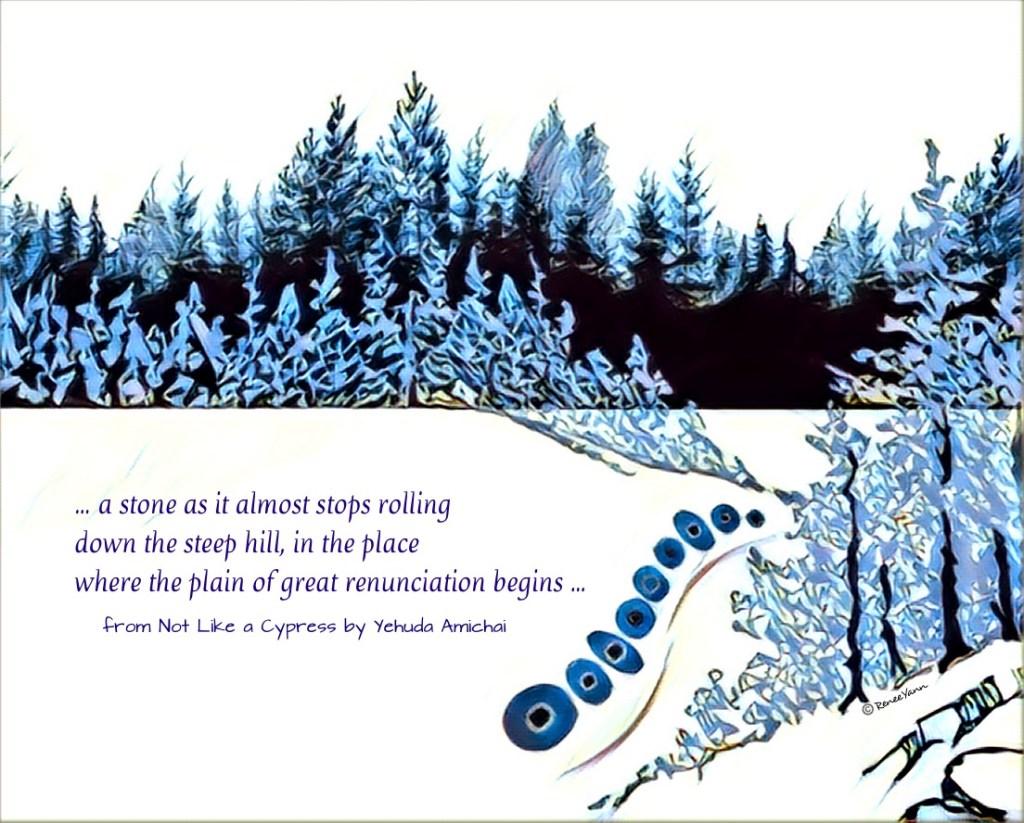
And afterward the quiet exit, like smoke without shofar-blasts, a statesman resigning, children tired from play, a stone as it almost stops rolling down the steep hill, in the place where the plain of great renunciation begins, from which, like prayers that are answered, dust rises in many myriads of grains.
Music: Paintbox – Ofra Haza and Kobi Oshrat
Ofra Haza accompanied by pianist and composer Kobi Oshrat at the Nobel Peace Prize Award Ceremony on December 10, 1994 at the Oslo City Hall in Oslo, Norway, honoring Nobel Laureates Israeli Prime Minister Yitzhak Rabin (1922-1995), Israeli Foreign Minister Shimon Peres (1923-2016) and Palestine Liberation Organization Chairman Yasser Arafat (1929-2004) for their efforts to create peace in the Middle East. She performed here at the request of Israeli Prime Minister Yitzhak Rabin. (Lyrics below)
I had a paintbox Each color glowing with delight I had a paintbox with colors Warm and cool and bright
I had a paintbox Each color glowing with delight I had a paintbox with colors Warm and cool and bright
I had no red I had no red for wounds and blood I had no black for an orphaned child
I had no white I had no white for the face of the dead I had no yellow for burning sands
I had a paintbox Each color glowing with delight I had a paintbox with colors Warm and cool and bright
I had orange I had orange for joy and life I had green Green for buds and blooms
I had blue I had blue for a clear, bright skies I had pink Pink for dreams and rest
I had a paintbox Each color glowing with delight I had a paintbox with colors Warm and cool and bright
I had a paintbox Each color glowing with delight I sat down I sat down and painted peace Peace, peace
Today, in God’s Lavish Mercy, both our readings are electric with emotion.
In our first reading, Israel is mortally threatened by the Philistines. We see Saul, their King, fearful and drained of courage. And we see David, their hope, filled with confidence in God’s presence and power.
David spoke to Saul: “Let your majesty not lose courage. I am at your service to go and fight this Philistine.” But Saul answered David, “You cannot go up against this Philistine and fight with him, for you are only a youth, while he has been a warrior from his youth.”
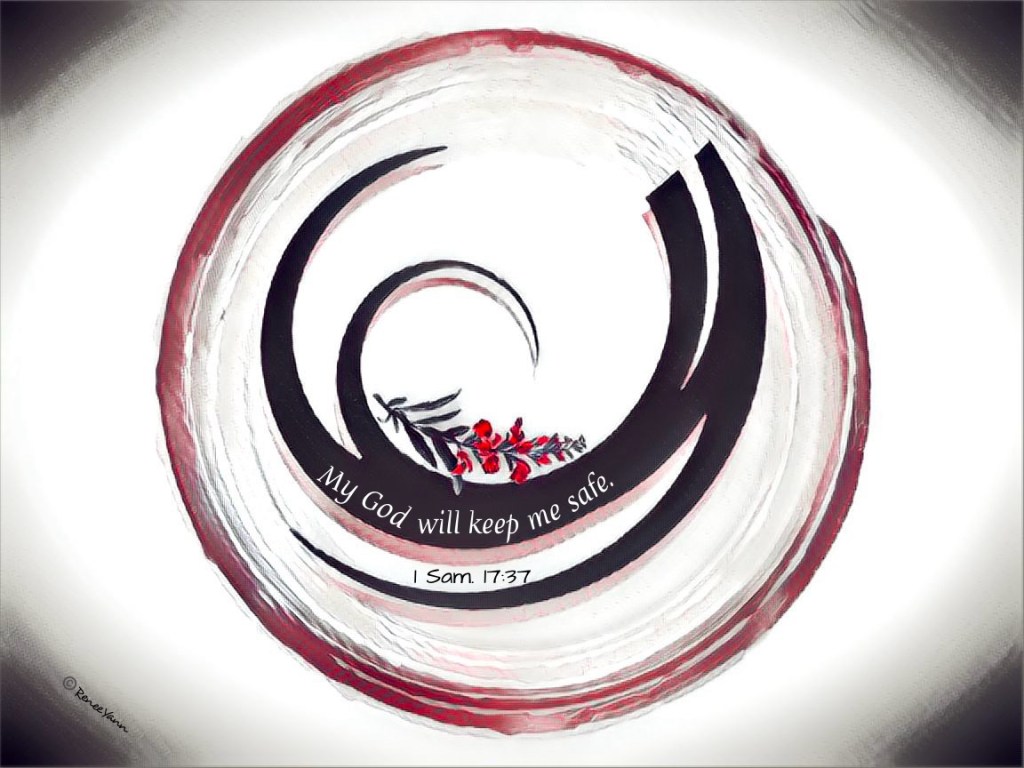
David continued: “The LORD, who delivered me from the claws of the lion and the bear, will also keep me safe from the clutches of this Philistine.” Saul answered David, “Go! the LORD will be with you.”
1 Samuel 17: 32-33;37
Young David engages God’s power with the confidence generated by innocence and goodness. This is the same confidence that Jesus has as he lives out his call. He knows what the Divine desire for us – our healing and wholeness. He is one with that desire.
In today’s Gospel, Jesus sees a man suffering from a withered hand. He knows he has the power to heal this man and that the Father desires such healing. But the Pharisees, who are afraid of Jesus’s power, invoke the Law in an attempt to control him.
The Pharisees watched Jesus closely to see if Jesus would cure the man on the sabbath so that they might accuse him. He said to the man with the withered hand, “Come up here before us.” Then he said to the Pharisees, “Is it lawful to do good on the sabbath rather than to do evil, to save life rather than to destroy it?”
Mark 3:2-4
But the Pharisees didn’t even have the guts to answer Jesus. This angered him. He was disgusted with their small-hearted selfishness. Rather than be filled with wonder at this man restored to wholeness, “… they went out and plotted against Jesus.”
We often encounter this kind of fearful smallness in our lives … sometimes even in ourselves. What can we learn from David and Jesus about confidently living a larger life, held within the power of God?
Prose Poem: West Wind 2 – Mary Oliver
You are young. So you know everything. You leap into the boat and begin rowing. But, listen to me. Without fanfare, without embarrassment, without any doubt, I talk directly to your soul. Listen to me.
Lift the oars from the water, let your arms rest, and your heart, and your heart’s little intelligence, and listen to me.
There is life without love. It is not worth a bent penny, or a scuffed shoe. It is not worth the body of a dead dog nine days unburied.
When you hear, a mile away and still out of sight, the churn of the water as it begins to swirl and roil, fretting around the sharp rocks — when you feel the mist on your mouth and sense ahead the embattlement, the long falls plunging and steaming—then row, row for your life toward it.
Today, in God’s Lavish Mercy, our first reading introduces us to David, whose thrilling and passionate story unfolds and echoes throughout the rest of biblical history.
In today’s passage, David is called in from the fields to receive, quite unexpectedly, Samuel’s anointing:
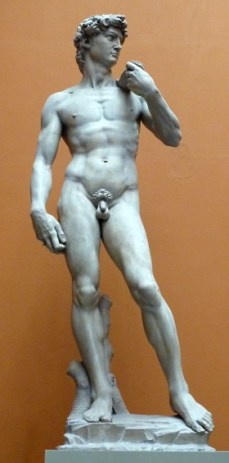
Michelangelo’s David
“The LORD has not chosen any one of these.” Then Samuel asked Jesse, “Are these all the sons you have?” Jesse replied, “There is still the youngest, who is tending the sheep.” Samuel said to Jesse, “Send for him; we will not begin the sacrificial banquet until he arrives here.” Jesse sent and had the young man brought to them. He was ruddy, a youth handsome to behold and making a splendid appearance. The LORD said, “There–anoint him, for this is he!”
1 Samuel 16: 10-12
Now, the passage doesn’t indicate which field David was in. But maybe he was out in proverbial “left field”, the place from which many human beings are called to do important things, to respond in courageous ways.
Most of us, like David, are just living our ordinary daily lives –relatively oblivious to grace – when the life-changing moments come. Those moments may not be as momentous as David’s, but they are big deals for us.
We get a college acceptance (or rejection) letter.
We get a job offer (or we get laid off).
We get elected to a position (or we don’t)
Someone asks us:
Want to go steady?
Will you marry me?
Have you ever considered religious life?
Young people, like young David, seem to meet a lot of these obvious directional points in their unfolding lives. But, in reality, we continue to meet them as we move to full maturity. Until the day we die, God is always calling to become deeper, more honest, more loving, more gracefully beautiful, more fully in God’s image.
Where have the pivotal calls and turning points come in your life? What are the junctures at which everything would have been different had you made another choice? What made young, innocent David ready when his first, and ensuing, calls came?
Here’s why: David had an exquisite love and constant relationship with God. And God loved him back, just like God loves us.
Every critical point in our life’s journey is charged with the power of God’s love. That power comes disguised in routine circumstances, like a parent calling his shepherd son home for dinner. But if our hearts are tuned to God, we hear the call deep within those ordinary appearances and we receive the moment’s anointing.
May it be so, until we meet the Beloved Face to face.
Poetry: Vocation – William Stafford
This dream the world is having about itself
includes a trace on the plains of the Oregon trail,
a groove in the grass my father showed us all
one day while meadowlarks were trying to tell
something better about to happen.

I dreamed the trace to the mountains, over the hills,
and there a girl who belonged wherever she was;
but then my mother called us back to the car:
she was afraid; she always blamed the place,
the time, anything my father planned.

Now both of my parents, the long line through the plain,
the meadowlarks, the sky, the world's whole dream remain,
and I hear him say while I stand between the two,
helpless, both of them part of me:
"Your job is to find what the world is trying to be."
Music: Anoint Me, Lord – written by Vickie Yohe, sung by Jonathan Matthews
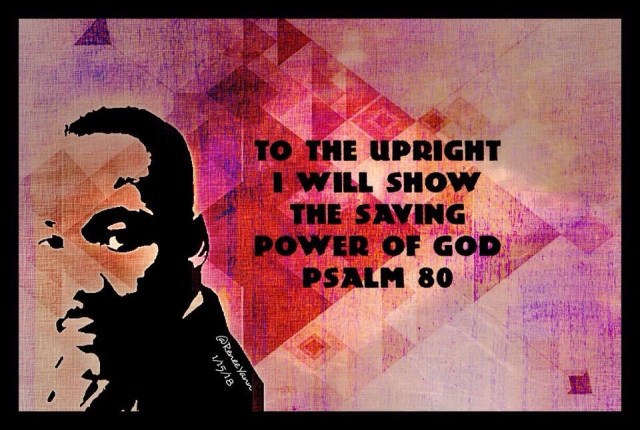
Today, in God’s Lavish Mercy, as we memorialize the life and legacy of Dr. Martin Luther King, Jr., our readings speak about leadership and its continuing call to renew the world in the image of its Creator.
But Samuel said: “Does the LORD so delight in burnt offerings and sacrifices as in obedience to the command of the LORD? Obedience is better than sacrifice, and submission than the fat of rams. For a sin like divination is rebellion, and presumption is the crime of idolatry. Because you have rejected the command of the LORD, he, too, has rejected you as ruler.”
1 Samuel 15:22-23
In our first reading, Samuel relays God’s displeasure to Saul who, though a conquering hero, has failed in humility and obedience before the Lord.
In the story, God has given a clear direction to Saul to obliterate Israel’s centuries-old enemy, the Amalekites. Instead Saul, after executing the masses, keeps the enemy king alive as a war trophy. He appropriates the cattle as personal spoil. He also sets up a shrine to commemorate the victory as his own.
God is not happy. When we profess to lead in God’s name we must act as God directs us. In order to understand God’s direction, we must cultivate an honest, just and merciful heart.
Martin Luther King was such a leader. By his faithful obedience to God’s inspiration, Martin, at the ultimate cost, turned the tides of history toward justice and freedom.
But the tides still need turning, because there will always be those who seek “war trophies”, and personal spoil, and domination for themselves. Our times are tortured by such selfish and failed leadership, just as all of history has been from ancient Israel until 1968 and until now.
Today, as we pray with Martin Luther King, great prophet and leader, we ask that selfless, merciful, and faith-impelled souls continue to hear the call to justice in our day. May Dr. King’s witness strengthen and inspire us.
Poetry: Devouring the Light – Cheryl Boyce-Taylor
The day they killed Martin
we could not return to New York City
our visiting senior class stuck in Huntsville
streets blazed with suffering in that small
Alabama town
in the dull shroud of morning
the whole world went crazy
devouring whatever light
that lit our half-cracked windows.
Music: Precious Lord, Take My Hand – Mahalia Jackson (Lyrics below)
Per Dr. King’s request, his good friend Mahalia Jackson sang his favorite hymn, “Take My Hand, Precious Lord”, though not as part of the morning funeral service but later that day at a second open-air service at Morehouse College.
Precious Lord, take my hand Lead me on, let me stand I’m tired, I’m weak, I’m lone Through the storm, through the night Lead me on to the light Take my hand precious Lord, lead me home
When my way grows drear precious Lord linger near When my light is almost gone Hear my cry, hear my call Hold my hand lest I fall Take my hand precious Lord, lead me home
When the darkness appears and the night draws near And the day is past and gone At the river I stand Guide my feet, hold my hand Take my hand precious Lord, lead me home
Precious Lord, take my hand Lead me on, let me stand I’m tired, I’m weak, I’m lone Through the storm, through the night Lead me on to the light Take my hand precious Lord, lead me home
Today, in God’s Lavish Mercy, we pray with Psalm 40, the prayer of one at home with God:
I delight to do your will, my God; your law is in my inner being!
Psalm 40:9
We are reminded that we find this kind of peace by believing and listening to our experience:
Throughout our readings today, God leans over heaven’s edge to whisper into human experience.
Samuel’s Call by Joshua Reynolds
In our first reading, that whisper comes in a sacred call to a listening Samuel:
When Samuel went to sleep in his place, the LORD came and revealed his presence, calling out as before, “Samuel, Samuel!” Samuel answered, “Speak, for your servant is listening”.
1 Samuel 3: 9-10
In our second reading, Paul reminds us that the Whispering Spirit is already resident within us:
Do you not know that your body is a temple of the Holy Spirit within you, whom you have from God, and that you are not your own?
1 Corinthians 6:19
In our Gospel, Jesus – the Word, the Divine Whisper – invites us to come to him, to see his power with us in our ordinary lives.
The two disciples said to Jesus, “Rabbi, where do you live?” He said to them, “Come, and you will see”.
John 1: 39
Praying with Psalm 40 can turn our hearts to listening for God’s voice under and within our experiences.
It can wake us up, as Samuel was awakened.
It can attune us to the melody deep within our hearts.
It can reiterate God’s invitation to live our lives so fully in the Beloved’s Presence that, even without a sound, we know each other’s thoughts.
Poetry: from Whispers of the Beloved by Rumi
Do you know what the music is saying?
“Come follow me and you will find the way.
Your mistakes can also lead you to the Truth.
When you ask, the answer will be given.”









 Lavish Mercy