To help me more truly engage this Lenten time, I have considered some proven elements from our long Christian tradition. I thought some of you might like to think about these as well. These three elements are:
Practice
Time
Reflection
On Sunday, we thought about “Lenten Practice”. On Monday, “ Lenten Time”. Today, we consider “Lenten Reflection”
Lenten Reflection
How might I trace the effect of grace in my life as I make the Paschal journey with Jesus?
It is beneficial to commit to paper (or to voice recording) the effects of our prayer and spiritual practice. Journaling is a proven spiritual tradition to help focus our hearts on God and God’s goodness to us. Some easy ways to introduce this practice into our lives might be:
to choose a new book or tablet (or computer page) which might give us the sense of a fresh start
to record at least one phrase every morning and/or evening after our prayer
to draw, sketch, or doodle as we listen to spiritual or inspiring music
to re-read our entries weekly and consider how we have been blessed over those days.
What is essential is to focus our attention on God as we engage these practices, to make our actions a prayer.
I hope these simple suggestions have been helpful. Praying for a blessed Lent for all of you, and I hope that you will pray for me.
Today, in God’s Lavish Mercy, James continues his spiritual encouragements.
For one thing, he makes it clear that God doesn’t tempt us. Some of us make the mistake of thinking that, saying things like, “God is testing me.”
James, outlining a perfect way to examine one’s conscience, says this:
No one experiencing temptation should say, “I am being tempted by God”; for God is not subject to temptation to evil, and God himself tempts no one. Rather, each person is tempted when lured and enticed by his own desire. Then desire conceives and brings forth sin, and when sin reaches maturity it gives birth to death.
James 1:13-15
Sin is an uncomfortable topic, and it’s an elusive one. Most of us aren’t outright blatant sinners. I think most of our sins are quiet indifferences, failures to love, unacknowledged greeds, self-imposed blindnesses to our responsibilities toward one another. These generate excuses that allow us to gossip, judge, blame, ignore, hurt and even use others both in our immediate world and in the larger global community.
In my experience, these desires are usually disguised, pretending to be beneficial for us at first sight. But underneath, they are rooted in selfishness and excess, diverting us from our center in God.
So if we have some little labyrinths of temptation and sinful habits ensnaring us, we should listen to James. He encourages us to examine and check our own concupiscent desires as they are the seeds of our spiritual undoing.
In the second part of this passage, James takes the tone up a notch. He reminds us that, once centered on God, we realize that only good things come from God.
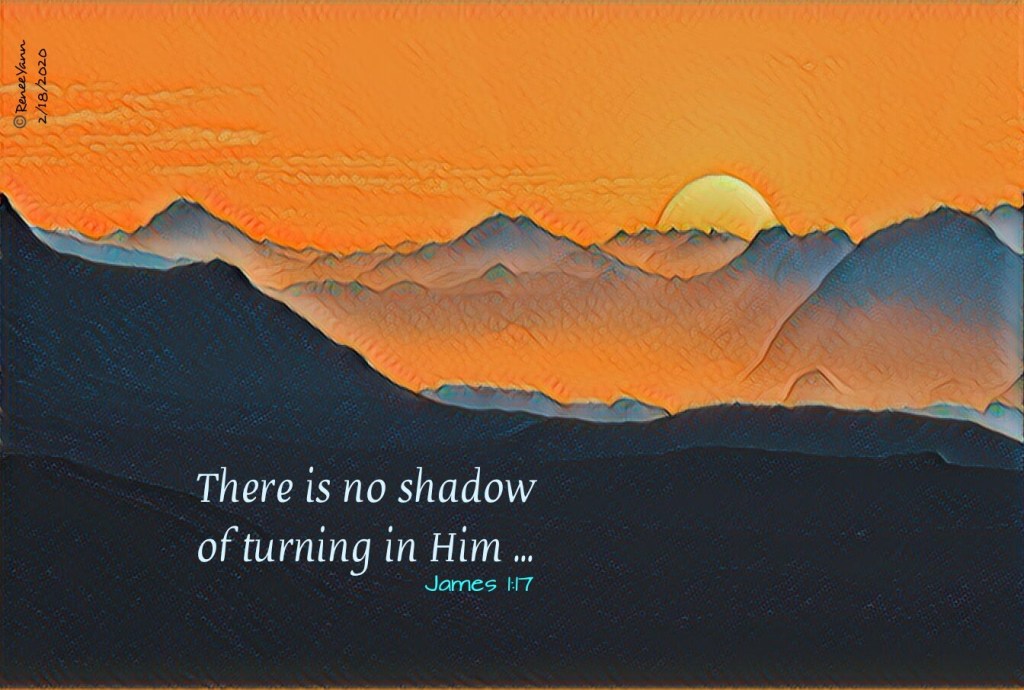
All good giving and every perfect gift is from above, coming down from the Father of lights, with whom there is no alteration or shadow of turning.
James 1:17
I particularly love that last phrase, rendered in our hymn today like this:
It’s beautiful to see how James, as a real spiritual leader, is so aware of his flock’s human struggles. No doubt, he shares them. What a blessing that his wise and loving guidance has come down through the ages to us!
Prose: from Carl Jung
The worst sin is unconsciousness,
but it is indulged in with the greatest piety
even by those who should serve humankind
as teachers and examples.
Music: Great Is Thy Faithfulness – sung by Chris Rice
To help me more truly engage this Lenten time, I considered some proven elements from our long Christian tradition. I thought some of you might like to think about these as well. These three elements are:
Practice
Time
Reflection
On Sunday, we thought about “Lenten Practice”. Today, “Lenten Time”. Tomorrow, “Lenten Reflection”
Lenten Time What time in my day might I reclaim for deepening my relationship with God in prayer and reflection? Re-ordering our use of time is a great spiritual discipline. I can choose:
to dedicate a specific time slot to silence, prayer, and/or service. This dedicated time can be as short as a few minutes before we engage the ignition in our car, or as long as a dedicated Sunday to silence and prayer
to forego a daily TV show to instead do spiritual reading
to retire and rise earlier throughout Lent so that I have morning time to focus my day on God
What is essential is to focus our attention on God as we engage this simple practice, to make our actions a prayer. A final thought tomorrow.
Today, in God’s Lavish Mercy, Lent is just a few days away. We will spend the intervening time in good company with insights from James, Peter and Mark. Today we begin the Epistle of James.
The Epistle of James- Chapter 1: Illustration provided to Wikimedia Commons by Distant Shores Media/Sweet Publishing as part of a cooperation project. Sweet Publishing released these images, which are taken from now-out-of-print Read’n Grow Picture Bible Illustrations (Biblical illustrations by Jim Padgett, courtesy of Sweet Publishing, Ft. Worth, TX, and Gospel Light, Ventura, CA. Copyright 1984.), under new license, CC-BY-SA 3.0
This letter is one of the very earliest of the New Testament. Scholars are mixed about exactly which “James” wrote it, but agree that it was one of several who were very close to Jesus – perhaps one of “the brothers of Jesus” mentioned in several New Testament passages:
Matthew 12:46-50
Mark 3:31
Luke 8:19
John 2:12
Acts 1:14
1 Corinthians 9:5
and specifically “the Lord’s brother James” in Galatians 1:19
James writes in the style of Wisdom Literature, those Old Testament books that give advice, proverbs, and insights for living a holy life. His immediate audience was a community of dispersed Christian Jews whose world was filled with increasing upheaval and persecution.
When I read the following description I thought how germane James’s letter could be for our world today. His themes echo the teachings of Pope Francis for our chaotic time:
The epistle is renowned for exhortions on fighting poverty and caring for the poor in practical ways (1:26–27; 2:1-4; 2:14-19; 5:1-6), standing up for the oppressed (2:1-4; 5:1-6) and not being “like the world” in the way one responds to evil in the world (1:26-27; 2:11; 3:13-18; 4:1-10). Worldly wisdom is rejected and people are exhorted to embrace heavenly wisdom, which includes peacemaking and pursuing righteousness and justice (3:13-18).
JIM REIHER, “VIOLENT LANGUAGE – A CLUE TO THE HISTORICAL OCCASION OF JAMES.”EVANGELICAL QUARTERLY. VOL. LXXXV NO. 3. JULY 2013
Here is the golden advice James gives us today:
Be joyful in trials.
Let trials increase your perseverance not discourage you.
Doing this is a sign of wisdom.
When your wisdom is depleted, ask God for more with an open and trusting heart.
Honor all people, high or low in circumstances
Don’t be fooled by riches. They fade away.
In our Gospel, Jesus is frustrated with the Pharisees who insincerely demand a magical sign from him. They demonstrate none of the spiritual wisdom and openness to grace that James describes.
When we think about our own faith, where does it fall on the scale of sincerity, on the spectrum joy, justice, and faithful perseverance?
Poetry: On Joy and Sorrow – Kahlil Gibran
Then a woman said, Speak to us of Joy and Sorrow.
And he answered:
Your joy is your sorrow unmasked.
And the selfsame well from which your laughter rises
was oftentimes filled with your tears.
And how else can it be?
The deeper that sorrow carves into your being,
the more joy you can contain.
Is not the cup that holds your wine
the very cup that was burned in the potter’s oven?
And is not the lute that soothes your spirit,
the very wood that was hollowed with knives?
When you are joyous, look deep into your heart
and you shall find it is only that which has given you sorrow
that is giving you joy.
When you are sorrowful look again in your heart,
and you shall see that in truth you are weeping for
that which has been your delight.
Some of you say, “Joy is greater than sorrow,”
and others say, “Nay, sorrow is the greater.”
But I say unto you, they are inseparable.
Together they come,
and when one sits alone with you at your board,
remember that the other is asleep upon your bed.
Verily you are suspended like scales
between your sorrow and your joy.
Only when you are empty
are you at standstill and balanced.
When the treasure-keeper lifts you
to weigh his gold and his silver,
needs must your joy or your sorrow rise or fall.
Today we stand at the threshold of a sacred time. In a few days, we will begin our Lenten journey for the Year of our Lord, 2024. I reflected this morning on the purpose of Lent and on how I want to prepare in these three days leading up to Ash Wednesday.
Often Lent is interpreted only in the light of sacrifice and renunciation. We think about what we will give up, or what difficult practice we will assume. We might even introduce mixed purposes to our renunciations – thinking that fasting is a good way to lose weight, or that purging our excessive possessions is a path to feng shui in our environment. I know I have been guilty of these hidden agendas. Realizing this, I want to make the effort to live a more sincere Lent. I want to focus my spiritual awareness on Lent’s true purpose which is to align my life with the life of Christ.
To help me more truly engage this Lenten time, I have considered some proven elements from our long Christian tradition. I know that many of my readers already live a spiritual life deeply enriched by their own chosen practices. Still, I thought some of you might like to think about these few simple elements as well. These three elements are: • Practice • Time • Reflection
Today, let’s think about “Lenten Practice”. Tomorrow, “ Lenten Time”. On Tuesday, “Lenten Reflection”
Lenten Practice What practice might I introduce or deepen in my life that would turn my attention to God? The choice of a Lenten practice can be very simple: • to take a daily morning or evening walk in a spirit of prayer • to read a spiritual rather than secular book throughout Lent • to write a note or make a phone call to someone who would be blessed by your voice • to not choose a new practice, but to choose a new attitude about some circumstance in my life, an attitude of hope or generosity
What is essential is to focus our attention on God as we engage this simple practice, to make our actions a prayer. More tomorrow.
Today, in God’s Lavish Mercy, our readings are connected by the topic of leprosy.
The LORD said to Moses and Aaron, “If someone has on his skin a scab or pustule or blotch which appears to be the sore of leprosy, he shall be brought to Aaron, the priest, or to one of the priests among his descendants. If the man is leprous and unclean, the priest shall declare him unclean by reason of the sore on his head.
Leviticus 13:2-3
“Leprosy” (Hebrew “tzaraat“) is first mentioned in chapters 13 and 14 of the Book of Leviticus. The term referred not only to many types of skin maladies but to ritual impurities and visually perceptible “punishments for sin”. In ancient times, someone suffering from an affliction as common as eczema might have been shunned as a leper.
Essentially, Levitical Law could base moral judgment of a person on their physical appearance. One might be seen to suffer physical deformity because of their own sins or the sins of their ancestors. The illness or deformity was then used as an excuse to condemn and isolate the suffering person.
Cleansing of the Leper by Harold Copping
Even though our scripture readings today are ostensibly about “leprosy”, they are about much more. Our readings challenge our ability or inability to see, love, and support our neighbor for who they are, not for how they appear.
Jesus sees the person who comes to him, not the disease or disfigurement which inhibits him.
A leper came to Jesus and kneeling down begged him and said, “If you wish, you can make me clean.” Moved with pity, he stretched out his hand, touched him, and said to him, “I do will it. Be made clean.”
Mark 1: 40-41
Praying with today’s Gospel reminds me of the powerful movie “Philadelphia” starring Tom Hanks who won an Academy Award for his role as Andrew Beckett, a lawyer suffering from AIDS.
“Philadelphia” is notable for being one of the first mainstream Hollywood films not only to explicitly address HIV/AIDS and homophobia, but also to portray gay people in a positive light. Andrew Beckett is a senior associate at the largest corporate law firm in Philadelphia. He conceals his homosexuality and his status as an AIDS patient from others in the office. A partner in the firm notices a lesion on Beckett’s forehead. Although Beckett attributes the lesion to a racquetball injury, it indicates Kaposi’s sarcoma, an AIDS-defining condition.
wikipedia
My own reflection today benefitted from revisiting this scene from the film. Like any parable, the story invites us to find ourselves somewhere in it.
People can be cut off from society for many conditions, be they leprosy, AIDS, or any other visible impediment. But the underlying reason they are shunned is fear — something about the person frightens us, or threatens to upset our religious, political, or economic securities.
If we want to be like Jesus, we must move beyond those fears and judgments – to see and love the person whom Mercy sees.
Music: “La Mamma Morta”, a 1950 Studio recording by Renata Tebaldi
Those who remember this movie will also remember this beautiful aria, played when Denzel Washington comes to consult with Tom Hanks in his home. The moment is a turning point for Washington who is fighting his own fears and prejudices as he takes on Hank’s case.
“La mamma morta” (They killed my mother) is a soprano aria from act 3 of the 1896 opera Andrea Chénier by Umberto Giordano. It is sung by Maddalena di Coigny to Gérard about how her mother died protecting her during the turmoils of the French Revolution.
Today, in God’s Lavish Mercy, we finish with the Book of Kings. And, as several of my readers have told me, they’ll be glad for it. There may have been points in our journey through Samuel and Kings, when you thought, “WHY am I even reading this! Who cares about Rehoboam, Jeroboam or any other “boams”!
I understand, but here are two of my “WHY”s:
The Hebrew Scriptures show us how human beings deepened, over thousands of years, in their understanding of God. Throughout that extended deepening, God remains unchangingly faithful. Even though the cultural context of some Old Testament stories may upset, befuddle, or offend us, they still express the human attempt to find God in one's experience.
The Hebrew Scriptures inform and underlie the theology of the Christian Scriptures, and the culture in which Jesus lived and taught. Like a butterfly is the fulfillment of the chrysalis, Jesus was the fulfillment of the Promise to Abraham. Without an appreciation of that Promise, and how Israel lived out its long realization, our comprehension of Christ's meaning is limited.
Our Gospel today gives us the familiar story of the feeding of the multitude. Mark describes a large crowd engaged in the search for God. They follow Jesus for three days, listening, learning, and being amazed at his miracles. They are so hungry to find something to believe in that they forget to feed their human hungers!
I love the compassionate way Jesus takes notice of their predicament:
“My heart is moved with pity for the crowd, because they have been with me now for three days and have nothing to eat. If I send them away hungry to their homes, they will collapse on the way, and some of them have come a great distance.”
In this pivotal miracle, Jesus teaches a core lesson of faith.
In Christ, we are given the gift of full and abundant life. Our hearts then must become like his, moved in mercy toward those who are still hungry, both spiritually and physically.
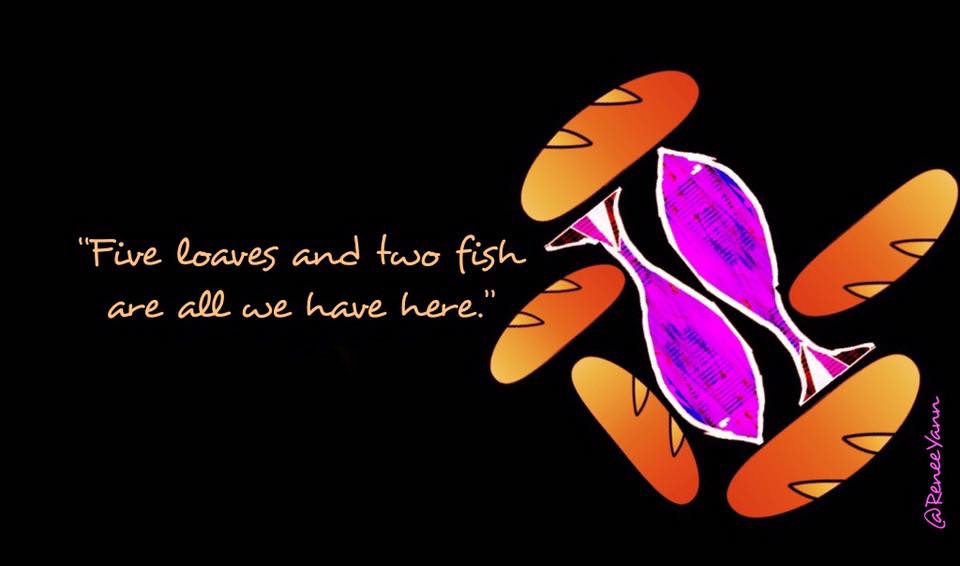
The miracle of the loaves and fishes calls the faithful community to the practice of shared abundance. It invites us to notice the hungers around us and within our world. It moves us to understand the distances people experience from love, inclusion, respect, security, and peace. It convinces us that the need to have more and more will only yield less and less for our spirits.
Our culture works to convince us that we can never work hard enough or accumulate enough. It deludes us to believe that we matter because of what we have, not because of who we are. In this miracle, Jesus models another way to live in relationship with God, ourselves and with Creation:
Trust in and respect for the abundant generosity of God’s Creation
His disciples answered him, “Where can anyone get enough bread
to satisfy them here in this deserted place?”
Still he asked them, “How many loaves do you have?”
They replied, “Seven.”
He ordered the crowd to sit down on the ground.
Deep reverence and gratitude for God’s Presence in all life
Then, taking the seven loaves he gave thanks, broke them,
and gave them to his disciples to distribute,
and they distributed them to the crowd.
They also had a few fish.
He said the blessing over them
and ordered them distributed also.
They ate and were satisfied.
Acknowledgement of our need to replenish our spirits in rest and solitude
He dismissed the crowd and got into the boat with his disciples
and came to the region of Dalmanutha.
Somewhere in each of our lives, we might find a few loaves or minnows hidden away. Or we might be the famished one with an empty basket after a long journey. Today’s Gospel tells us to invite God’s transformative grace into our needs, hungers, inhibitions, or emptiness. Like this amazed Gospel crowd, we might be wowed at what God can do with our generous hearts!
Poetry: In the Storm – Mary Oliver
Some black ducks
were shrugged up
on the shore.
It was snowing
hard, from the east,
and the sea
was in disorder.
Then some sanderlings,
five inches long
with beaks like wire,
flew in,
snowflakes on their backs,
and settled
in a row
behind the ducks --
whose backs were also
covered with snow --
so close
they were all but touching,
they were all but under
the roof of the duck's tails,
so the wind, pretty much,
blew over them.
They stayed that way, motionless,
for maybe an hour,
then the sanderlings,
each a handful of feathers,
shifted, and were blown away
out over the water
which was still raging.
But, somehow,
they came back
and again the ducks,
like a feathered hedge,
let them
crouch there, and live.
If someone you didn't know
told you this,
as I am telling you this,
would you believe it?
Belief isn't always easy.
But this much I have learned --
if not enough else --
to live with my eyes open.
I know what everyone wants
is a miracle.
This wasn't a miracle.
Unless, of course, kindness --
as now and again
some rare person has suggested --
is a miracle.
As surely it is.
Music: Krystian Zimerman – Beethoven: Piano Concerto No. 5 in E Flat Major, Op. 73: II. Adagio un poco moto
A lovely piece to accompany our reflection on faith, miracles, and abundance.
Today, in God’s Lavish Mercy, both our readings describe situations in which the fullness of the spiritual life is inhibited by choice or circumstance. In the readings from 1 Kings, we meet human beings crippled by moral incapacities. In Mark’s Gospel, we see a man handicapped by physical limitations.
What can we learn about God’s faithfulness from these passages? What can we learn about healing and spiritual renewal?
The Division of the Kingdom under Rehoboam by William Brassey Hole
In Solomon’s case, his unfaithful choices have brought him to spiritual collapse. 1 Kings tells us that Solomon committed all the sins forbidden in the Book of Deuteronomy. For example, he had over 700 wives and concubines from many alien nations. He built altars to their gods and allowed their idolatry to seep into Israel’s culture. As a result, God pronounced that the united monarchy, composed of the twelve tribes, would be ripped apart – symbolized in the cloak in today’s readings.
Today’s and tomorrow’s passages foretell the revolt within Israel that created the Northern and Southern Kingdoms. Rehoboam, Solomon’s son, is corrupt. The people revolt against his cruelty. Jeroboam, one of Solomon’s political ministers, assumes kingship over ten of the tribes, creating the Northern Kingdom (the Kingdom of Israel).
However, despite Solomon’s and Rehoboam’s infidelity, God remains faithful to the promise to David, allowing two of the tribes to continue under the leadership of David’s house through Rehoboam – the Southern Kingdom (the Kingdom of Judah)
So, are you bored with these snippets of biblical history? Don’t be. They are included in scripture to offer us lessons:
God’s voice comes to us in the unfolding of our lives
God expects our fidelity
Our infidelity leads to disruption
Still, God remains faithful and loving toward us
It is never too late to open our heart to God’s grace
Our Gospel can teach us similar lessons. For undisclosed reasons, our central character is hog-tied by the incapacity to speak and hear. Jesus’s healing of this man shows us that we too can be healed from any incapacity to hear God’s truth in our hearts and to speak it in our lives. All that we need do is what this man has done – to place ourselves in God’s Presence with faith and hope.
Notice that Jesus heals this man in a very human way – with fingers, spit, and guttural groans.
Jesus put his finger into the man’s ears and, spitting, touched his tongue; then he looked up to heaven and groaned, and said to him, “Ephphatha!” (that is, “Be opened!”) And immediately the man’s ears were opened, his speech impediment was removed, and he spoke plainly.
Mark 7:33-35
For the most part, healing comes to us in very human ways as well. God works through our circumstances and relationships to offer us renewing grace. As we live out each day, our life challenges us with a silent command: “Ephphatha!” Be opened to God speaking to you in this moment, in this person, in this situation, in this silence!
Sometimes, we just cannot hear the challenge or speak the truth. We are mute and deaf to the grace of the moment. Today is a good time to pray for openness – Ephphatha!
Poetry: At the Kishinev School for Deaf and Mute Children – Katia Kapovich (1960), a bilingual Russian poet. Born in Chişinău, the capital of Moldova, she later lived in Moscow and St Petersburg. Unable to publish her work in the former USSR because she participated in a samizdat dissident group, she emigrated, moving in 1990 to Jerusalem, where she published her first collection, and then in 1992 to the USA. In 2001, US Poet Laureate Billy Collins selected her for a Witter Bynner Fellowship from the Library of Congress, and she has also been Poet-in-Residence at Amherst College.
My first autumn after college I worked
at the Kishinev School for the Deaf and Mute,
whose voices were not speech,
yet sounded like a language.
A foreign language, muffled and unknown
to the teachers. Its strange vowels,
born in their windpipes,
burned away in their throats.
I wrote the alphabet on the blackboard,
watched them move their lips as they
tried to articulate the sounds of Russian,
but no one could help them.
Yet there was a children’s god in the classroom
who guided them across quicksand
to where the Tower of Babel stood crumbling
and filled their mouths with the ABCs.
Music: I Need Thee Every Hour – in American Sign Language
Today, in God’s Lavish Mercy, our readings leave me wondering about what makes God tick.
We really know nothing about God for sure, except what we have learned and believed in Jesus. The writers of the Hebrew scriptures stretched their imaginations to understand and portray God to the people. Sometimes their metaphors work for us, sometimes not. Today’s, I think, is tricky.
In this first reading, God exacts justice for Solomon’s unfaithfulness, but He does it sort of like a prosecutor in a plea bargain.
I will deprive you of the kingdom … but not during your lifetime It is your son whom I will deprive … but I won’t take away the whole kingdom.
What’s going on with God in this reading? Well, it’s more like “What’s going on with the writer who tries, retrospectively, to interpret God’s role in Israel’s history?”
The passage is much more than a report on exchanges between God and Solomon.
It is a testament to Israel’s unwavering faith that God is intimately involved in their lives. In every circumstance, the believing community returns to the fact that experience leads to God and not away from Him.
So “Solomon … had TURNED his heart to strange gods” BUT God had not turned from Solomon. Nor would God EVER turn because God has CHOSEN Israel.
In our Gospel, the Syrophoenician woman tries to get the favor of Jesus to turn toward her. And actually, Jesus sounds pretty mean and stingy about it.
The woman was a Greek, a Syrophoenician by birth, and she begged him to drive the demon out of her daughter. He said to her, “Let the children be fed first. For it is not right to take the food of the children and throw it to the dogs.” She replied and said to him, “Lord, even the dogs under the table eat the children’s scraps.” Then he said to her, “For saying this, you may go. The demon has gone out of your daughter.”
Mark 7:26-30
The writer Mark is portraying, retrospectively, a significant time in Christ’s ministry. Jesus has really gone into hiding in a remote place. Apparently, he wants space to figure some things out. The story indicates that one of those things might be whether or not his ministry should embrace the Gentiles.
The persistence of this woman’s faith is a turning point for Jesus Who evolved, as we all do, in his understanding of his sacred role and meaning in the world.
These passages encourage us to constantly turn toward God Who lives our life with us. Such “turning” helps us to grow spiritually. As we become bigger in heart and soul, so does our concept of God and what God’s hope is for us.
Poetry: All this “turning” brought to mind some favorites lines from T.S. Eliot:
At the still point of the turning world. Neither flesh nor fleshless;
Neither from nor towards; at the still point, there the dance is,
But neither arrest nor movement. And do not call it fixity,
Where past and future are gathered. Neither movement from nor towards,
Neither ascent nor decline. Except for the point, the still point,
There would be no dance, and there is only the dance.
Today, in God’s Lavish Mercy, the Queen of Sheba visits Solomon. It’s another Solomon story worthy of the big screen where, in fact, it has been loosely fictionalized and adulterated many times.
Many trusted scripture scholars question the historicity of the story. Several agree that Solomon never rose to the kind of material glory described in the passage. The two books of Kings were written 500 years after Solomon lived. In many aspects, the writings offer a reflection on the meaning of his reign in Israel’s covenanted life rather than a strict account of his life.
So what might we glean from today’s passage on the mysterious queen. The story demonstrates that Solomon is so accomplished that a revered leader will come to learn from him. Once she arrives, she is overwhelmed by his material successes and strength. Solomon has constructed a dominant, rich and subservient culture.
But wait. Is there a bit of ironic judgement and, perhaps, prophetic reminder woven into the Queen’s accolades? Shifting the focus from an increasingly arrogant Solomon back to Israel’s God, she says:
Blessed be the LORD, your God, whom it has pleased to place you on the throne of Israel. In his enduring love for Israel, the LORD has made you king to carry out judgment and justice
1 Kings 10:9
In fact, the great wealth and power of Solomon’s kingdom was built, not on justice and judgement, but on the backs of the poor and excluded. For example, Walter Brueggemann says this:
(Solomon’s kingdom) … was an economy of extraction that regularly transferred wealth from subsistence farmers to the elite in Jerusalem, who lived off the surplus and the device and the strategy for that extraction was an exploitative tax system.
When the Biblical scribe puts the words judgment and justice into the Queen’s remarks, it may be intended to forecast the miserable end Solomon will meet because he has abandoned his responsibilities to care for all the people according the the Lord’s covenant.
This glorious, shining realm which so impressed the Queen is a kingdom built on corruption, greed, militarism, and manipulation of the poor.
The lessons for our world are obvious.
As Jesus tells us in today’s Gospel, it doesn’t matter whether we’re gilded in gold on the outside and spin our words in glorious promises. What matters are the true intentions of our hearts and the compassionate actions they inspire:
But what comes out of the person, that is what defiles him. From within, from the heart, come evil thoughts, unchastity, theft, murder, adultery, greed, malice, deceit, licentiousness, envy, blasphemy, arrogance, folly.
Mark 7:20-23
Ultimately, the great Solomon misses the boat on this. May his story help us not to do the same.
Poetry: The Queen of Sheba by Hadewijch English version by Mother Columba (Elizabeth) Hart, OSB Original Language Dutch
The Queen of Sheba
Came to Solomon;
That was in order to gain wisdom.
When she had found him, indeed,
His wonders streamed upon her so suddenly
That she melted in contemplation.
She gave him all,
And the gift robbed her
Of everything she had within --
In both heart and mind,
Nothing remained:
Everything was engulfed in love.







 Lavish Mercy