Covenant of Mercy

Memorial of Saint Paul Miki and Companions, Martyrs
Tuesday of the Fifth Week in Ordinary Time
February 6, 2024

Today’s Readings:

https://bible.usccb.org/bible/readings/020624.cfm


Today, in God’s Lavish Mercy, our readings might lead us to consider what we pay attention to in our spiritual lives and why.

In our first reading, Solomon prays simply and sincerely before the presence of God. It is the prayer of one who is spiritually vulnerable to God’s grace in whatever way it comes.

Solomon stood before the altar of the LORD
in the presence of the whole community of Israel,
and stretching forth his hands toward heaven,
he said, “LORD, God of Israel,
there is no God like you in heaven above or on earth below;
you keep your covenant of mercy with your servants
who are faithful to you with their whole heart.

1 Kings 8:22-23

Solomon’s focus in prayer is to honor and acknowledge God and to ask mercy for himself and the people for whom he is responsible.

Today’s Responsorial Psalm 84


The Pharisees, on the other hand, fear the presence of God in Jesus because he threatens the collapse of their false religionism. To protect their man-made securities, they have constructed an elaborate maze of rules and judgments which hardens them to renewing grace.

Rather than listen to Jesus who offers them redemption, they focus on the lifeless particularities of the Law:

When the Pharisees with some scribes who had come from Jerusalem
gathered around Jesus,
they observed that some of his disciples ate their meals
with unclean, that is, unwashed, hands.

Mark 7:1-2

The Pharisees’ recalcitrance disappoints and angers Jesus:

He responded,
“Well did Isaiah prophesy about you hypocrites,
as it is written:

This people honors me with their lips,
but their hearts are far from me;
In vain do they worship me,
teaching as doctrines human precepts.

You disregard God’s commandment but cling to human tradition.”
He went on to say,
“How well you have set aside the commandment of God
in order to uphold your tradition!

Mark 7:6-8

We live our lives always in the Presence of God. Do we even realize this? Do we pray, like Solomon, with an open heart for the grace to grow ever closer to God in every circumstance that is offered to us? 

Do we ask for the grace to see where judgments, measurements, and definitions limit our spiritual growth?


As I read today’s Gospel, I think of Pope Francis’s recent decision to allow the blessing of same-sex couples. Francis looked beyond traditional constraints to offer healing mercy to those seeking God’s love. Some people, caught in strictures similar to those of the Pharisees, have not only resisted but condemned the Pope for his decision.

The situation is not dissimilar from that of today’s Gospel. What can we learn about our own attitudes and spiritual openness as we pray with these readings? What can Solomon teach us about sincere, humble, and transparent prayer?


Poetry: Peace Is This Moment Without Judgment – Dorothy Hunt

Do you think peace requires an end to war?
Or tigers eating only vegetables?
Does peace require an absence from
your boss, your spouse, yourself?…
Do you think peace will come some other place than here?
Some other time than Now?
In some other heart than yours?

Peace is this moment without judgment.
That is all. This moment in the Heart-space
where everything that is is welcome.
Peace is this moment without thinking
that it should be some other way,
that you should feel some other thing,
that your life should unfold according to your plans.

Peace is this moment without judgment,
this moment in the Heart-space where
everything that is is welcome.

Music: Heart of Gold – Nicholas Gunn

I think this song can be like a prayer asking God’s warmth and mercy in our judgments and prayers.

Presence

Memorial of Saint Agatha, Virgin and Martyr
Monday of the Fifth week in Ordinary Time
February 5, 2024

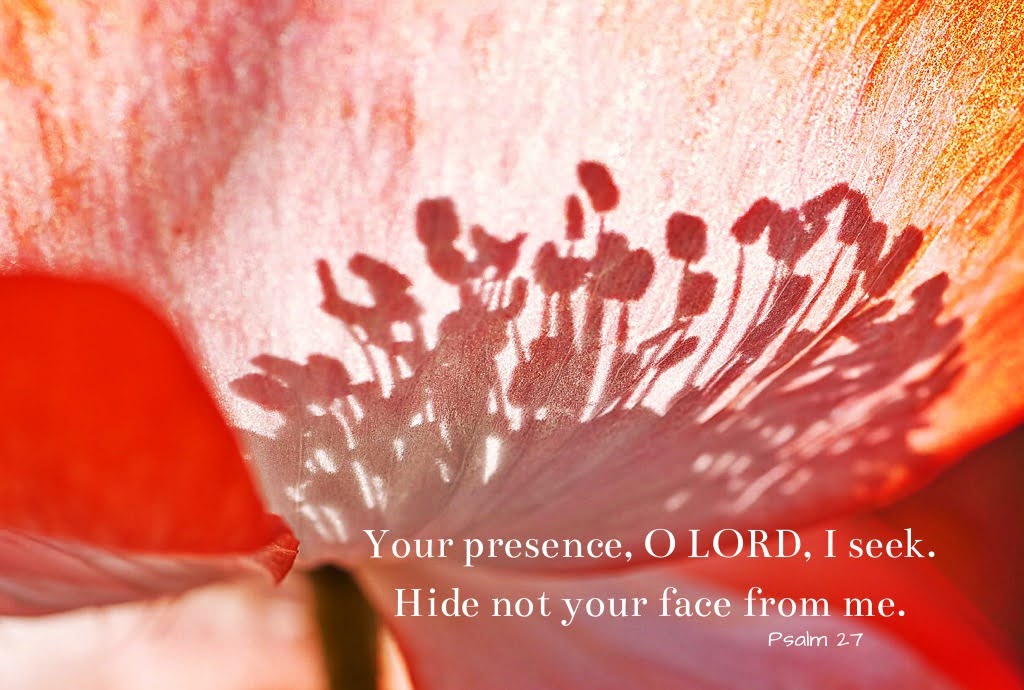
Today, in God’s Lavish Mercy, both our readings lead us to pray with the mystery of God’s Presence.

In the passage from Kings, Solomon has completed his most memorable task – the rebuilding of the Temple in Jerusalem. Today’s verses describe the transfer of the Ark of the Covenant from its holding place to its permanent home in the Temple.

Upon the completion of that festive transfer, the Divine Presence is manifested by a cloud which fills the Holy of Holies.

When the priests left the holy place,
the cloud filled the temple of the LORD
so that the priests could no longer minister because of the cloud,
since the LORD’s glory had filled the temple of the LORD.
Then Solomon said, “The LORD intends to dwell in the dark cloud;
I have truly built you a princely house,
a dwelling where you may abide forever.”

1 Kings 8:10-11

In Mark’s Gospel today, the townspeople of Gennesaret become aware that Jesus is present in their vicinity. They have heard about his miracles. As Mark puts it, they scurry to gather all their needy friends and relatives into Christ’s healing Presence.

After making the crossing to the other side of the sea,
Jesus and his disciples came to land at Gennesaret
and tied up there.
As they were leaving the boat, people immediately recognized him.
They scurried about the surrounding country
and began to bring in the sick on mats
to wherever they heard he was.
Whatever villages or towns or countryside he entered,
they laid the sick in the marketplaces
and begged him that they might touch only the tassel on his cloak;
and as many as touched it were healed.

Mark 6:53-56

As we pray these passages, we might long for the tactile presence of God in the cloudiness of our own lives. Sometimes God seems far away, hidden somewhere beyond the stars – disconnected from the flesh-and-bone challenges of our existence.

But as we pray today we might remind ourselves that we are a Temple. God dwells in us as truly as God dwelt in the Holy of Holies. Any felt distance is not on God’s part, it is on ours and our restrained and anxious faith.

May these readings inspire us to be as sincere in our prayer as were the Gennesarenes – to scurry to the hem of Christ’s garment, to grasp its tassel in the fullness of faith, hope, and love.


Thought:

‘The mystery of God hugs you
in its all-encompassing arms.”-

Hildegard von Bingin

Music: Invocation: Hildegard von Bingen ~ Written by Emma Bergen, sung by Anonymous 4

Traditionally the Hebrew term Shekinah שכינה means ‘dwelling’, as a way of describing the Presence of the Divine. As the term is feminine, it also has come to be used to describe the feminine aspect of the divinity: the Divine Feminine.

Emma Bergen writes: “I came to learn about the Shekinah while I was writing about the Gnostic Sophia, and was inspired to write my ‘Invocation’ as a way, both of expressing what such a contact means to me personally, and to reach out in the spirit (and within myself) to what has been described as ‘the feminine face of God’. Oppression has many faces, some serious, and others so subtle that they might remain unnoticed by others. I invite you to join me in this invocation, written for all women everywhere, in whatever circumstances they might find themselves.”

(To see the words more clearly in the video, click on the little white square in the lower right-hand corner of the YouTube screen.)

Praise God Always

Fifth Sunday in Ordinary Time
February 4, 2024

Today’s Readings:

https://bible.usccb.org/bible/readings/020424.cfm


Today, in God’s Lavish Mercy, we pray with Psalm 147 which invites us to:

Praise the LORD Who is good;
    sing praise to our God, Who is gracious;
   the One it is fitting to praise.

It is a psalm for the left-brained who, like Job in our first reading, might need some explanation about just why we should praise when life seems so unpraiseworthy at times!

Job spoke, saying:
Is not man’s life on earth a drudgery?
    Are not his days those of hirelings?
He is a slave who longs for the shade,
    a hireling who waits for his wages.
So I have been assigned months of misery,
    and troubled nights have been allotted to me.

Job 7: 1-4

Job, like many of us when we suffer, feels crushed under life’s burdens. However, an extended reading of the Book of Job reveals that humility and repentance allow Job to “see God”, and to rediscover the richness and flavor of his life.

Calling us to the same kind of awareness, Psalm 147 presents a series of reasons for praising God, including God’s continual attention to the city of Jerusalem, to brokenhearted and injured individuals, to the cosmos, and to nature.

For me, the most moving of these reasons comes in verse 3:

The Lord heals the brokenhearted
    and binds up their wounds.
The Lord tells the number of the stars;
    calling each by name.


This is a beautiful picture of our infinitely compassionate God who is able to recognize our broken-heartedness. 

This loving God, who knows the stars by name, knows us as well. We, like Job, begin to heal within the divine lullaby God patiently sings over our broken hearts.

Jesus is that Healing Song, the Word hummed over the world by the merciful Creator. In today’s Gospel, we see that Melody poured out over the suffering:

When it was evening, after sunset,
they brought to him all who were ill or possessed by demons.
The whole town was gathered at the door.
He cured many who were sick with various diseases,
and he drove out many demons,
not permitting them to speak because they knew him.

Mark 1: 32-34

As we pray today, 
let us hear God’s song of mercy 
being sung over all Creation. 
Let us rest our own brokenness 
there in its compassionate chords. 
Let us bring the world’s pain to our prayer.


Poetry: A Cure Of Souls by Denise Levertov

The pastor
of grief and dreams
guides his flock towards
the next field
with all his care.
He has heard
the bell tolling
but the sheep
are hungry and need
the grass, today and
every day. Beautiful
his patience, his long
shadow, the rippling
sound of the flocks moving
along the valley.

Music: God Heals My Broken Heart – Patty Felker

If Job were singing his sadness today, it might sound like this song.

Selflessness

Saturday of the Fourth Week in Ordinary Time
February 3, 2024

Today’s Readings:

https://bible.usccb.org/bible/readings/020324.cfm


Today, in God’s Lavish Mercy, our readings offer us insights into the ministry of leadership. They are insights worth pondering for at least these two reasons:

  • We are all called to be leaders in some way in our lives, be it as parent, teacher, supervisor, team captain, committee lead, board chair … you name it.
  • We need to be able to recognize good leaders in order to follow wisely, otherwise we are following self-interested fools determined to re-create us in their likeness.

In both our readings, leadership is characterized by this key element: selflessness.

Solomon, when given the chance to ask for anything he wants, asks for a gift that will benefit the community.


Give your servant, therefore, an understanding heart
to judge your people and to distinguish right from wrong.

1 Kings 4:9

Jesus and the disciples, exhausted from the press of the crowd, still respond in mercy to their relentless needs

Jesus said to the disciples,
“Come away by yourselves to a deserted place and rest a while.”
People were coming and going in great numbers,
and they had no opportunity even to eat.
So they went off in the boat by themselves to a deserted place.
People saw them leaving and many came to know about it.
They hastened there on foot from all the towns
and arrived at the place before them.

When Jesus disembarked and saw the vast crowd,
his heart was moved with pity for them,
for they were like sheep without a shepherd;
and he began to teach them many things.

Mark 6: 30-34

As we daily focus our lives on becoming more like Christ, the practice of selflessness can be tricky – how to live selflessly without losing one’s self; how to foster common and individual good without depleting one’s own spiritual strength. To my mind, these things are important:

Honesty: I think the grounding virtue of a good leader is honesty – with others and with self. Once a leader starts to pretend, deceive, equivocate, feign ignorance, or outright lie, (even to themselves), they are no longer fit to lead.

Spiritual Discipline: When we look at Jesus’s life, we see that he practiced a cycle of ministry and prayer. Several times in the Gospel, Jesus withdraws to commune with the Father. Although Christ was in union with the Father at all times, he exercised his ministry around a personal discipline of solitude and prayer.

Discernment: Solomon understands the importance of this gift. What Solomon actually prays for is the sensitivity to practice the “cardinal virtues” that we learned long ago in catechism class. Remember? Prudence, Justice, Fortitude, and Temperance.


Prose: Remember the Baltimore Catechism? Well, maybe some of you are too young to remember, Here’s how wikipedia defines it:

A Catechism of Christian Doctrine, Prepared and Enjoined by Order of the Third Council of Baltimore, or simply the Baltimore Catechism, was the national Catholic catechism for children in the United States, based on St. Robert Bellarmine’s 1614 Small Catechism. The first such catechism written for Catholics in North America, it was the standard Catholic school text in the country from 1885 to the late 1960s. From its publication, however, there were calls to revise it, and many other catechisms were used during this period. It was officially replaced by the United States Catholic Catechism for Adults in 2004, based on the revised universal Catechism of the Catholic Church.


Throughout my adult life, I have retained an appreciation for what I learned from the now-defunct edition of the Baltimore Catechism. While it conveyed the impression that a recipe for holiness could be compacted into a small manual, its inimitable Thomistic logic left valuable lessons with me to which I often return. Here are a few that informed my prayer today as I reflected on “selflessness”:

Besides the theological virtues of faith, hope, and charity there are other virtues, called moral virtues.

These virtues are called moral virtues because they dispose us to lead moral, or good lives, by aiding us to treat persons and things in the right way, that is, according to the will of God.

The chief moral virtues are: prudence, justice, fortitude, and temperance; these are called cardinal virtues.

These virtues are called cardinal virtues because they are like hinges on which hang all the other moral virtues and our whole moral life. The word “cardinal” is derived from the Latin word “cardo” meaning hinge.

  • Prudence disposes us in all circumstances to form right judgments about what we must do or not do.
  • Justice disposes us to give everyone what belongs to them.
  • Fortitude disposes us to do what is good despite any difficulty.
  • Temperance disposes us to control our desires and to use rightly the things which please ourselves.

Music: Song of Solomon – Martin Smith

We Shall Behold Him

Feast of the Presentation of the Lord
February 2, 2024

Today’s Readings:

https://bible.usccb.org/bible/readings/020224.cfm


Today, in God’s Lavish Mercy, we celebrate the Feast of the Presentation of the Lord, that time when Jesus is brought to the Temple to be dedicated, just as any Jewish boy would have been.

When the days were completed for their purification
according to the law of Moses,
Mary and Joseph took Jesus up to Jerusalem
to present him to the Lord,
just as it is written in the law of the Lord,
Every male that opens the womb shall be consecrated to the Lord,
and to offer the sacrifice of
a pair of turtledoves or two young pigeons,
in accordance with the dictate in the law of the Lord.

Luke 2: 22-24

This event is one of the many throughout Jesus’s life that show us two things:

  • Jesus honored Jewish Law
  • Jesus, although God, lived a human life

This Gospel scene in particular is layered with a poignant and tender humanity. First off, Jesus is a baby, small and vulnerable in the vastness of the Temple.

His young parents, although knowing he is God, bring him to be blessed in the ancient traditions of their faith. They certainly must have wondered how to handle teaching the Messiah the faith! How to guide the human development of one Who is Divine! It’s challenging enough for young parents to adapt to a new human being in their lives, let alone one who is also Divine!


Edited in Prisma app with Hunter

But how fortuitous that the sage and comforting elders await them at the Temple doors, dear Simeon and Anna. These two are steeped in a wise faith, deepened by a long patience.

Put yourself in the scene of this beautiful passage and listen to Simeon. Watch his eyes as he looks upon the sweet face of Jesus:

Now there was a man in Jerusalem whose name was Simeon.
This man was righteous and devout,
awaiting the consolation of Israel,
and the Holy Spirit was upon him.
It had been revealed to him by the Holy Spirit
that he should not see death
before he had seen the Christ of the Lord.
He came in the Spirit into the temple;
and when the parents brought in the child Jesus
to perform the custom of the law in regard to him,
he took him into his arms and blessed God, saying:

“Now, Master, you may let your servant go
in peace, according to your word,
for my eyes have seen your salvation,
which you prepared in the sight of all the peoples:
a light for revelation to the Gentiles,
and glory for your people Israel.”

Luke 2: 25-32

Now turn toward beautiful Anna, filled with the grace of prayerful years, as she takes the Holy Child in her arms:

There was also a prophetess, Anna,
the daughter of Phanuel, of the tribe of Asher.
She was advanced in years,
having lived seven years with her husband after her marriage,
and then as a widow until she was eighty-four.
She never left the temple,
but worshiped night and day with fasting and prayer.
And coming forward at that very time,
she gave thanks to God and spoke about the child
to all who were awaiting the redemption of Jerusalem.

Luke 2: 36-38

As we pray with the Holy Family and these two ancient prophets, how do we feel about the presence of Christ in our midst? What might we have said to Jesus, to Mary or Joseph had we been in the Temple that morning? What might we have seen or heard from Anna and Simeon that would have fueled our own hope and faith? How open is the door of our heart’s temple to welcome the Holy One? What Grace are we awaiting in our deepest hearts?


Poetry: Wait and See (Simeon and Anna) by Richard Bauckham

Richard Bauckham is a renowned English biblical scholar and theologian, whose many published works include The Theology of the Book of Revelation (1993) and Jesus and the Eyewitnesses (2006).


In the drab waiting-room
the failed travellers, resigned, sleep
on the hard benches, inured
to postponement and foul coffee.
Hope has given up on them.
There are also the impatient,
pacing platforms, and the driven,
purple with frustration, abusing
their mobiles, for the hardest part
of waiting is the not doing.
Truly to wait is pure dependence.
But waiting too long the heart
grows sclerotic. Will it still
be fit to leap when the time comes?
Prayer is waiting with desire.
Two aged lives incarnate
century on century
of waiting for God, their waiting-room
his temple, waiting on his presence,
marking time by practicing
the cycle of the sacrifices,
ferial and festival,
circling onward, spiralling
towards a centre out ahead,
seasons of revolving hope.
Holding out for God who cannot
be given up for dead, holding
him to his promises – not now,
not just yet, but soon, surely,
eyes will see what hearts await.

Music: We Shall Behold Him – LaKisha Jones and the Woodlands United Methodist Church

One of my top ten favorite hymns… “the sweet light in his eyes”!
Lyrics below.

The sky shall unfold
Preparing His entrance
The stars shall applaud Him
With thunders of praise
The sweet light in His eyes,
shall enhance those awaiting
And we shall behold Him, then face to face

O we shall behold Him, we shall behold Him
Face to face in all of His glory
O we shall behold Him, yes we shall behold Him
Face to face, our Savior and Lord

The angel will sound, the shout of His coming
And the sleeping shall rise, from there slumbering place
And those remaining, shall be changed in a moment
And we shall behold him, then face to face

We shall behold Him, o yes we shall behold Him
Face to face in all of His glory
We shall behold Him, face to face
Our Savior and Lord
We shall behold Him, our Savior and Lord
Savior and Lord!